
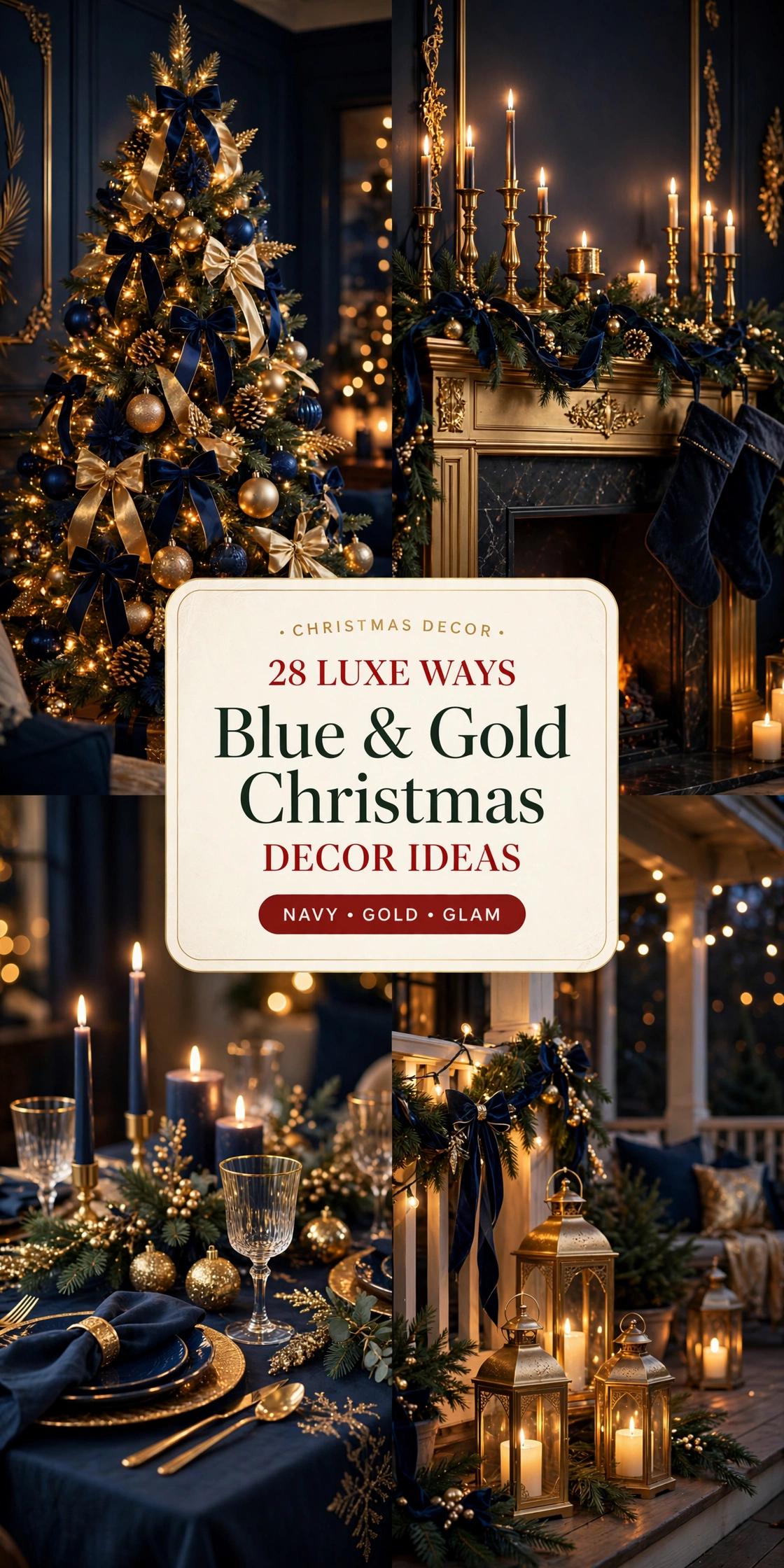
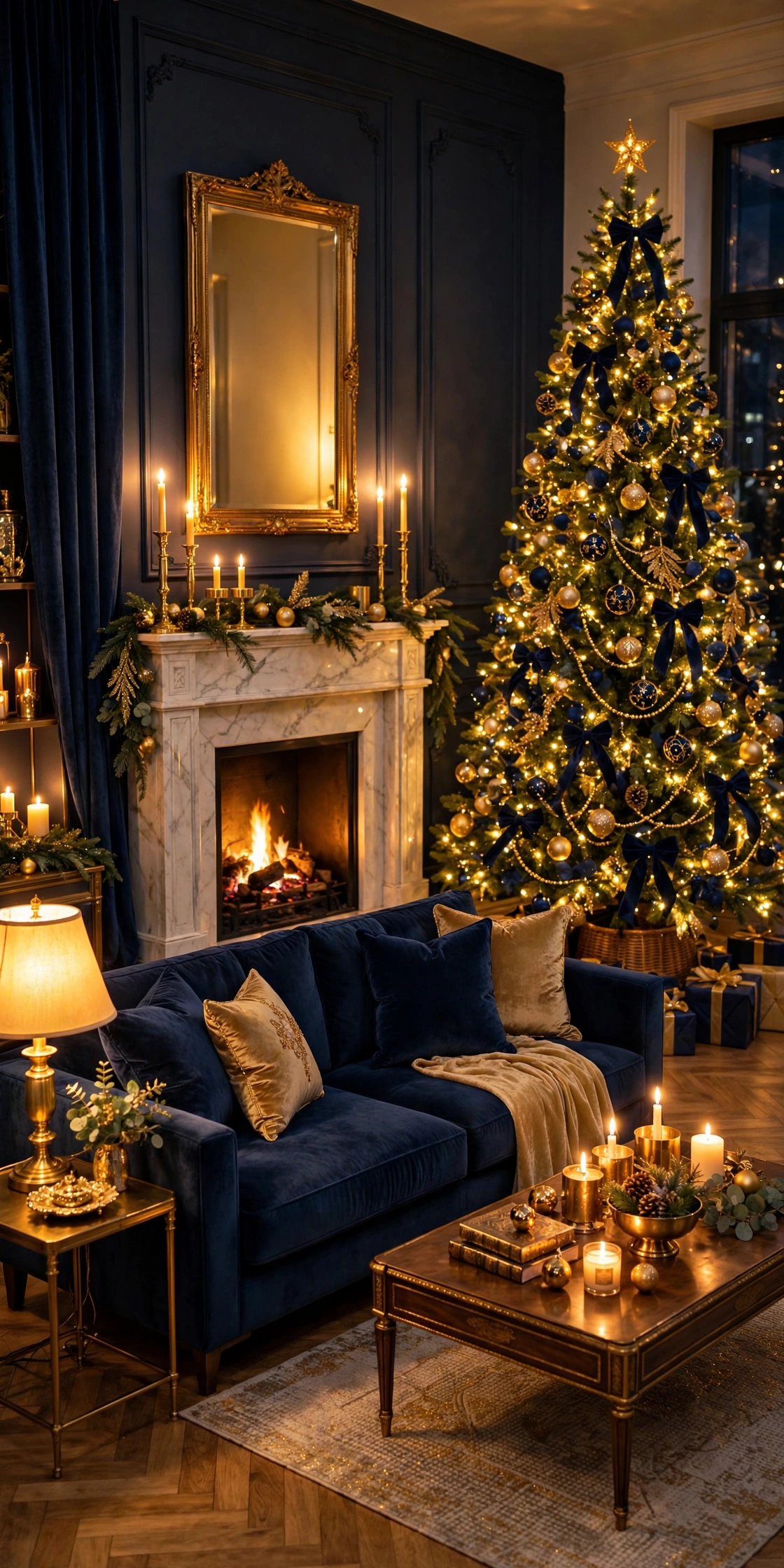
Some Christmas palettes whisper, and some walk into the room like they own it. These blue and gold christmas decor ideas are the second kind, built on deep navy, one bright partner blue, and warm gold that glows under evening light instead of shouting at noon. You will get exact ratios, sizes, and prices for every look, from the tree to the last wrapped gift. Start with the tree, carry the palette through the mantel and the table, and finish with the details that make the whole house feel like one expensive idea.
Quick Idea Summary
- The key takeaway: Run a 60/40 split in every zone: 60 percent blue, 40 percent gold. Blue does the heavy lifting as the calm, deep base, and gold works as the jewelry; the moment gold passes half, the room tips from luxe to gaudy.
- The detail most people miss: Warm light is gold’s best friend. Gold finishes are literally warm-toned, so 2700K bulbs and real or flameless candlelight make them glow, while cool white light over 4000K turns gold brassy and navy muddy.
- What it costs or how long it takes: Most ideas here cost $12 to $50 and take under an hour. A full living room in this palette runs about $160 to $240 if you shop your existing gold pieces first.
At a glance
| Zone | Ideas | Budget |
|---|---|---|
| The tree | 01–07 | $30–$120 |
| Mantel and hearth | 08–11 | $20–$70 |
| Table and dining | 12–16 | $25–$90 |
| Textiles and surfaces | 17–20 | $20–$65 |
| Bedroom, entry, and porch | 21–25 | $15–$75 |
| Details and finishing touches | 26–28 | $10–$45 |
The ideas
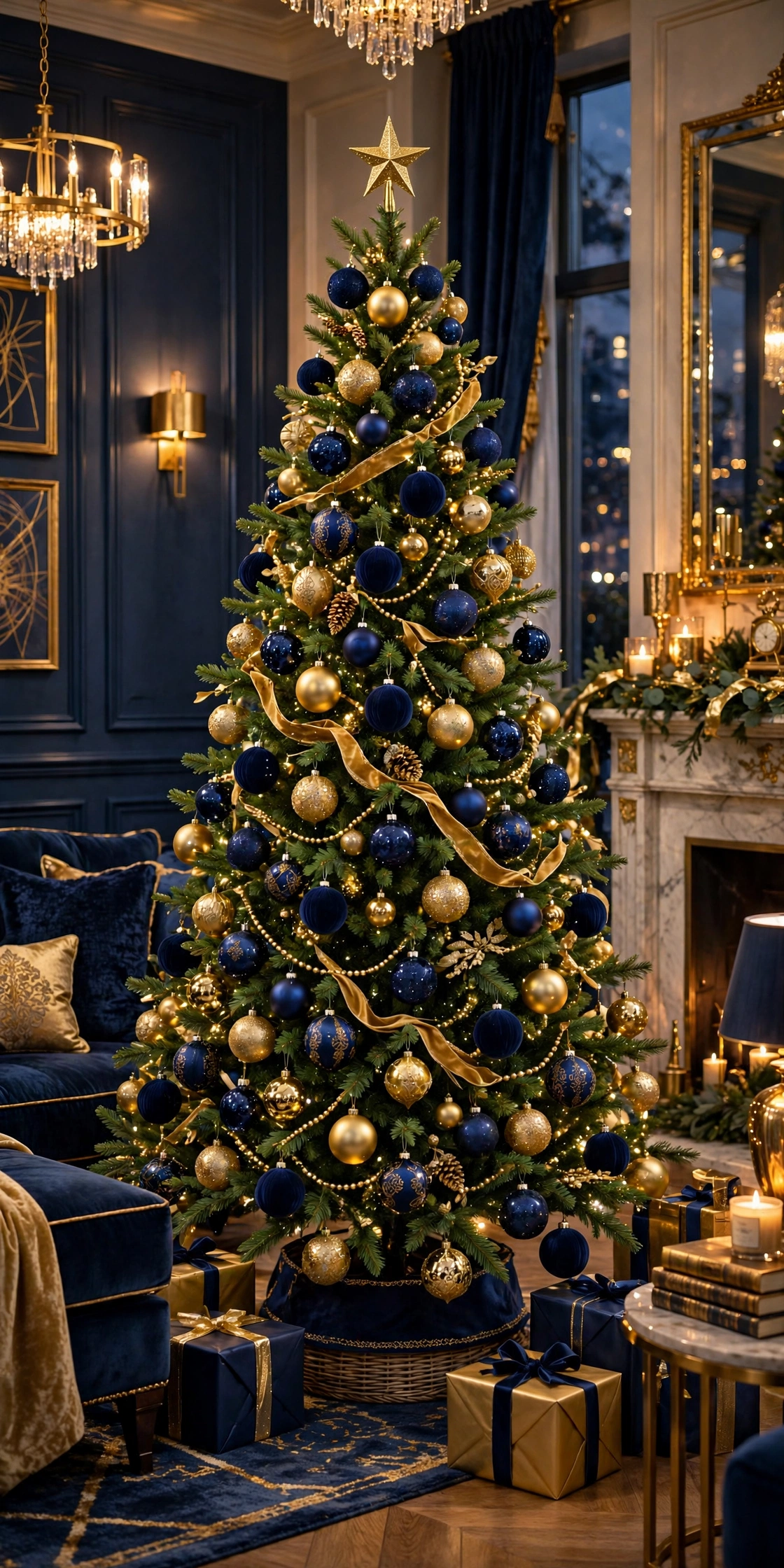
01
The Classic Navy and Gold Tree
Build your main tree on a 60/40 split: 60 percent blue ornaments, 40 percent gold. On a 7.5-foot tree that means roughly 55 to 65 navy baubles in two sizes (3-inch and 2.4-inch) and about 40 gold ones spread across shiny, matte, and brushed finishes. The ratio keeps the tree reading deep and calm first, with gold sparkling on top like light on water.
Try it: Hang the largest gold ornaments at eye level on the outer third of the branches. Gold is a light catcher, so place it where the light and the eyes actually land instead of burying it near the trunk.
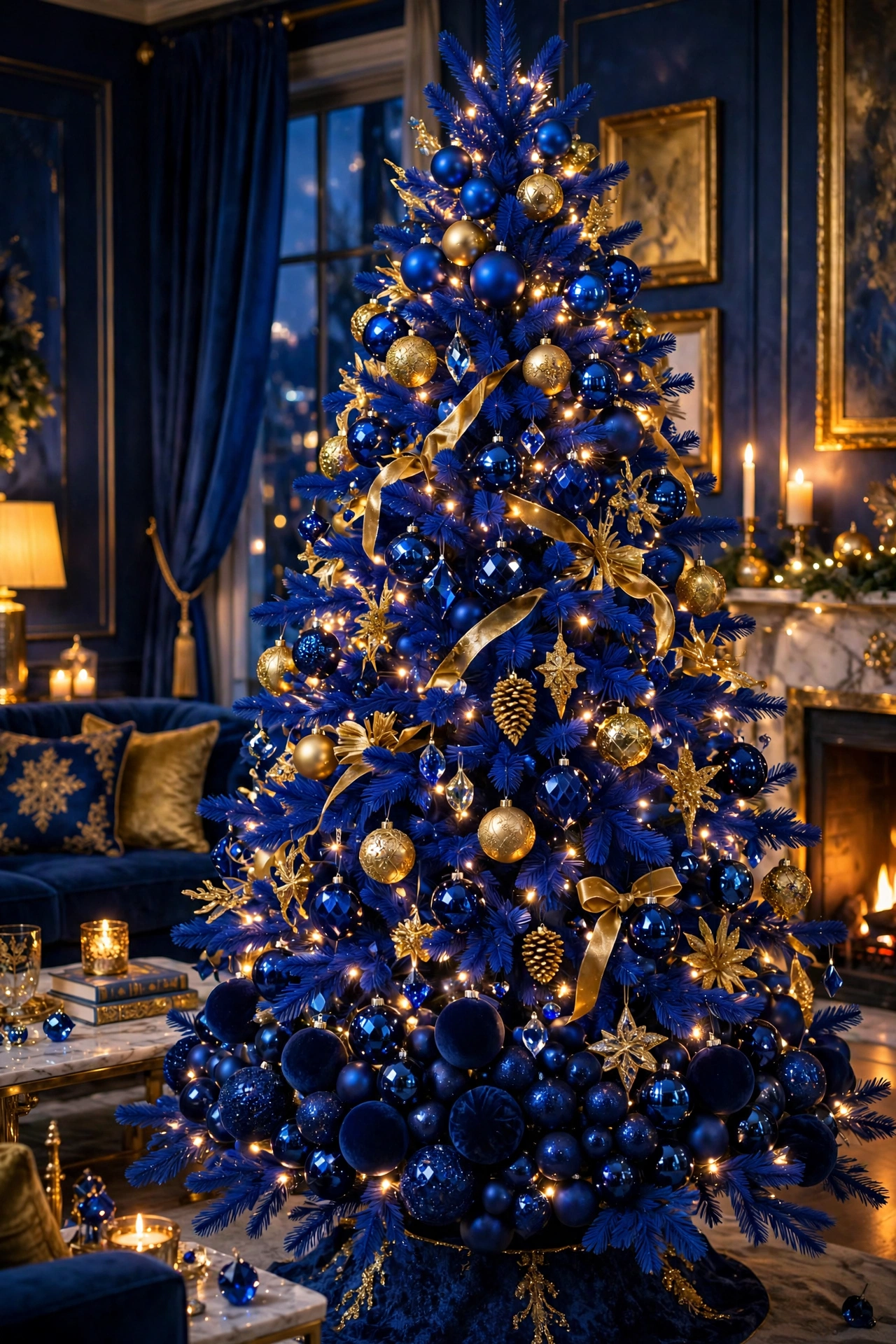
02
The Royal Blue Statement Tree
If navy feels too quiet, make royal blue the lead: a brighter, jewel-toned blue that reads almost electric next to gold. Keep the same 60/40 math, but let royal do 45 of the 60 blue points and navy the other 15 as depth near the trunk. Royal blue needs a green or flocked tree under it; on a white tree it can read more playful than regal.
Try it: Pick one lead blue per tree and commit. Two blues fighting for the lead role is how this palette turns into a sample shelf; the second blue is only ever the supporting shadow color.
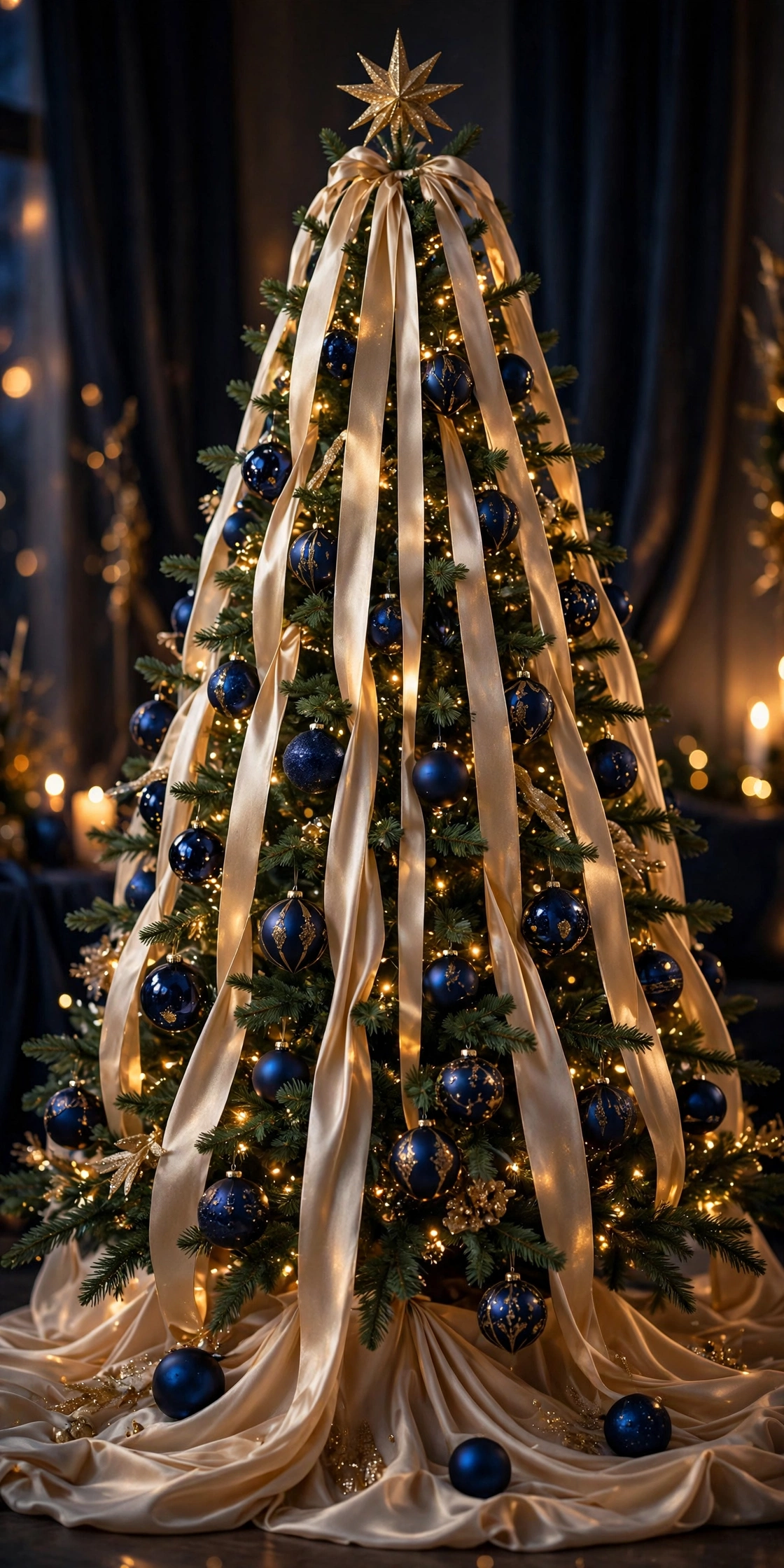
03
The Champagne Gold Ribbon Cascade
Skip the spiral wrap and let ribbon fall in vertical streams: cut a 10-yard roll of 2.5-inch wired ribbon in a soft champagne gold into 6 to 8 streamers, tuck each top into the crown, and let them cascade to the base. Champagne gold is the gentlest gold, pale and warm, so it flatters navy instead of competing with it. One roll runs about $10 and covers a 7-foot tree.
Try it: Give each streamer one soft billow, pushed into the branches every 12 to 18 inches. Flat ribbon looks pasted on; the gentle wave is what makes it read as fabric instead of packaging.

04
Gold Garland Woven Deep
Most people drape garland on the branch tips, where it sits like a necklace. Push a fine gold bead garland or slim tinsel garland deep into the tree instead, about 6 inches inside the outer branches, circling the trunk zone. The gold glows from inside the tree and gives navy ornaments a lit backdrop. Use 18 to 24 feet of garland for a 7.5-foot tree, roughly $12 to $18.
Try it: Add garland after the lights but before the ornaments. Reaching past hung ornaments to fix a garland line is how baubles end up on the floor.

05
Navy Velvet Ribbon and Bows
Velvet is the texture that makes this palette feel like a hotel lobby instead of a showroom, and navy velvet is its most forgiving piece. Tie 10 to 14 bows from 2-inch navy velvet ribbon and cluster them in threes on the tree, the wreath, and the mantel. A 10-yard spool costs about $12, and velvet ribbon never creases the way satin does, so the bows survive storage.
Try it: Pair each velvet bow with one small gold ornament hung directly below it. The soft blue and hard shine together create the expensive contrast this whole palette runs on.
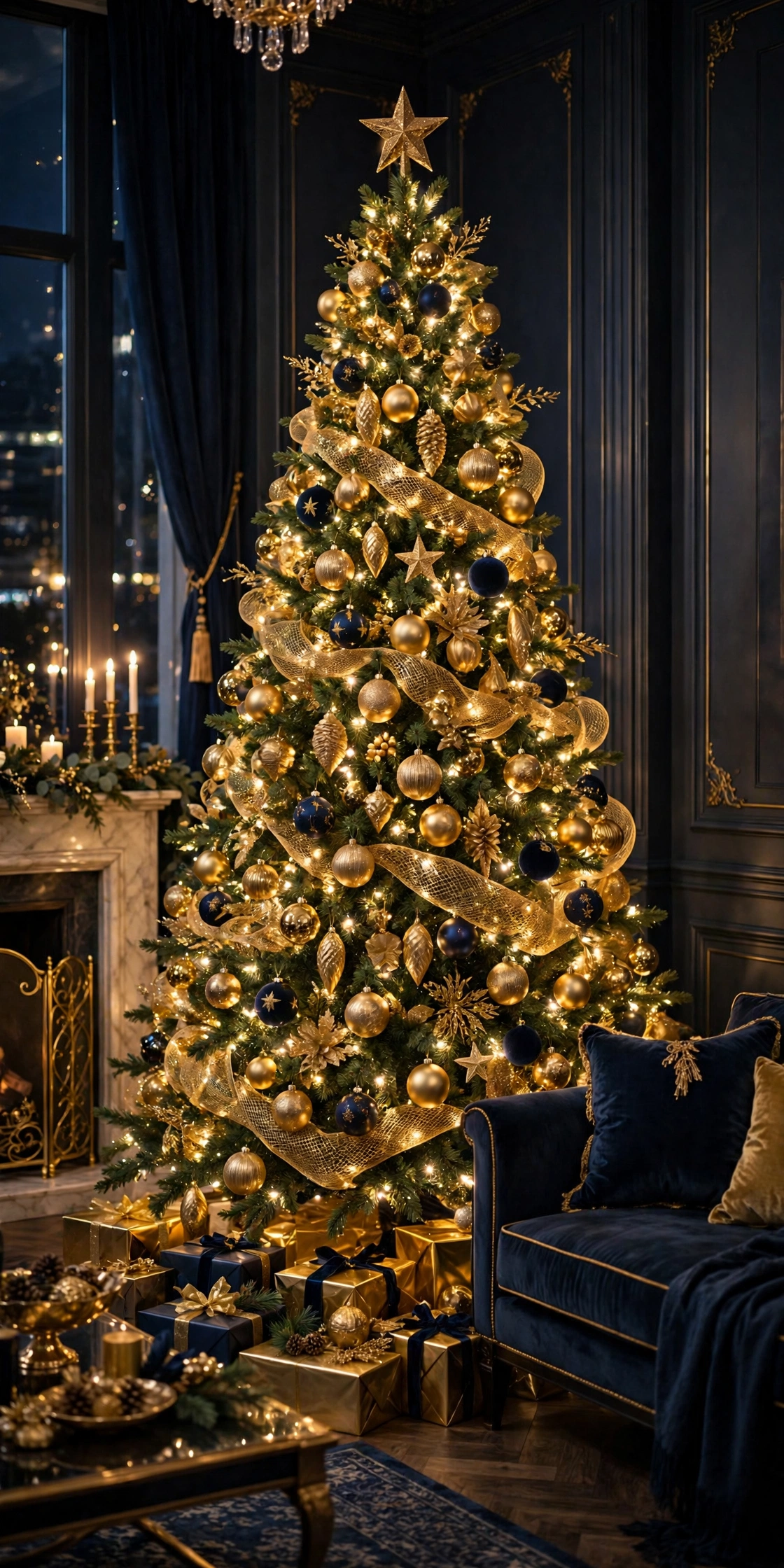
06
The Gold-Forward Glam Tree
For a formal room or a second tree, flip the ratio: 60 percent gold, 40 percent blue, with navy as the accent. Gold mesh ribbon, gold finials, and brushed gold baubles carry the tree while deep navy pieces act as punctuation, 25 to 30 of them on a 7.5-foot tree. This formula only works with warm white lights; gold on gold under cool light is the one version of this palette that genuinely looks cheap.
Try it: Break up the gold with three finishes minimum: shiny, matte, and glitter or brushed. All-shiny gold has no shadows, and shadows are what make a tree look deep instead of flat.
07
A Flocked Tree in Navy and Gold
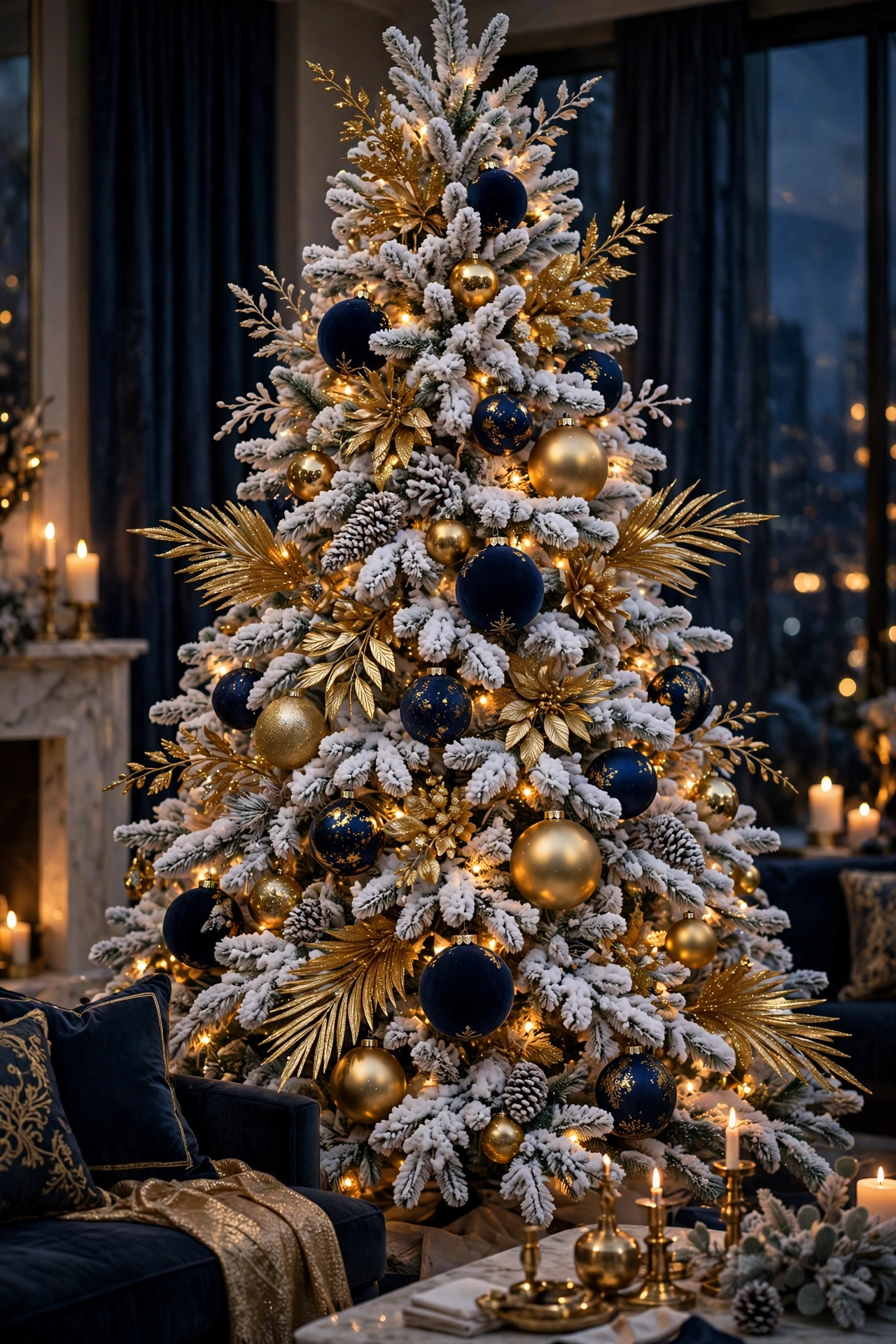
Heavy flocking changes the math in your favor: the white snow layer acts as a built-in neutral, so navy reads softer and gold reads warmer against it. Keep ornaments slightly larger than usual (3-inch and up) because small pieces disappear into flocked branches. A flocked tree also solves the bare-spot problem, since the white branches fill gaps that a green tree would show.
Try it: Skip ribbon on a flocked tree and use wide gold picks and sprays instead. Ribbon sheds flocking every time it brushes a branch, and by Christmas Eve the tree looks dusty.
08
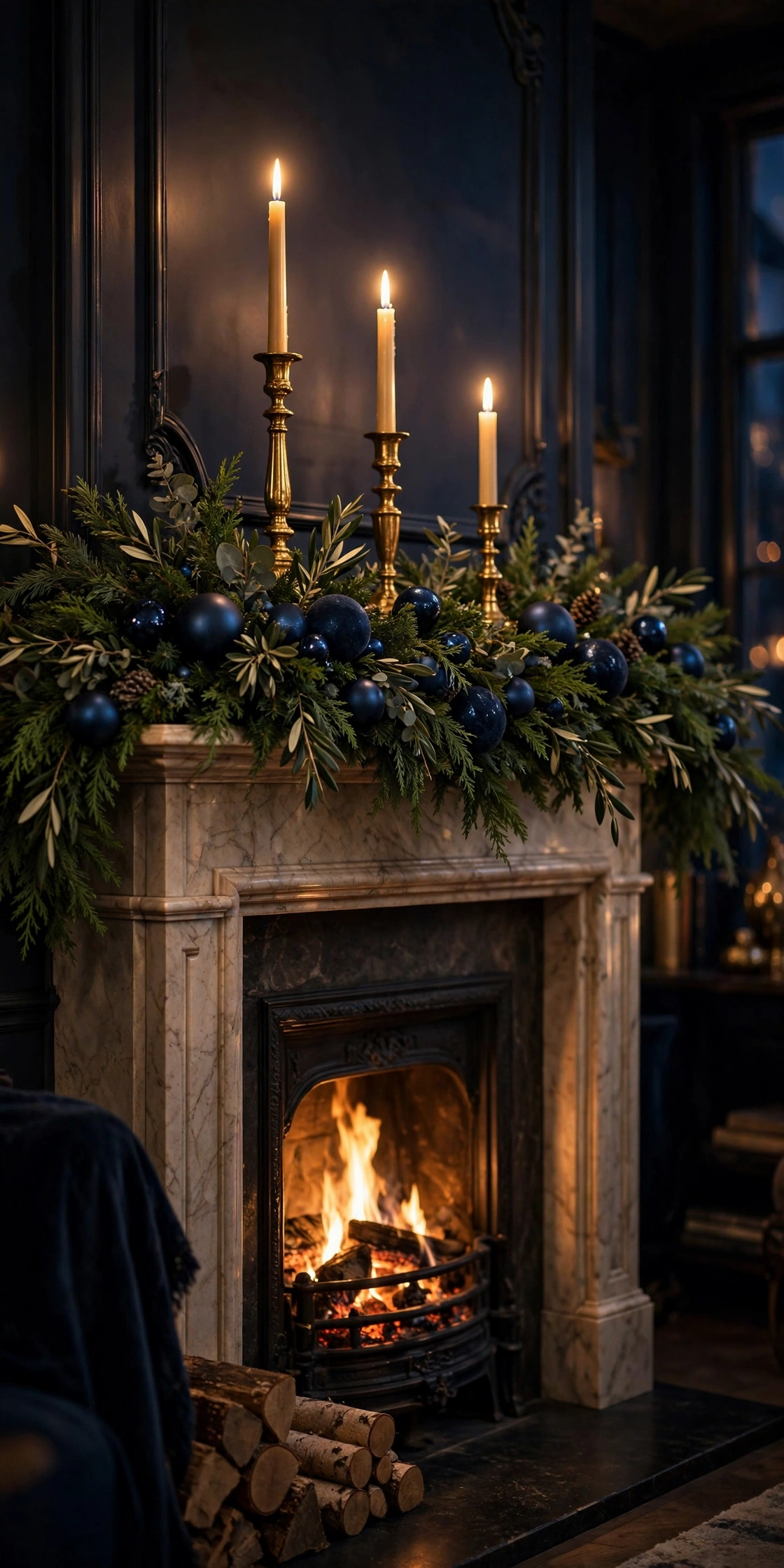
The Mantel: Garland, Gold Candlesticks, Navy Weight
Build the mantel in three layers: a full greenery garland as the base, navy ornaments nested into it for color weight, and gold candlesticks standing above it for height. Five to seven gold candlesticks in mixed heights (8 to 14 inches) with cream tapers give the mantel its glow line. Brass candlesticks from a thrift store count fully as gold here and usually cost $3 to $6 each.
Try it: Keep flames, real or flameless, at least 6 inches from the garland — that is basic candle and fireplace safety — and use flameless tapers if the mantel gets warm from the fireplace below.
09
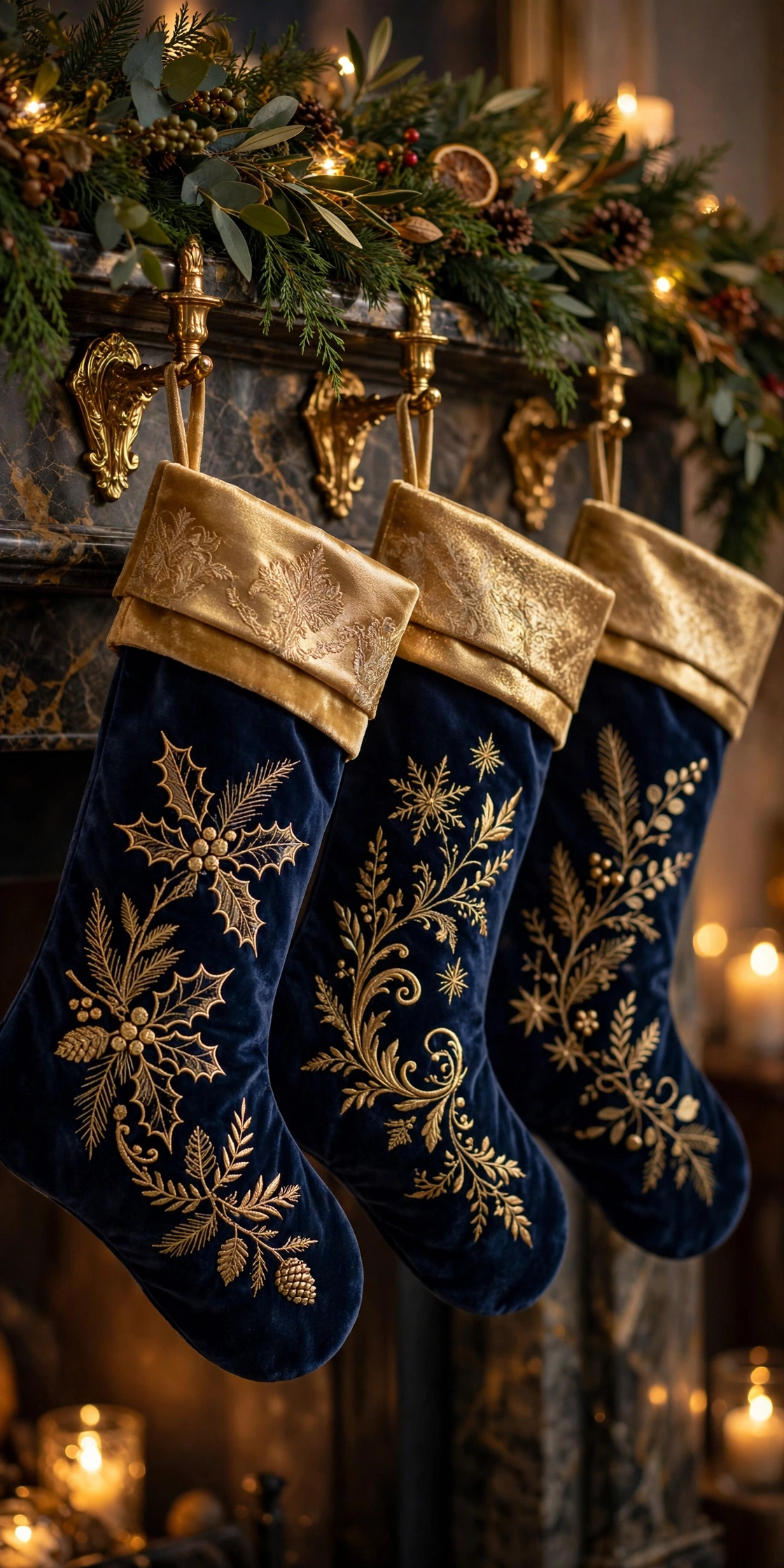
Navy Velvet Stockings with Gold Details
Stockings are the mantel’s second color block, so make them navy velvet with one gold detail each: a gold cuff, a gold name tag, or gold embroidery. Matching stockings in this palette look like a boutique display; mismatched ones look like a compromise. A set of four velvet stockings runs $30 to $48, and the gold detail is what photographs.
Try it: Hang stockings from weighted gold stocking holders instead of hooks stuck to the mantel edge. A stuffed velvet stocking easily weighs 3 to 5 pounds by Christmas morning.
10
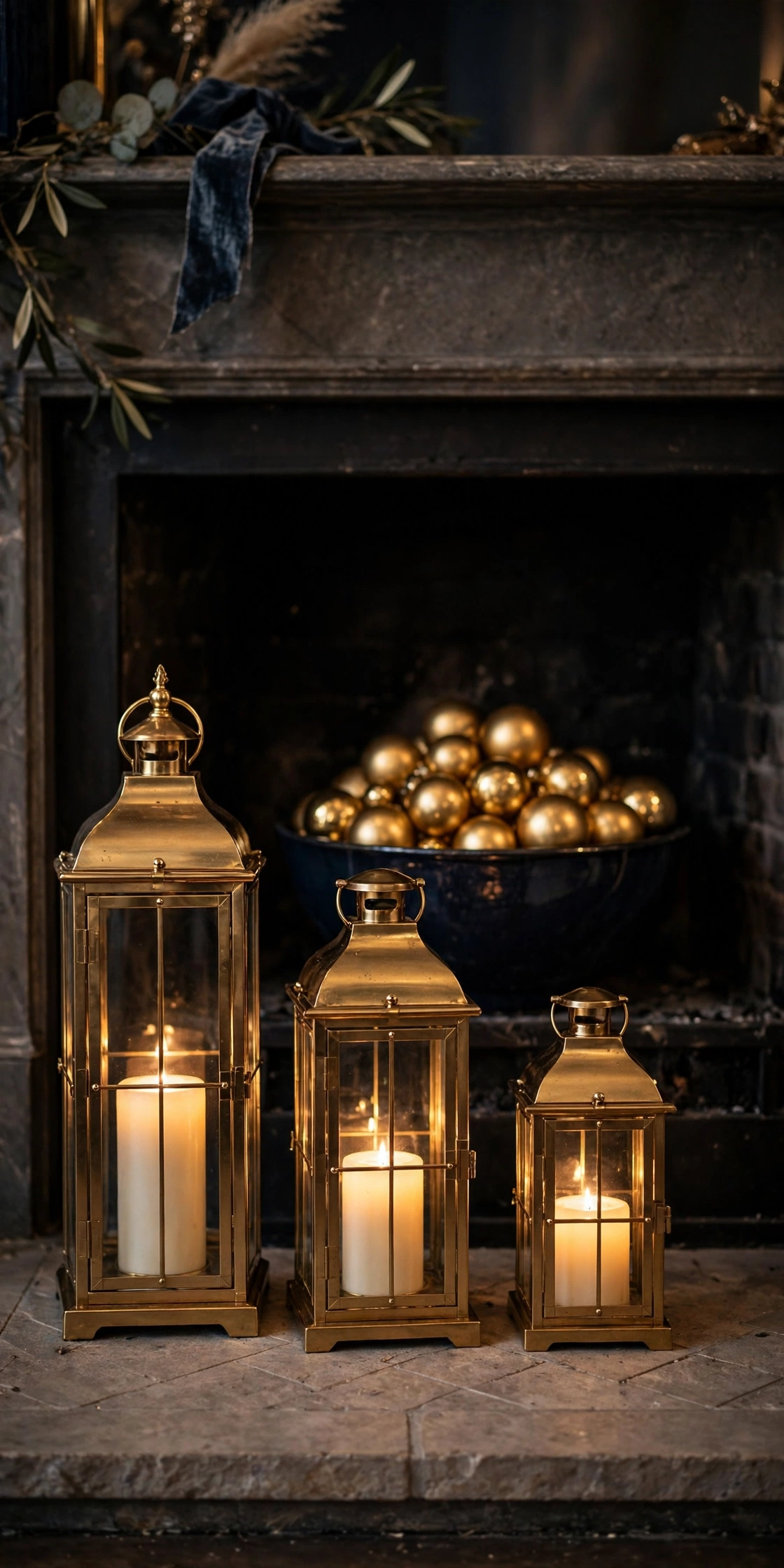
Gold Lanterns on the Hearth
An empty hearth is a black hole in a decorated room, and gold lanterns are the fix that also adds light. Cluster three gold lanterns in graduated heights (12, 16, and 20 inches) on one side of the firebox, each holding a flameless pillar in warm white. Inside the firebox itself, a shallow stack of gold baubles in a navy bowl gives a cold fireplace a finished look for about $10.
Try it: Put the tallest lantern closest to the room’s main seat. Lantern light should land where people sit, not where people walk past.
11
A Gilded Wreath Above the Mantel
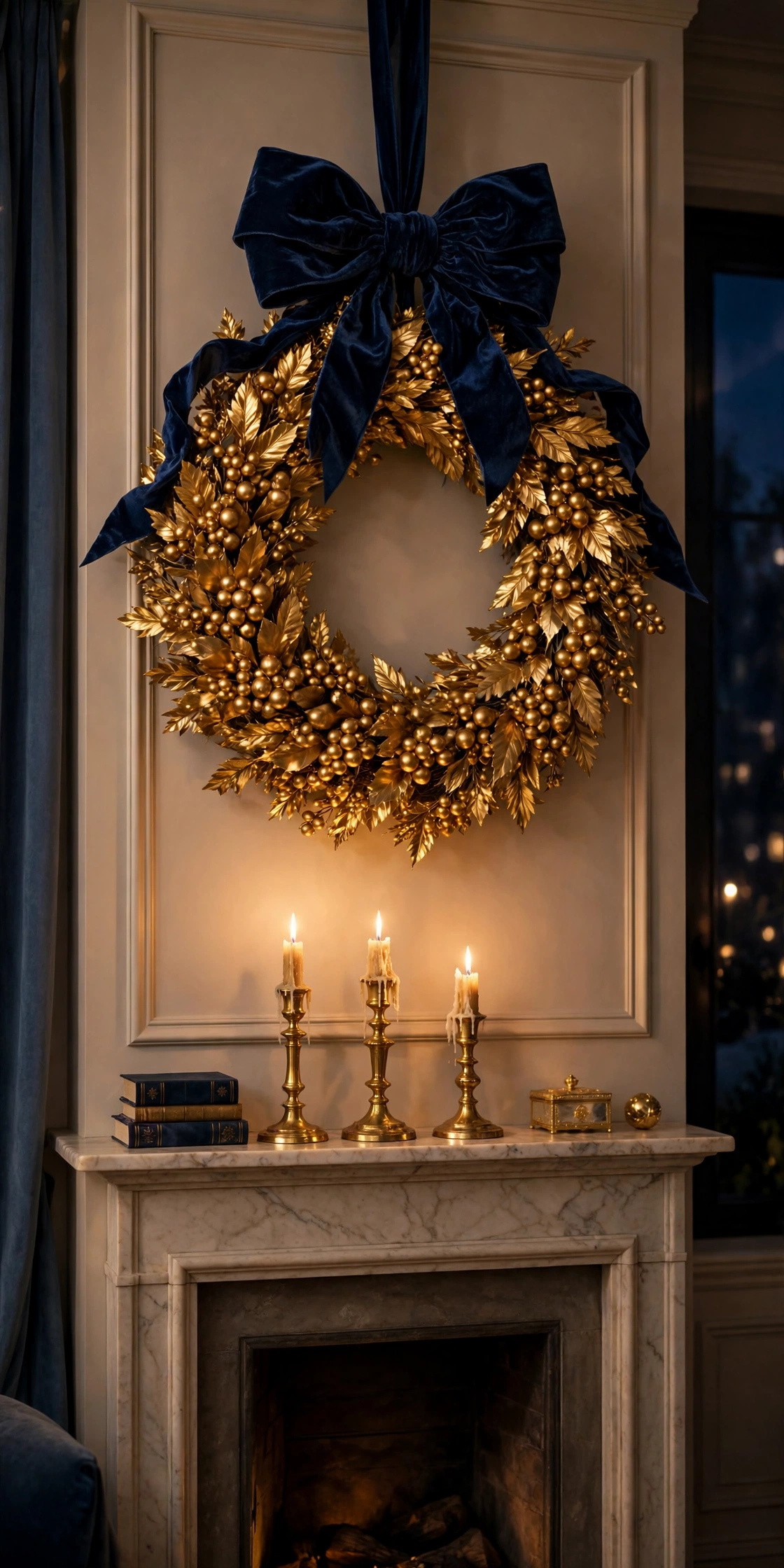
Hang one generously sized wreath above the mantel, 30 to 36 inches across, either a gold-leaf wreath or a greenery wreath loaded with gold berries and a single large navy velvet bow. The wreath is the mantel’s crown, and in this palette it should be the most gold-forward piece in the room. Hung so its center sits about 12 inches above the mantel shelf, it pulls the whole fireplace wall together.
Try it: Repeat one element from the wreath, the same gold berry or the same navy bow, somewhere on the tree. One repeated detail is what makes two decorated pieces read as one design.
12
The Blue and Gold Tablescape Formula
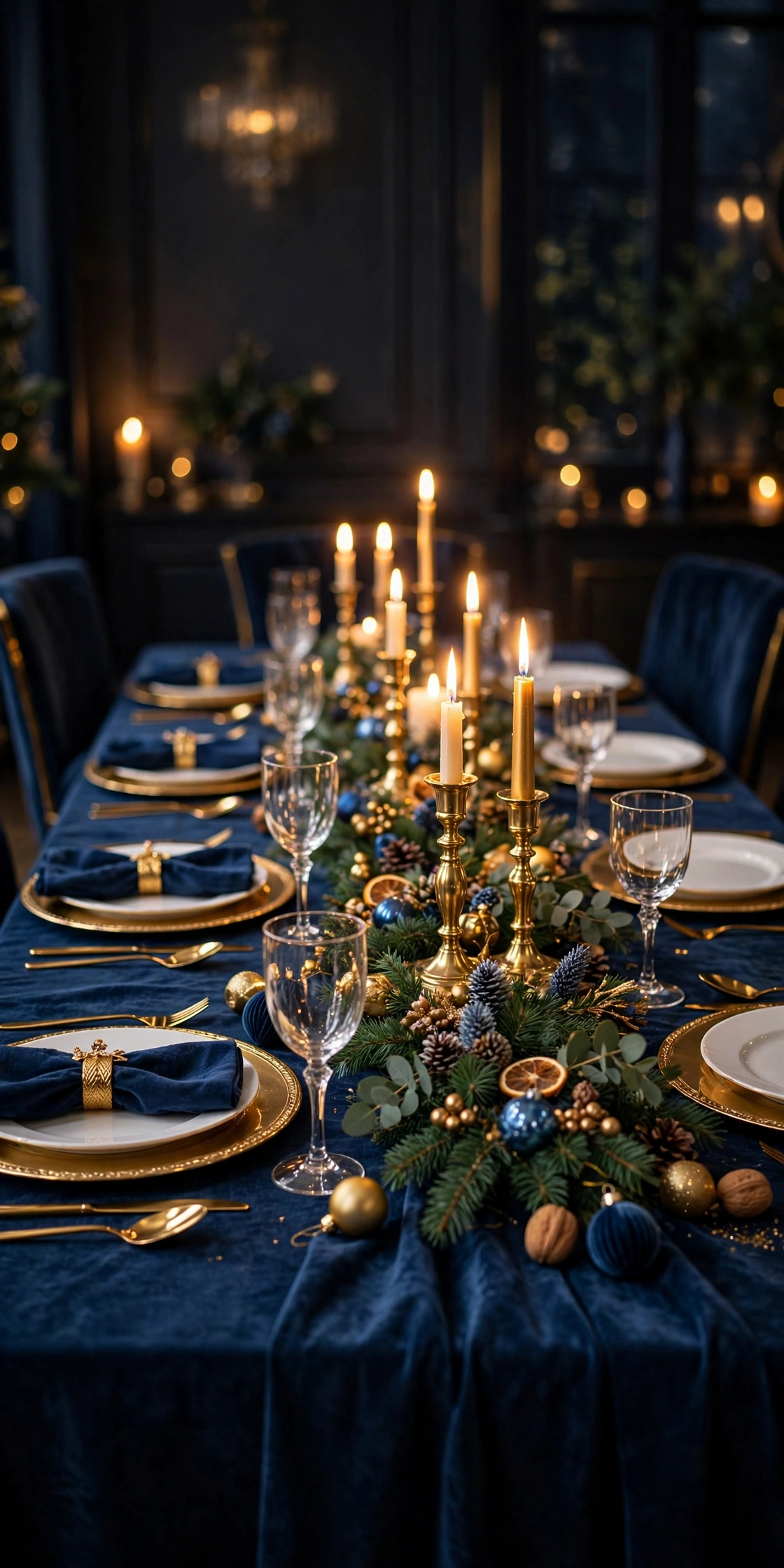
The dining table runs the same 60/40 split as the tree: navy linen or a navy runner as the 60, gold as the 40 layered on top. Start with a navy tablecloth (about $18 for a 120-inch) or a deep navy runner over your existing cloth, then build each setting on a gold charger. The dark base makes every gold piece look richer, the same way a jeweler displays gold on navy velvet.
Try it: Test the table at night with the actual dinner lighting before the day. Navy that looks perfect at noon can go nearly black under dim dining light, and you want to know before guests sit down.
13
Gold Chargers and Navy Linens, Setting by Setting
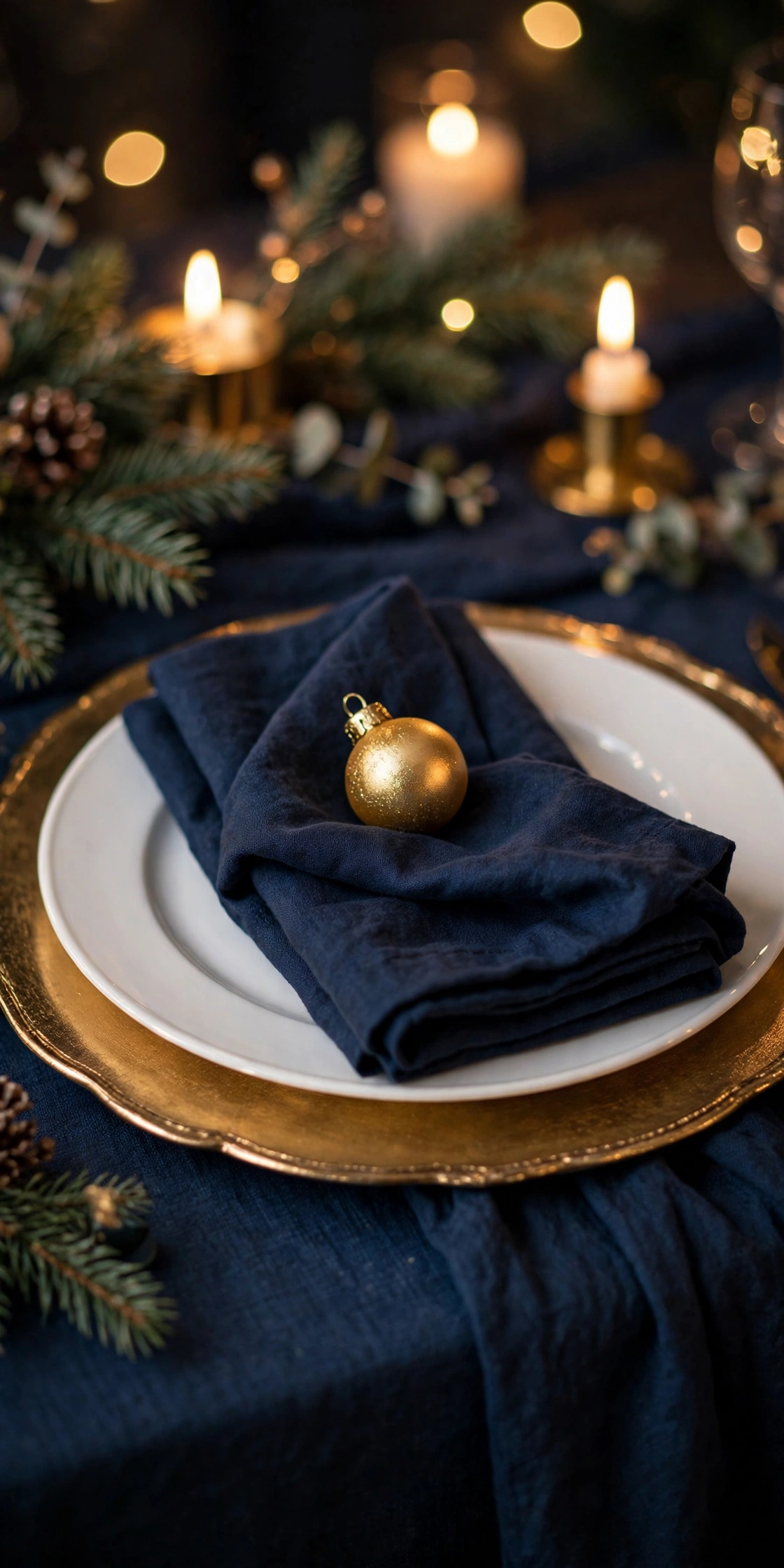
A charger is the cheapest luxury in this palette: gold chargers run $1.50 to $3 each in packs and make plain white plates look like a catered event. Layer white plate, navy napkin folded on top, one small gold ornament resting on the napkin as the place marker. For eight settings the whole formula costs about $25 and stores flat in one box.
Try it: Skip printed napkins here. A solid navy napkin lets the gold do the talking; a patterned napkin introduces a third design idea the table did not ask for.
14
A Low, Long Centerpiece in Gold and Navy
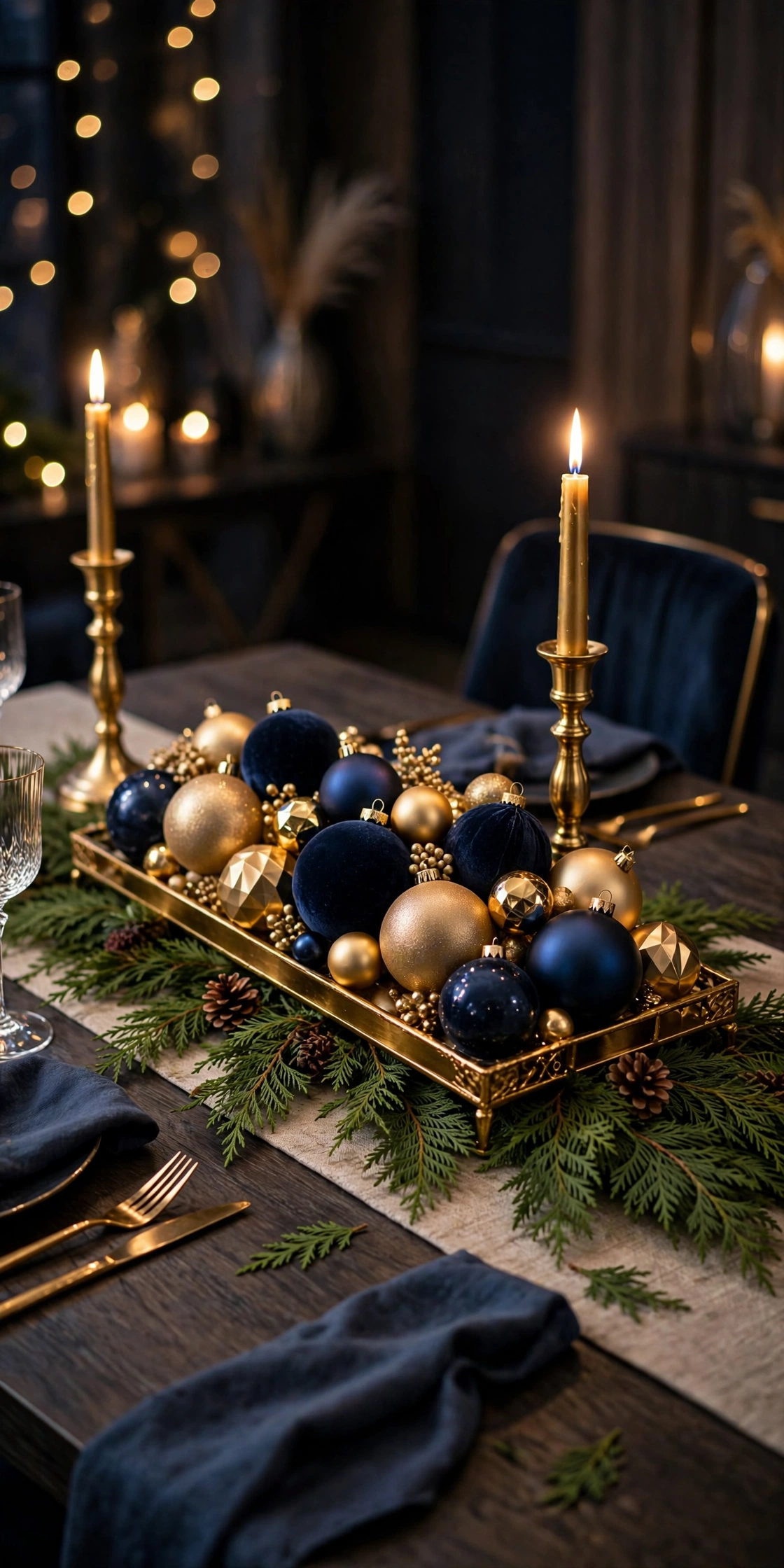
Keep the centerpiece under 10 inches tall so guests can see each other, and build it long instead: a gold tray or a long navy ceramic bowl filled with mixed navy and gold ornaments, flanked by two pairs of gold candlesticks. The ornaments in the bowl should mirror the tree’s finishes, shiny, matte, and brushed, so the table and tree argue the same case. Total build cost is $20 to $35 if the ornaments come from your tree stash.
Try it: Add one living element, a few stems of navy-dyed or natural blue hydrangea or plain cedar clippings. Everything metallic can feel staged; one organic piece makes it a table instead of a display.
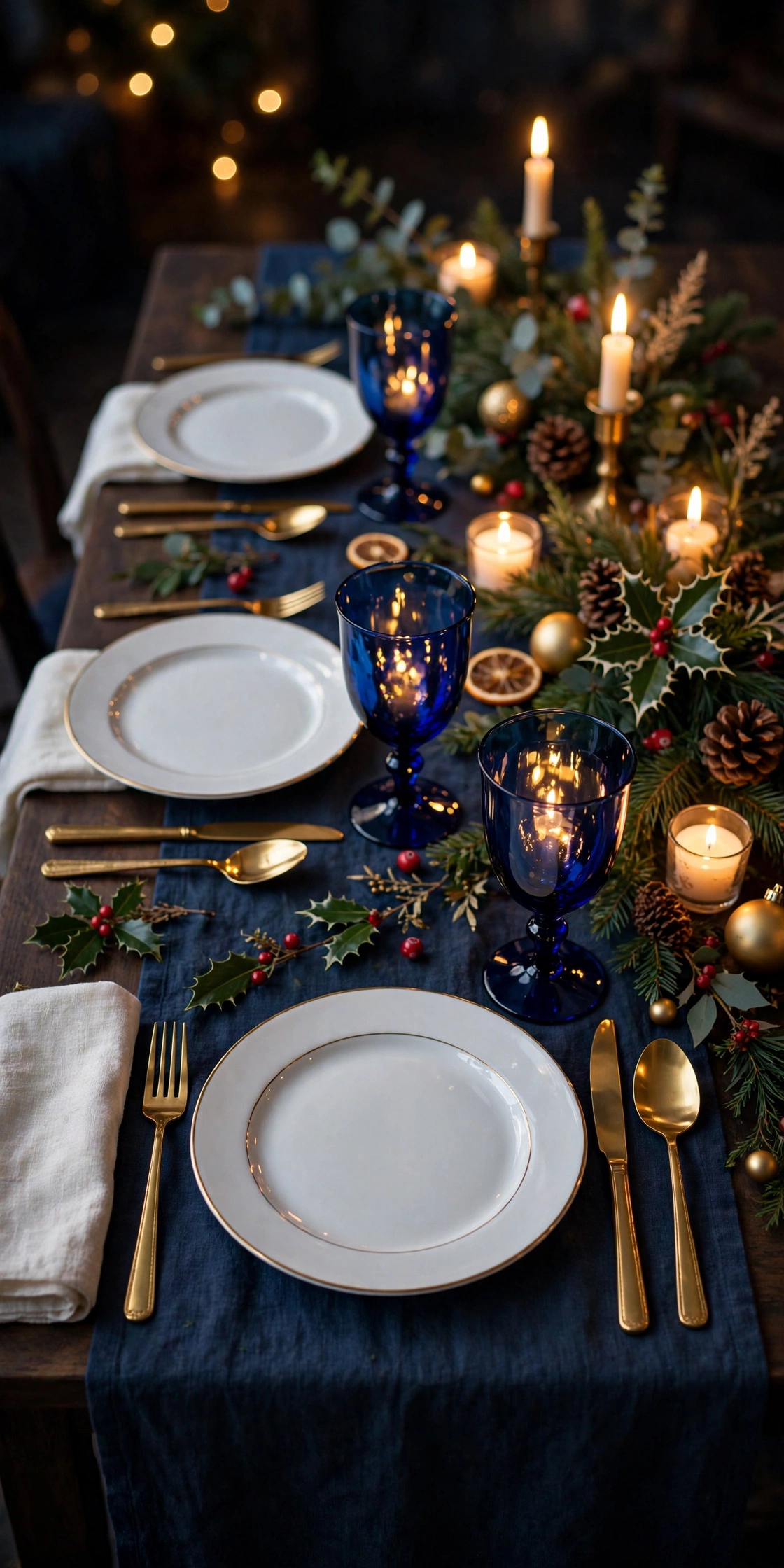
15
Cobalt Glassware and Gold Flatware
Cobalt blue glasses are the table’s jewelry: they carry the blue at drinking height, where a tablecloth cannot reach. A set of six cobalt goblets runs $24 to $36, and gold flatware (about $30 for a service for eight) finishes each setting with shine at hand level. Together they mean the table still reads blue and gold even after plates are cleared.
Try it: Hand-wash the gold flatware or use the top rack only. Dishwasher heat and detergent dull gold plating in a single season, and dull gold is worse than none.
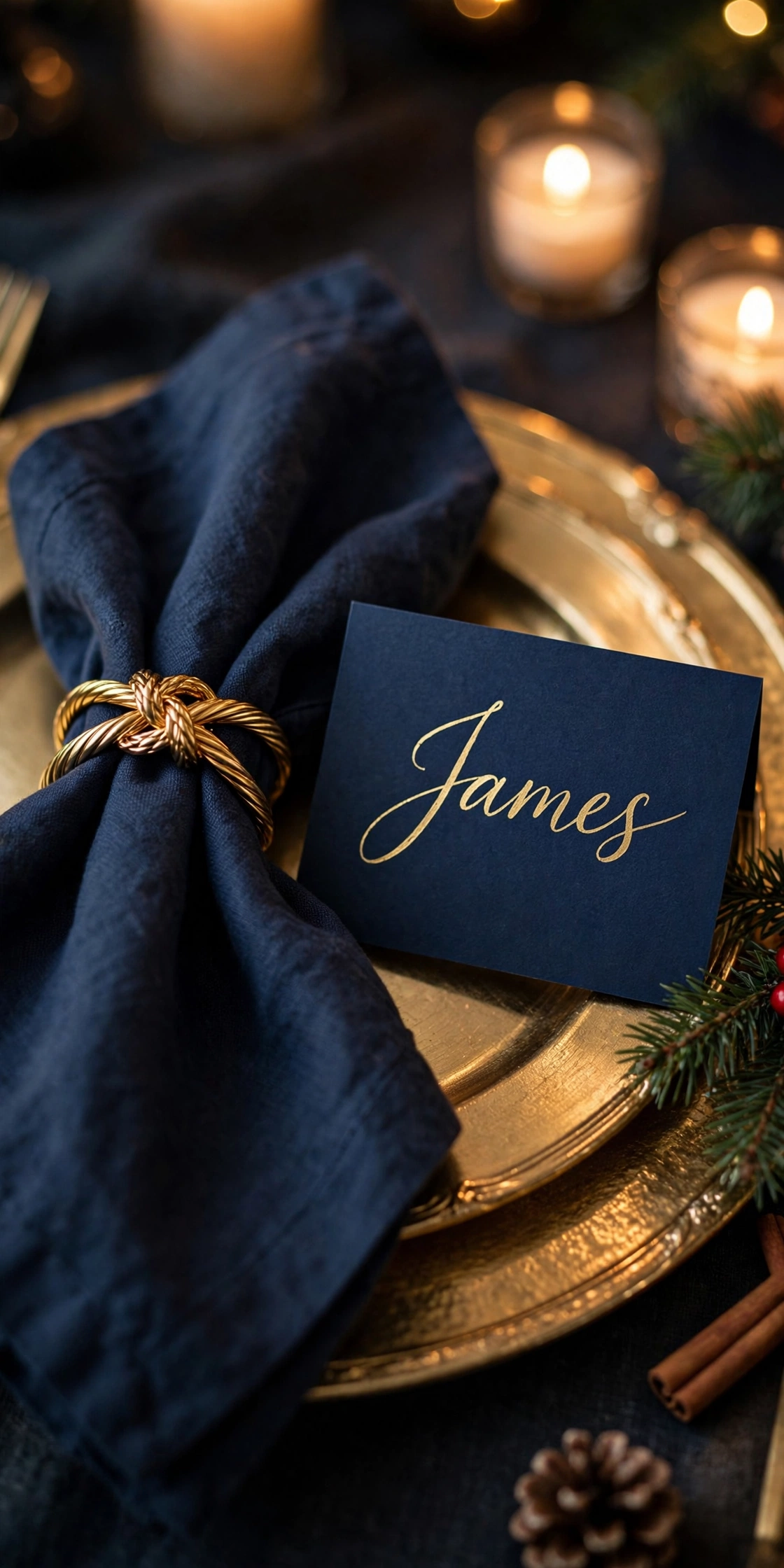
16
Gold Napkin Rings and Handwritten Place Cards
Finish each setting with a gold napkin ring and a place card in navy card stock with gold lettering. Rings run $8 to $12 for eight, and a gold paint pen ($4) turns plain navy cards into calligraphy-looking place markers. Seating plans feel formal, but at a Christmas table they read as care, and they stop the annual chair negotiation cold.
Try it: Write one short, true compliment on the back of each place card. It takes five minutes total and guests keep the cards long after the chargers are boxed away.
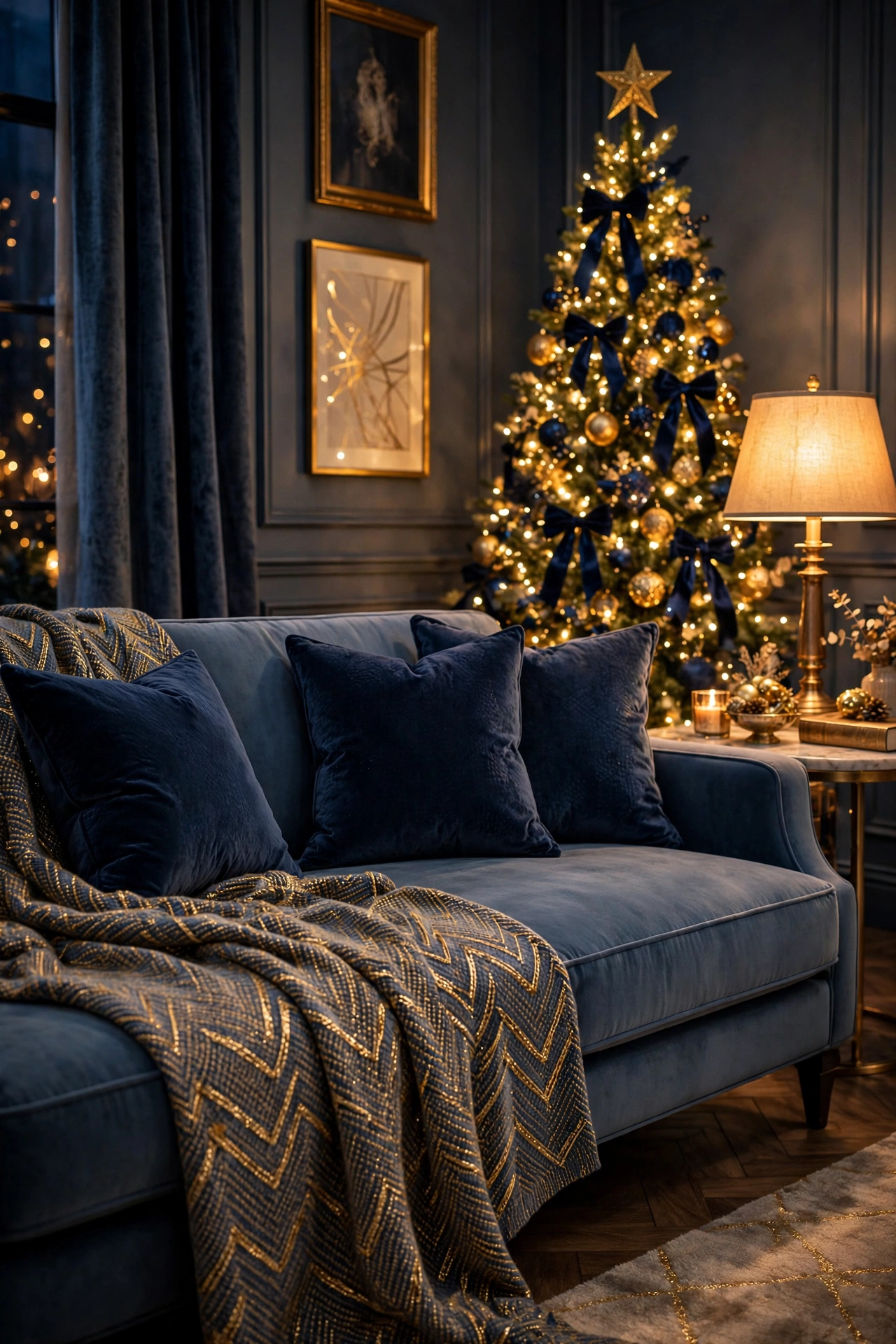
17
Velvet Pillows and a Gold-Thread Throw
Textiles are how the palette gets comfortable: two navy velvet pillow covers (18 or 20-inch, about $12 each) on the sofa, one throw with a gold thread or gold edge woven through it (about $25). Keep your everyday neutral pillows in the mix so the sofa looks collected rather than costumed. This is the cheapest full-room statement in the article: under $50 and ten minutes.
Try it: Mirror the tree ratio on the sofa too, roughly two blue pieces for every one gold piece. Consistency of ratio is what makes a palette feel designed across a whole room.

18
A Navy Tree Skirt with Gold Trim
The tree base is the tree’s weakest visual point, and a navy velvet tree skirt with a gold trim band fixes it in one step. Choose a 48-inch skirt for a 7.5-foot tree, or a gold metal tree collar (about $25) if your tree is modern and you want shine instead of softness. Wrapped gifts in navy paper with gold ribbon (idea 27) then sit on a base that already belongs to the design.
Try it: Steam the skirt before it goes down, not after. Creased velvet under a lit tree catches light in every wrinkle and reads as tired instead of lush.
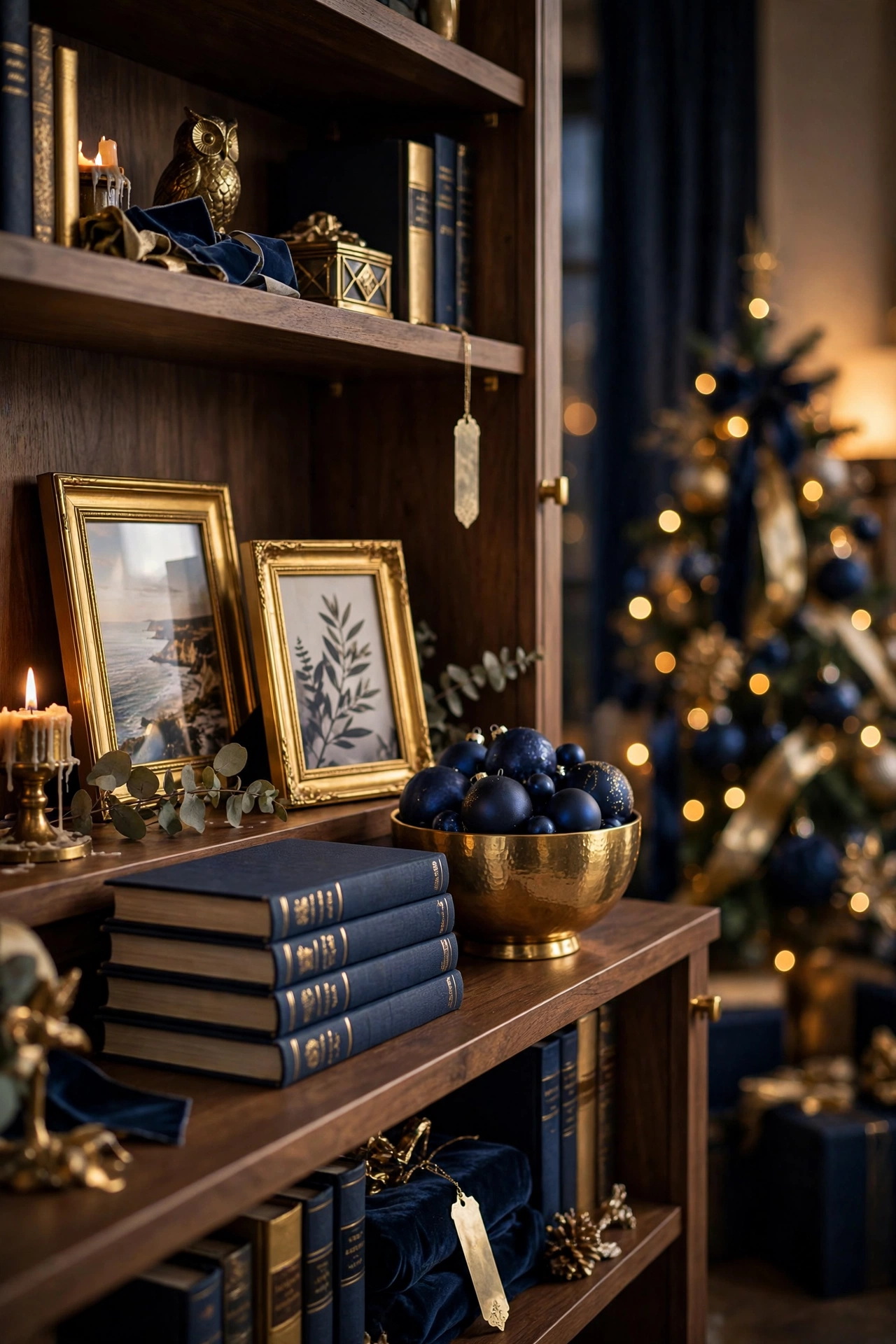
19
Bookshelves and Consoles: Gold Frames, Navy Books
Surfaces carry the palette at standing height. On a console or bookshelf, group a gold-framed photo or small gold mirror, a short stack of navy-covered books, and one ornament vignette: a gold bowl holding five navy baubles. Groups of three, always, and leave at least a third of the surface empty. A styled surface in this palette costs nothing if you shop your own shelves first.
Try it: Turn two or three books spine-in so the navy pages and covers face out in a clean block. It is the fastest free color block a bookshelf can give you.
20
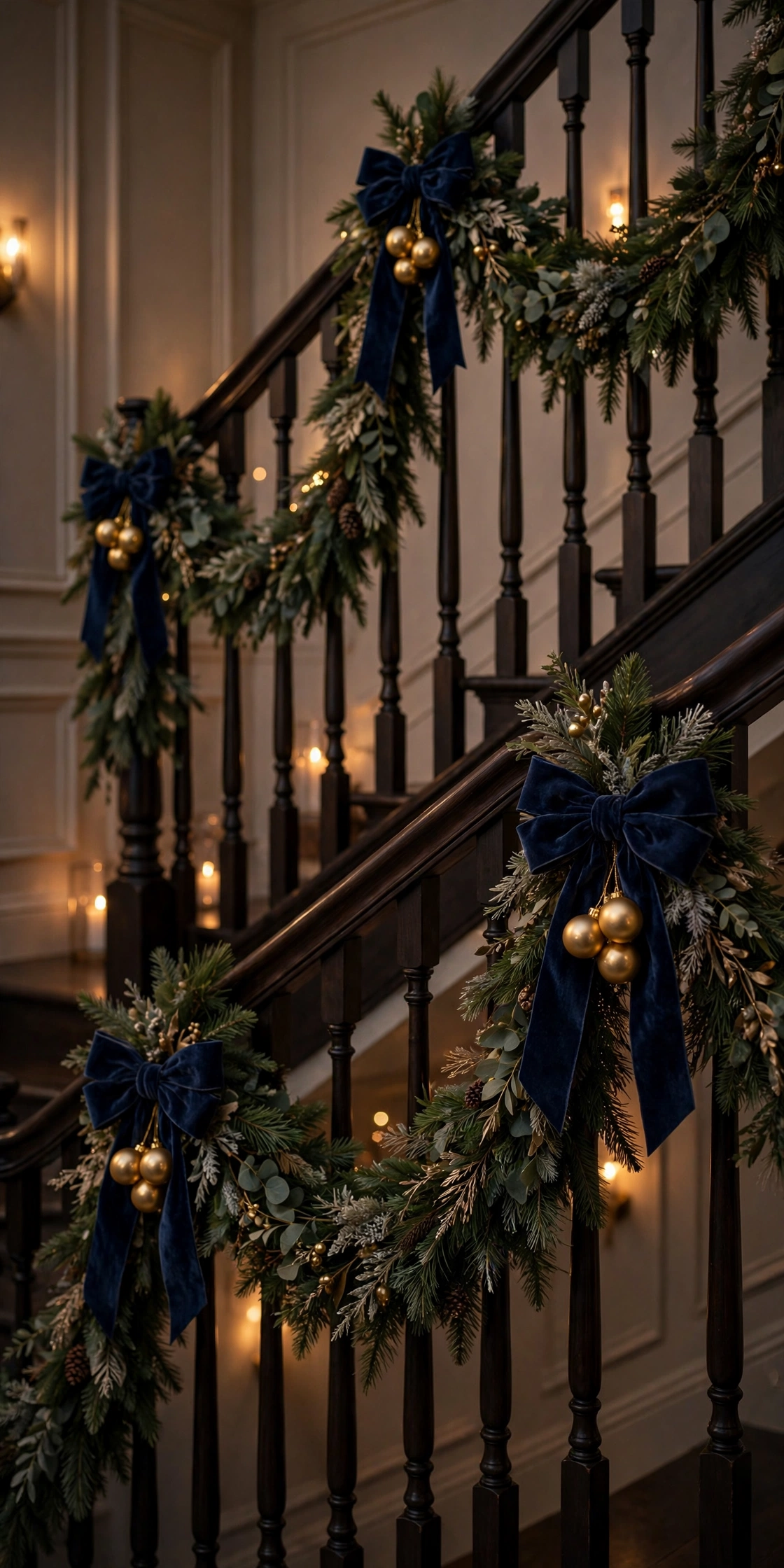
Staircase Garland with Navy Bows and Gold Baubles
A staircase is a room-sized ribbon, so dress it like one: real-touch garland along the rail (plan 1.5 feet of garland for every foot of rail so it can swag), navy velvet bows at every swag point, and gold baubles clustered where the bows land. Clusters of three gold ornaments at each bow keep the gold disciplined instead of sprinkled. Budget $35 to $60 for a standard flight.
Try it: Wire the bows and ornament clusters to the garland first, then attach the finished garland to the rail. Decorating on the rail means working on stairs with your arms over your head.
21
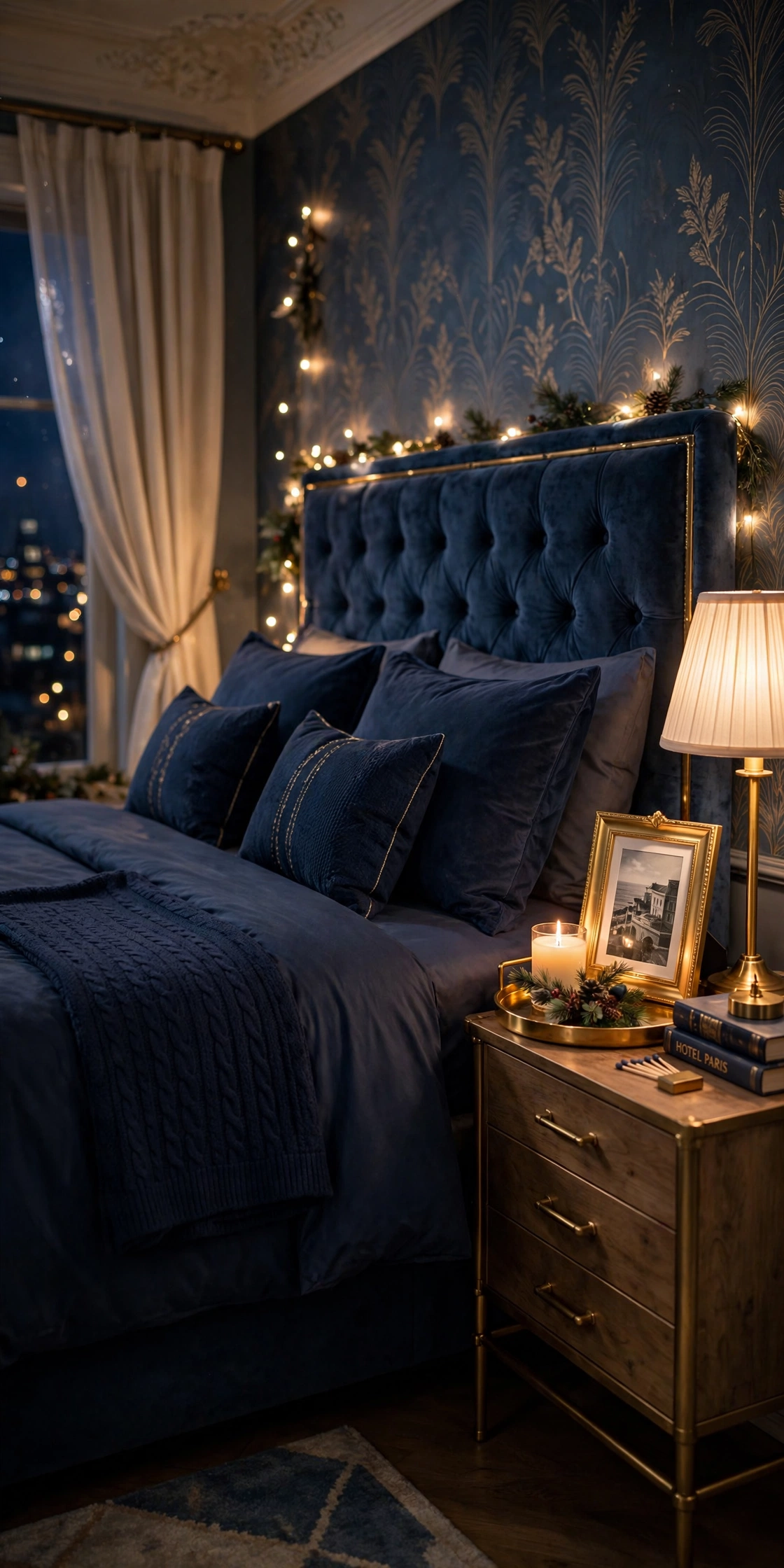
The Bedroom: Navy Bedding, Gold at Arm’s Reach
A bedroom in this palette should feel like a boutique hotel in December: navy bedding or a navy throw folded across the foot of the bed, and gold kept small and close, a gold tray on the nightstand, gold picture frame, one gold ornament on the dresser. Blue does the calming work; gold stays at arm’s reach where its glow is personal. A navy throw (about $22) is often the only purchase the room needs.
Try it: Keep the bedroom ratio closer to 75/25 in favor of blue. Gold is energizing, and the bedroom is the one room where the palette should lower your heart rate, not raise it.
22
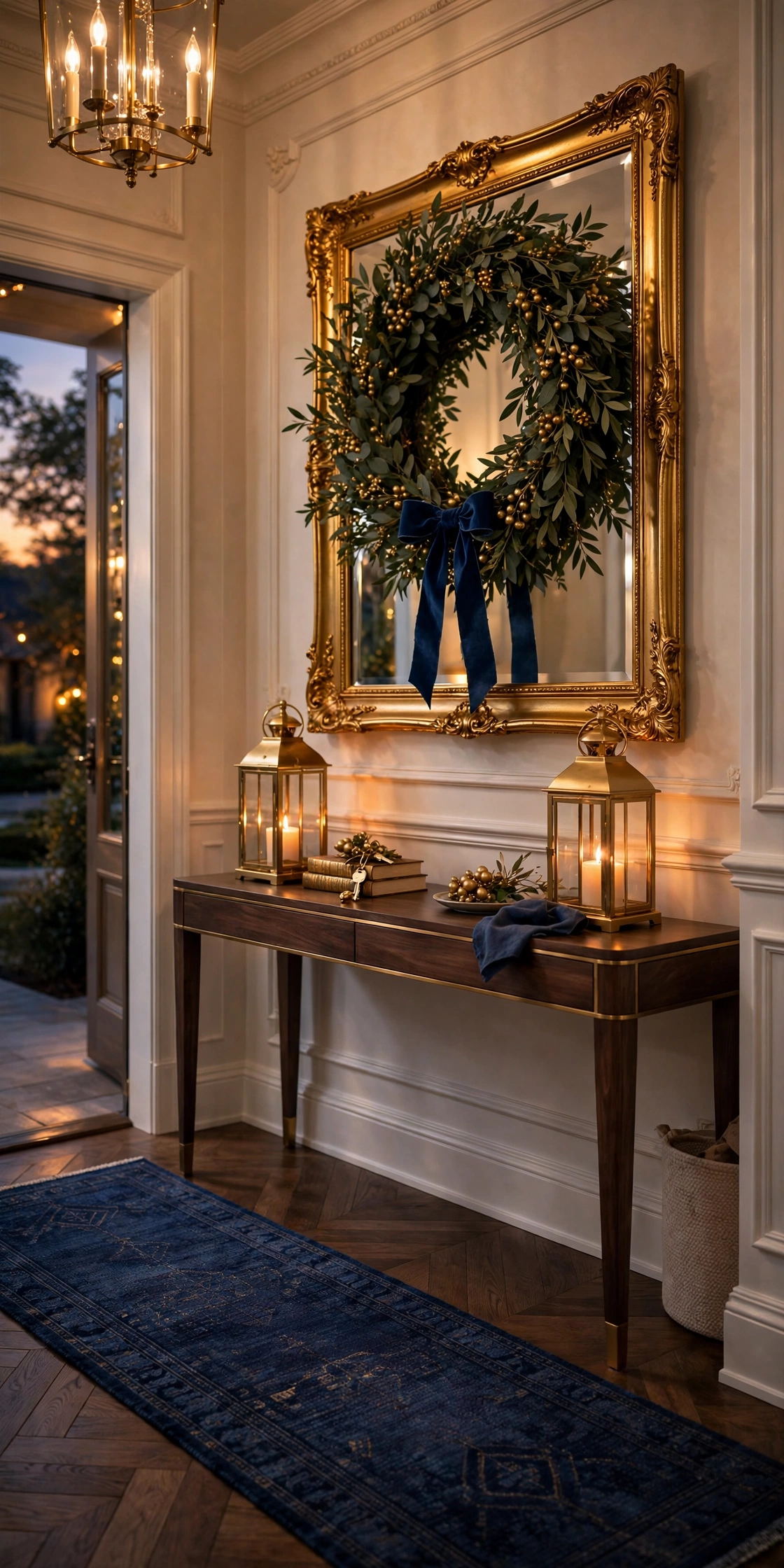
The Entryway: A Gold Mirror Moment
Your entry makes the palette’s promise in five seconds. Hang a gold-framed mirror or a greenery wreath with a navy bow and gold berries over the console, set a gold lantern or two on the surface, and let a navy runner do the floor work. The mirror doubles every gold surface near it, which is why entryways in this palette photograph so well.
Try it: Place one gold object where it reflects in the mirror, not across from something plain. Reflection is free decoration: one lantern becomes two, and guests notice the glow before the object.
23
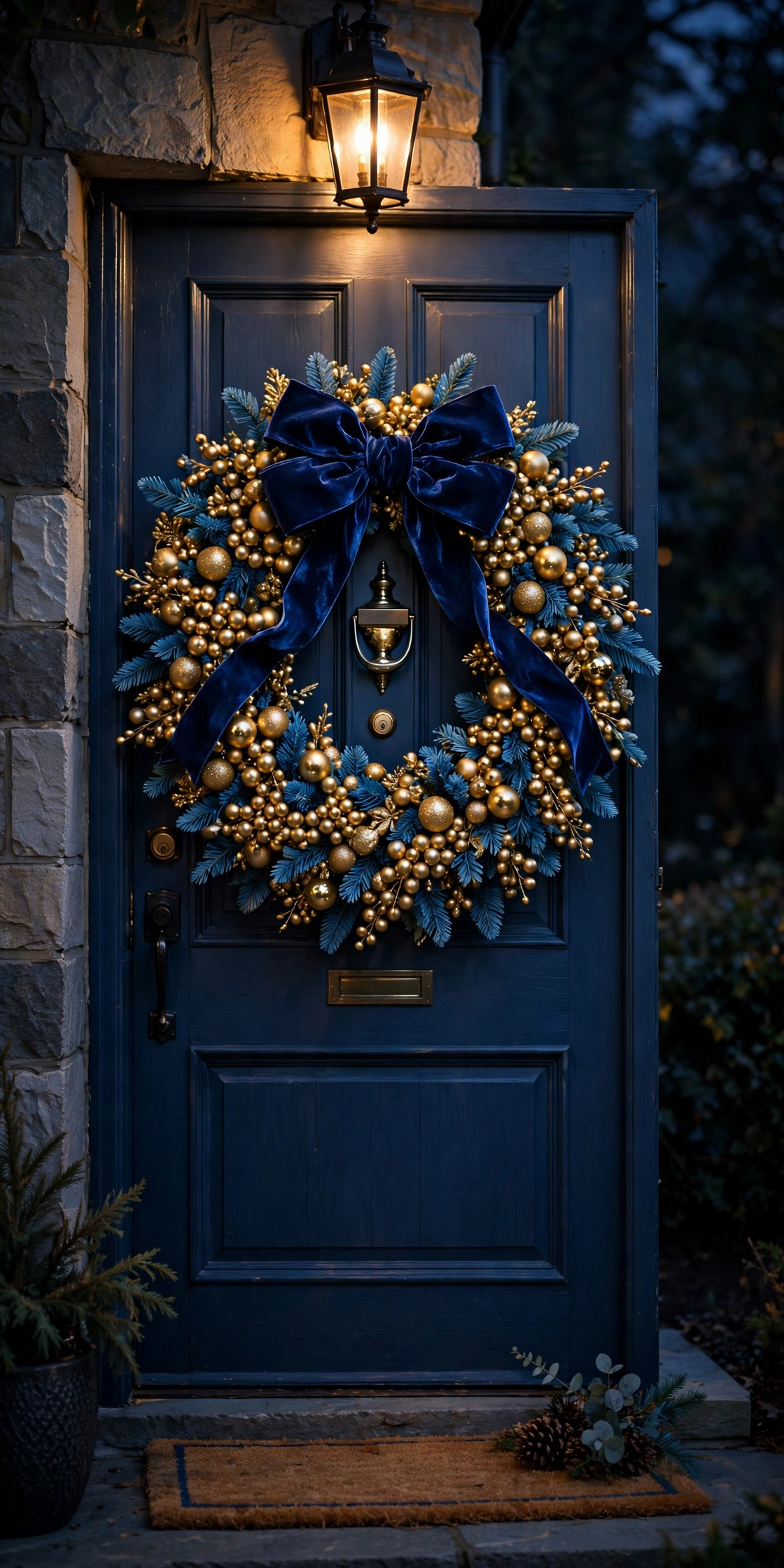
The Front Door Wreath in Blue and Gold
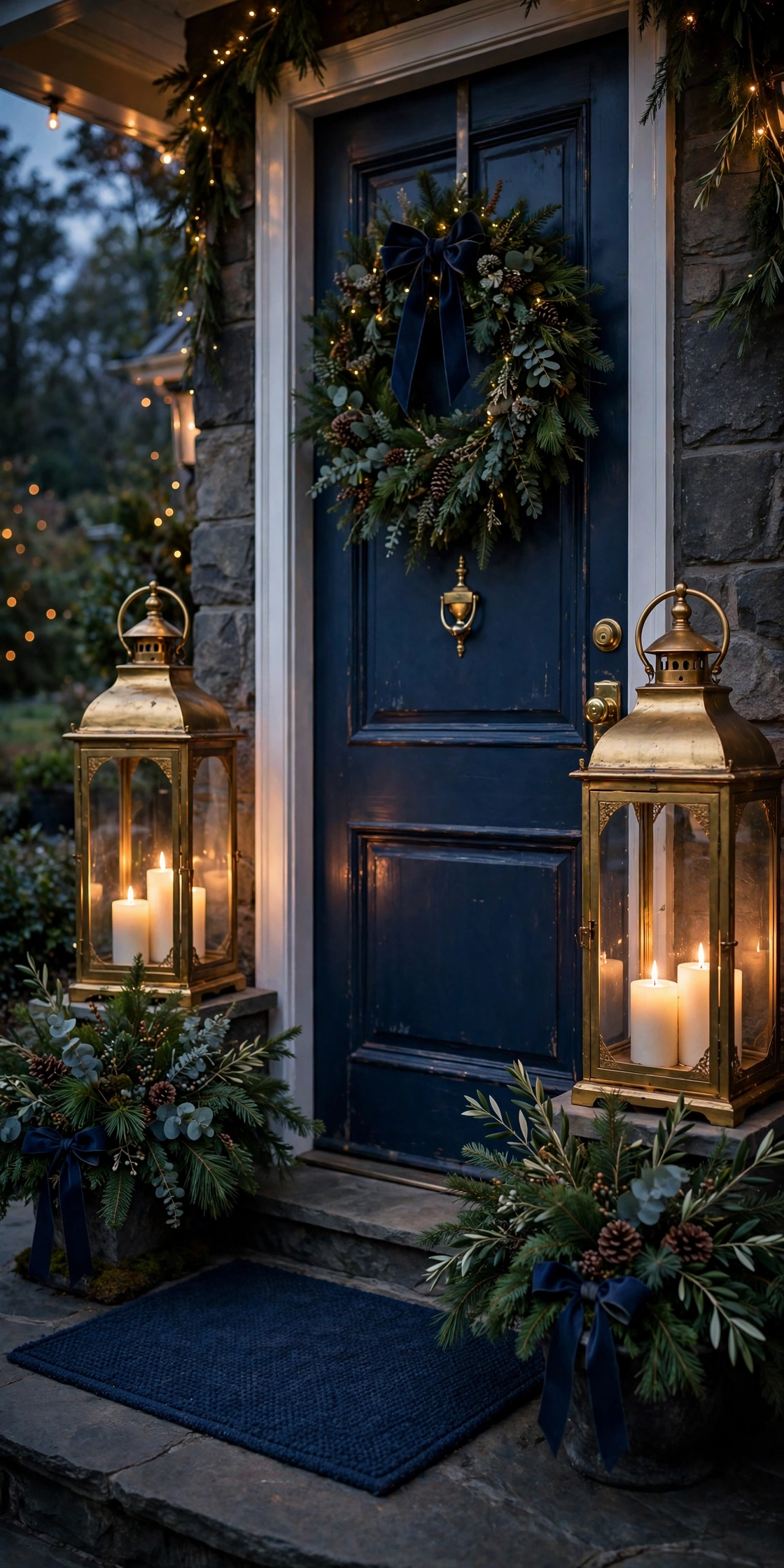
The door wreath is the palette’s handshake: a 24 to 28-inch greenery or navy ornament wreath, loaded with gold berries, small gold baubles, and one oversized navy velvet bow at the top or bottom. Size it to the door: the wreath should span about two-thirds of the door’s width to look generous instead of lost. A materials budget of $30 to $45 covers a DIY version that looks triple the price.
Try it: Check your door color before choosing the lead. Navy wreaths disappear on navy and black doors; on dark doors, lead with the gold pieces and use navy only as the bow.
24
Porch Lanterns and a Navy Welcome
Give the porch the entryway’s formula at outdoor scale: two large gold-finish lanterns flanking the door with flameless pillars inside, a navy coir door mat, and planters of greenery tied with navy ribbon. Outdoor gold finishes should be powder-coated or sealed metal; unsealed brass tones weather fast in December rain. Everything here stores in one bin and goes up in 15 minutes.
Try it: Choose solar or timer flameless candles for the porch lanterns, set to come on at dusk. A lit porch that lights itself is the difference between decor and hospitality.
25
Kitchen Touches: Cabinet Wreaths and a Gold Tray Station
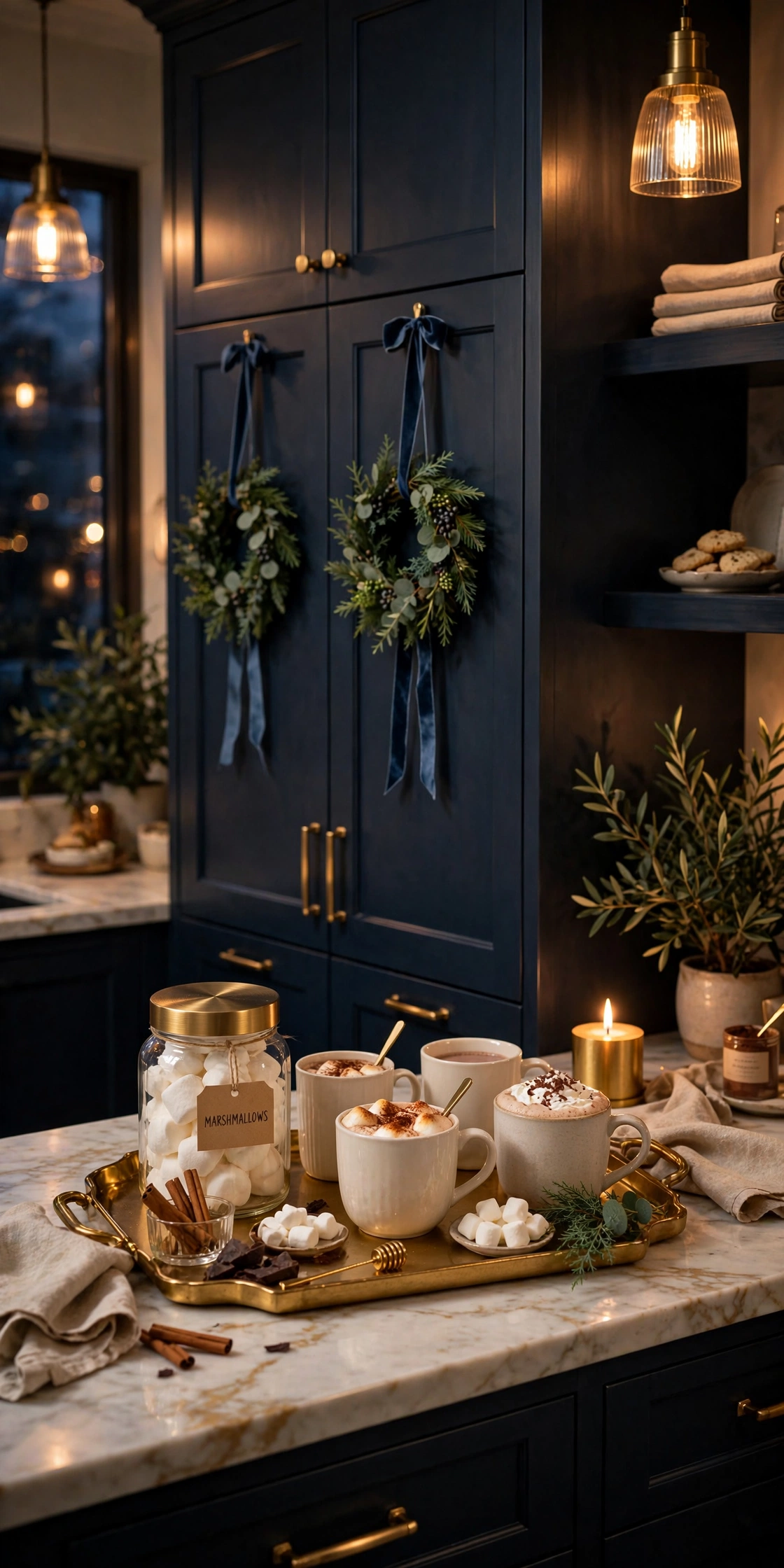
Kitchens take this palette in small, wipeable doses: mini greenery wreaths (6 to 8 inches) hung on cabinet doors with navy ribbon, and a gold tray corralling the hot cocoa station, mugs, cocoa tin, marshmallow jar, and one small navy ornament as the tray’s mascot. Nothing fabric-heavy, nothing near the stove’s heat. The whole kitchen treatment costs about $20 and comes down in five minutes.
Try it: Hang cabinet wreaths from the inside of the door with the ribbon looped over the top edge. No hardware touches the cabinet face, and the ribbon becomes part of the look.
26
Gilded Pinecones, the Luxe Filler
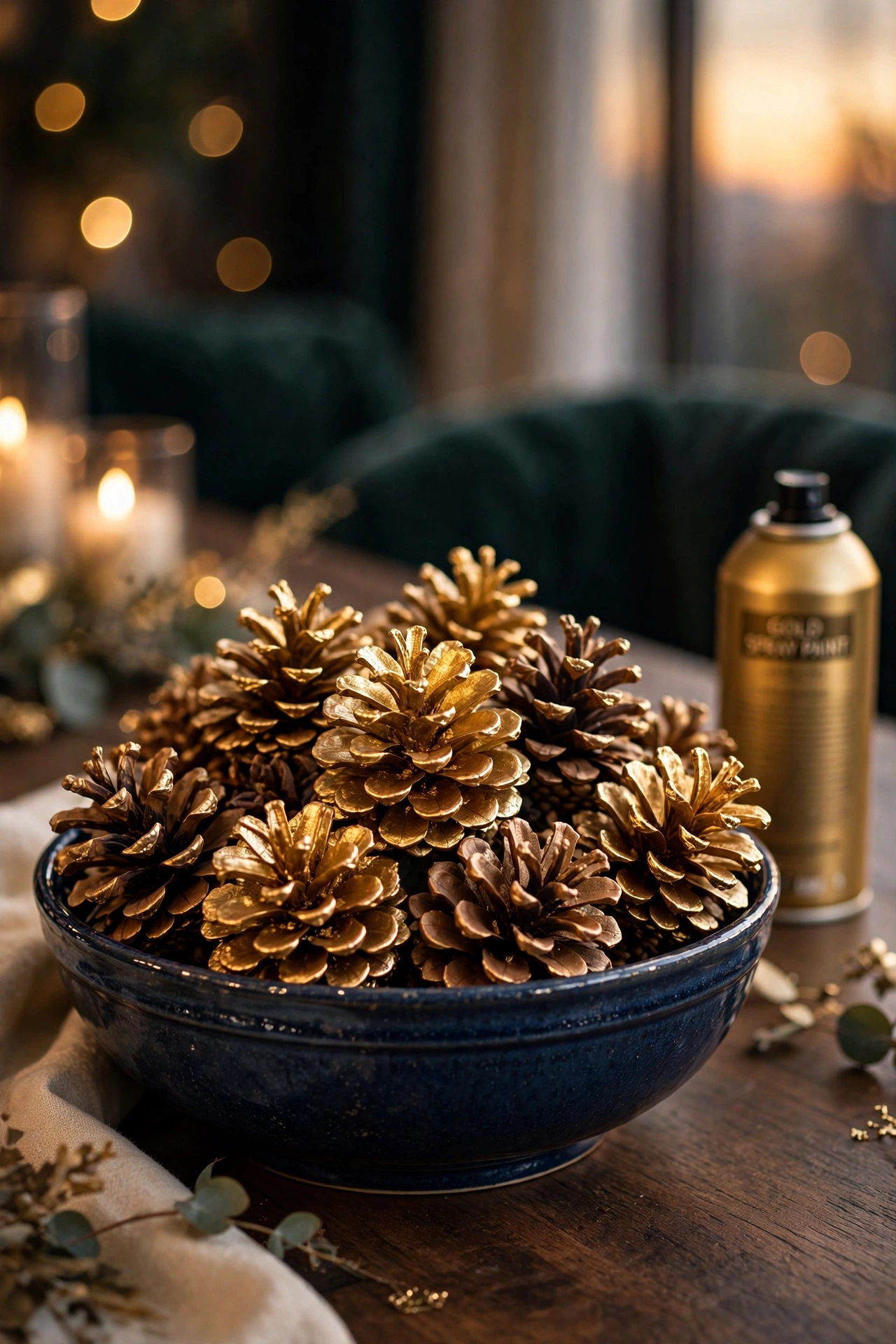
Every palette needs a cheap filler that looks expensive, and for this one it is the gilded pinecone. Collect pinecones, bake them at 200°F for 30 minutes to clean them, and spray or dry-brush them gold. They fill the spaces this palette leaves: between ornaments on the tree, along the mantel garland, piled in a navy bowl on the table, and scattered down a runner. A can of gold spray paint is $6 and covers about 40 cones.
Try it: Gild only the edges of half the cones and leave the rest natural. Full-gold cones read as ornaments; edge-gilded cones read as nature with good lighting, and the mix looks deliberate.
27
Wrapped Gifts as Part of the Palette
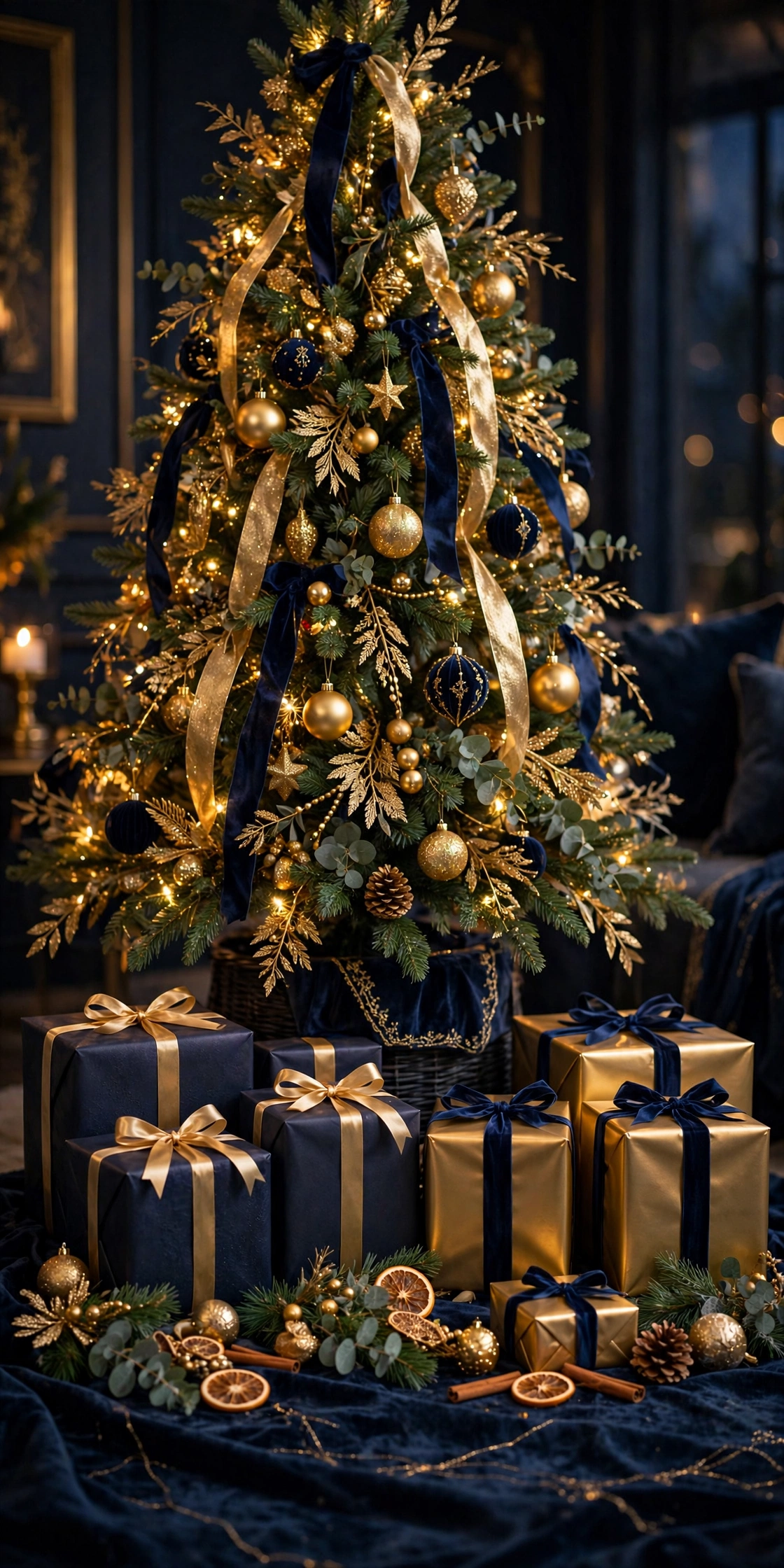
For three weeks, your wrapping is decor, so wrap in the palette: navy paper with gold ribbon, gold paper with navy ribbon, and cream as the only third paper. Coordinated gifts make the tree base look styled from day one, and empty decoy boxes wrapped early do the same job before a single real gift exists. Real ribbon, not the curling kind; in a luxe palette the ribbon is where cheap wrapping shows.
Try it: Keep one roll of each paper and ribbon in the room where you wrap. Palette discipline fails in the last week of December, at midnight, with whatever paper is closest.
28
The Warm Light Audit, Room by Room
Finish where this palette is won or lost: the light. Swap any cool white bulbs over 4000K in decorated rooms for warm white 2700K, use warm white strands on the tree (about 100 lights per foot of tree height for a full glow), and put tree and mantel lights on timers. Gold is a warm metal with a mirror’s honesty: warm light makes it look like candlelit treasure, and cool light makes it look like a clearance bin.
Try it: Photograph the finished room at night with the overheads off. Any spot that reads gray instead of glowing is a cool bulb or a missing warm light source, and one flameless candle cluster usually fixes it.
Pro tip: Do the doorway squint test before you call any room done. Stand in the doorway, squint until the details blur, and look at the balance: you should see calm blue masses with gold glowing in clusters, never gold scattered as single dots. Scattered gold reads as noise; clustered gold reads as wealth. Move three single gold pieces together and the whole room upgrades without spending a dollar.
Three rules for blue and gold decorating
- Gold is the only metal: Gold in its warm family finishes, shiny, brushed, antique, and champagne gold, plus warm brass that matches them. Silver, chrome, and cool nickel stay out of this palette completely; a second, colder metal breaks the warm spell the whole scheme depends on.
- Two blues, one lead: Navy plus exactly one partner blue, royal or sapphire, and the partner never outnumbers the lead. A third blue turns a palette into a paint aisle. If a piece does not match one of your two blues, it does not come home.
- Cluster the gold, never sprinkle it: Gold belongs in groups of three or more, on the tree, the mantel, and the table alike. Single gold items scattered through a room read as accidents; the same items grouped read as a decision, and decisions are what luxe actually is.
After Christmas: storing blue and gold
- Ornaments sorted by blue, then by finish: Pack navy and royal blue in separate labeled trays, and within each tray keep shiny, matte, and brushed finishes apart with tissue. The ratios and gradients in this list depend on knowing your exact inventory, and mixed bins guarantee a mismatched tree next year.
- Gold stored dry, with silica gel: Gold paint, gold leaf, and metallic finishes flake and dull with humidity. Wrap gold pieces in acid-free tissue, add a silica gel packet to each bin, and store in a cool, dry closet rather than a damp basement or hot attic.
- Velvet flat, ribbon spooled: Store navy velvet stockings, bows, and ribbon flat with tissue between layers, and wind ribbon back onto spools or cards so it comes out smooth. Velvet and ribbon are half this palette’s texture; creased, they make next year’s tree look tired before it starts.
More ideas you’ll love: blue and silver christmas decor ideas, red and gold christmas decor ideas, christmas dining room decor ideas, christmas living room decor ideas, and more in the Christmas Decor category.
Questions readers ask
What colors go with blue and gold Christmas decor?
Cream and warm white are the main partners: they give your eye a rest and keep navy from closing the room in. Natural greenery is the second partner, since green is the color both blue and gold already expect at Christmas. Avoid silver and chrome, which cool the gold down, and avoid red accents, which push the scheme toward a flag instead of a jewel box.
How do I decorate a blue and gold Christmas tree?
Work in layers: warm white lights first, then gold garland woven deep and gold ribbon cascading from the crown, then ornaments in a 60/40 blue-to-gold split with the largest pieces placed first and the biggest gold at eye level on the outer branches. Finish with a gold topper sized to about one-tenth of the tree’s height. A 7.5-foot tree takes roughly 100 ornaments for a full, luxe look.
Which blue works better for Christmas, navy or royal blue?
Navy is the workhorse: it reads almost like a neutral at night, hides dust, and pairs with every gold finish from shiny to antique. Royal blue is the energy color, brighter and more jewel-like, best as the lead in well-lit rooms or the partner shade in navy-led rooms. If you are buying one blue, buy navy in the big pieces and royal in the small shiny ones.
Can I mix gold with brass in Christmas decor?
Yes, as long as the brass is warm and antique rather than bright and yellow-green. Brass and antique gold sit in the same warm metal family and blend seamlessly, especially in candlelight. What you cannot add is a cool metal: silver, chrome, and polished nickel clash with gold’s warmth and split the room into two competing schemes.
How do I keep blue and gold decor from looking gaudy?
Control the shine ratio: for every shiny gold piece, include a matte, brushed, or velvet piece nearby. Cap glitter at about a quarter of your gold pieces, cluster gold in groups of three or more instead of sprinkling singles, and light everything warm. Gaudy is almost never about the colors; it is about all-shine, all-scattered, and cool light.
What color lights work best with blue and gold?
Warm white, around 2700K, everywhere, no exceptions in this palette. Gold is a warm-toned metal, so warm light completes it and makes navy read rich and deep. Cool white light over 4000K makes gold look brassy and cheap and flattens navy to gray-blue. Put the main lights on timers so the room glows on schedule every evening, and follow holiday lighting safety basics with every strand you hang.
Does blue and gold work in a small room?
Yes, and it can work better than warm palettes do. Navy recedes visually, so walls and large pieces in navy make a small room feel calm and deep, while clustered gold reflects warm light and keeps it from feeling dark. Concentrate the scheme: one fully decorated slim or tabletop tree, a dressed shelf or mantel, and textiles doing the rest, with surfaces kept clear.
Is blue and gold a classic Christmas palette or a trend?
It is a classic with deep roots: gold leaf and deep blue have been paired in holiday and religious art for centuries, and the combination returns every generation because it copies candlelight against a winter night sky. Buy good navy and gold pieces and they will outlast trend cycles; the accessories change, the palette does not.
People Also Ask
Can I use blue and gold Christmas decor outside?
Yes. Navy reads clearly at a distance, which makes it one of the best door and wreath colors, and gold lanterns and powder-coated gold finishes handle a season outdoors well. Use outdoor-rated lights and shatterproof ornaments, weight planters against wind, and store gold finishes dry in January so the coating survives to next year.
How do I get the blue and gold look on a small budget?
Start with light and textiles: warm white bulbs, two navy pillow covers, and one gold-thread throw transform a room for about $45. Then use gold spray paint ($6 a can) to gild pinecones, thrift-store candlesticks, and old ornaments you already own. Buy navy and gold ornaments in the January sales and the palette builds itself year by year.
My room already has silver fixtures. Can I still do blue and gold?
Yes, because fixtures are architecture, not decor. Light fixtures, cabinet hardware, and curtain rods in a cool metal read as part of the house, and nobody counts them against the palette. Keep every decorative metal, ornaments, frames, candlesticks, chargers, gold, cluster the gold where eyes rest, and the silver hardware will simply disappear into the background.
loved these ideas? ✿
Save this guide for later
Pin it to your board so it’s there when you’re ready to recreate it.

Curated by
Hey! I'm Sanaullah — visual curator and content creator. I search, curate, and test the best aesthetic ideas across Pinterest so you can easily transform your living space, style daily outfits, and try simple creative DIYs without the overwhelm.