

Your living room might be small, but your Christmas does not have to be. The secret is scale: every one of these small living room christmas decor ideas is sized for tight square footage, hung on walls, or doubled up on furniture you already own. You will get the tree, the glow, and the cozy layers without losing a single walkway. Follow this guide and your small room will feel like the most festive seat in the house.
Quick Idea Summary
- The key takeaway: Decorate up, not out. Walls, windows, shelves, and the space above furniture carry Christmas in a small room; the floor stays clear for people.
- The detail most people miss: Declutter before you decorate. Removing three everyday objects makes room for ten Christmas ones, and the swap is what keeps the room calm instead of crowded.
- What it costs or how long it takes: Most ideas below cost $10 to $40 and take under 30 minutes. A full small-room transformation fits into one afternoon and under $150.
At a glance
| Zone | Ideas | Budget |
|---|---|---|
| The tree, scaled down | 01–06 | $20–$80 |
| Walls and windows | 07–12 | $10–$45 |
| Shelves and surfaces | 13–18 | $10–$50 |
| Seating and textiles | 19–24 | $15–$60 |
| Light and the illusion of space | 25–29 | $10–$40 |
| No-floor-space fixes | 30–35 | $10–$45 |
The ideas
01
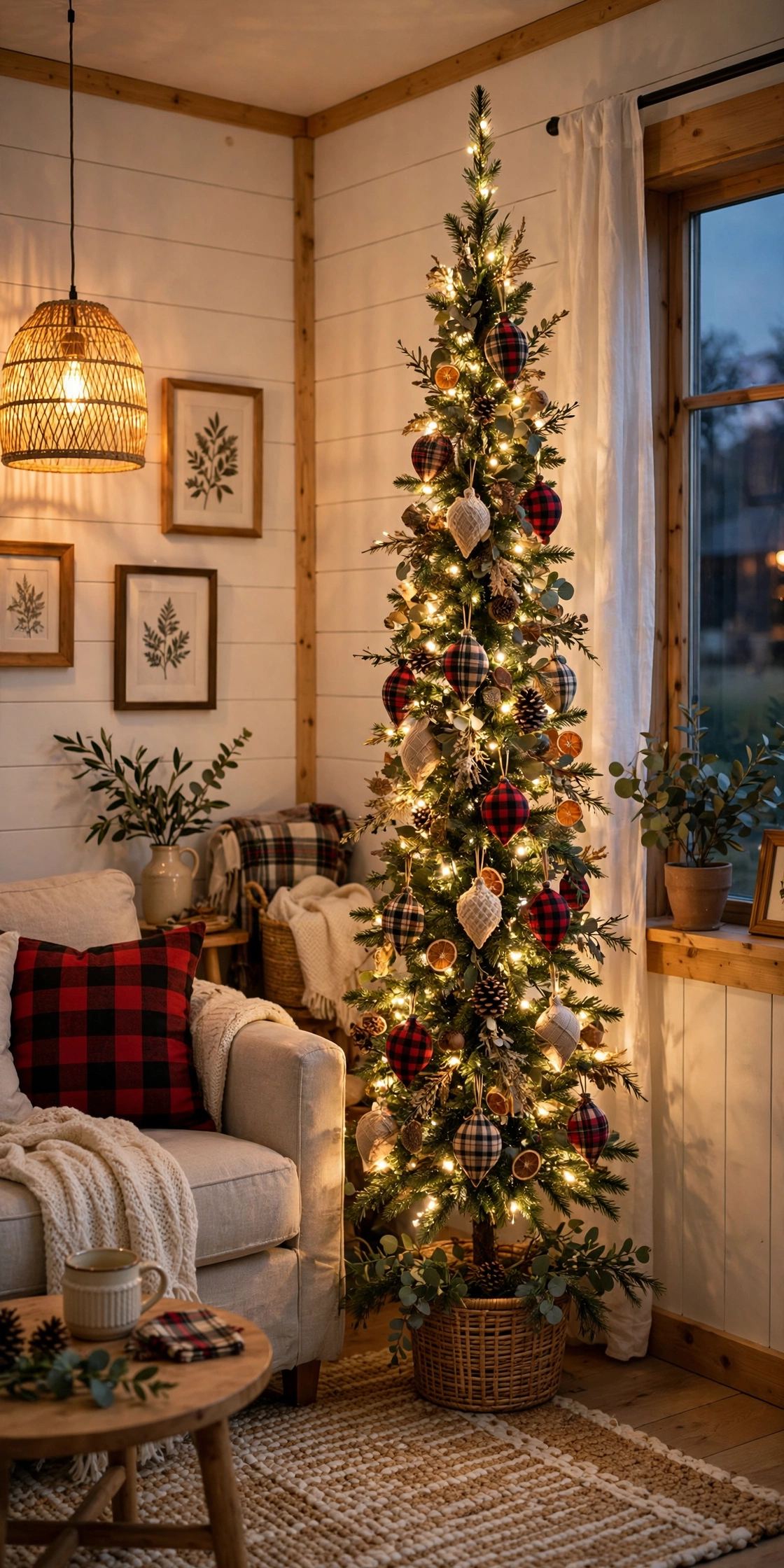
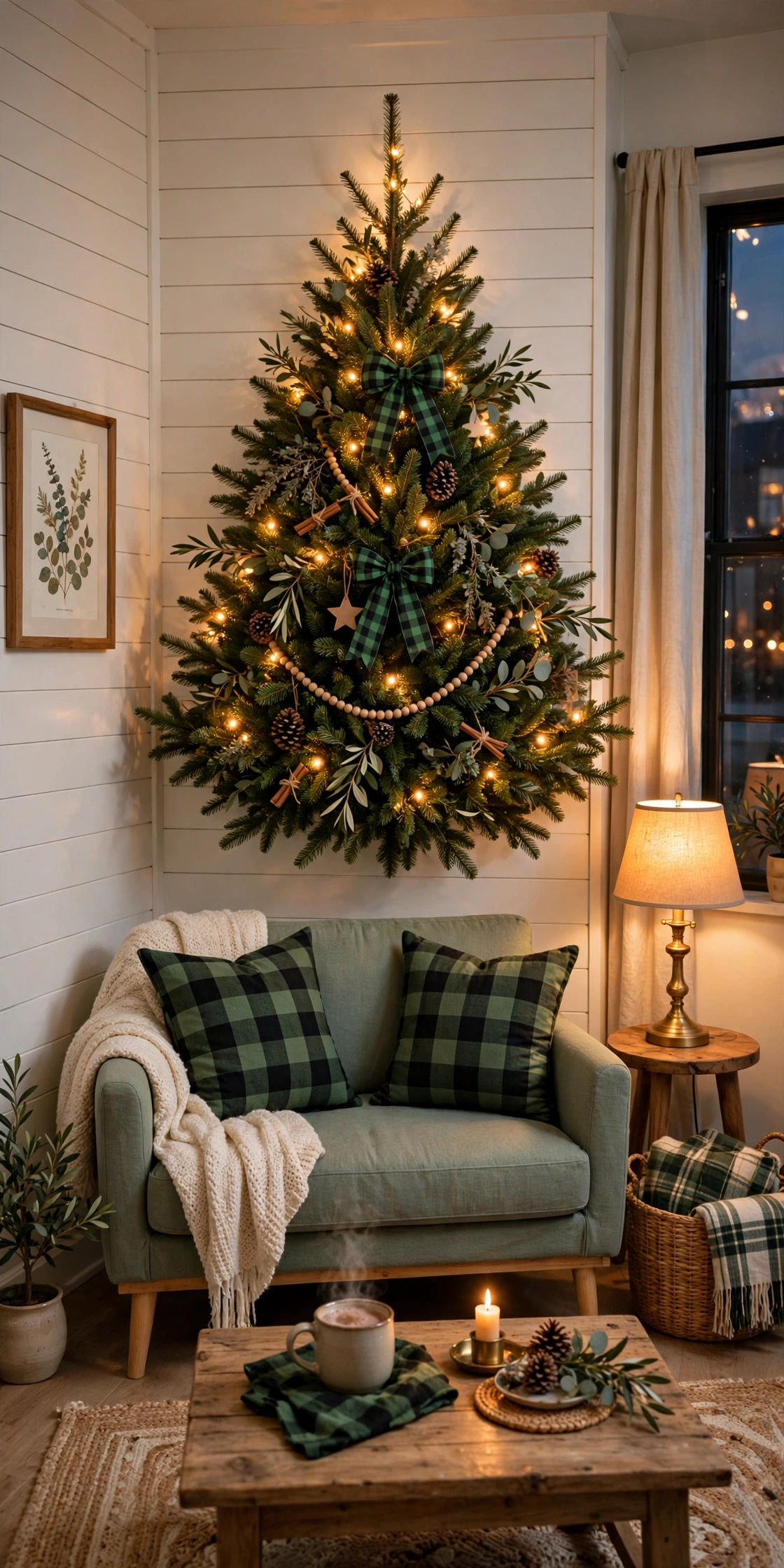
A Slim Pencil Tree in the Corner
A full tree eats 12 square feet of floor; a pencil tree needs less than 3. Choose a 6 to 7 foot slim tree 24 to 30 inches wide, tuck it into the corner diagonal from the door, and keep 36 inches of walkway clear in front of it. Height does the festive work here, not width.
Try it: Leave 6 to 12 inches between the topper and the ceiling. A tree that nearly touches the ceiling makes the whole room feel taller.
02
A Half Tree Against the Wall
A flat-back half tree gives you a full tree from every seat and a stump from nobody’s. It sits flush against the wall, so a 6 foot tree takes under 18 inches of depth. Look for branch density above 700 tips so the front still reads lush.
Try it: Concentrate your best ornaments on the front hemisphere. You need roughly 40 percent fewer ornaments than a full tree for the same effect.
03
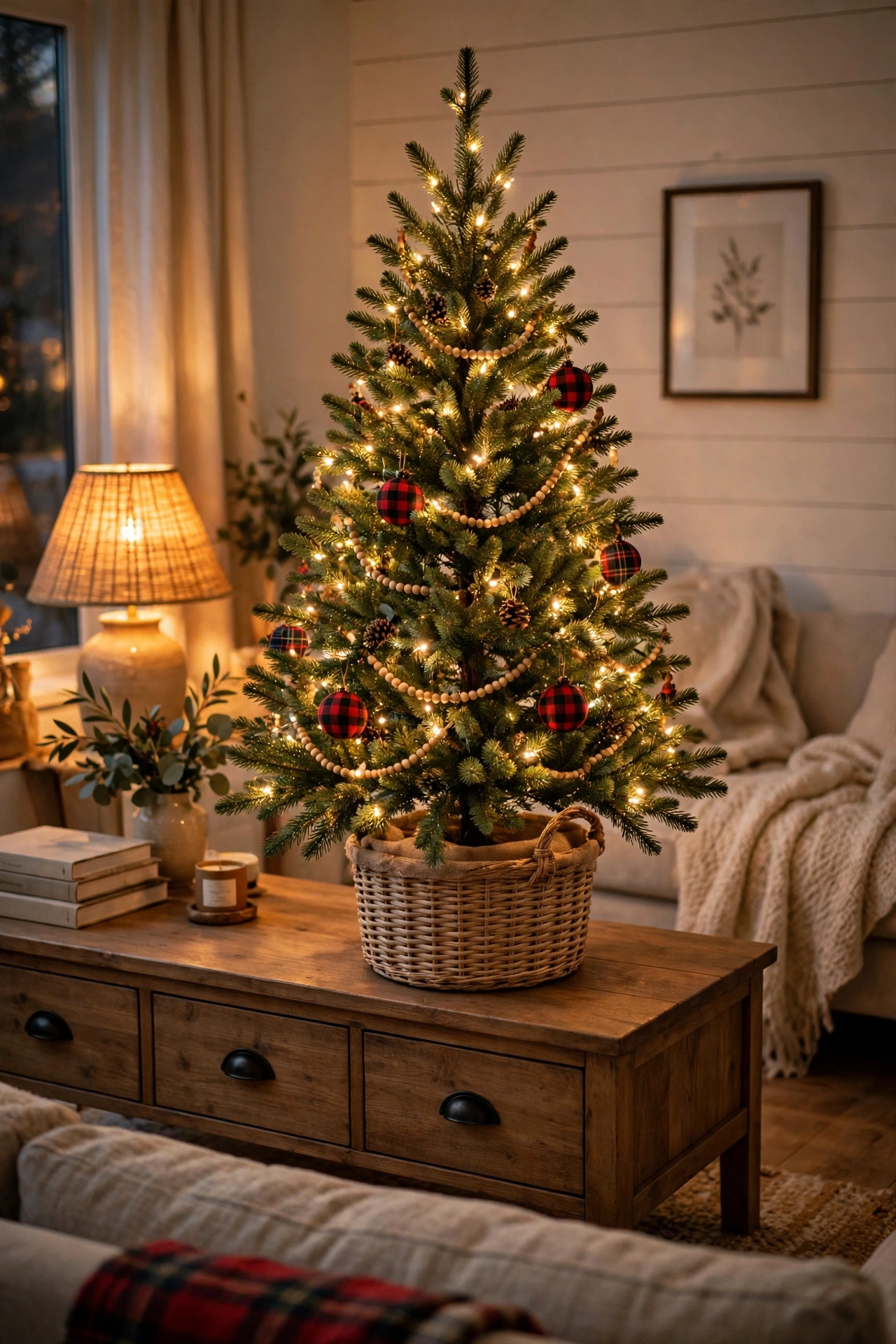
A Tabletop Tree on the Cabinet
When the floor is fully spoken for, put the tree on furniture. A 3 to 4 foot tabletop tree on a sideboard, media console, or sturdy stool lifts the tree to eye level and frees the floor completely. Set the base in a crock, basket, or galvanized bucket so it reads as a styled piece, not an afterthought.
Try it: Anchor the tree to the wall behind it with one clear fishing line loop. Tabletop trees on cabinets are the first thing a curious cat tests.
04
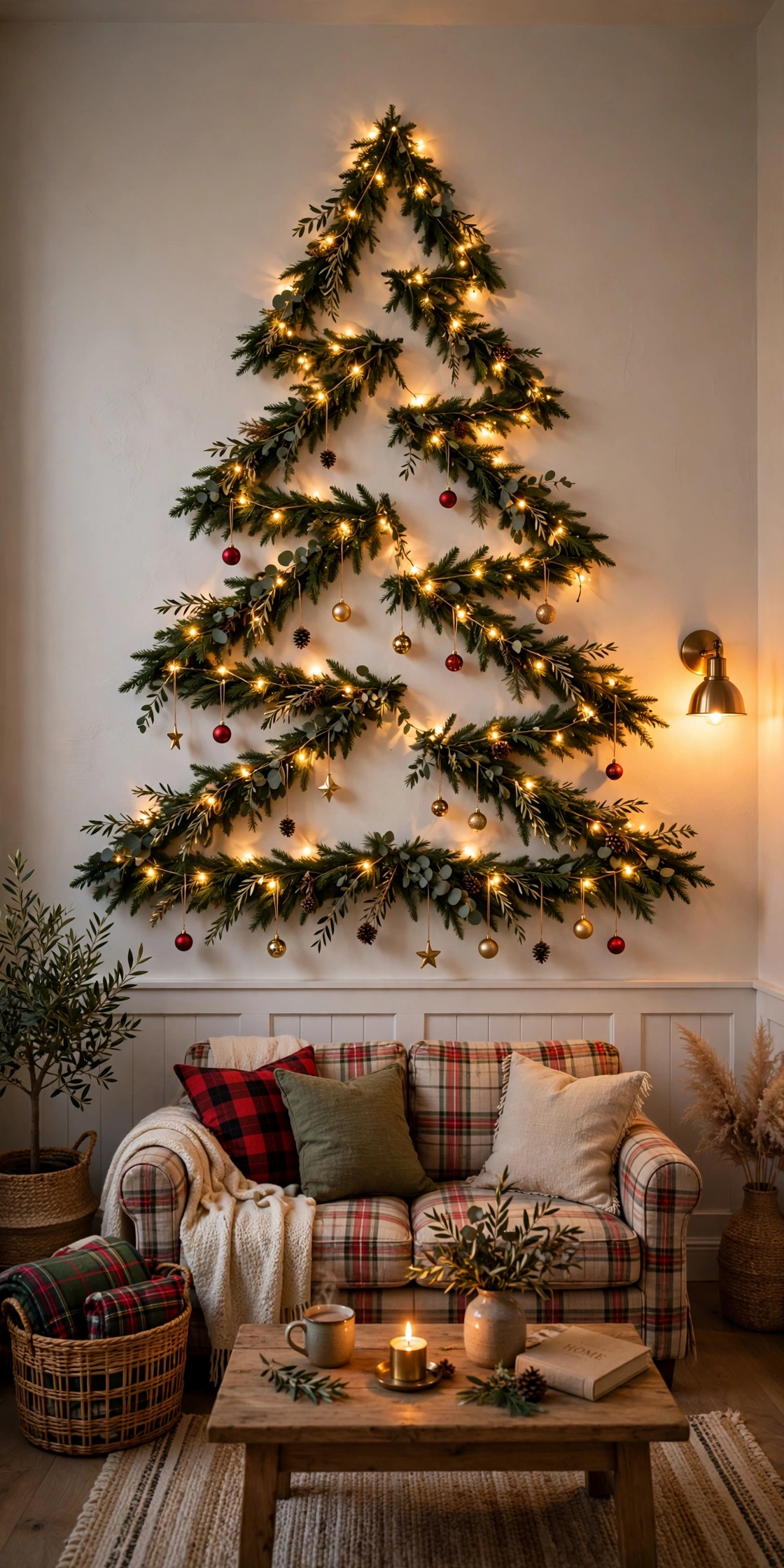
A Wall Tree Made of Garland and Lights
No floor at all? Build the tree on the wall. Shape a zigzag of green garland into a triangle on the one blank wall, weave in a 20 foot strand of warm white lights, and hang 15 to 20 lightweight ornaments from the branches. Total cost is around $25 and the whole display stores in one shoebox.
Try it: Use clear removable hooks every 12 inches along the outline. Garland sags in the middle of long runs, and the sag is what makes wall trees look homemade.
05
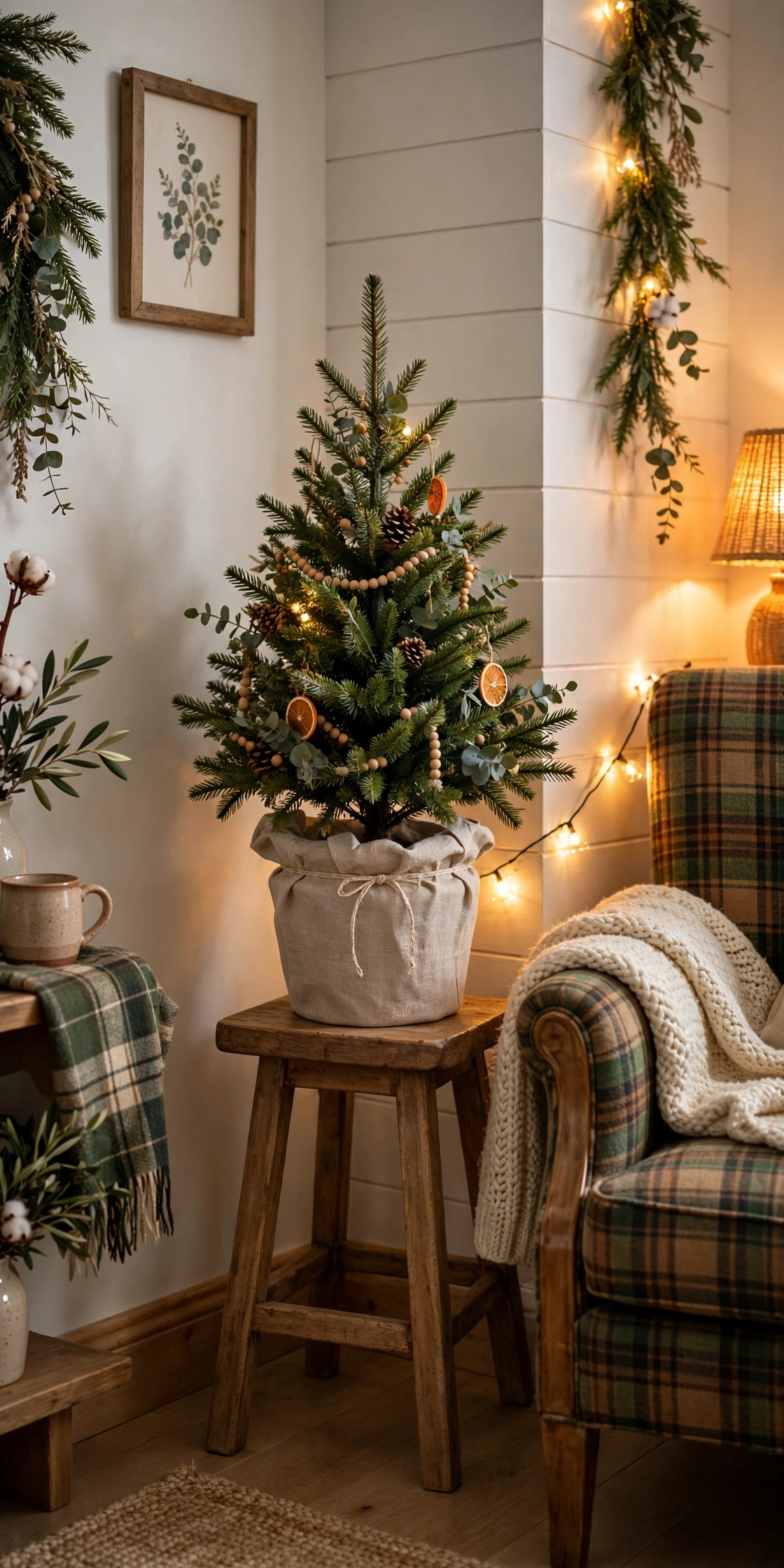
A Mini Tree Raised on a Stool
A 2 foot mini tree looks lost on the floor and perfect at chair height. Set it on a stool, a storage cube, or a stack of two vintage suitcases in the corner and wrap the base in linen or burlap. Raising the tree puts the lights in the room’s sightline, which is where small rooms need them.
Try it: Choose a stool or cube with storage inside. In December it holds the tree; in January it holds the tree’s decorations.
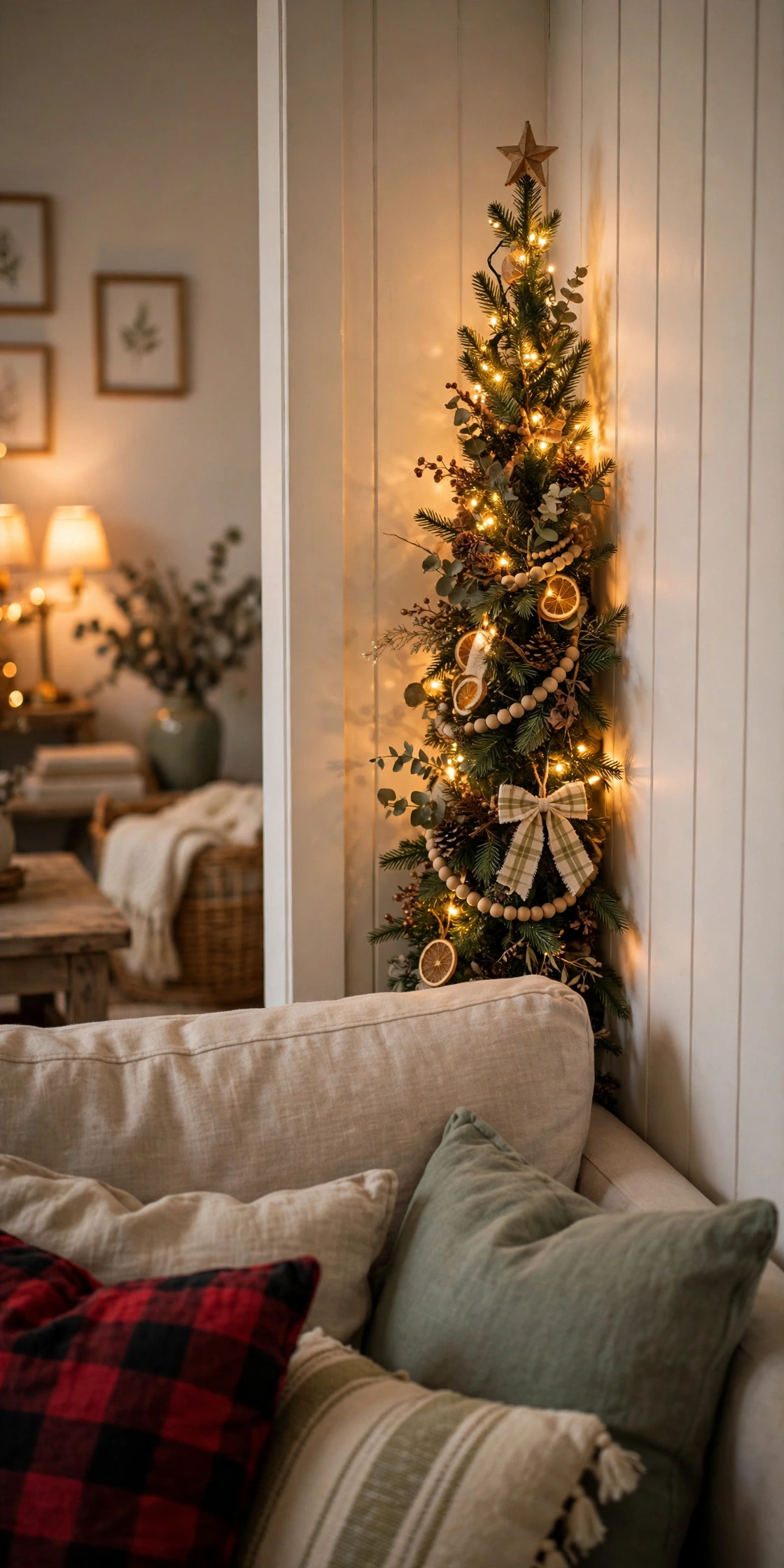
06
The Sofa-Gap Tree
Most small living rooms hide 10 to 14 unused inches between the sofa end and the wall. Measure that gap before you buy anything: a slim tree 20 inches wide fits gaps most people assume are useless. The sofa arm hides the stand, so only the decorated top half shows.
Try it: Pull the sofa 2 inches forward if the gap is tight. Two inches of room depth traded for a full tree corner is the best exchange in small-space decorating.
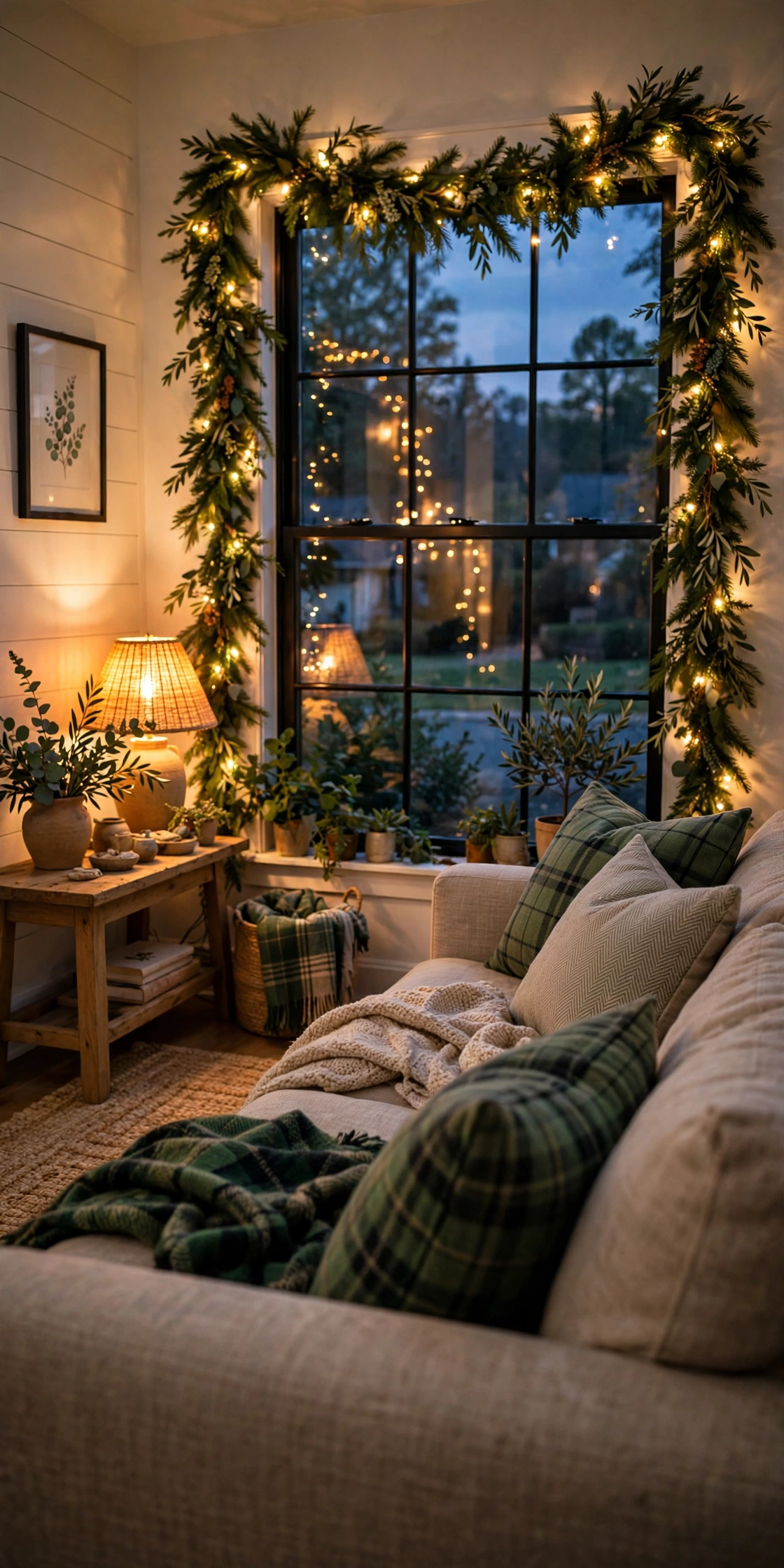
07
Garland Around the Window Frame
Framing the window with garland turns the room’s biggest light source into its biggest decoration. Run a 9 foot pre-lit garland around the inside of the frame with clear clips, and the window glows like a shop display after dark. It costs zero floor space and zero surface space.
Try it: Put the garland on a timer set for dusk. A lit window frame makes a small room feel twice as deep from the sofa.
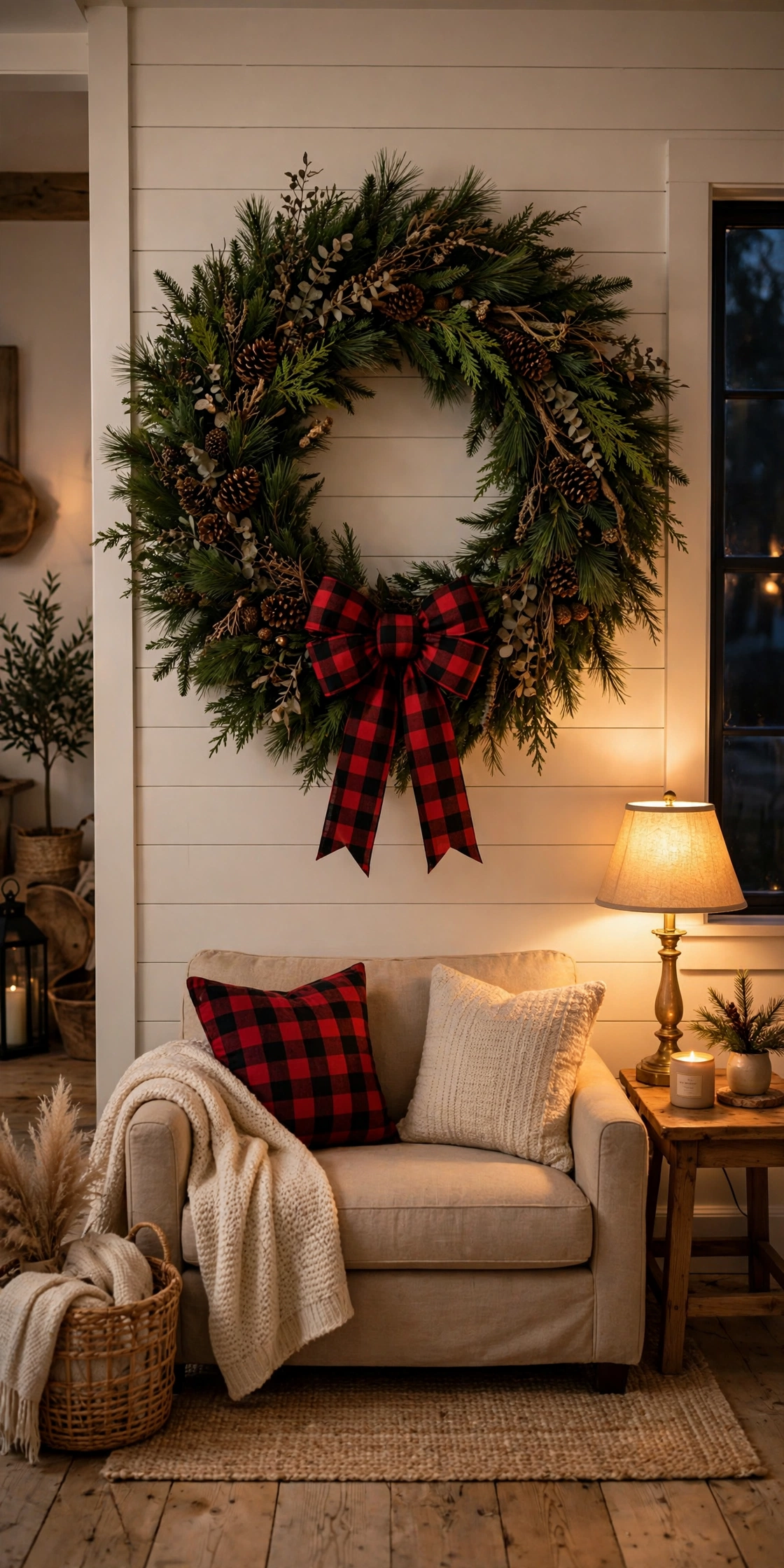
08
One Oversized Wreath Above the Sofa
In a small room, one big piece beats ten small ones. A single 30 to 36 inch wreath centered above the sofa becomes the room’s anchor and replaces the gallery wall for December. Oversized reads intentional; a cluster of small wreaths reads as clutter at this scale.
Try it: Hang it so the bottom of the wreath sits 8 to 10 inches above the sofa back. Lower crowds the people sitting under it; higher detaches it from the furniture.
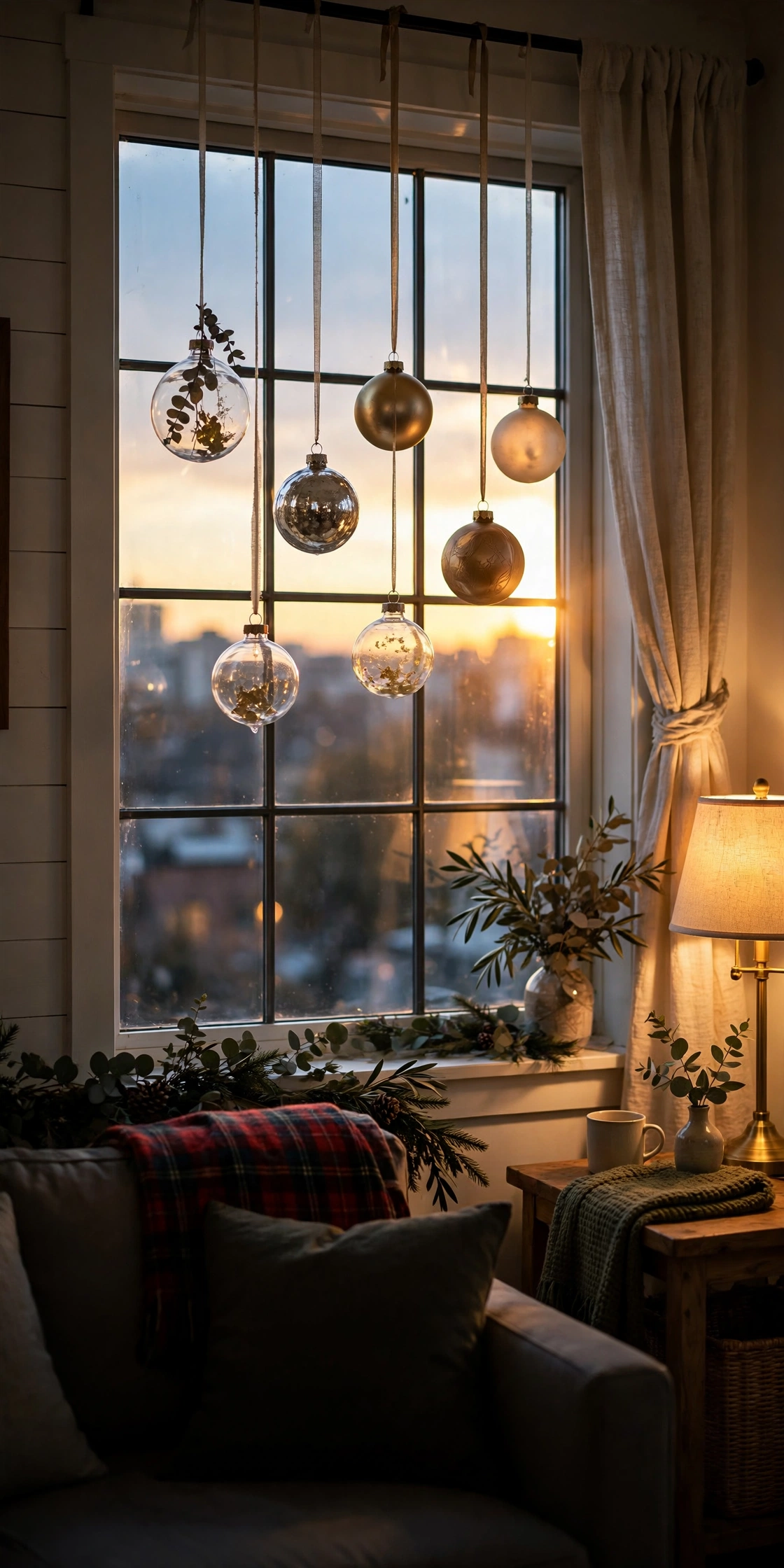
09
Ornaments Hanging in the Window
Suspend 7 to 9 ornaments at staggered heights in the window on clear fishing line or thin ribbon. They catch daylight all day, glow against the tree lights at night, and occupy a plane of space nothing else uses. Glass and metallic finishes bounce the most light into the room.
Try it: Hang the longest ornament at one-third of the window height, not the middle. The off-center low point is what makes the arrangement look designed.
10
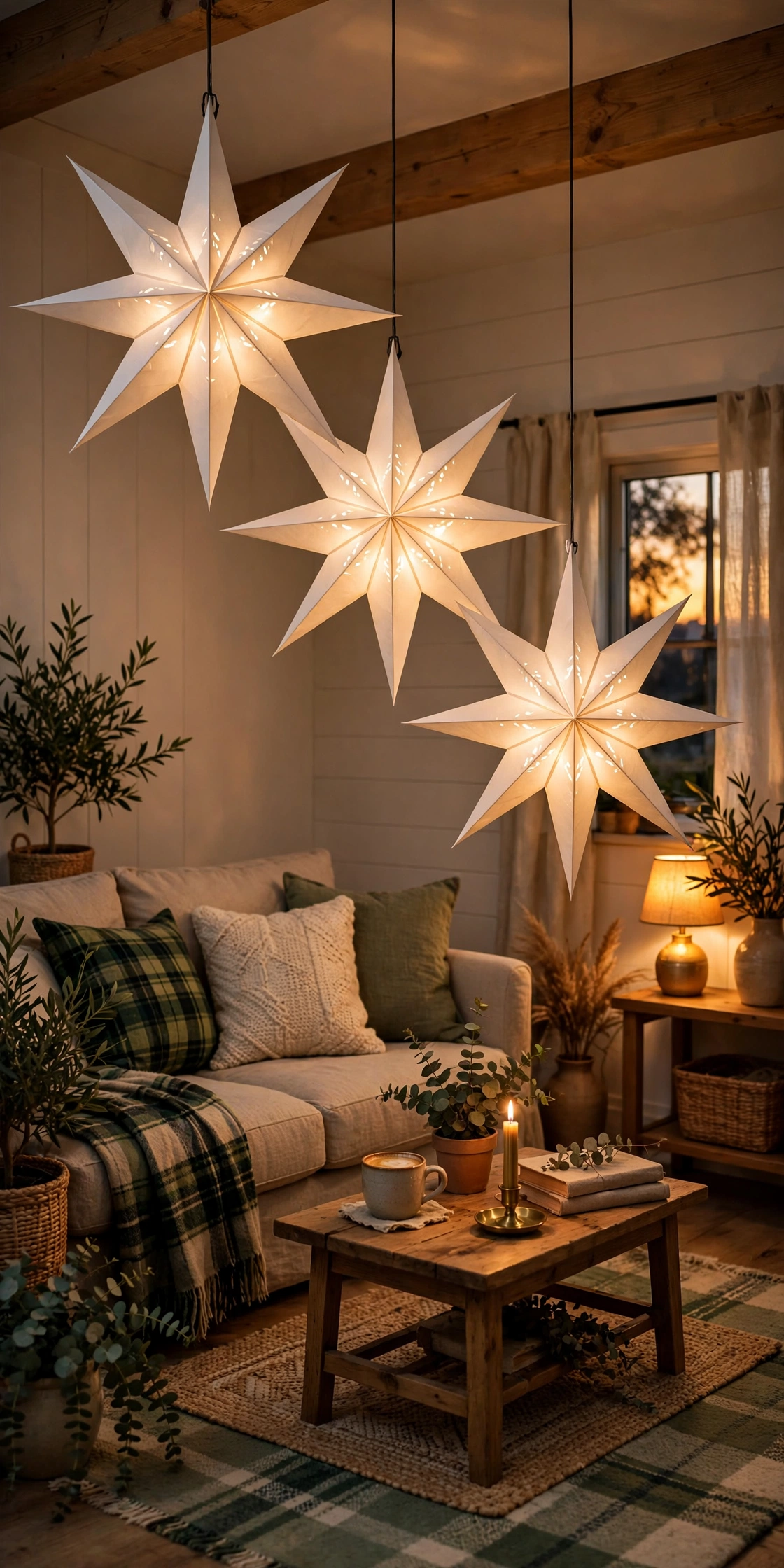
Paper Stars From the Ceiling
Three oversized paper star lanterns hung at different heights fill the dead air above the coffee table with zero footprint. Stars 18 to 24 inches across cost $8 to $15 each, fold flat in January, and their warm bulb glow flatters everything under it. Keep the lowest star at least 6 feet 6 inches off the floor so sightlines stay open.
Try it: Hang stars over the coffee table and seating, never over walkways. Guests should see them, not duck under them.
11
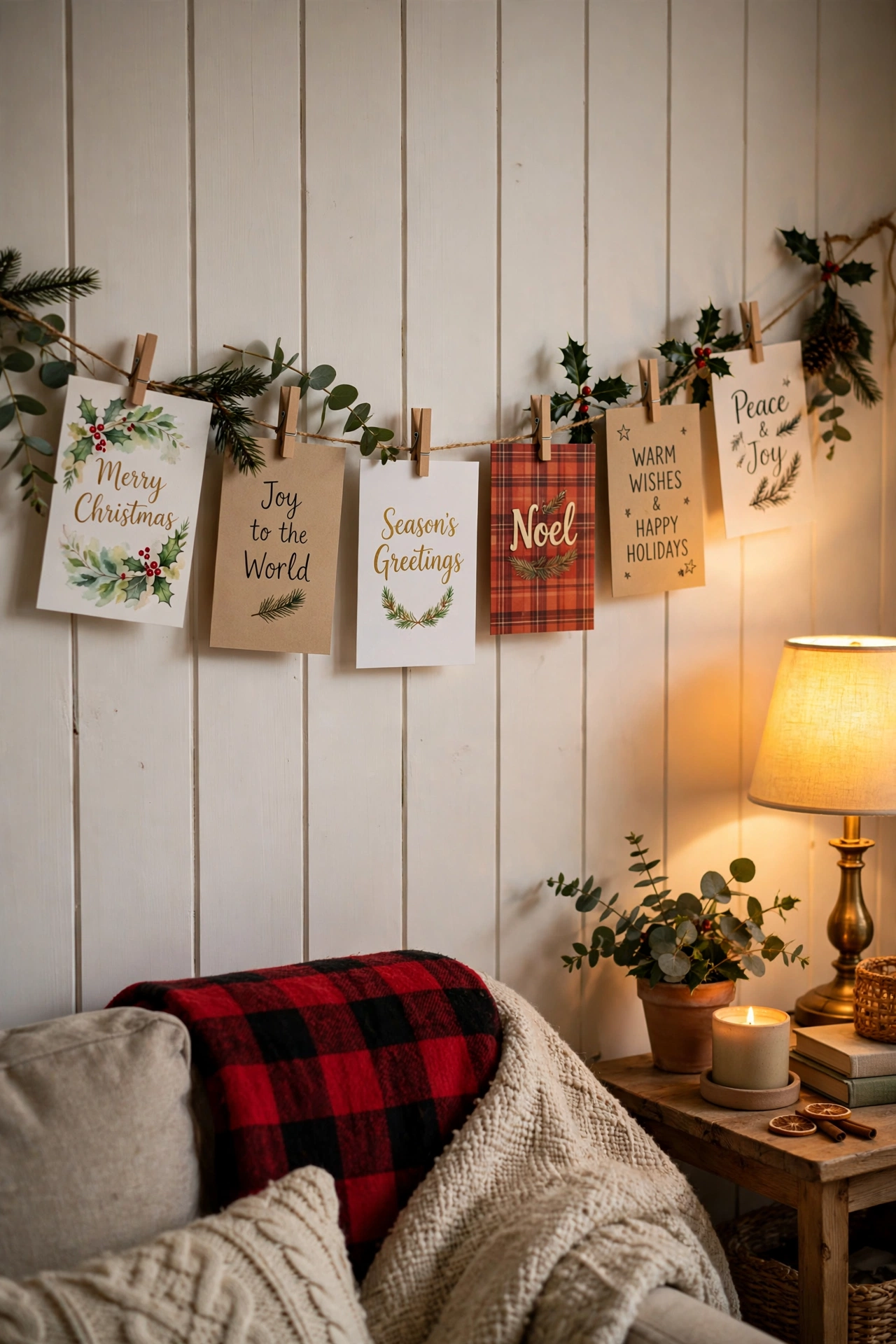
A Holiday Card String on the Wall
Cards pile up on the one surface a small room cannot spare. Clip them to a 6 foot length of twine strung between two removable hooks and they become a garland that costs nothing and means something. One string holds 20 to 25 cards without overlapping.
Try it: Start the string in early December with five cards and let it fill. A display that grows all month feels like an event, not a chore.
12
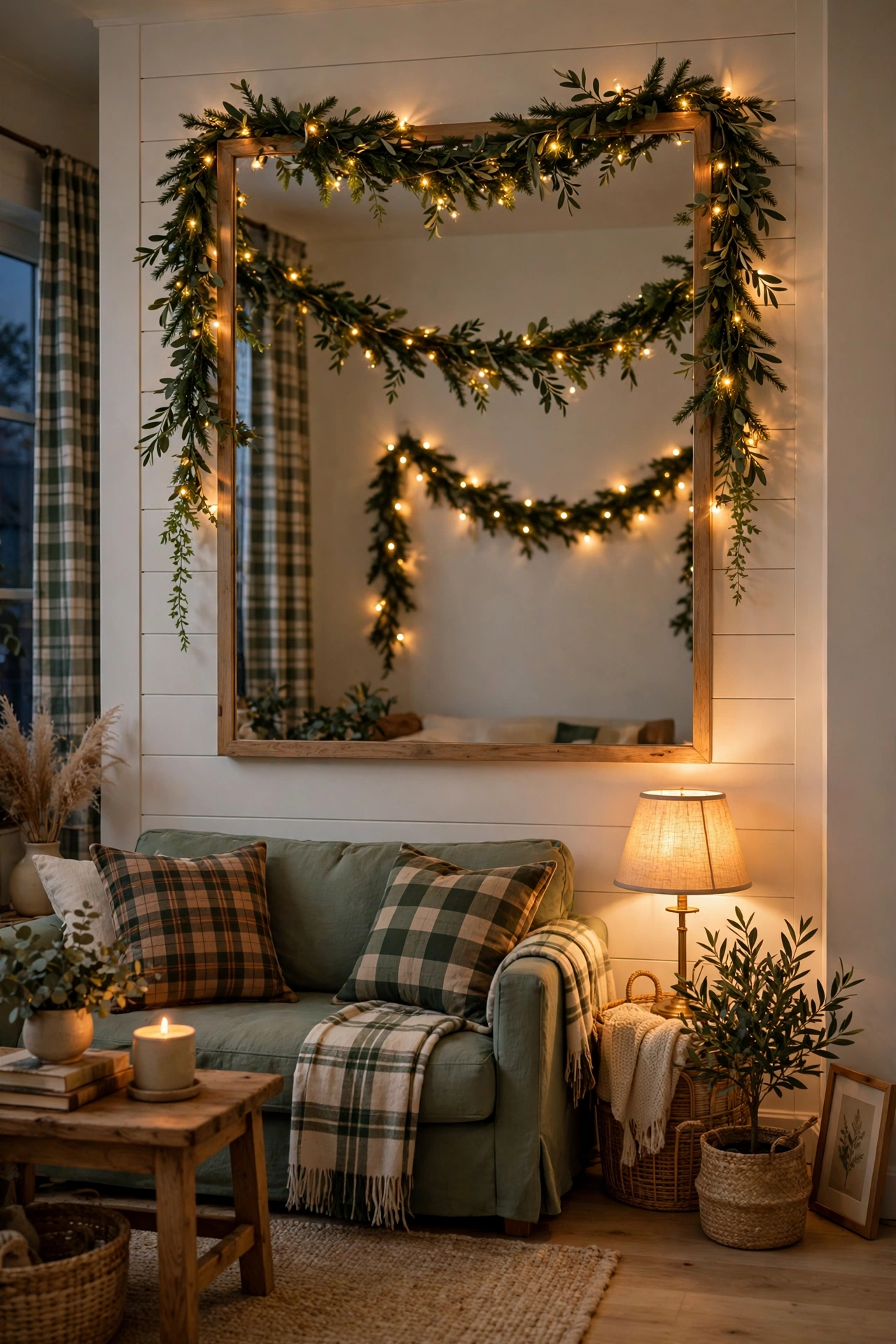
Garland Over the Mirror
If your small room has a mirror, decorate it first. A slim garland draped across the top doubles itself in the reflection, so one 6 foot garland does the work of two. The mirror also throws the tree lights back into the room, adding depth a small space desperately needs.
Try it: Keep the garland slim, 4 inches of profile or less. A fat garland swallows a mirror’s top edge and blocks the reflection you are decorating for.
13
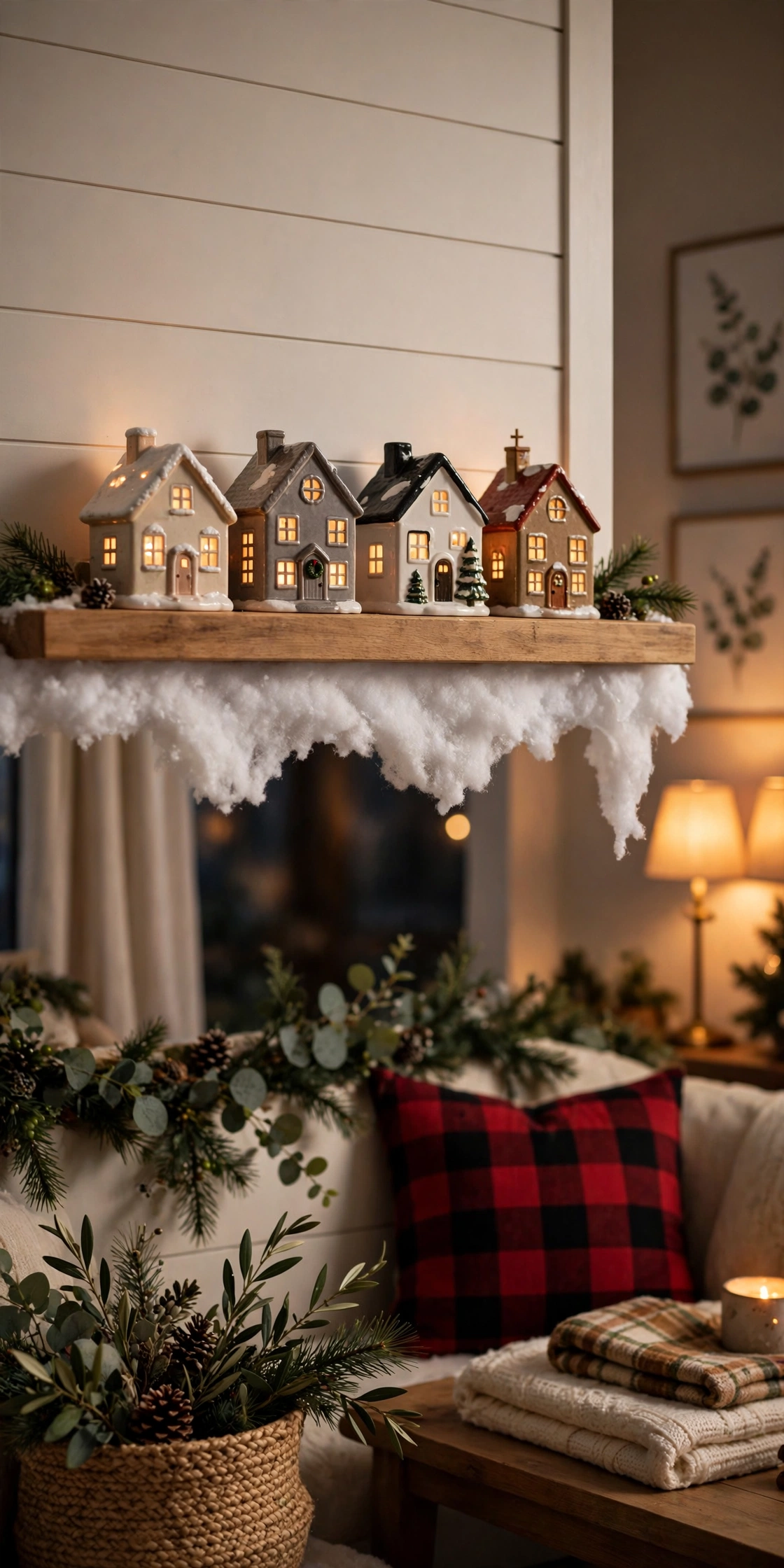
A Mini Village on One Floating Shelf
A Christmas village usually demands a table you do not have. Line up 3 to 5 houses from one collection on a single floating shelf or bookcase top over a strip of faux snow fabric, and the whole scene takes 24 inches of wall. One straight line reads styled; pieces scattered across surfaces read as clutter.
Try it: Add one battery tea light inside each house. Five glowing windows at dusk do more for a small room than a second tree would.

14
The Console Under the TV as a Mantel
No fireplace means no mantel, so promote the TV console. Run a slim garland along its top edge, stand 3 candlesticks at one end, and lean one framed holiday print at the other. The wall behind the TV is the wall everyone already faces, which makes it the highest-value decorating surface in the room.
Try it: Keep console decor under 10 inches tall. Anything taller fights the screen for attention and loses.

15
A Tray-Sized Coffee Table Display
A small coffee table gets exactly one display: a tray. On it, group one candle, one small stack of holiday books, and one bowl of ornaments or pinecones, and stop. The tray corrals the decor into 18 inches, lifts off in one move for movie night snacks, and keeps the rest of the table usable.
Try it: Size the tray to cover no more than one-third of the table. More than that and the table stops functioning, which is when small rooms start to feel chaotic.
16
Bookshelves Dressed in Rows
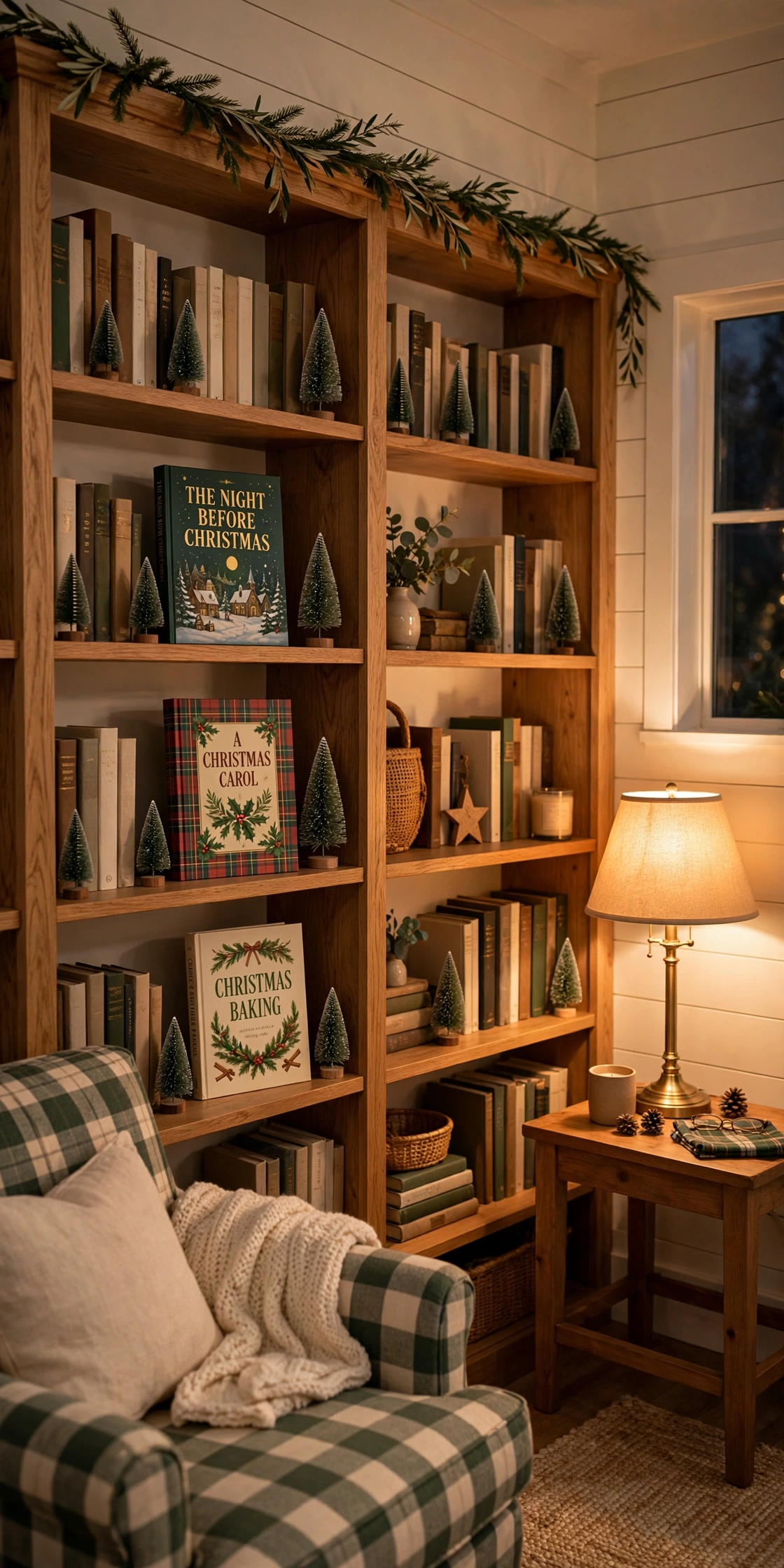
Bookshelves are built-in vertical storage, so decorate them like it. Tuck bottle brush trees 4 to 8 inches tall between books, run one slim garland along the top shelf only, and turn a few Christmas book covers face-out. Every shelf gets one touch, not a scene.
Try it: Repeat one color of bottle brush tree on every shelf. The repetition makes separate shelves read as one designed unit.
17
Pillow Covers, Not New Pillows
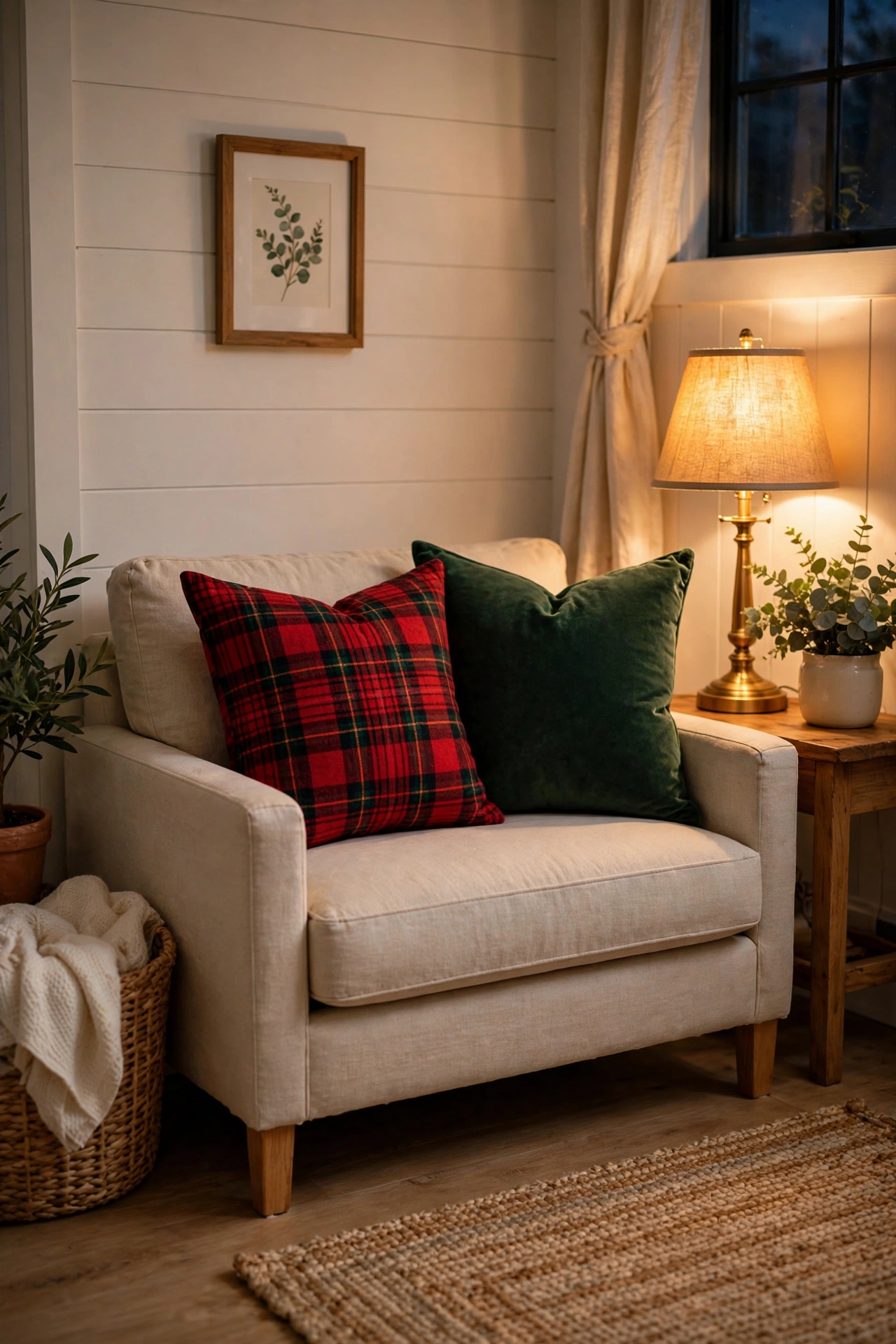
Storage for bulky Christmas pillows does not exist in a small home, but pillow covers fold into a drawer. Swap the covers on your two best sofa pillows for plaid, velvet, or embroidered ones for about $20, and keep the everyday inserts inside. Two covers transform the sofa; four overwhelm it at this scale.
Try it: Mix one plaid with one solid in a color pulled from the plaid. Two patterns plus the sofa fabric is the busyness limit for a small seating area.
18
A Folded Throw Stack on the Sofa Arm
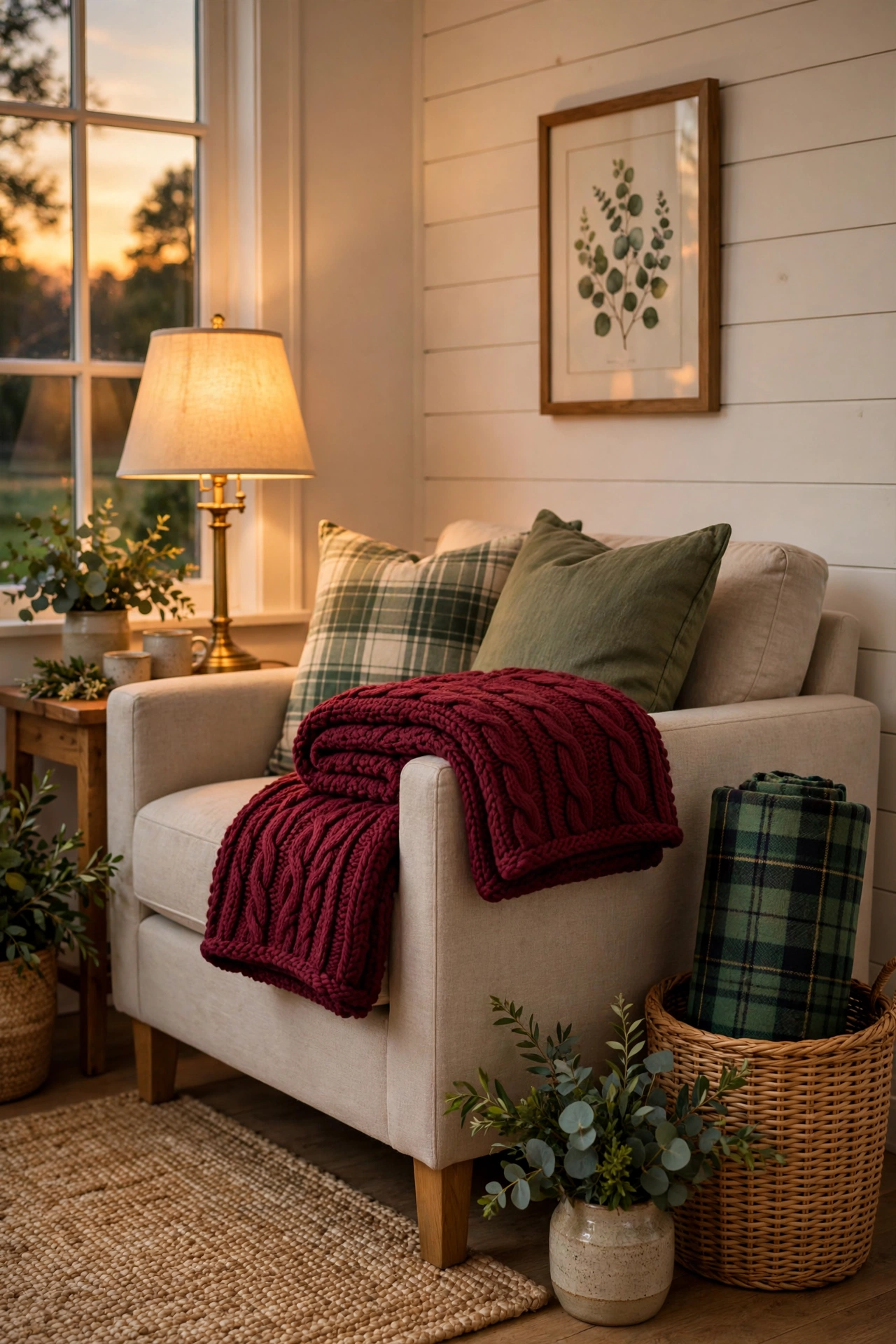
One thick, high-quality throw folded on the sofa arm adds more cozy than three thin ones draped everywhere. Choose a chunky knit or faux fur in your deepest accent color, fold it to a 12 inch band, and let it live in exactly one spot. In a small room, a single strong textile moment reads as luxury.
Try it: Roll the second throw and stand it in a basket beside the sofa. Vertical storage, visible texture, zero seat space lost.
19
A Ladder That Holds Throws and Stockings
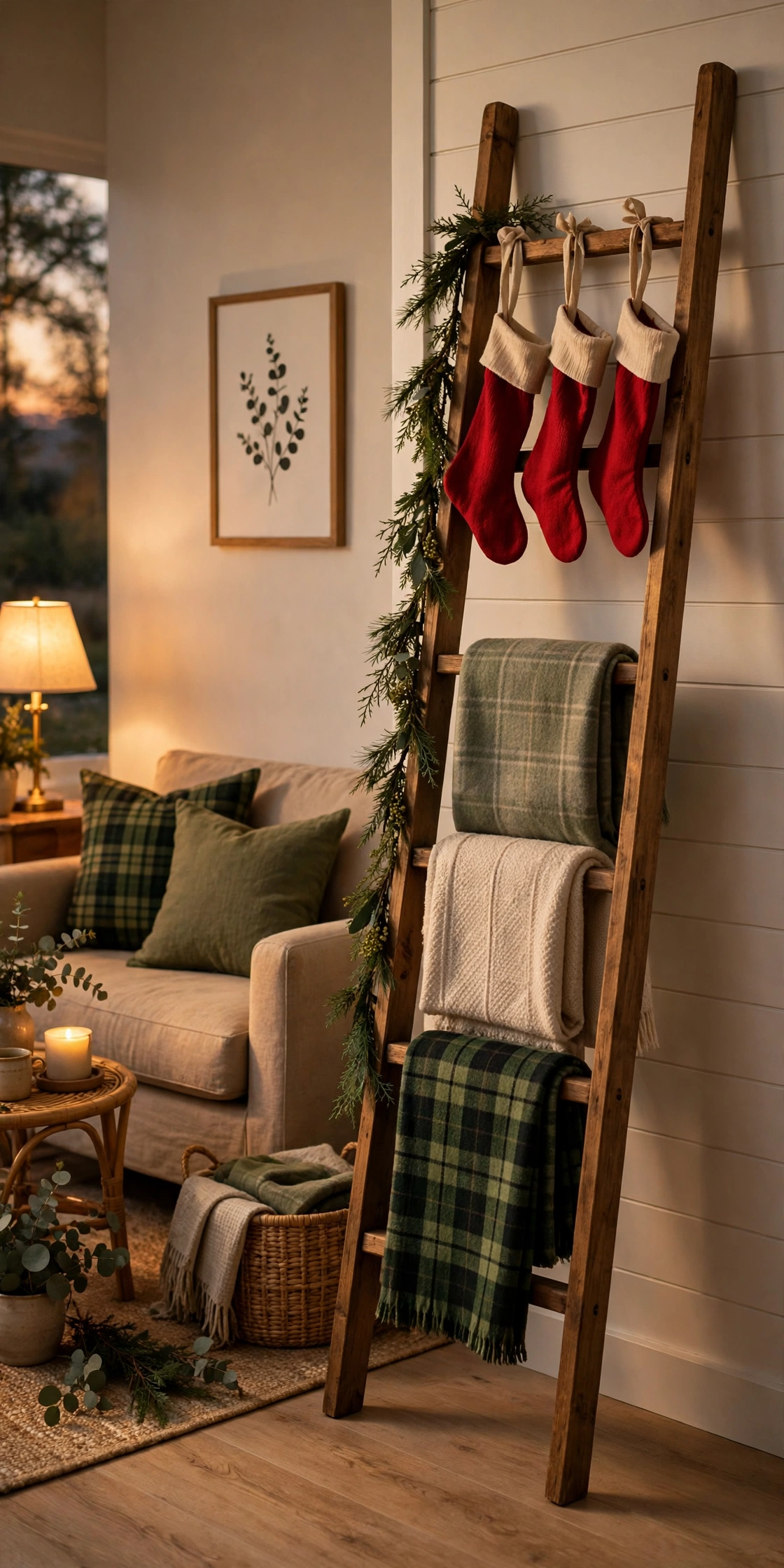
A leaning blanket ladder uses 6 inches of depth and gives you a mantel substitute: throws on the lower rungs, stockings on ribbon loops from the top rung, a slim garland along one side. Decorative ladders run $35 to $60 and work in the room all year, not just December.
Try it: Lean the ladder on the wall beside the sofa, not behind it. It should be reachable from a seat, because the throws on it are meant to be used.
20
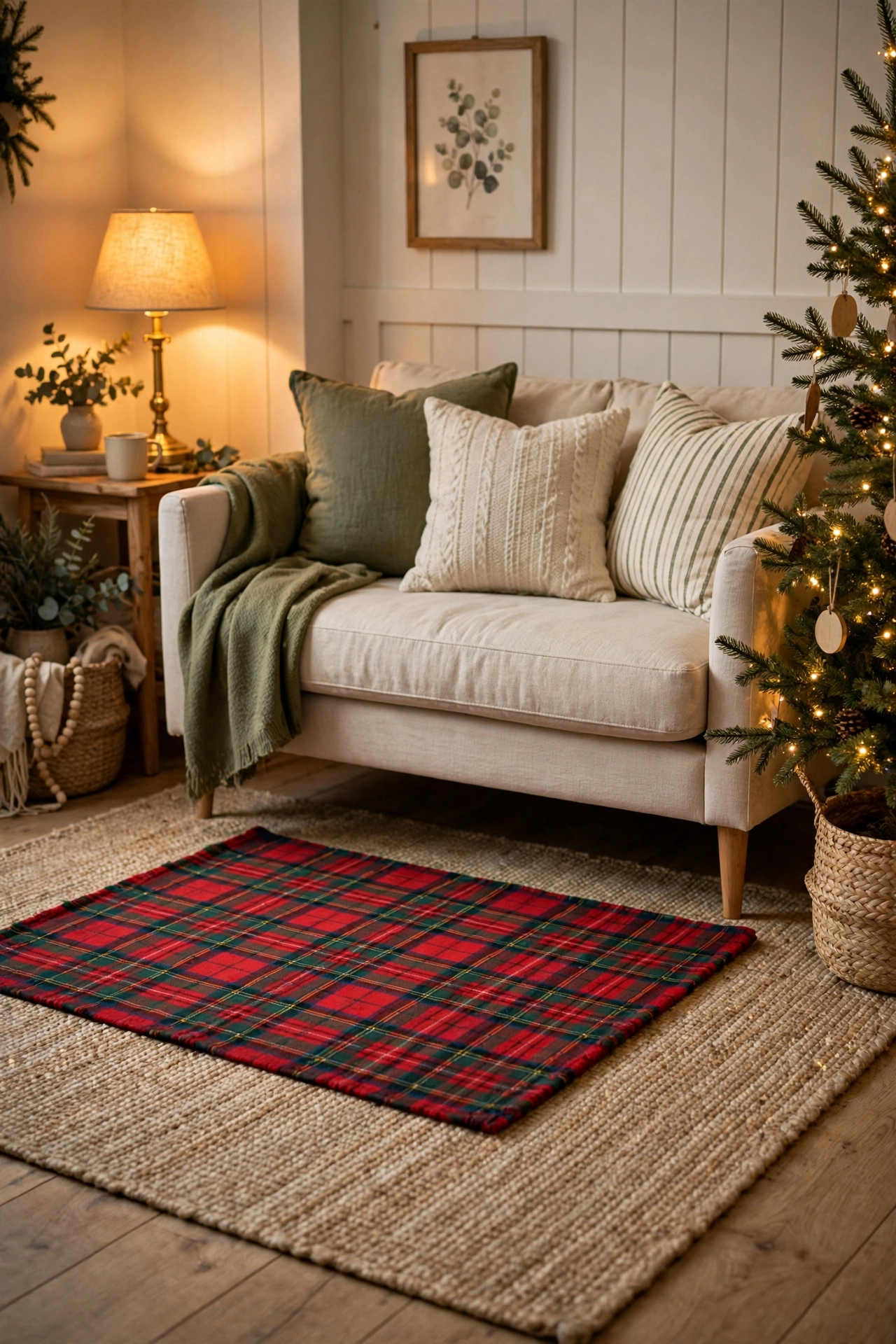
A Small Seasonal Rug Layered on Top
Layer a 3 by 5 foot Christmas rug over your everyday rug in front of the sofa. The small top layer defines the holiday zone, protects the good rug from tree needles, and rolls up for storage in a closet corner. Flat-weave layers sit smoothest and never bunch under the coffee table.
Try it: Anchor the layered rug to the sofa and tree, not to the room’s center. Its job is to mark the festive zone, and zones in small rooms should hug the furniture.
21
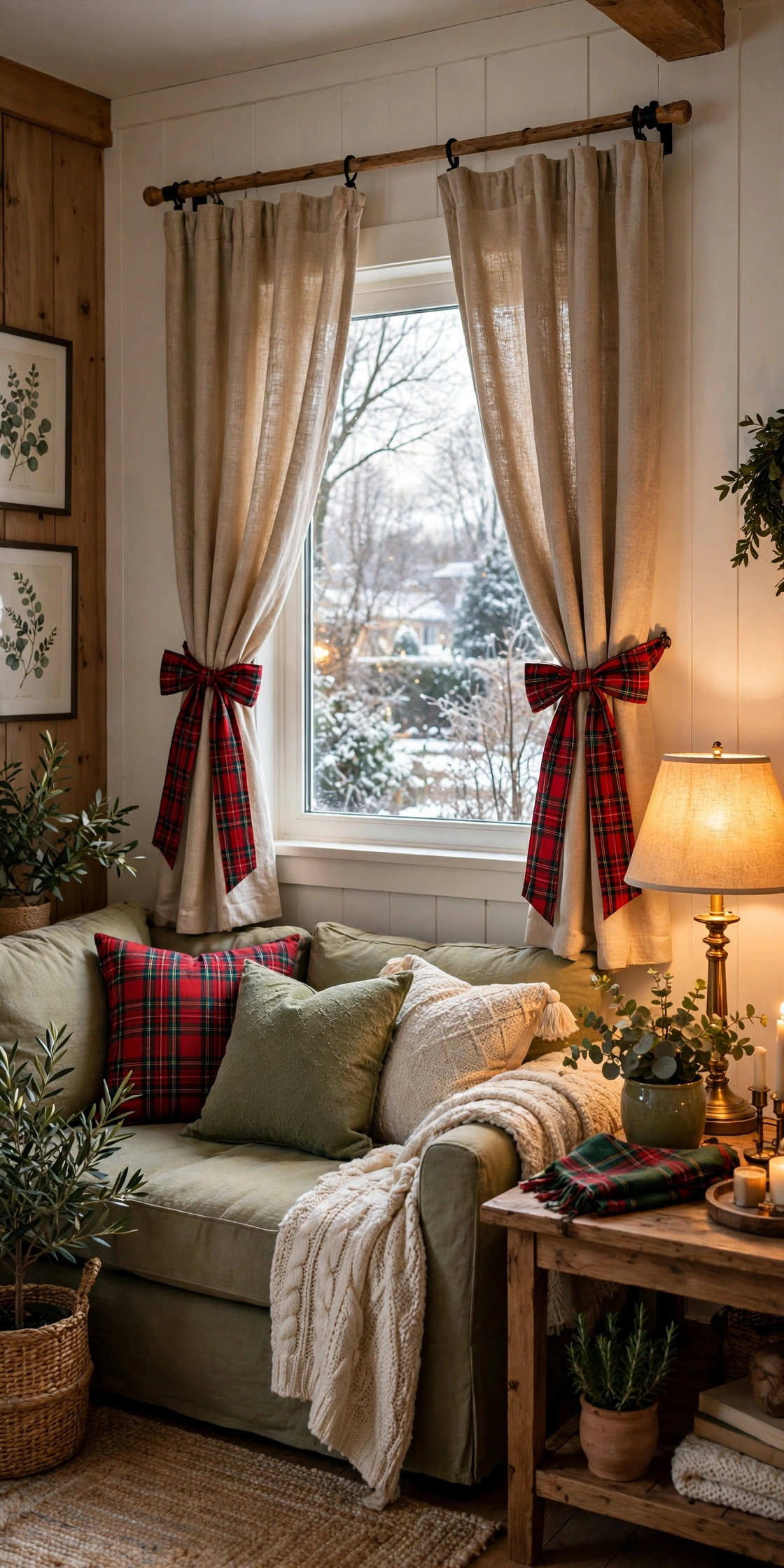
Ribbon Tiebacks Instead of New Curtains
Skip the seasonal curtain swap and tie the panels you own back with wide red or plaid ribbon. Two yards of 2.5 inch ribbon per window costs under $5, takes five minutes, and puts your Christmas color at the room’s tallest point. The pulled-back panels also let in more winter light, which small rooms need.
Try it: Bow the ribbon at one-third height on the panel, not halfway. The lower bow looks tailored; the mid-panel bow looks like a gift costume.
22
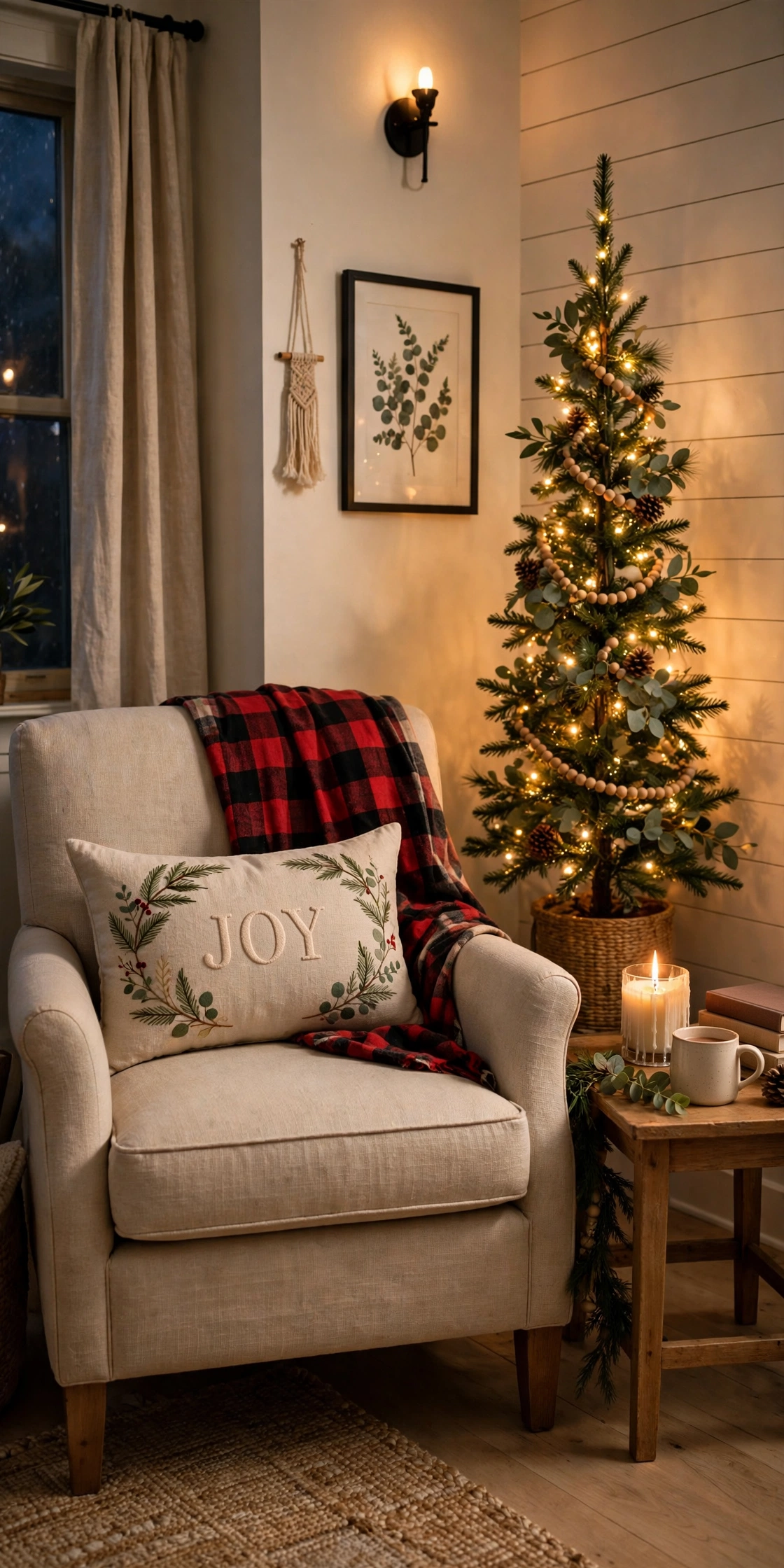
One Reading Chair, Fully Dressed
In a small room, decorate one chair completely instead of every seat a little. A plaid throw over the back, one Christmas lumbar pillow, and a candle on the side table beside it make a finished vignette in 4 square feet. The undressed second chair keeps the room from tipping into theme-park territory.
Try it: Place the dressed chair nearest the tree. Guests will fight over it, and the photo angle from the door captures both at once.
23
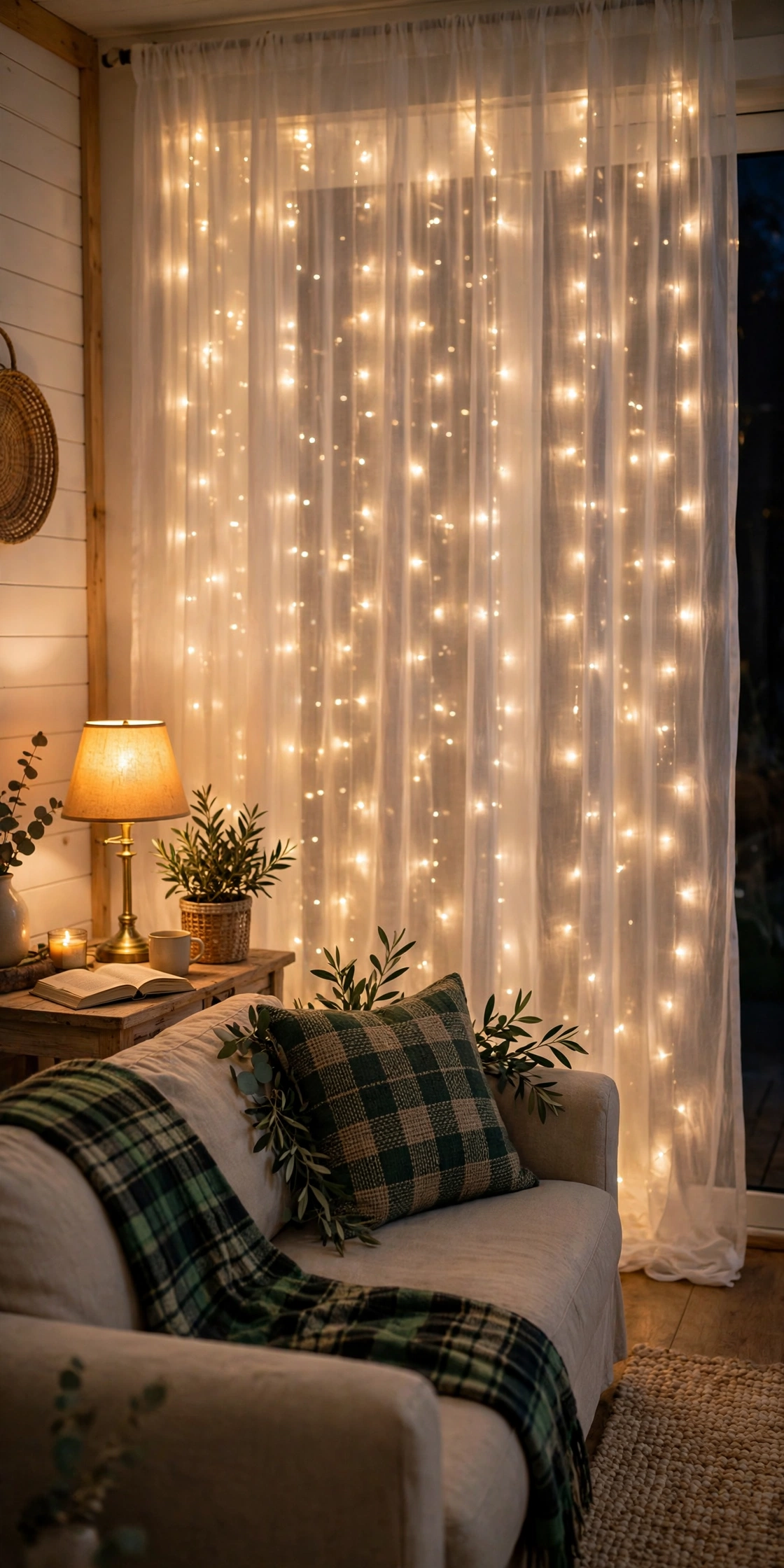
Curtain Lights Behind the Sheers
A curtain of warm LED string lights hung behind sheer panels turns one whole wall into a soft glow. It is the single biggest light upgrade for a small room, costs about $18 for a 10 by 10 foot curtain, and takes no floor, shelf, or table space at all. Use the remote’s timer mode and it runs itself from dusk to bedtime.
Try it: Choose warm white only. Cool white behind sheers reads as office light and makes a small room feel clinical instead of cozy.
24
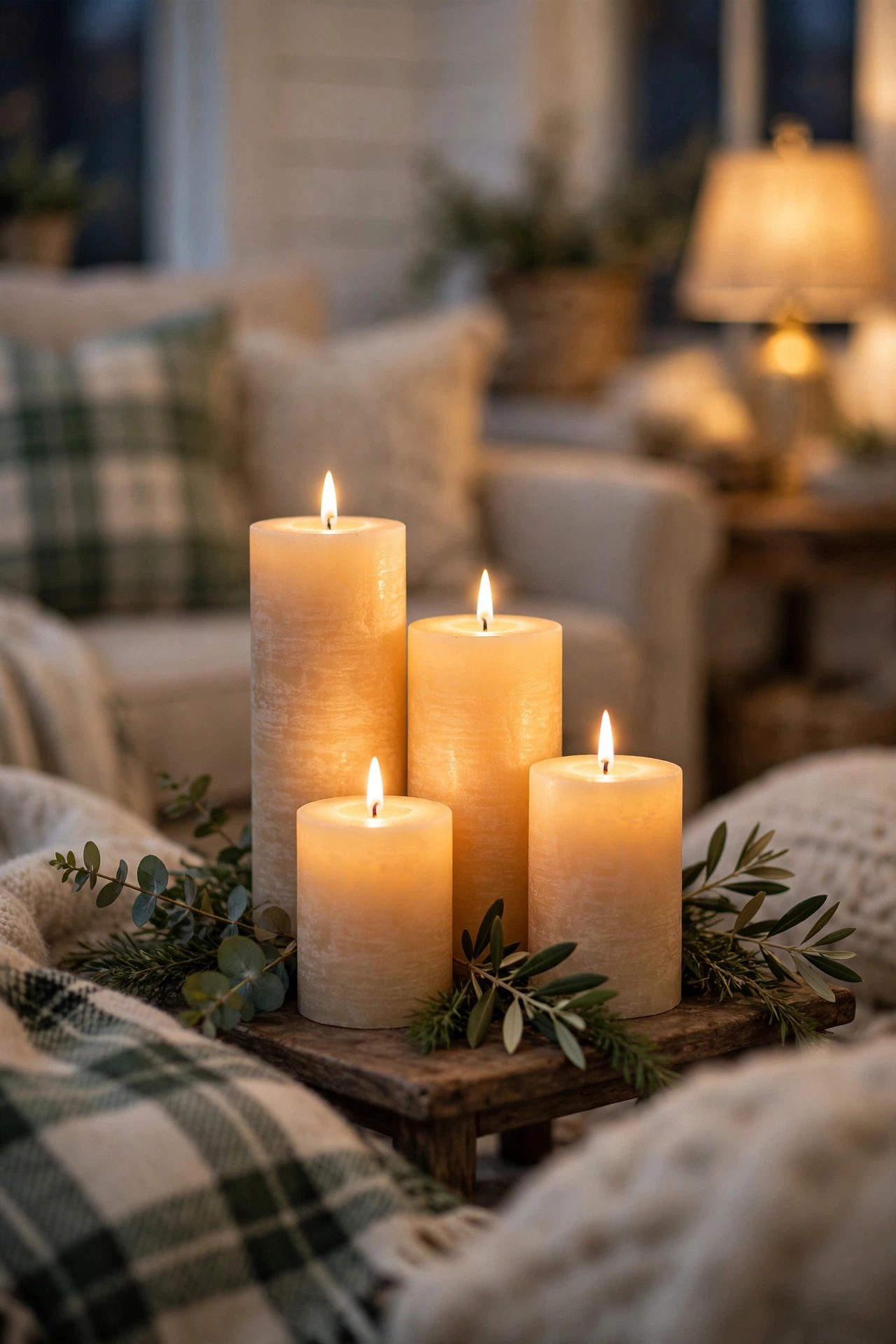
A Flameless Candle Cluster Instead of Lamps
Three to five flameless pillars at different heights on the coffee table tray or a windowsill give a small room candlelight without flame risk near throws and curtains. Grouped tight, they read as one light source with real presence. Set them on a 6 hour timer and the room lights itself every evening.
Try it: Mix heights in a 3, 5, 7 inch range. Same-height candles in a row look like a checkout display; varied heights look like a hearth.
25
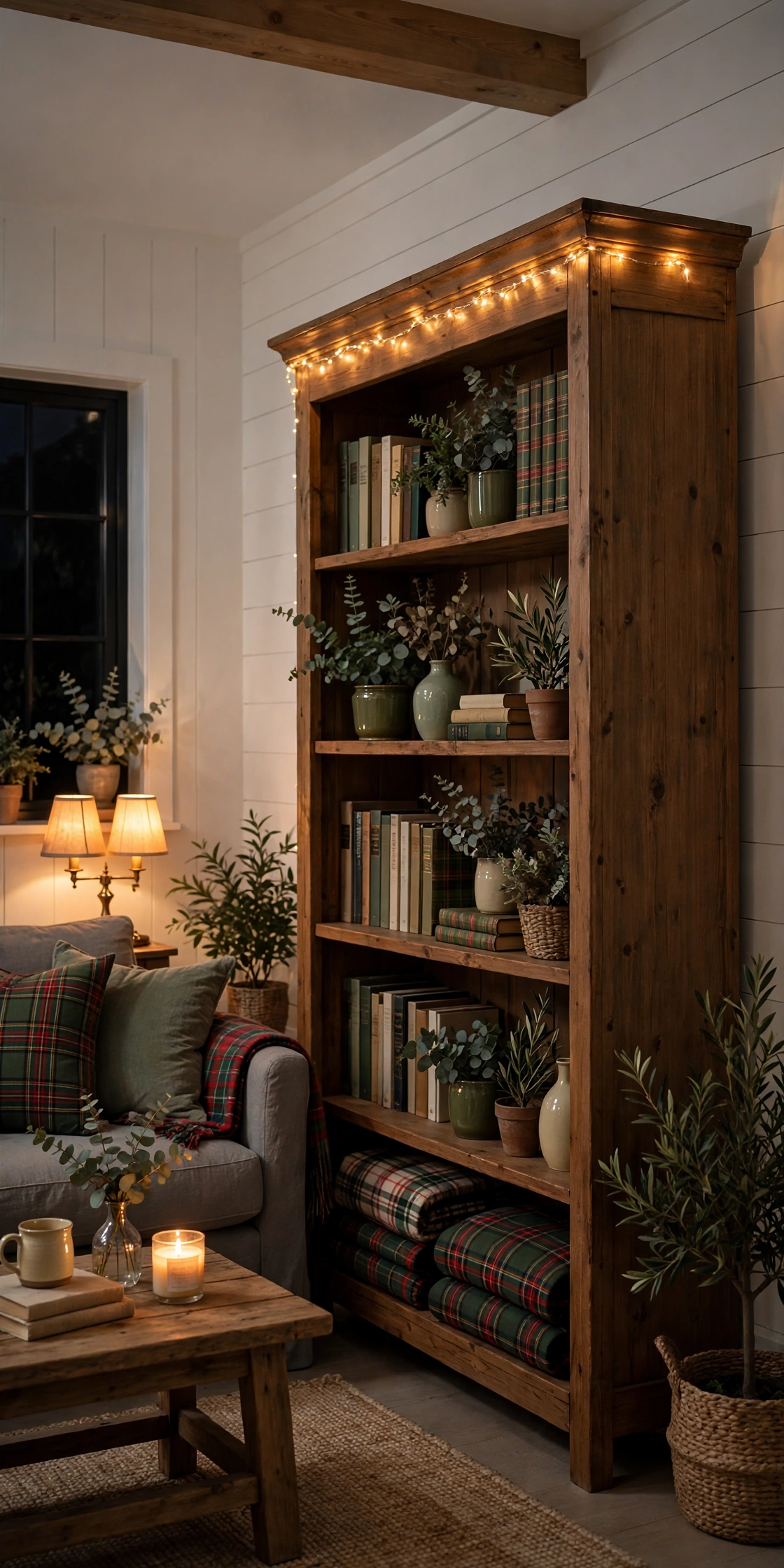
Fairy Lights as the Room’s Outline
Run one 33 foot strand of fairy lights along the top of the bookcase, across the window frame, or around the door trim to outline the room’s architecture. The outline makes the room’s shape visible at night, and a defined shape feels bigger than a dim blur. Battery strands with timers avoid cord runs to scarce outlets.
Try it: Outline only one feature, the tallest one. Outlining everything turns the room into a marquee; one glowing line is architecture, five is signage.

26
A Branch of Ornaments Over the Coffee Table
Hang a bare branch 3 to 4 feet long from two ceiling hooks over the coffee table and suspend 10 to 12 ornaments from it on ribbon at varied lengths. It borrows the drama of a chandelier, costs almost nothing if you forage the branch, and floats above the one surface that is already the room’s center.
Try it: Keep every ornament at least 24 inches above the table surface. Guests set down mugs without looking up, and the clearance keeps the display safe.
27
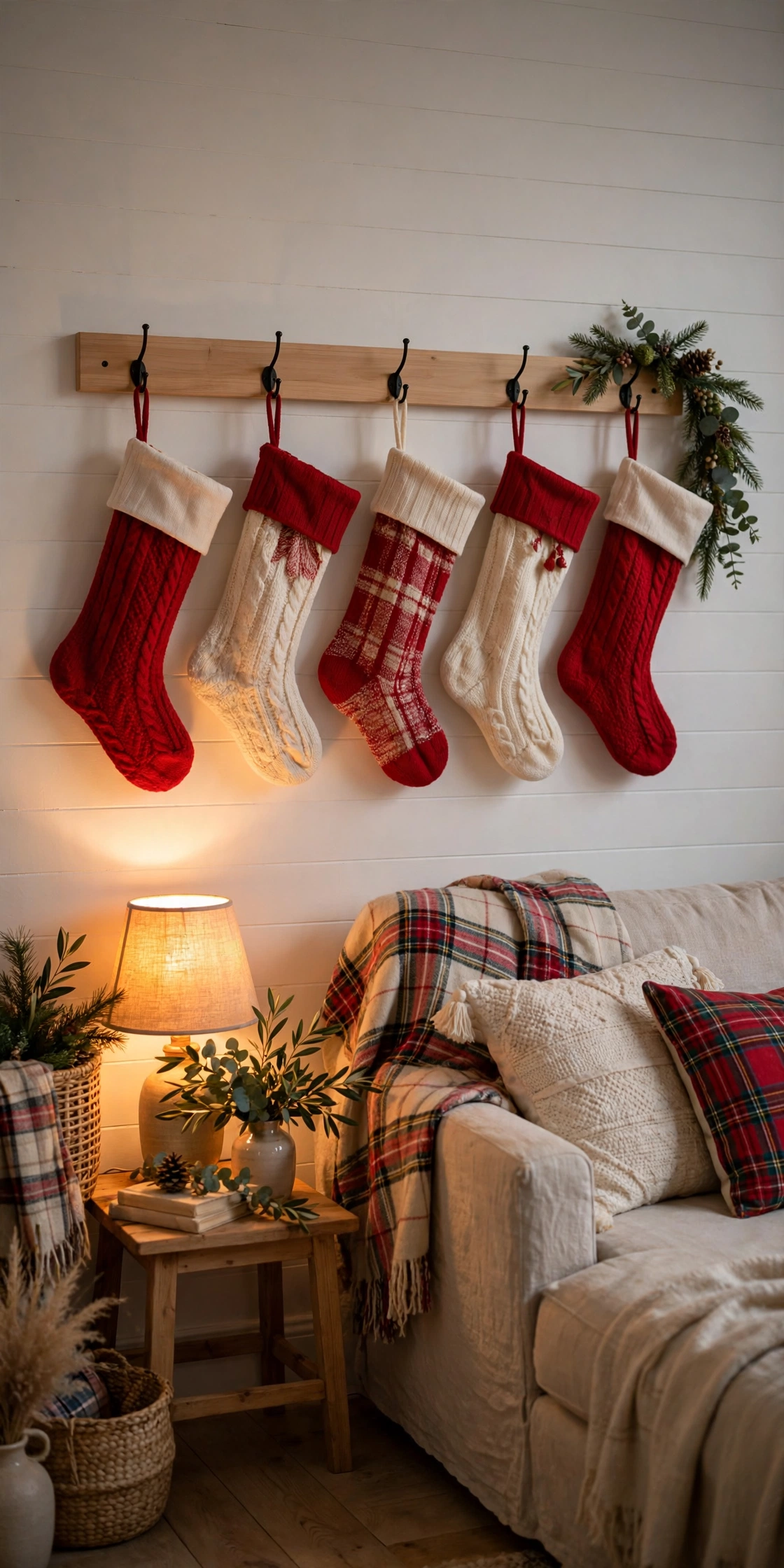
Stockings on a Slim Wall Rail
A 24 inch wall-mounted rail with 4 to 5 hooks gives stockings a home when there is no mantel, no ladder, and no spare wall unit. Mount it at mantel height, 48 to 54 inches, and the stockings hang in the visual band where a fireplace would be. The whole installation costs under $20 and the rail holds keys the other eleven months.
Try it: Fill stockings only on Christmas Eve. Stuffed stockings hung for weeks stretch, sag, and make a small wall look tired.
28
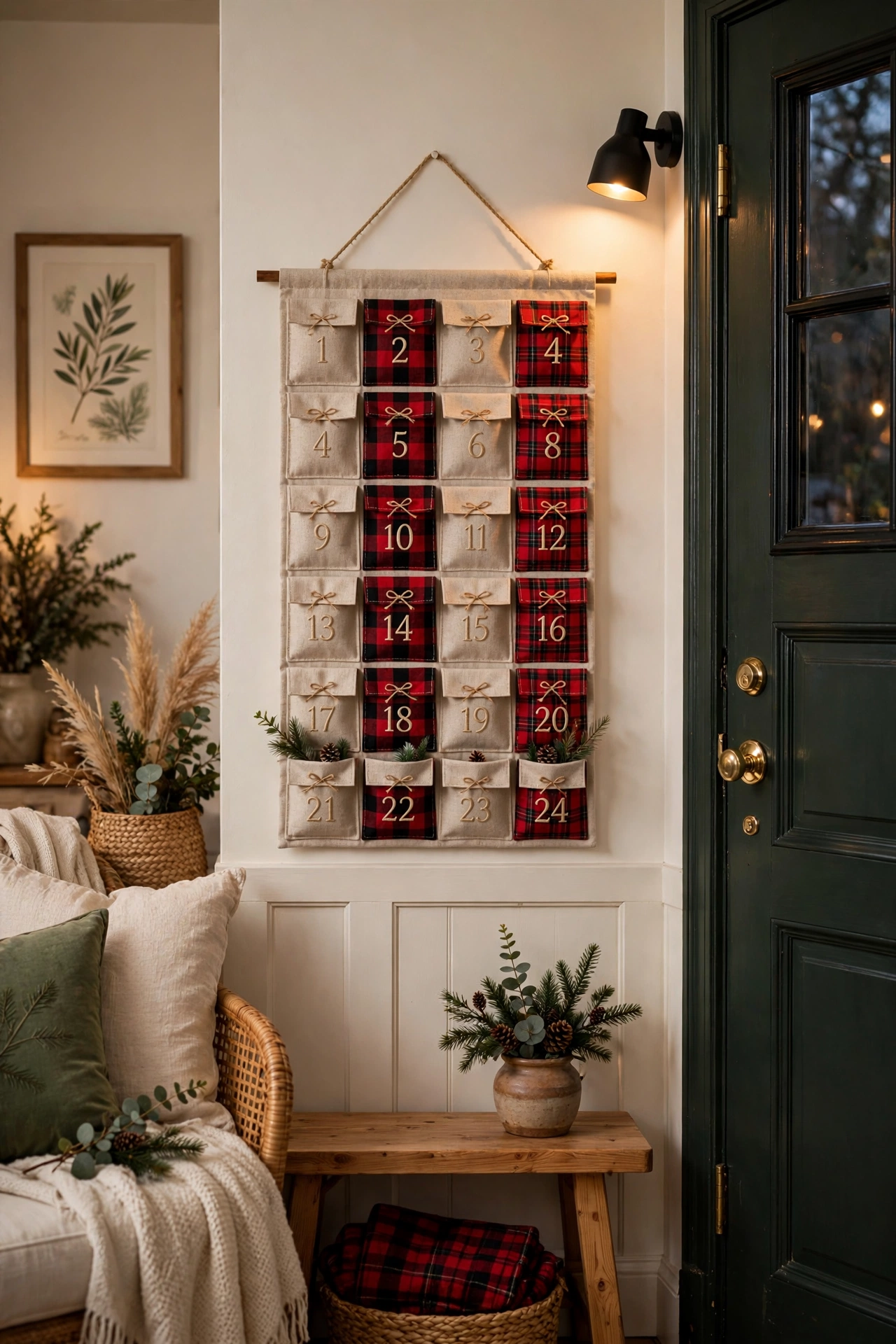
An Advent Calendar as Wall Art
A fabric or wooden advent calendar hung on the wall is a countdown and a 24 inch piece of Christmas art in one. Choose one with pockets deep enough for notes and small treats, and hang it at eye level by the door so the morning ritual happens on the way out. Reusable calendars pay for themselves by the second December.
Try it: Fill half the pockets with activity notes instead of candy: a cocoa night, a lights drive, a baking hour. Small rooms benefit from experiences that do not add objects.
29
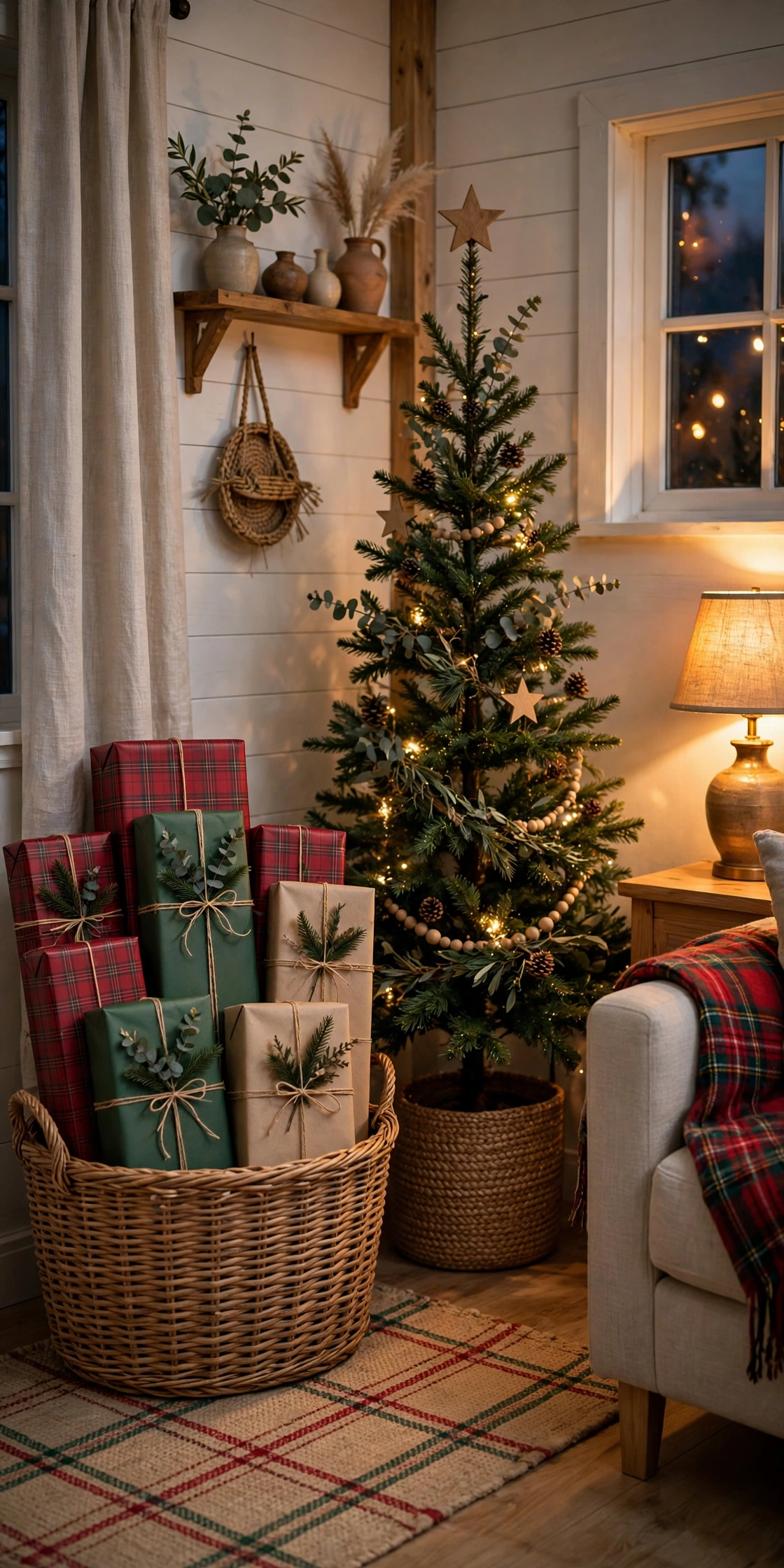
A Gift Basket Instead of a Gift Pile
Loose presents sprawl; a large basket corrals them. Put one wide basket or vintage crate beside the tree and stand wrapped gifts upright in it like files. The footprint stays at 2 square feet no matter how full it gets, and the wrapped paper becomes part of the decor instead of a tripping hazard.
Try it: Wrap early gifts in your room’s two main colors. Coordinated paper in the basket makes the display look planned from December 1st.
30
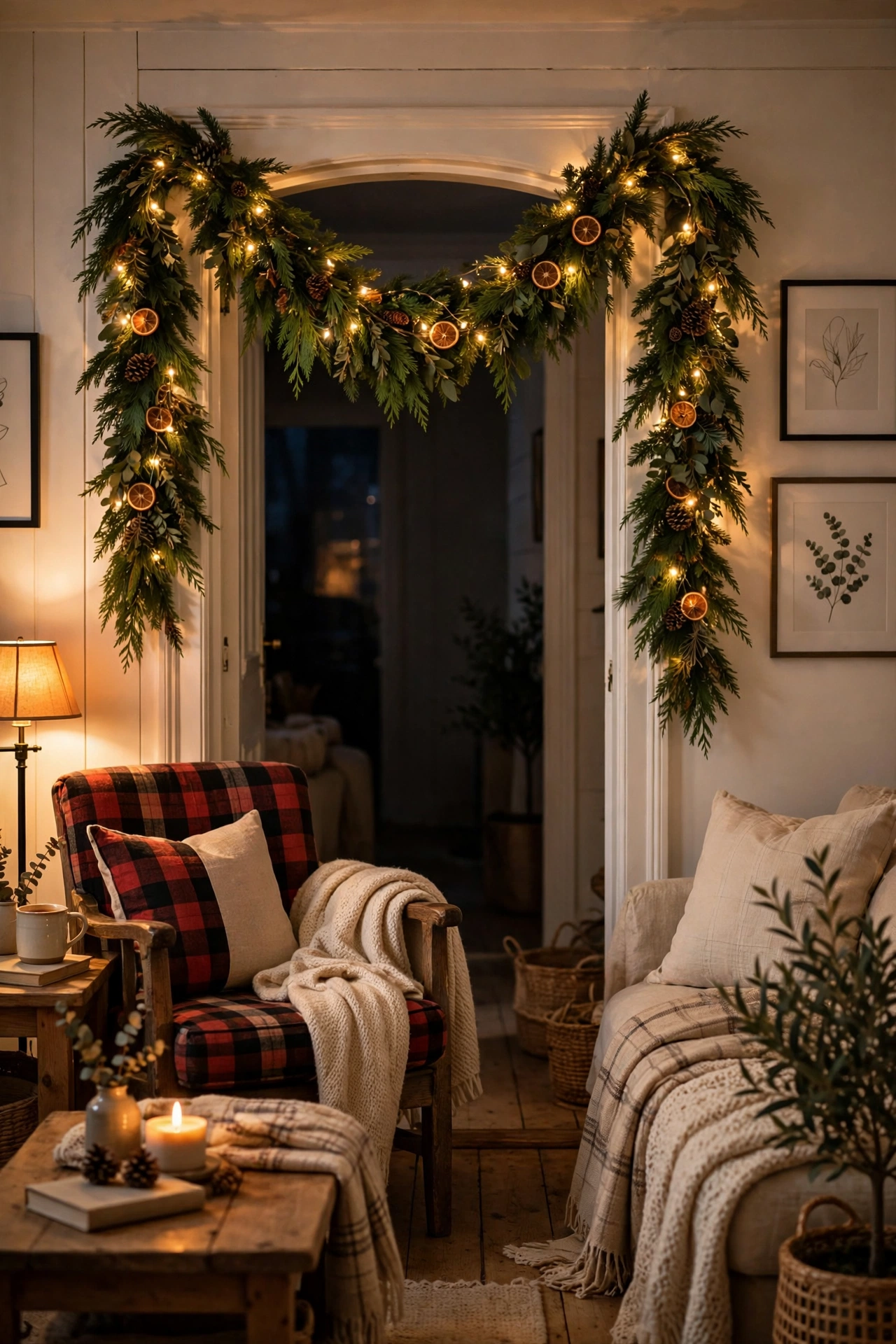
Garland Over the Living Room Doorway
The doorway is the frame everyone walks through to enter the room, so dress it. A 9 foot garland swagged over the inside of the living room door frame, hung with clear hooks, makes entering the room feel like an event. It uses a surface that holds nothing else and clears every head at standard 80 inch door height.
Try it: Let the center swag dip 6 inches, no more. A deeper dip catches tall guests and reads as an obstacle instead of a welcome.
31
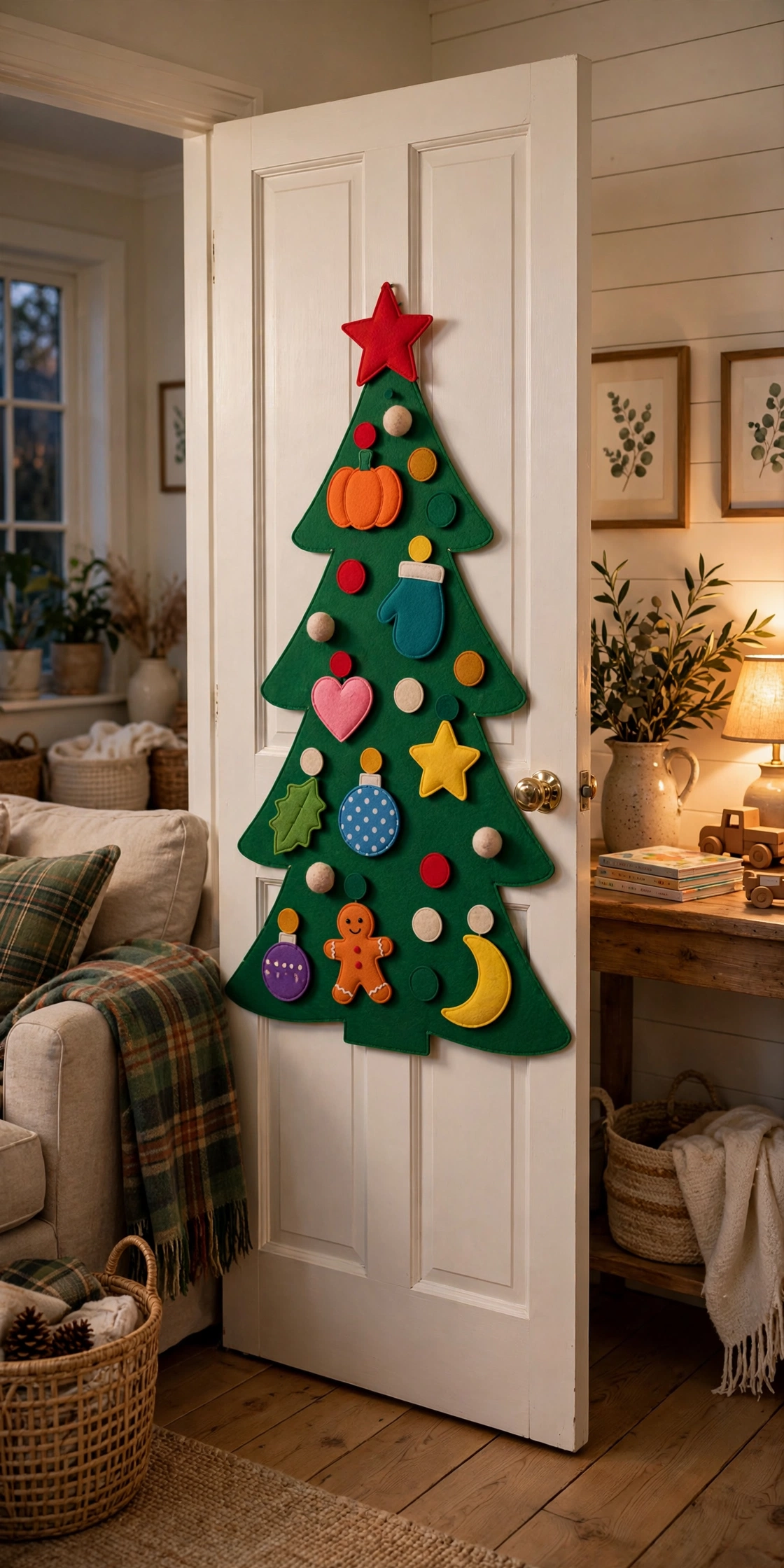
A Felt Tree on the Back of the Door
A flat felt tree, 3 to 4 feet tall, stuck to the back of the living room door with its own detachable felt ornaments, is a full second tree with literally zero depth. It is the best Christmas square inch in a home with toddlers, because the ornaments are meant to be pulled off and stuck back on. Sets cost $12 to $18.
Try it: Hang it on the door the kids pass most, at their eye height, not yours. A decoration at 36 inches gets used ten times more than one at 60.
32
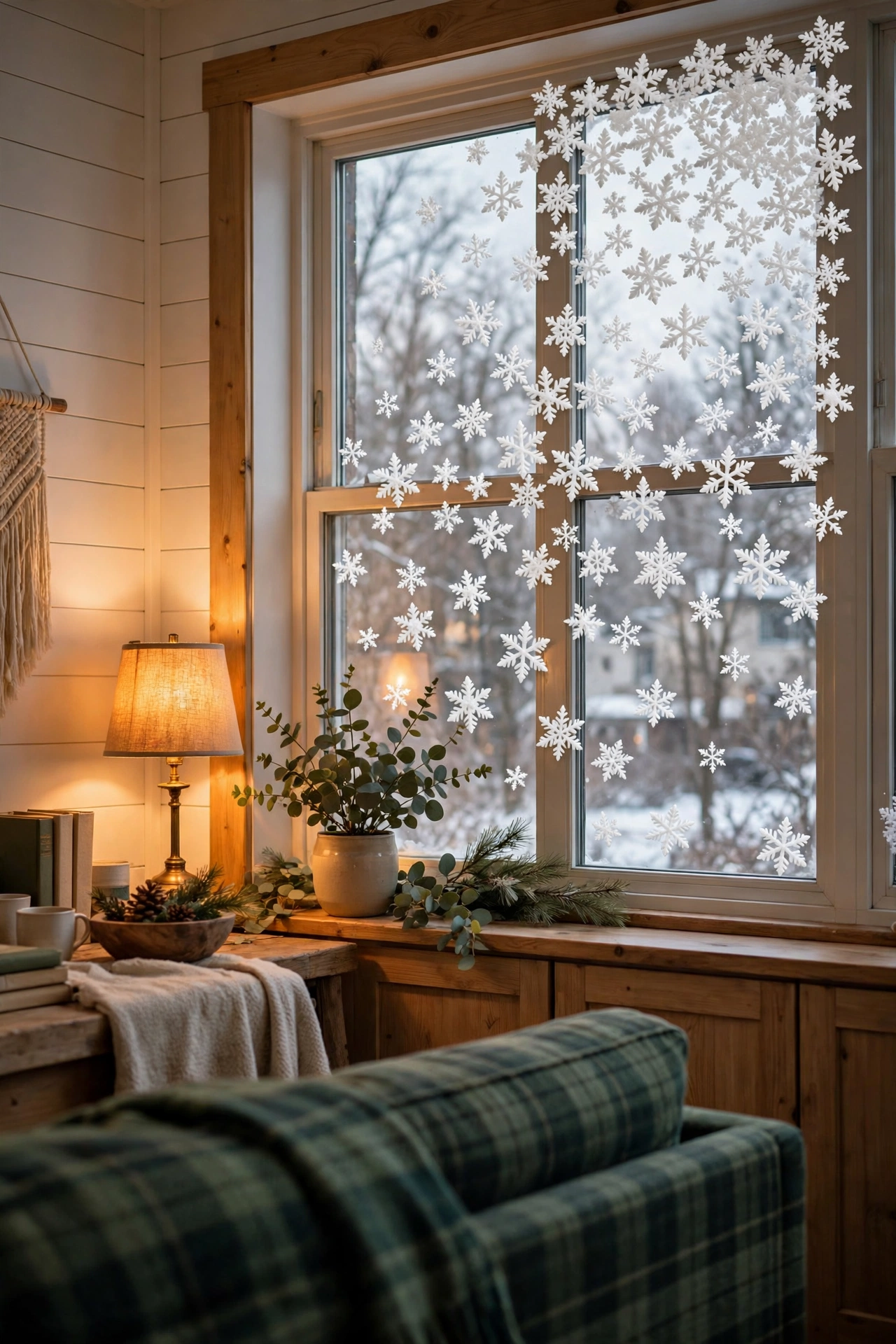
Static Clings on the Window Glass
Window clings add snowflakes, wreaths, or a village skyline to the glass with no adhesive, no hooks, and no space. A full window takes about $8 of clings and ten minutes, and they peel off in January into a single envelope. In a small room, the window is often the largest free surface you have.
Try it: Cluster clings in one corner of the window, growing outward. Scattered evenly over the whole pane looks like weather; a corner cluster looks like design.
33
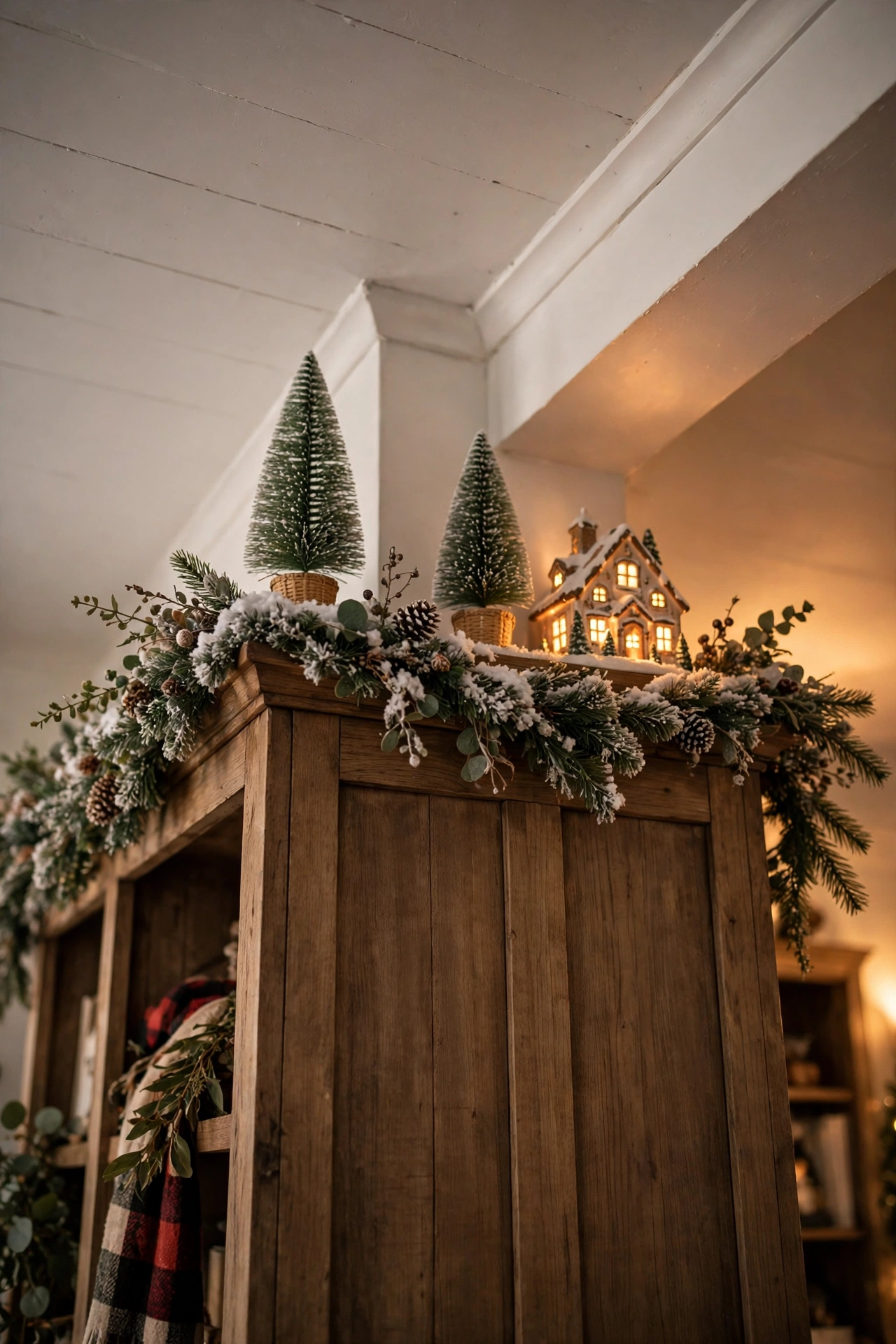
The Top-of-the-Bookcase Display
The 12 inches between your bookcase top and the ceiling is display space you already own. Set a snowy garland run, two bottle brush trees, and one small village house up there and the room gains a skyline. High decor pulls the eye upward, and upward is the direction that makes small rooms feel spacious.
Try it: Dust the bookcase top before you decorate. December garland on January dust is visible from every seat in the room.
34
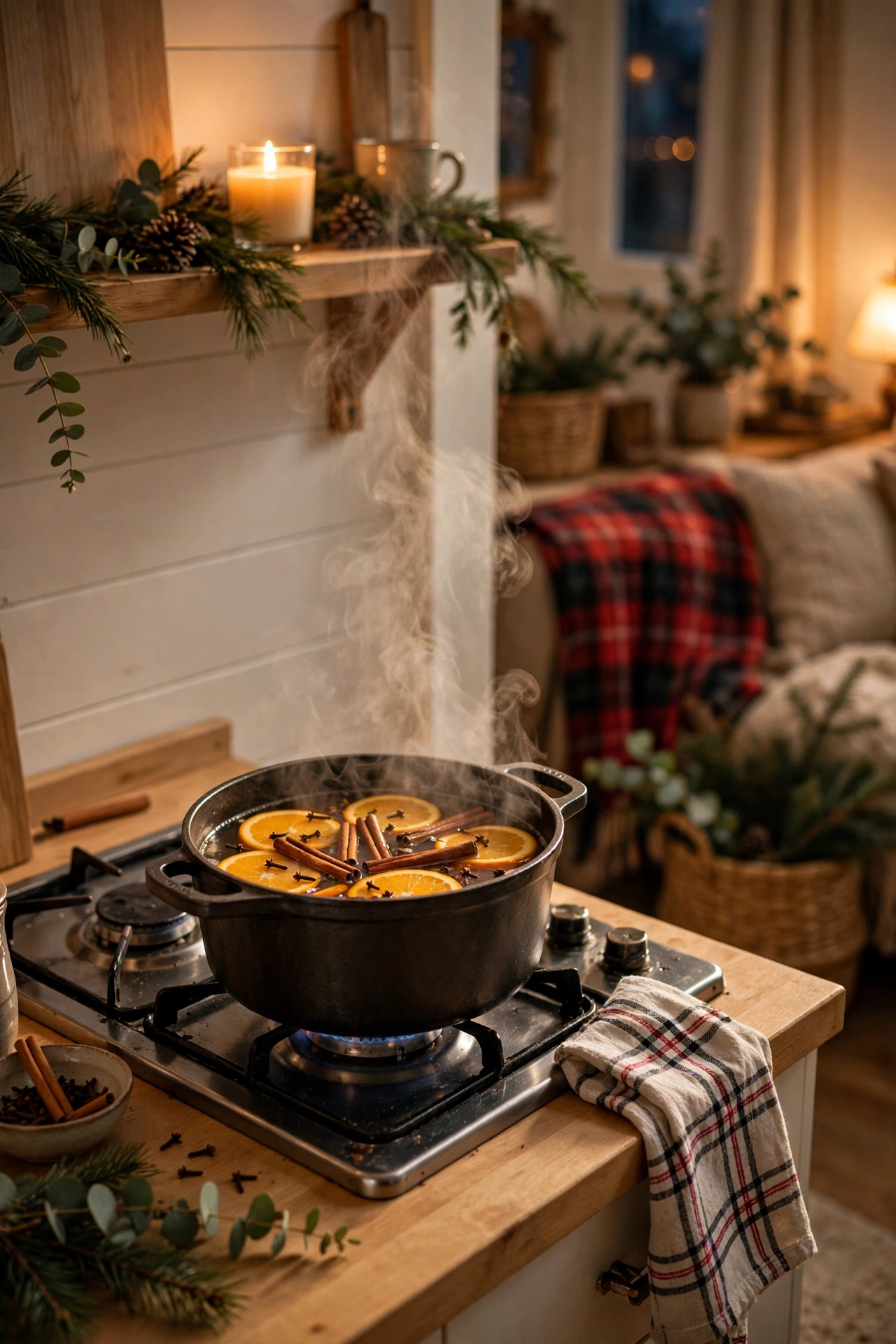
Scent That Takes No Space at All
A simmer pot on the stove (orange slices, cinnamon sticks, cloves, water) or a pine-scented candle on the shelf makes the room smell like Christmas while occupying nothing. Scent is the one layer of decor with a zero footprint, which makes it the highest-value layer in the smallest rooms. Refresh a simmer pot every 2 to 3 days.
Try it: Set the simmer pot going 30 minutes before guests arrive. Scent registers before sight, so the room will already feel decorated when the door opens.
35
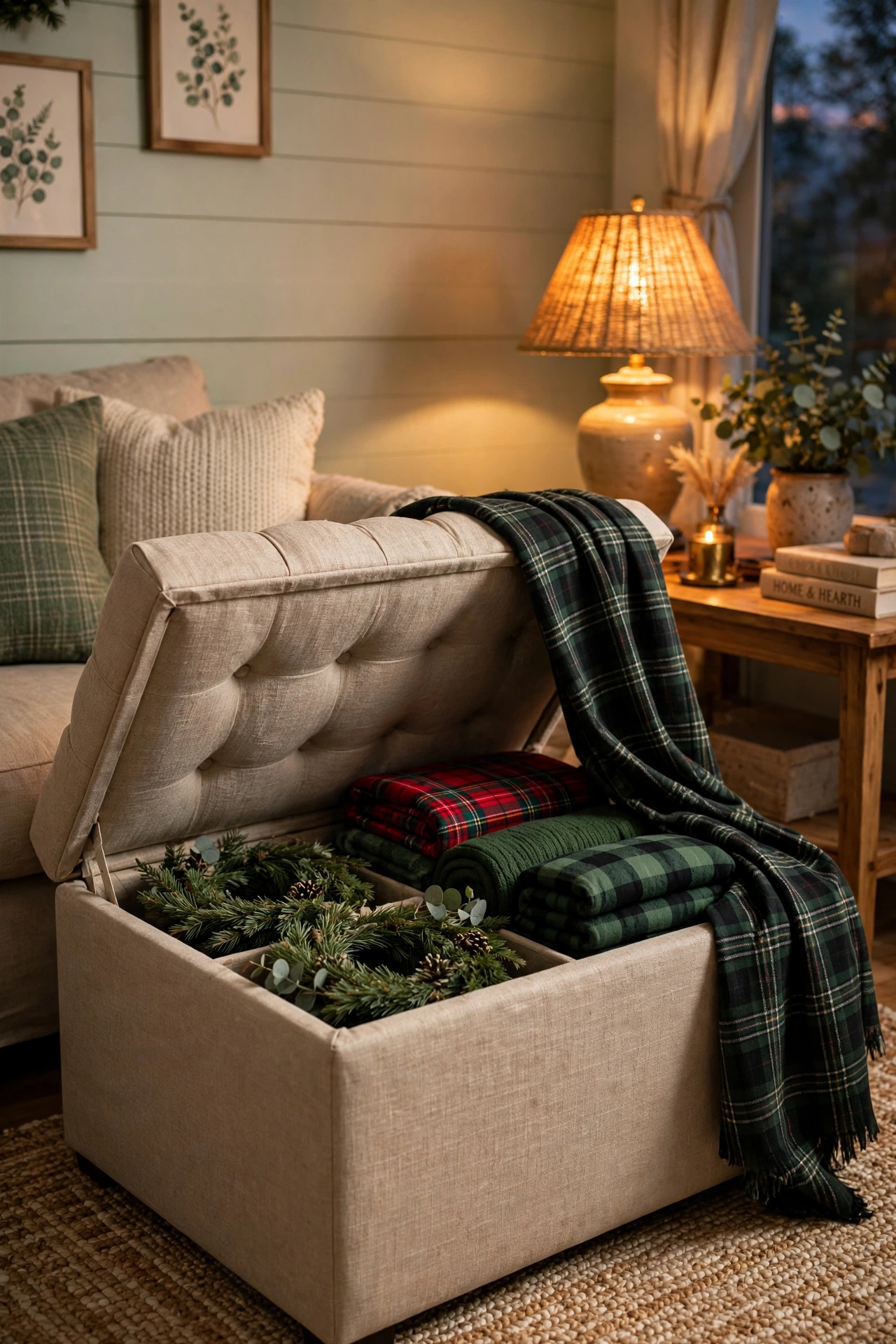
Decor That Stores Inside the Furniture
End the season where you started it: inside the room. A storage ottoman or bench holds the throws, pillow covers, and garlands in December’s room and the blankets the rest of the year, so no closet space is ever surrendered. Choose decor that folds flat (paper stars, fabric calendars, cover swaps) and a full Christmas fits in one 18 gallon bin.
Try it: Photograph your finished room before you pack anything away. Next year you will rebuild the exact layout in half the time from the photos.
Pro tip: Walk the room’s traffic path with a laundry basket in your arms. Anywhere the basket bumps, Christmas has taken too much space. Decor that survives the basket test never gets resented by mid-December, and resentment is what actually makes small rooms feel cluttered.
Three rules for small living room Christmas
Start every decision with these three, and a small room will never tip from cozy into crowded.
- The 36-inch rule: Keep every walkway at least 36 inches wide after decorating. If a piece narrows the path below that, the piece moves to a wall, a shelf, or back to the store.
- One hero, three supporting acts: Pick a single hero (the tree, the wreath, or the lit window) and let everything else support it. Two heroes in 150 square feet fight; one hero with helpers composes a room.
- Flat storage only: If a decoration cannot fold, nest, or roll into one 18 gallon bin alongside the others, it does not belong in a small home, no matter how beautiful it is in the store.
After Christmas: the small room reset
Small rooms forgive slow takedowns least, so run this order and the room breathes again in under two hours.
- Surfaces first, tree last: Clear shelves, trays, and tabletops on day one and the room feels normal immediately, even with the tree still up. The tree comes down last because it is the only piece big enough to need a helper.
- Photograph every vignette: Take one photo per shelf, tray, and corner before anything moves. Next December the photos rebuild your exact layout in half the time and stop the annual re-buying of things you already own.
- One bin, labeled by zone: Pack wall decor, shelf decor, and textiles into one 18 gallon bin with a photo of the room taped inside the lid. Flat items (stars, calendars, clings) go in an envelope on top so they are the first things found next year.
More ideas you’ll love: Christmas living room decor ideas, small bedroom ideas, small apartment Christmas decor ideas, slim Christmas tree ideas, and more in our Christmas Decor collection.
Questions readers ask
How do I decorate a small living room for Christmas without it feeling cluttered?
Declutter first, then decorate up. Remove three everyday objects from shelves and tables, hang decor on walls and windows instead of setting it on surfaces, and keep every walkway 36 inches wide. One hero piece with a few supporting touches always reads calmer than decor spread everywhere.
What size Christmas tree is best for a small living room?
A slim or pencil tree 6 to 7 feet tall and 24 to 30 inches wide suits most small living rooms with 8 foot ceilings. It takes under 3 square feet of floor while still looking like a real tree. Leave 6 to 12 inches between the topper and the ceiling.
Where should I put the tree in a small living room?
The corner diagonal from the door, out of the traffic path and near an outlet. Corners use the least floor, show the tree from two directions, and keep it clear of heat sources by the required 3 feet. The gap between the sofa end and the wall is the most underused alternative spot.
How can I decorate for Christmas with no fireplace or mantel?
Give another surface the mantel’s job. A TV console top, a floating shelf, a blanket ladder, or a slim wall rail all hold garland, candlesticks, and stockings at mantel height. The trick is concentrating the display in one band instead of scattering it.
What colors make a small living room look bigger at Christmas?
Light and low-contrast palettes: cream, soft white, natural green, and one metallic like gold or silver. Mirrors and glass ornaments multiply the light, and a tight palette of two colors plus one metal keeps visual noise low, which is what actually makes a small room feel larger.
How do I decorate a rental living room without damaging walls?
Use clear removable hooks and clips rated for the weight, static window clings, and tension or over-door options. Garland, wreaths, wall trees, and card strings all hang from removable hardware and come down in January without a single filled hole.
How much should I budget for small living room Christmas decor?
About $100 to $150 covers a full small room: a slim tree if you need one, one garland, lights, pillow covers, and a few vertical pieces. Textile swaps and wall decor give the most impact per dollar, and everything here stores in one bin for reuse next year.
How do I store Christmas decor in a small apartment?
Choose flat-folding decor and pack it in one labeled 18 gallon bin or a storage ottoman. Coil lights around cardboard, fold paper stars and fabric calendars flat, and tape a photo of your finished room inside the lid so next year’s setup takes half the time.
People Also Ask
Can a small living room have a real Christmas tree?
Yes, if you choose a narrow variety and keep it watered. A slim Fraser fir or a 4 to 5 foot tabletop real tree fits small rooms well. Keep it 3 feet from heat sources, check the water daily, and expect needle drop to need a quick daily sweep in a tight space.
How do I make a small living room feel cozy, not cramped, at Christmas?
Cozy comes from light and texture, cramped comes from footprint. Use warm 2700K light at three heights, one thick throw, and decor that lives on walls and shelves. If you can still walk every path with your arms full, the room is cozy; if you are sidestepping, remove the last thing you added.
Should small living room Christmas decor match the rest of the apartment?
Yes, carry the same two colors and one metal through every room, but scale the expression down in the living room’s tightest spots. Matching palettes make a small home feel like one designed space instead of several competing ones, which is the cheapest square footage you will ever gain.
loved these ideas? ✿
Save this guide for later
Pin it to your board so it’s there when you’re ready to recreate it.

Curated by
Hey! I'm Sanaullah — visual curator and content creator. I search, curate, and test the best aesthetic ideas across Pinterest so you can easily transform your living space, style daily outfits, and try simple creative DIYs without the overwhelm.