
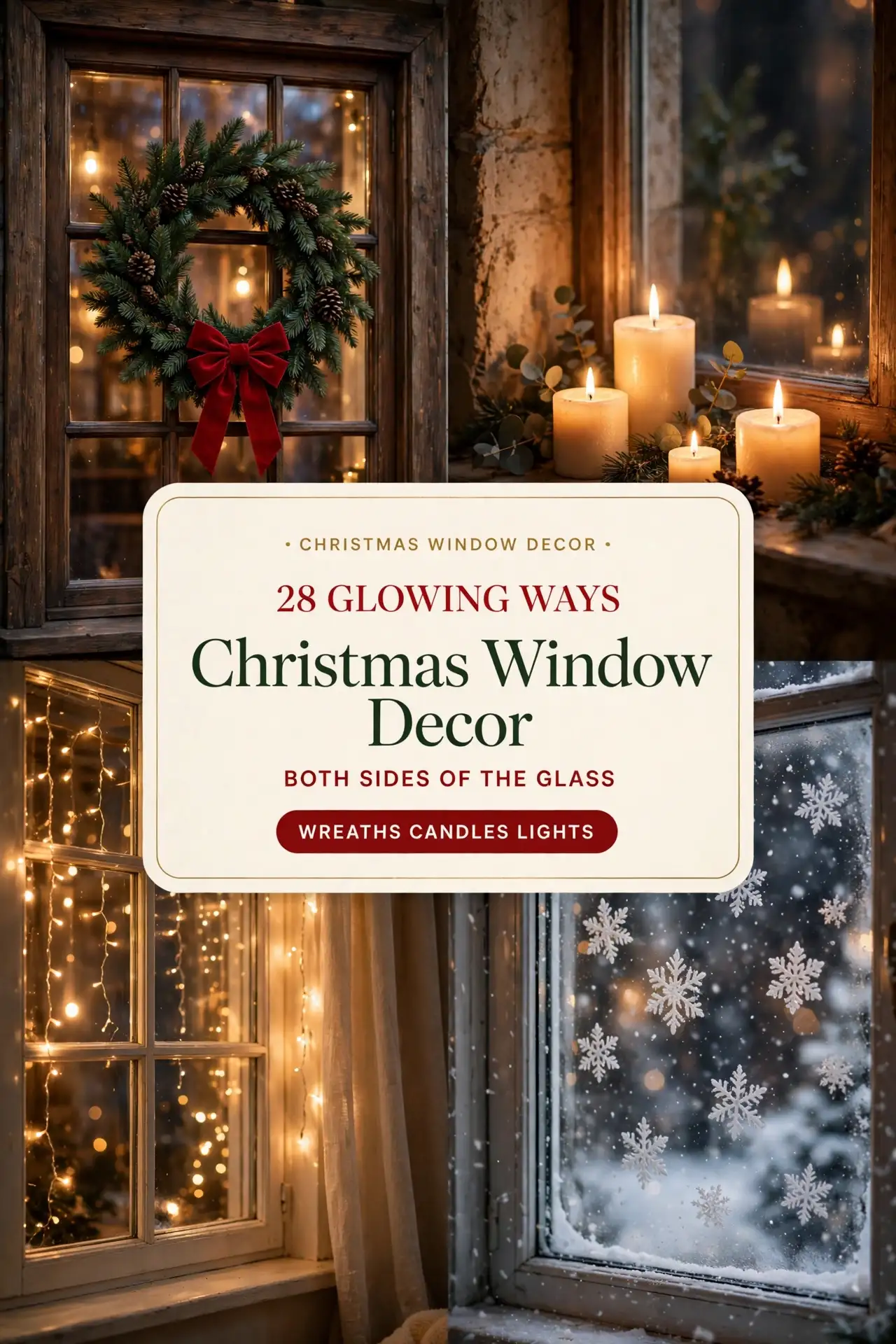
A window is the only decoration in your house that works two jobs: it is a picture for the street and a frame for the room. Most christmas window decor only thinks about one side, which is why so many windows look great from the driveway and bare from the sofa, or the other way around. These ideas are chosen to read from both directions, and they are all about the window itself: the glass, the frame, the sill. (The planter boxes outside the glass are a different project with its own guide.) Follow along and every window in the house will earn its keep, day and night.
Quick Idea Summary
- The key takeaway: Decorate the window in three parts: something on the glass, something on the sill, and light. A wreath or cling on the glass, a candle or small scene on the sill, and warm light behind it make a window that glows from the street and feels finished from the sofa.
- The detail most people miss: Scale. A window wreath should span about one-third to one-half of the window’s width; the cute 10-inch wreath on a 36-inch window disappears from the street, and the oversized one crowds the glass from inside.
- What it costs or how long it takes: Most of these ideas cost $3 to $30 per window and take 10 to 20 minutes. A whole house of front windows can be done in one afternoon for under $100.
At a glance
| Zone | Ideas | Budget |
|---|---|---|
| Wreaths and hanging pieces | 01–06 | $8–$40 |
| Candles and windowsill displays | 07–12 | $5–$35 |
| Lights in the window | 13–18 | $10–$30 |
| Clings, decals and glass art | 19–23 | $3–$15 |
| Natural and handmade touches | 24–28 | $0–$20 |
The ideas
01
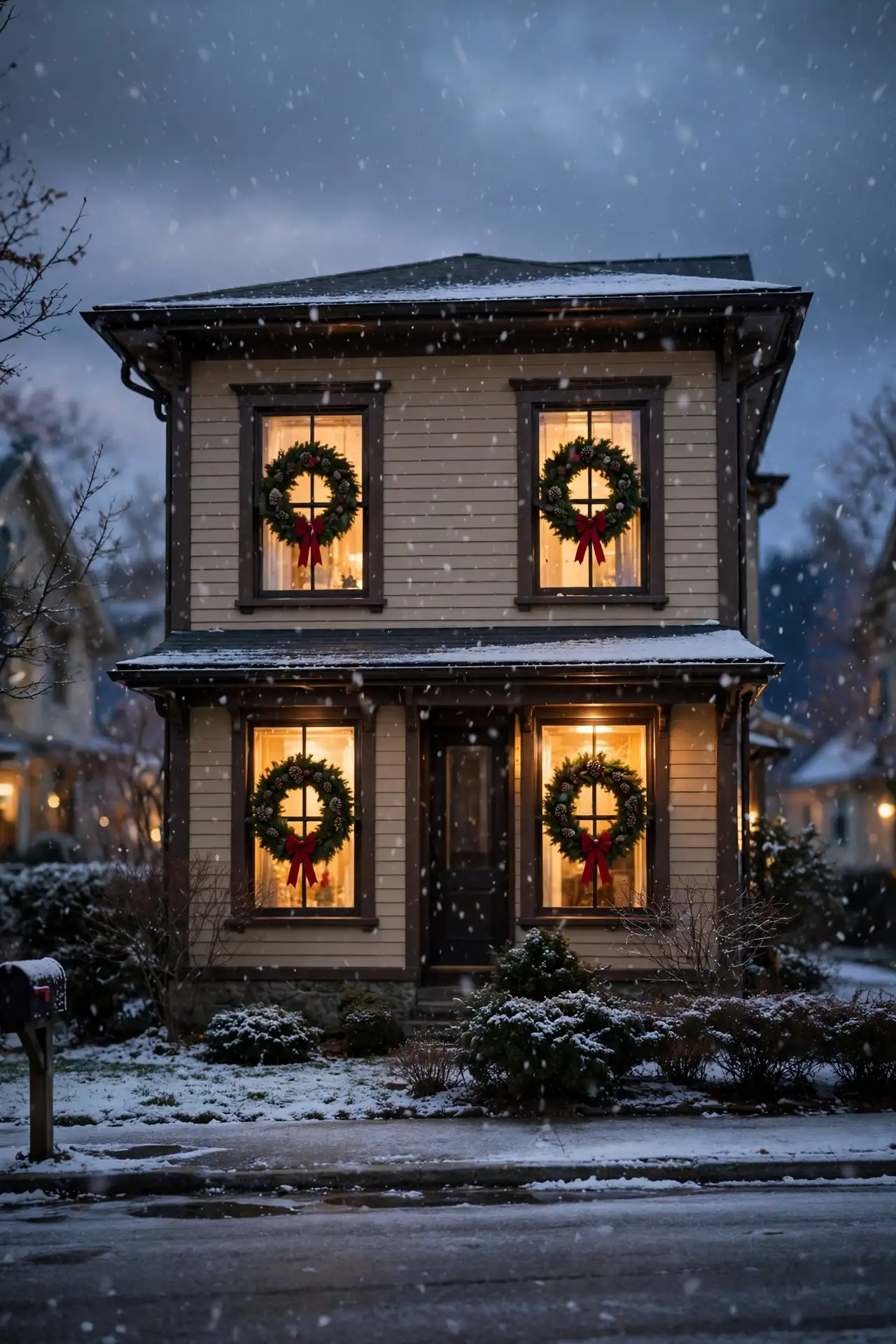
Matching Wreaths in Every Front Window
The classic colonial look is one identical wreath centered in every street-facing window, and it still beats everything else for curb appeal per dollar. Identical matters: same wreath, same bow, same height, measured from the top of each window. A standard double-hung window takes a 14 to 16-inch wreath, hung on a clear suction cup rated for the weight or on ribbon over the top sash.
Try it: Hang all the wreaths, then walk to the street and photograph the house. Your eyes forgive uneven heights; the camera does not.
02
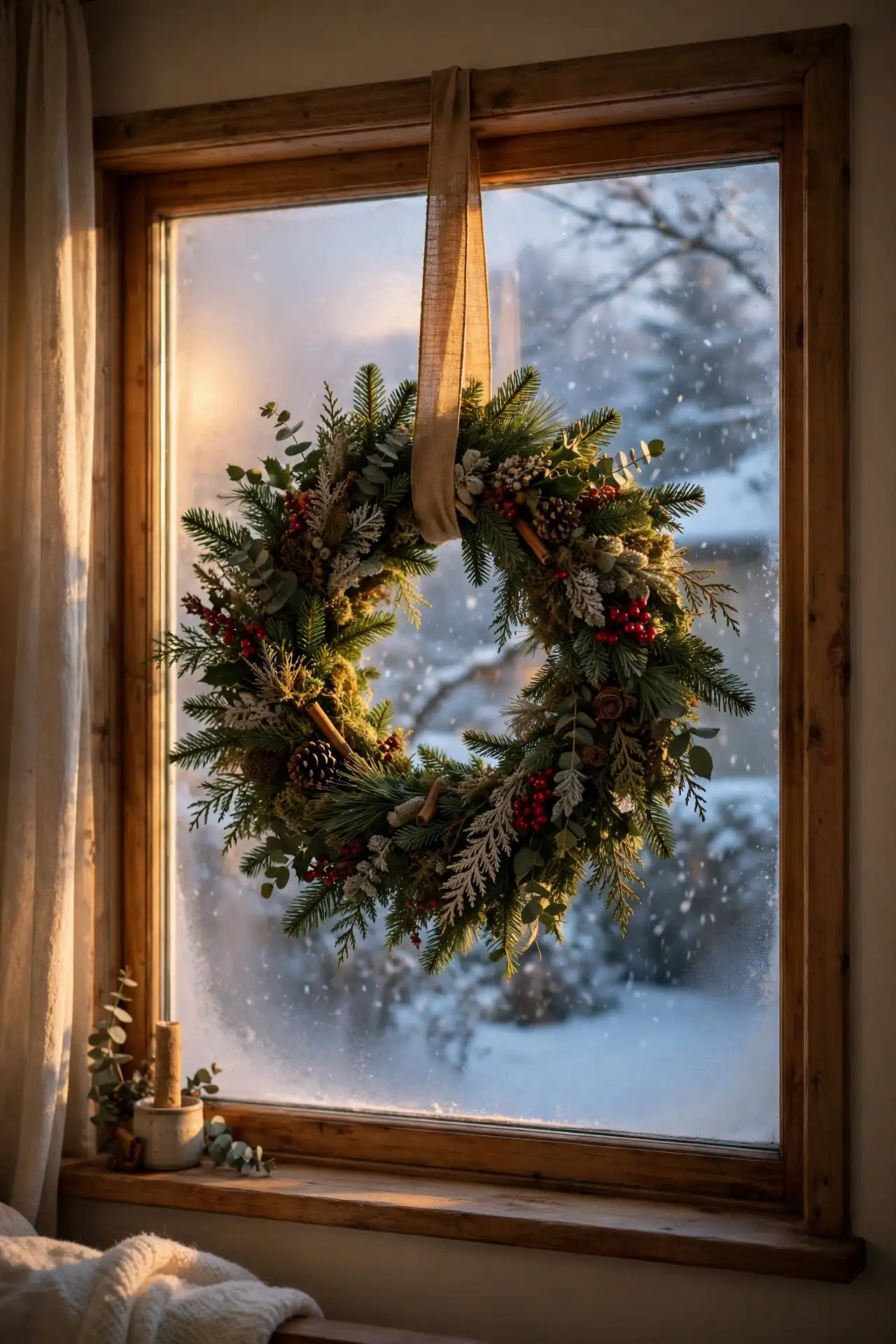
One Statement Wreath Inside the Glass
Hang a single wreath inside window glass, on the room side, where a ribbon drop and the wreath’s full texture are part of the interior. This is the move for the living room’s main window: from the sofa it is a picture, and from the street the lit silhouette still reads clearly. Choose a fuller, more detailed wreath here than you would outside, because it is seen from 6 feet, not 60.
Try it: Hang it from a removable hook on the window frame’s top edge rather than the glass. Inside glass gets condensation, and suction cups let go on cold, damp mornings.
03
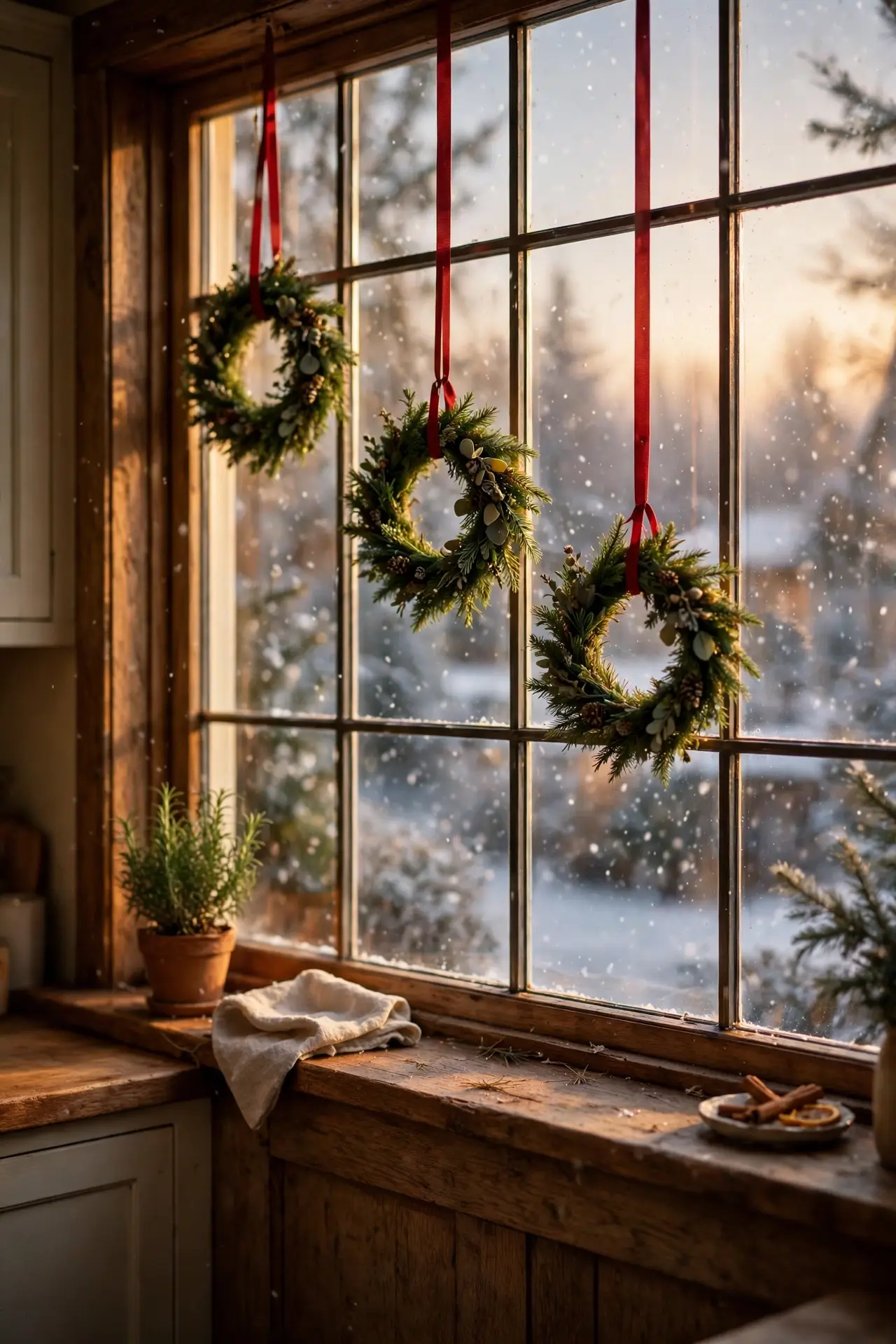
A Row of Mini Wreaths on One Wide Window
A wide picture window swallows a single wreath, so give it three small ones in a row, hung at staggered heights on ribbons of different lengths. The rhythm reads as a garland made of wreaths, and each one is small enough to store in a shoebox. Six to eight-inch mini wreaths suit this; tie the ribbons in your room’s accent color.
Try it: Keep the height stagger gentle, 2 to 3 inches between neighbors. A dramatic stagger looks like a mistake; a gentle one looks like music.
04
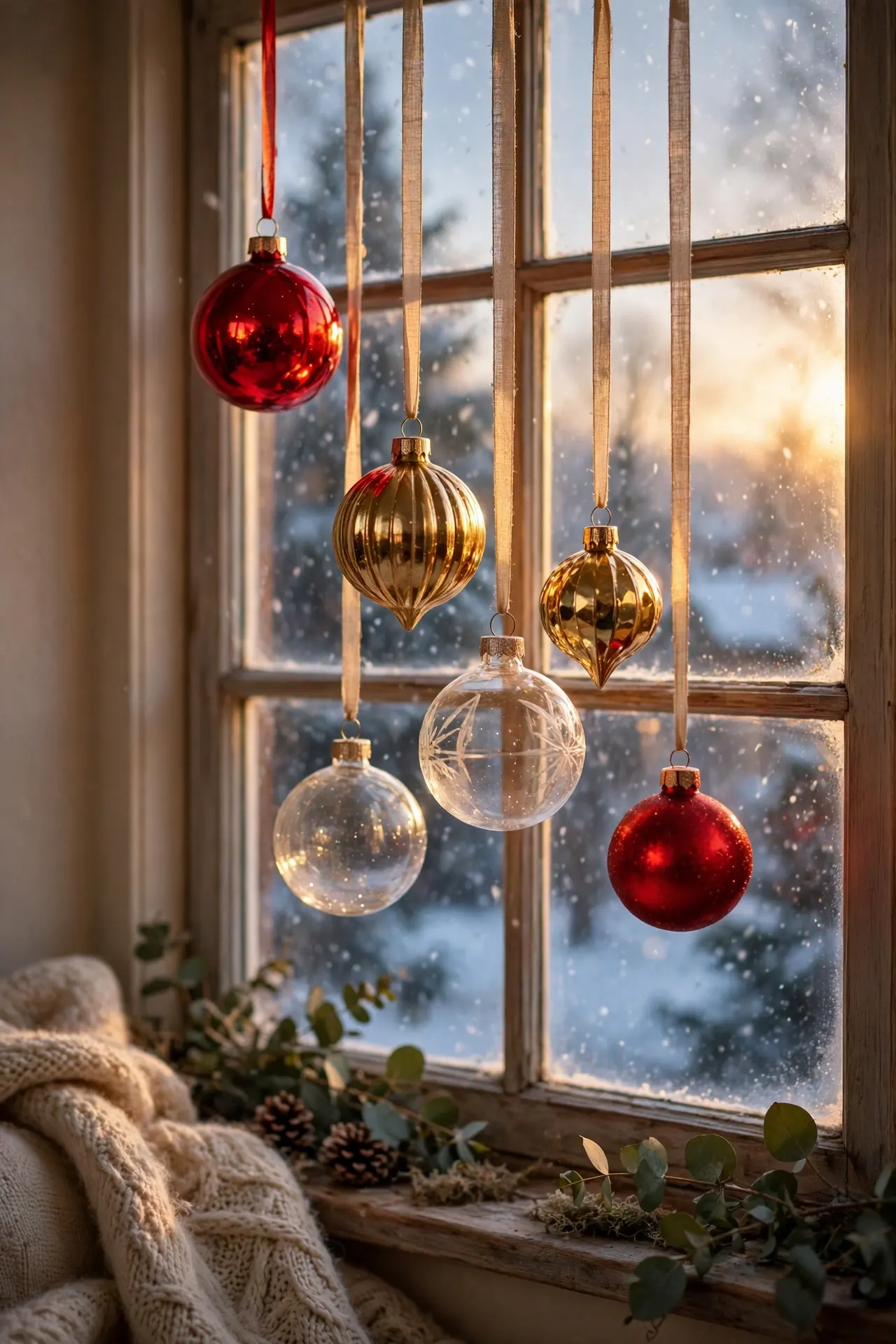
Ornaments Hanging at Different Heights
Suspend your best ornaments in the window on ribbons or clear fishing line, each at its own height, and let daylight and lamplight do the rest. Glass and metallic ornaments catch light from both sides, which makes this one of the few decorations that is genuinely better from inside. Five to seven ornaments per window is the sweet spot; more becomes a shop display.
Try it: Hang the largest ornament lowest and center. The eye lands there first, and the smaller ones read as rising sparks above it.
05
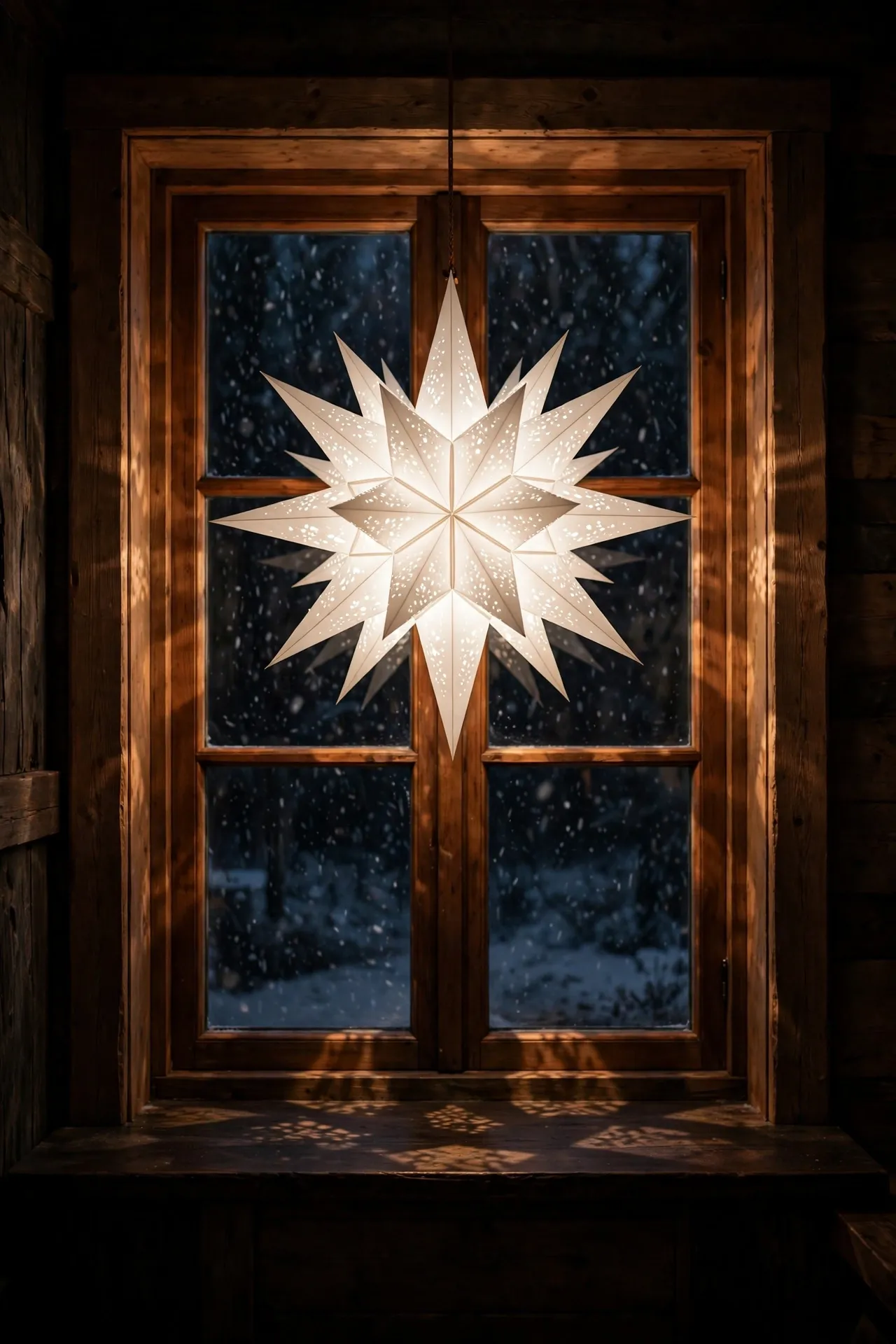
A Glowing Star in the Center Window
One illuminated paper or Moravian star hung dead-center in the main window is the minimal display that still stops traffic. The star does double duty as the room’s evening lamp, casting patterned light across the ceiling. Keep every other decoration on that window quiet so the star owns the glass.
Try it: Put the star on the same timer as the tree. A window star that lights at dusk on its own makes the whole house feel occupied and warm.
06
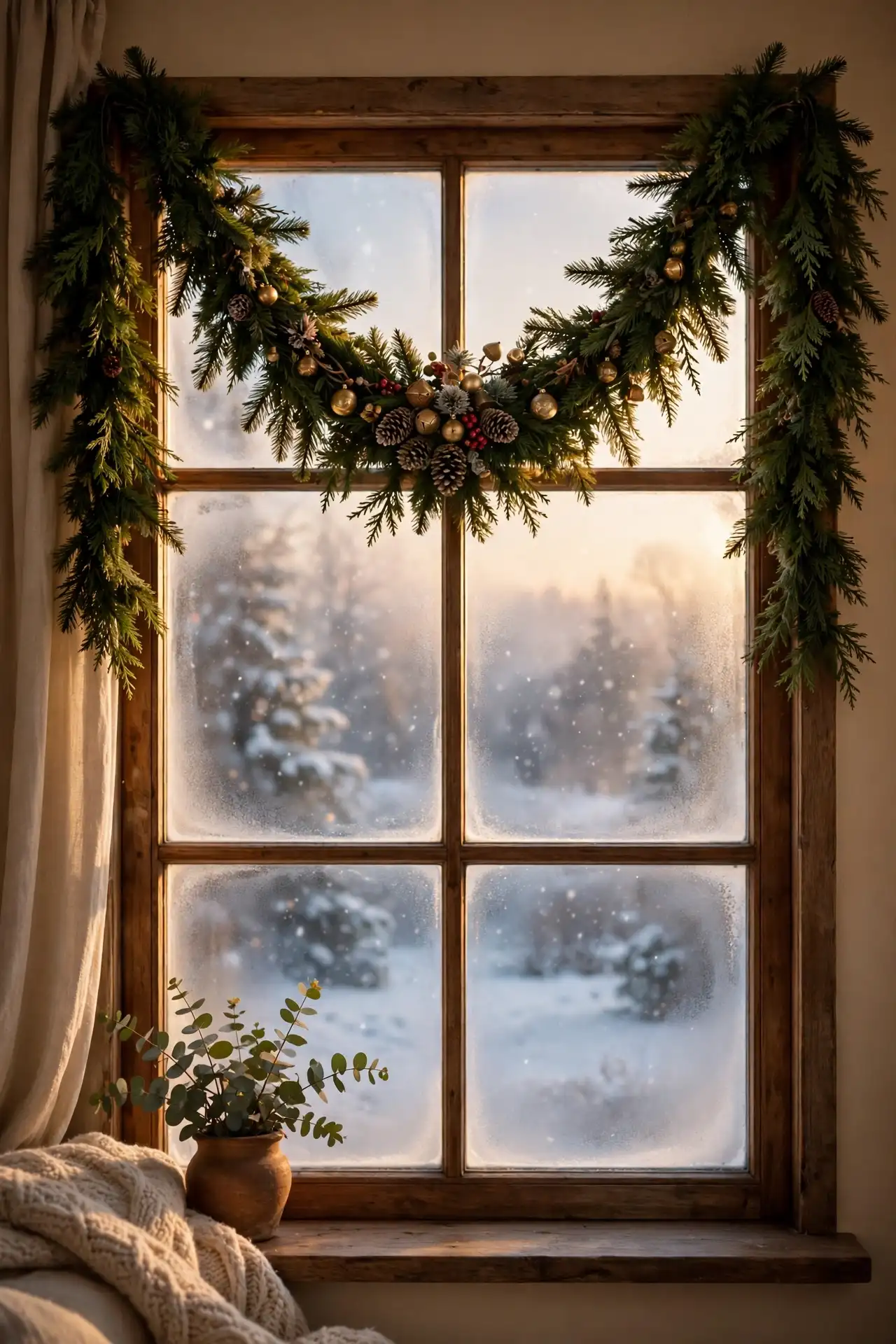
A Garland Swag Across the Top of the Frame
Drape garland in a single swag across the top of the window frame, fixed at the corners and the center, and christmas decorations on the window gain a valance that never blocks the view. From inside it frames the winter scene outside; from the street it crowns the glass. A 6-foot garland swags a standard window with a graceful 8-inch dip.
Try it: Wire two or three ornaments or pinecones into the swag’s center dip. The lowest point of the swag is where every eye lands, so give it the detail.
07
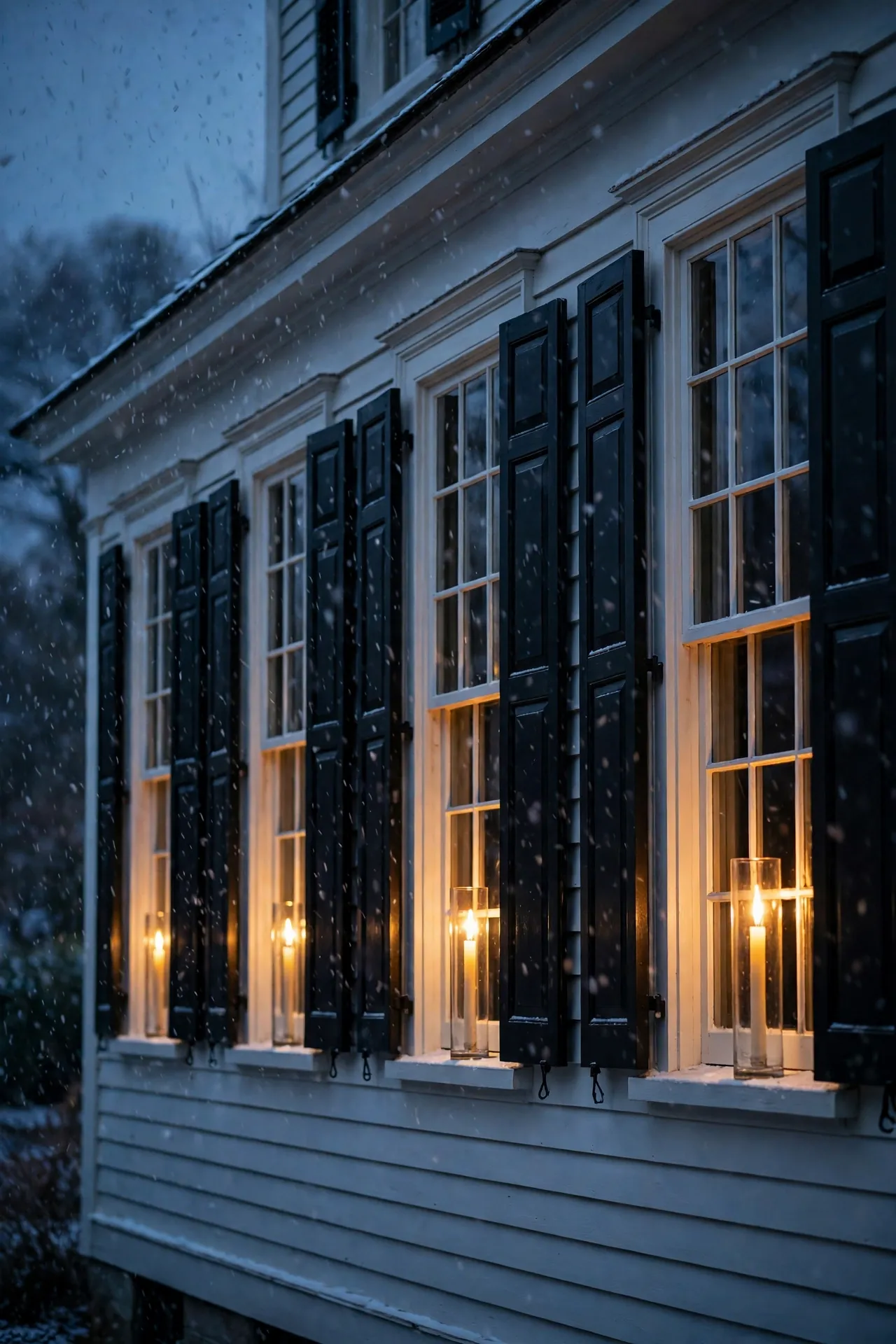
A Window Candle in Every Window
The single window candle is the oldest window decoration in America, a welcome light that once guided travelers home. One electric candle centered on each sill, all the same height and bulb color, gives a house a calm, unified glow nothing else matches. Modern versions are LED with flicker and dusk timers, so the tradition now runs itself for about $8 a window.
Try it: Choose candles with a sensor or timer and set them once in November. A candle you must switch on nightly is a candle that stays dark by December 15.
08
Candles at Varied Heights on the Sill
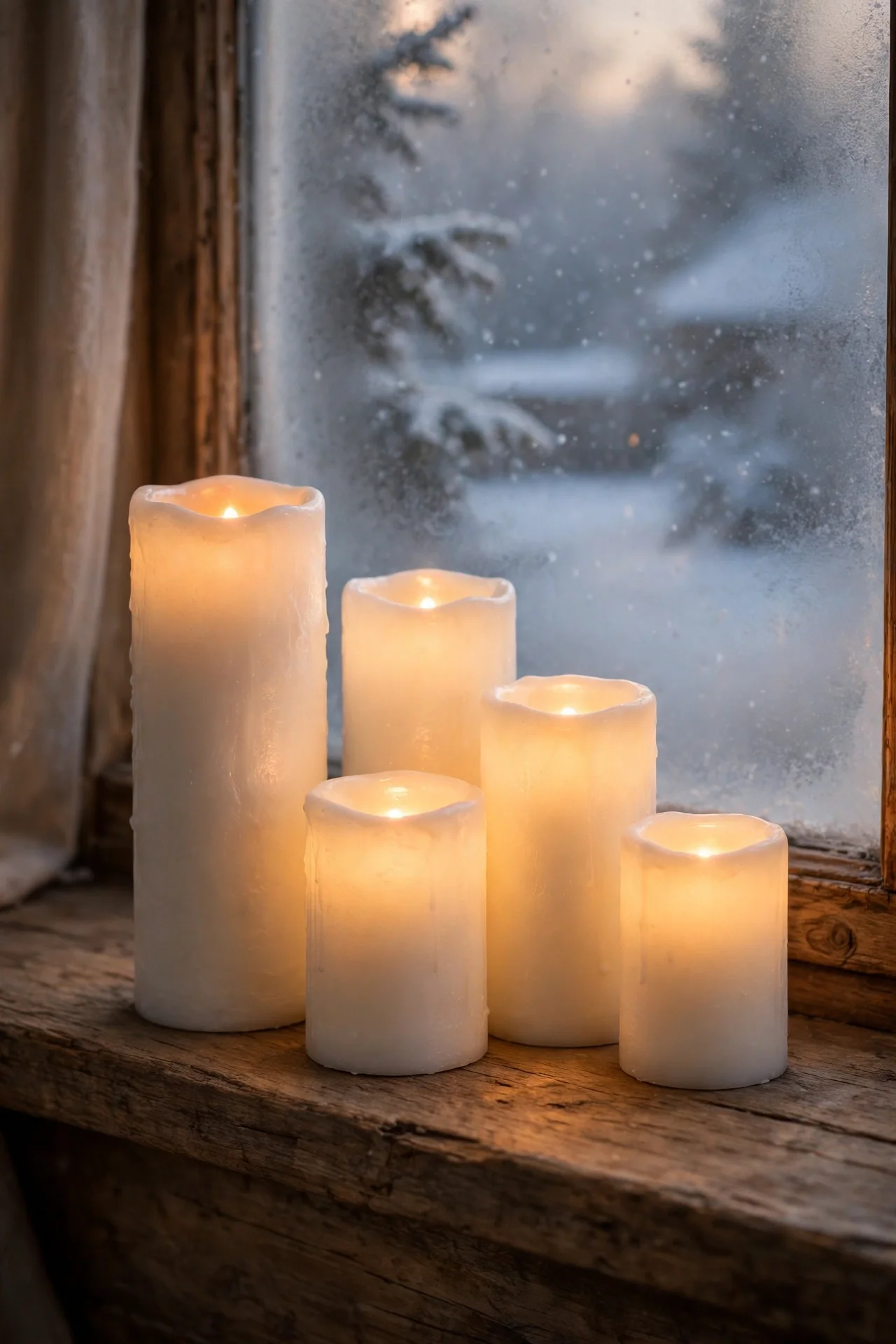
Where the single candle is formal, a cluster of three to five LED candles at different heights on one sill is a still life. Living rooms and dining rooms suit the cluster; bedrooms suit the single candle. Melted-edge flameless pillars look most real, and grouped odd numbers always read as styled rather than stored.
Try it: Put the tallest candle at the end nearest the room’s main seat. Height near the viewer layers the view out the window like a landscape.
09
Floating Candle Jars on the Sill
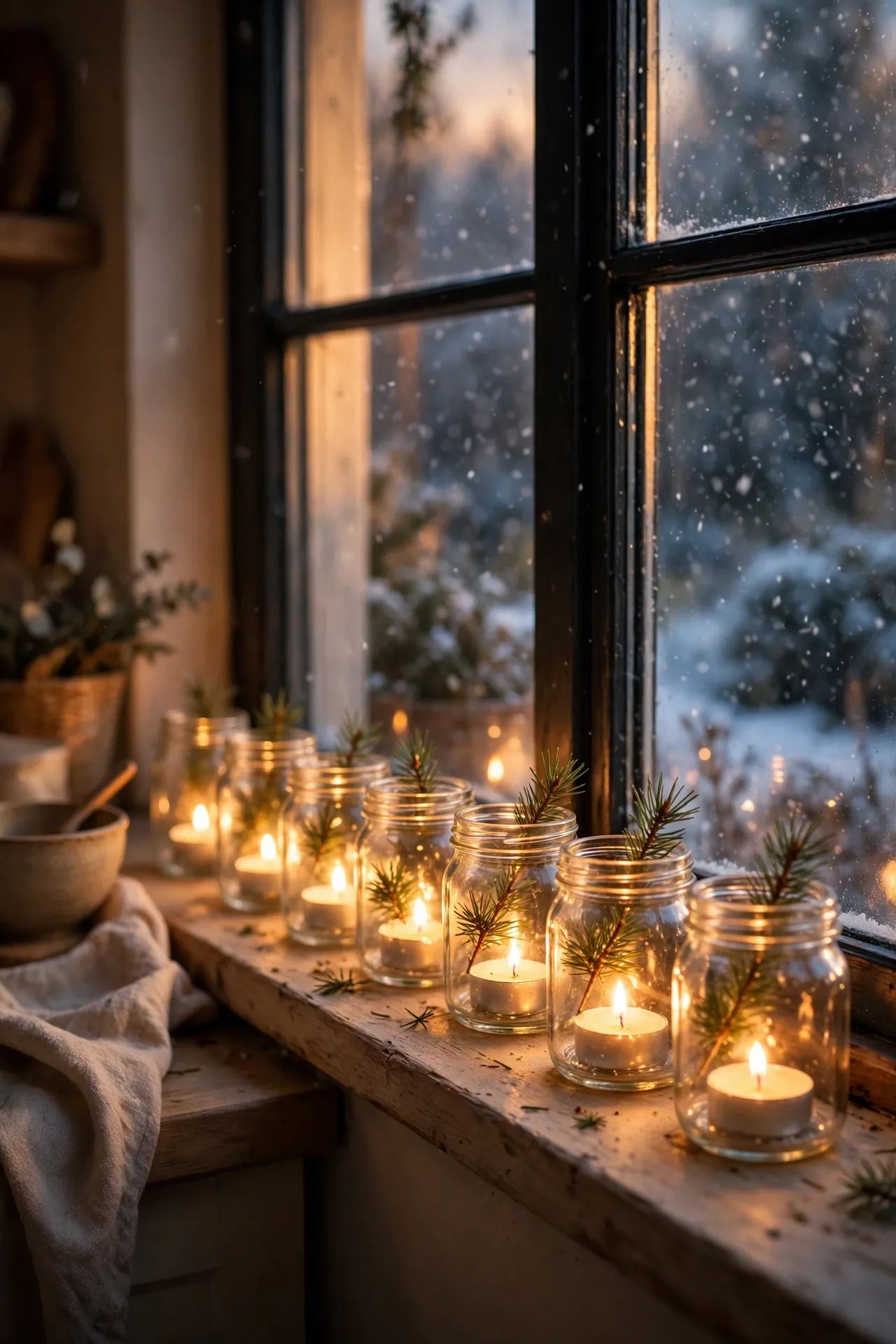
Small glass jars with battery tea lights and a sprig of pine or rosemary in each turn a kitchen or bathroom sill into a row of tiny lanterns. The glass magnifies the flicker, and the greenery scents the steam in a bathroom. Five jars cover a standard sill; the whole project costs less than one candle from a home store.
Try it: Use jars of two heights in an alternating pattern. Uniform jars look like stock; a gentle rhythm looks collected.
10
A Windowsill Village
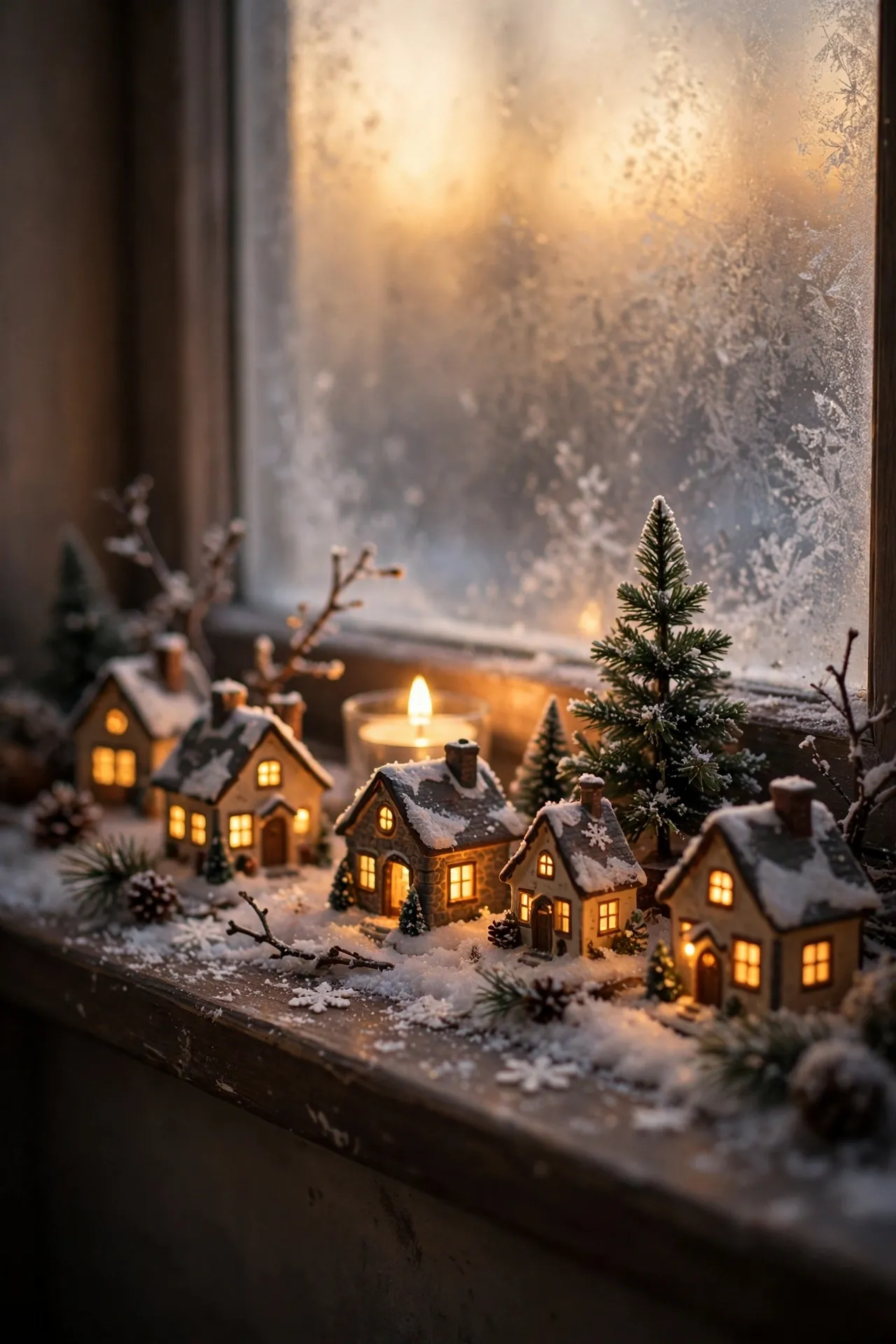
Line the sill with two or three miniature houses, a tiny tree, and a dusting of fake snow on a strip of white felt, and the window becomes a story. Backlit by daylight the village is a silhouette; at night, one tea light behind the houses makes the windows of the little houses glow. Deep sills (4 inches or more) hold a village best.
Try it: Run the felt 2 inches up the glass at the back. The village gains a snowy hillside and the felt hides the sill’s clutter line.
11
Mini Evergreens in a Row
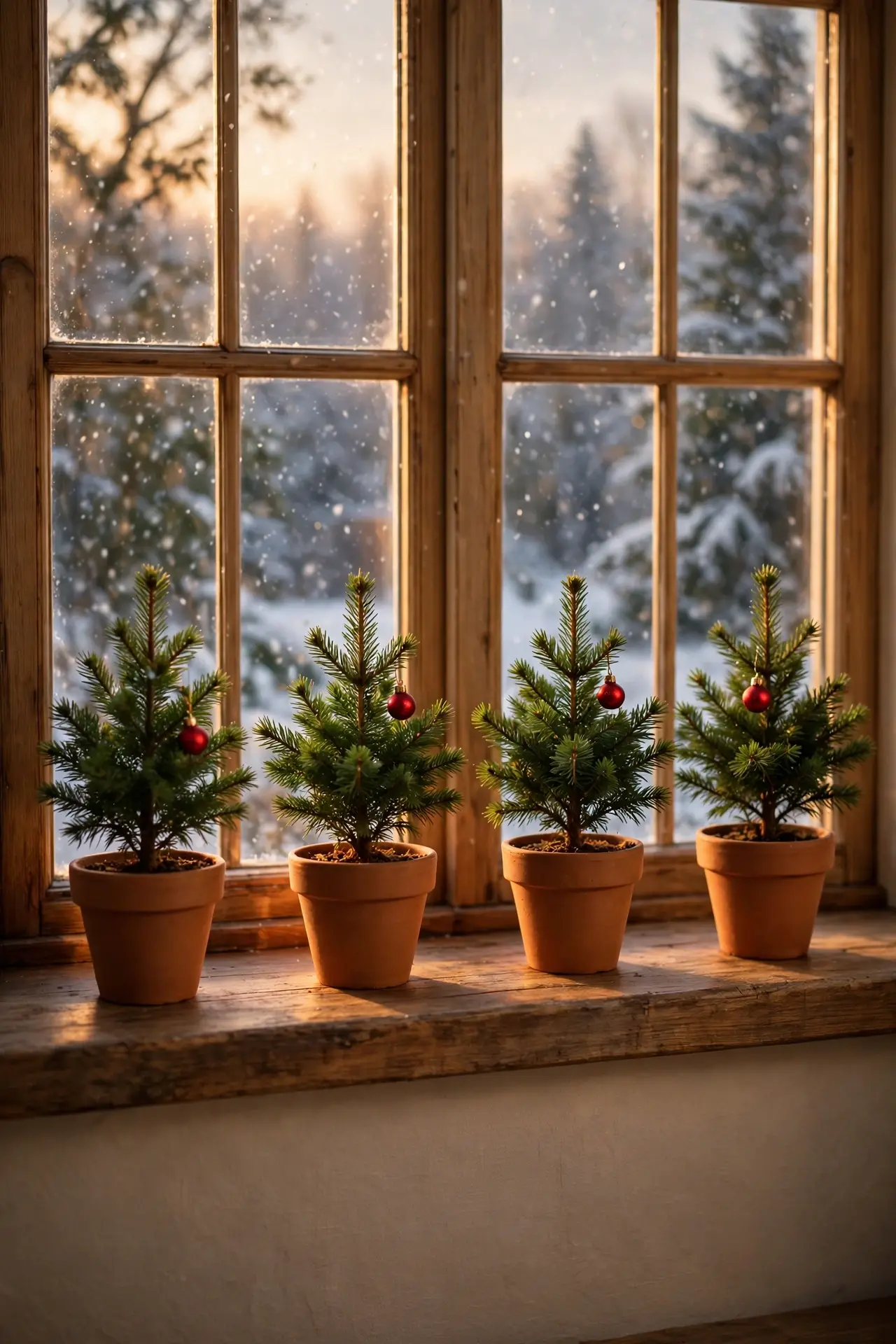
Three to five small potted evergreens, Norfolk pine, rosemary, or faux spruce in matching pots, spaced evenly along the sill give the window a living green frame all season. Real plants earn their place by staying for January in a plainer pot. Match the pots, vary nothing else; this look is about repetition.
Try it: Add one tiny ornament to each tree, the same one on each. A single red bauble per tree ties the row to the room’s palette.
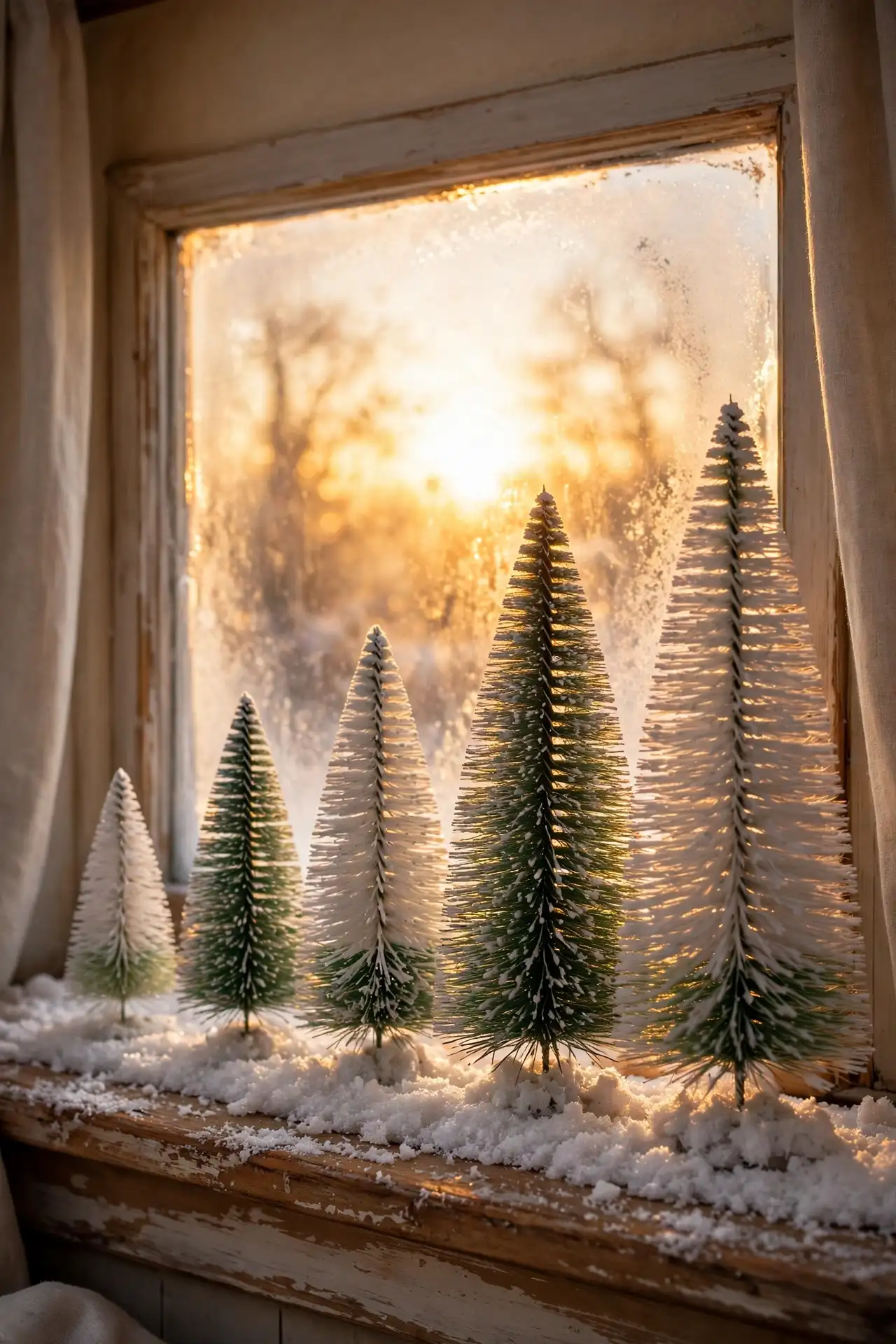
12
A Bottle Brush Tree Lineup
Bottle brush trees in graduated sizes along the sill are the playful version of the evergreen row: cheaper, lighter, and available in every color from snowy white to deep green. A lineup of five to seven trees costs under $20 total and packs flat in January. They read beautifully as silhouettes against a bright window.
Try it: Stand the trees on a strip of fake snow or white felt. Trees placed bare on a sill look parked; trees on snow look planted.
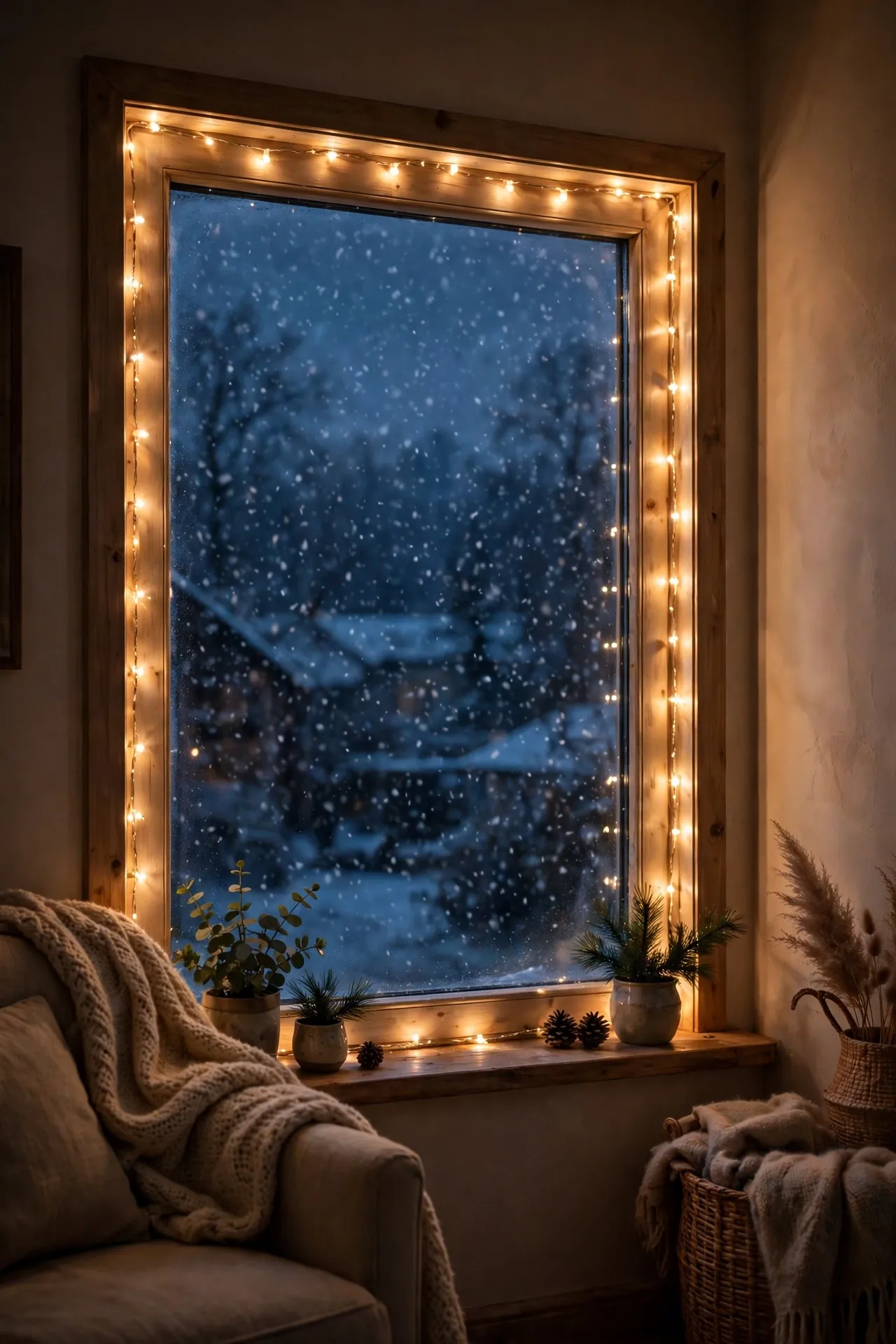
13
Frame the Glass With Window Lights
Run a strand of christmas window lights around the inside edge of the frame and the window becomes a lit picture frame for the night. Mini lights on clear wire disappear by day and outline the glass by dark. Adhesive clips every 12 inches keep the line crisp; a sagging frame of lights is worse than none.
Try it: Start the strand at the bottom corner nearest the outlet and work up and around, so the plug ends hidden behind the curtain.
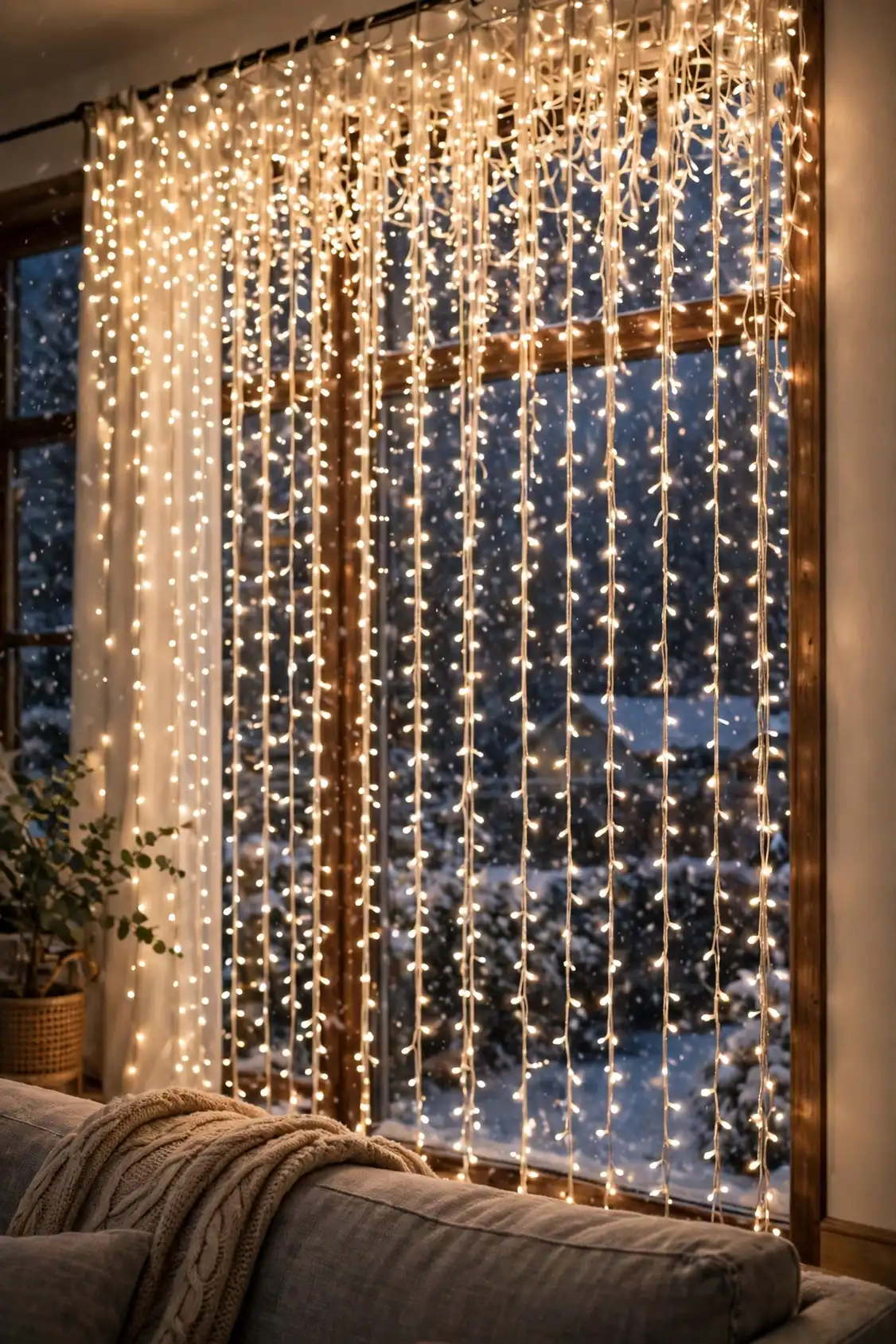
14
Curtain Lights Down the Glass
Curtain lights turn the whole window into a waterfall of light, densest at the top and sparkling all the way down. Hang them inside the glass from a tension rod or adhesive hooks, and from the room they are a backdrop; from the street they are a beacon. A standard window takes a 3-by-3-foot curtain; buy the size with a few spare drops rather than one that barely reaches.
Try it: Choose the twinkle or slow-fade setting, never the fast chase. Window curtain lights are ambiance, and fast settings turn a calm room into a departure board.
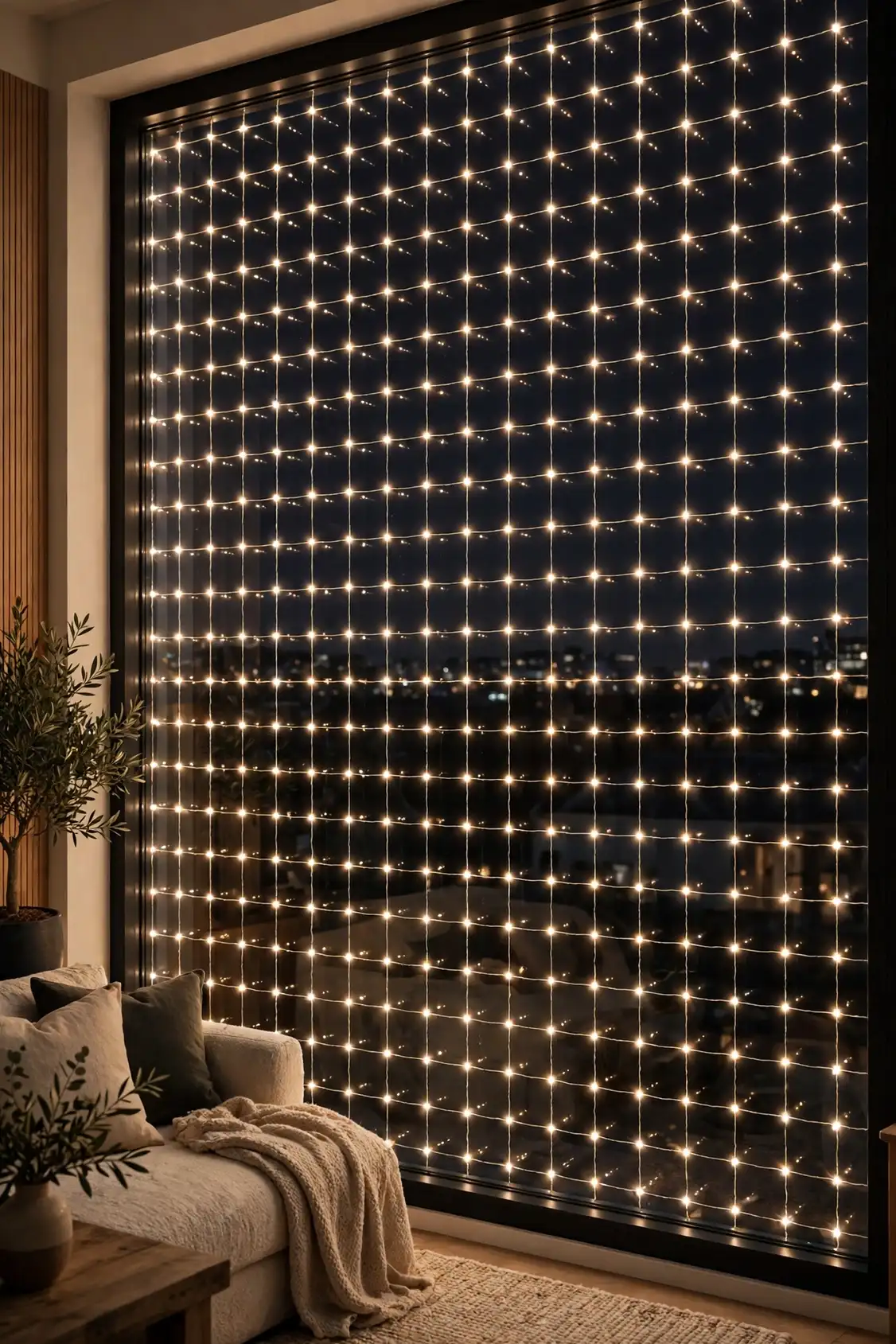
15
Net Lights for a Solid Field of Sparkle
Where curtain lights fall in strands, a net light covers the window in an even grid of light, which suits modern houses and big picture windows. Stretch the net gently on hooks at the four corners; even tension is what makes the grid look intentional. One 4-by-6-foot net dresses a large window in about five minutes.
Try it: Hang the net inside a window that faces a dark yard or street. Net lights need a dark backdrop to read as a field of stars instead of a grid of bulbs.
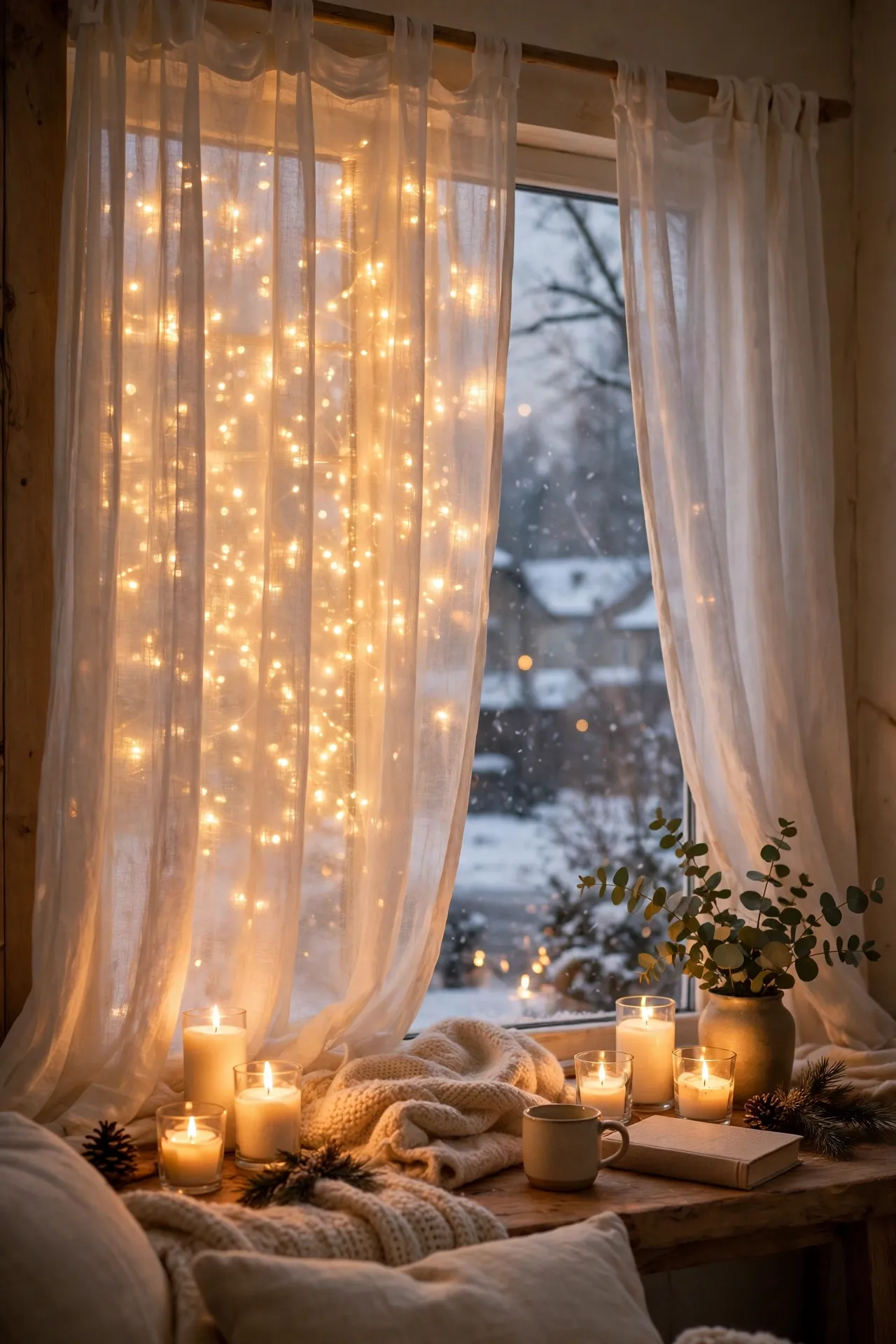
16
Fairy Lights Behind the Sheers
Weave a battery strand of fairy lights behind sheer curtains or clip it along the curtain rod, and the entire window glows like frosted glass lit from within. This is the softest light on the list and the one guests ask about. Because the lights are diffused by fabric, even cheap strands look expensive here.
Try it: Use warm white only behind sheers. Colored lights through fabric turn muddy; warm white turns to candlelight.
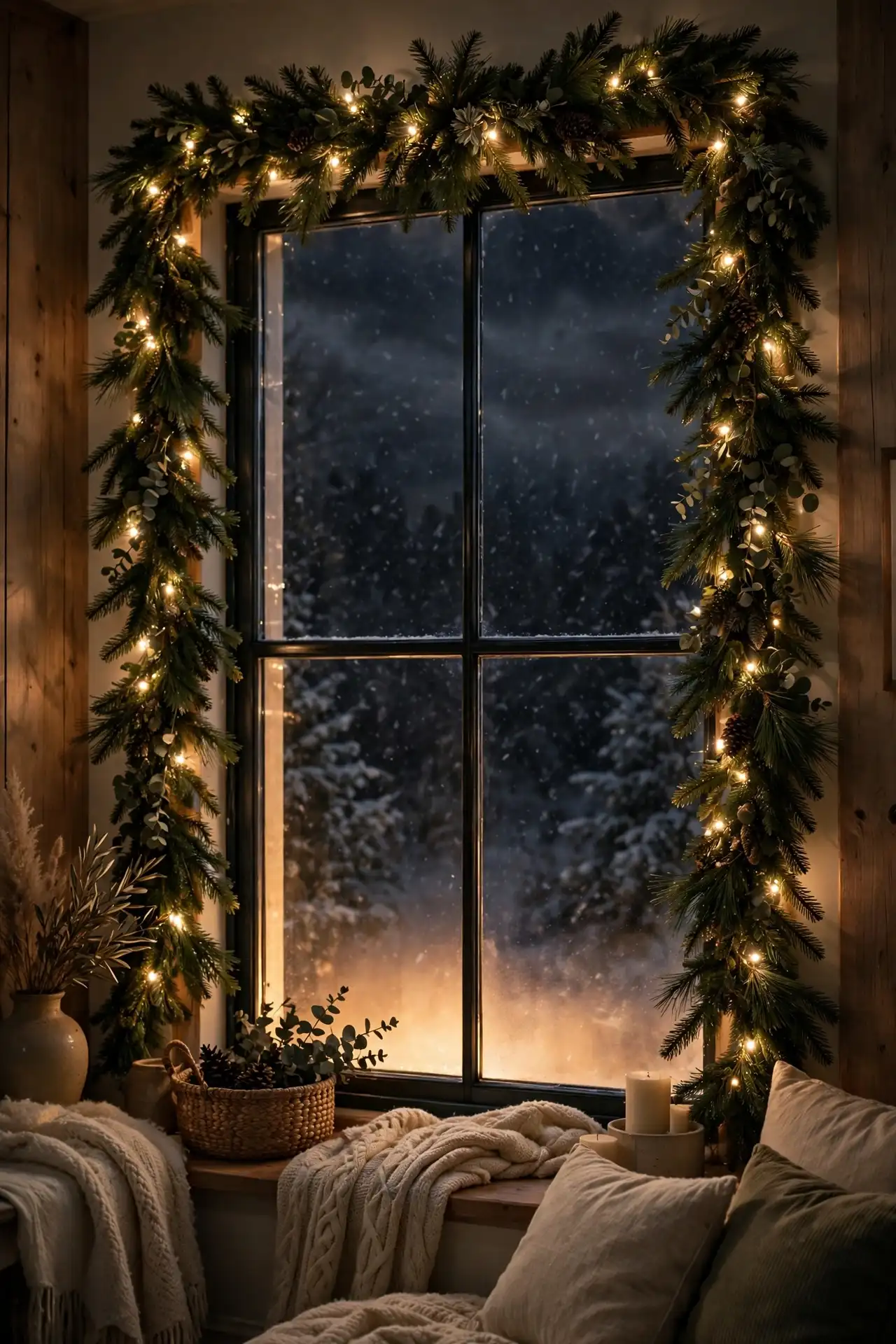
17
A Lit Garland Around All Four Sides
Frame the window completely: garland up one side, across the top, and down the other, with lights woven through. It is the fullest treatment on this list and turns the window into the room’s second fireplace, a glowing rectangle everyone orients toward. Prelit garland makes it one piece to hang and one piece to store.
Try it: Keep the bottom of the frame bare. Garland along the sill traps dust, blocks the sill displays, and visually closes the window; three sides frame it, four sides box it.
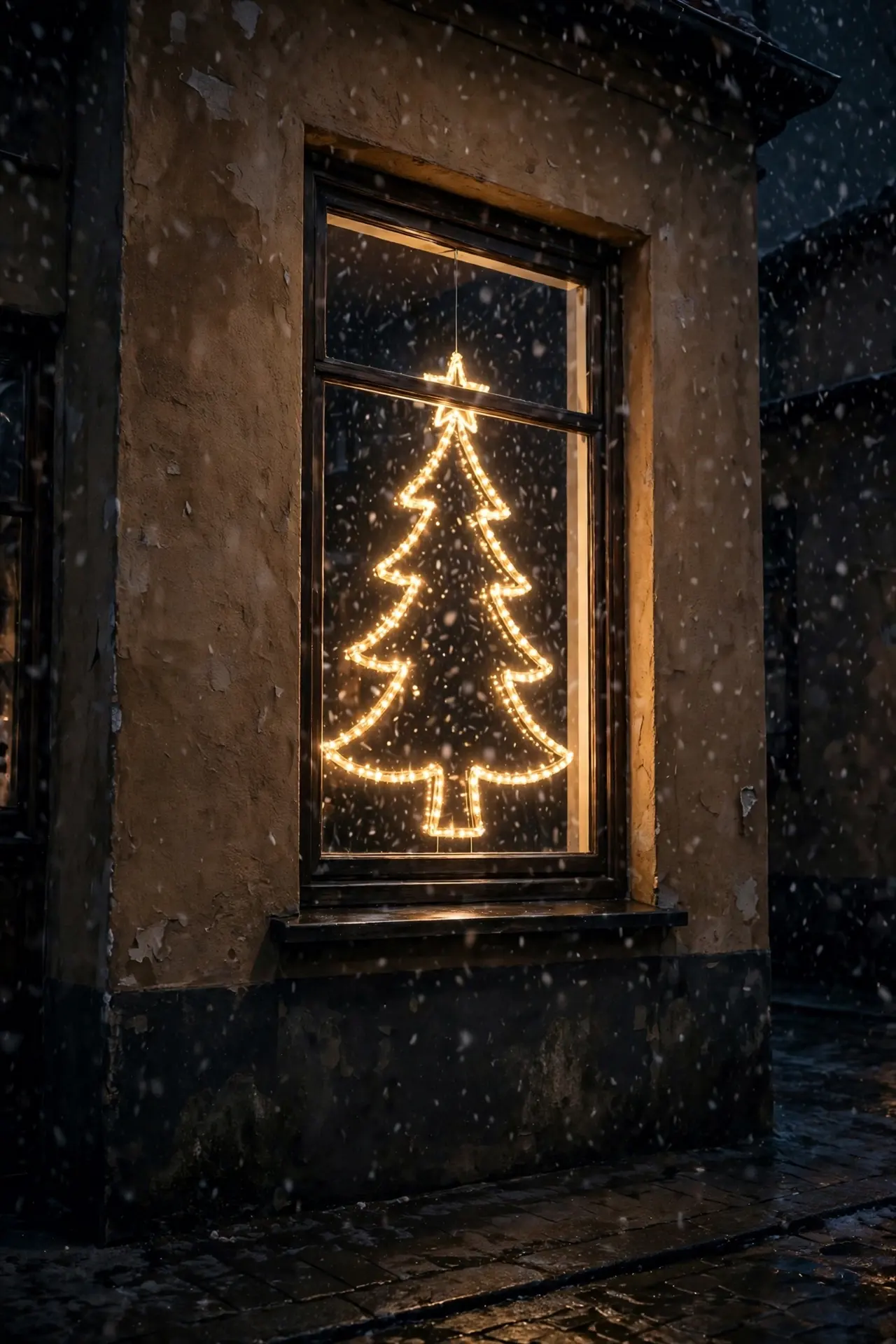
18
A Lighted Silhouette in the Glass
Framed light silhouettes, a Santa, a snowman, a simple tree outline, hang in the window like a lit sign made of pure outline. They are the boldest choice here and read from the far end of the street. One silhouette per house is a statement; one per window is a billboard, so choose the main window and let it work alone.
Try it: Center the silhouette and clear the sill below it completely. An empty sill under a silhouette is what makes it look like art instead of clutter.
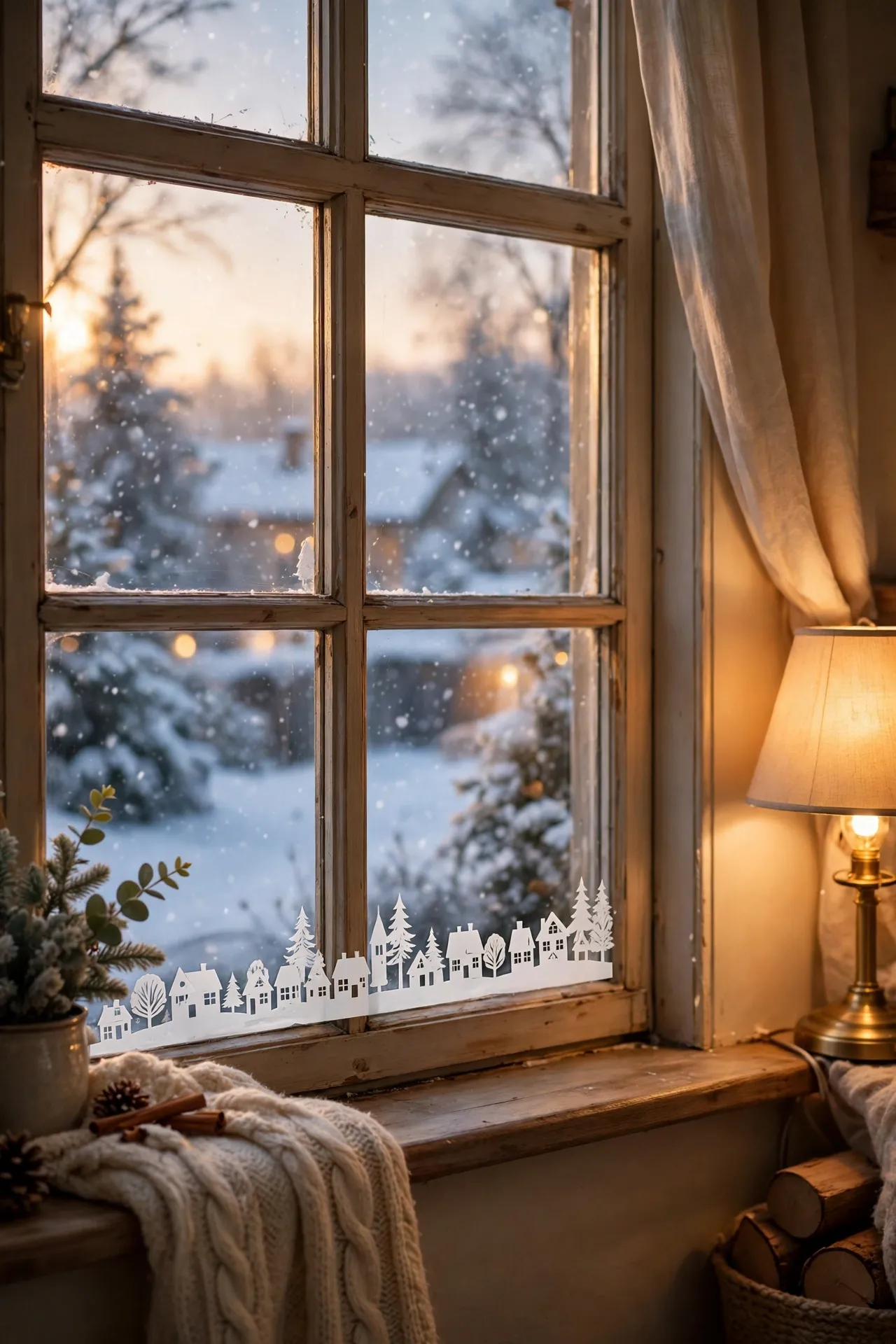
19
Window Clings: The Winter Village
Christmas window clings are the renter’s and parent’s champion: a full winter village across the glass for under $10, up in ten minutes, gone in January without a trace. Build the scene along the bottom of the glass like a skyline, houses and trees at sill level, so from inside it sits below your sightline and from outside it reads as a little town.
Try it: Apply clings to clean, dry, room-temperature glass and press from the center outward. Bubbles trapped on day one are still there on Christmas.
20
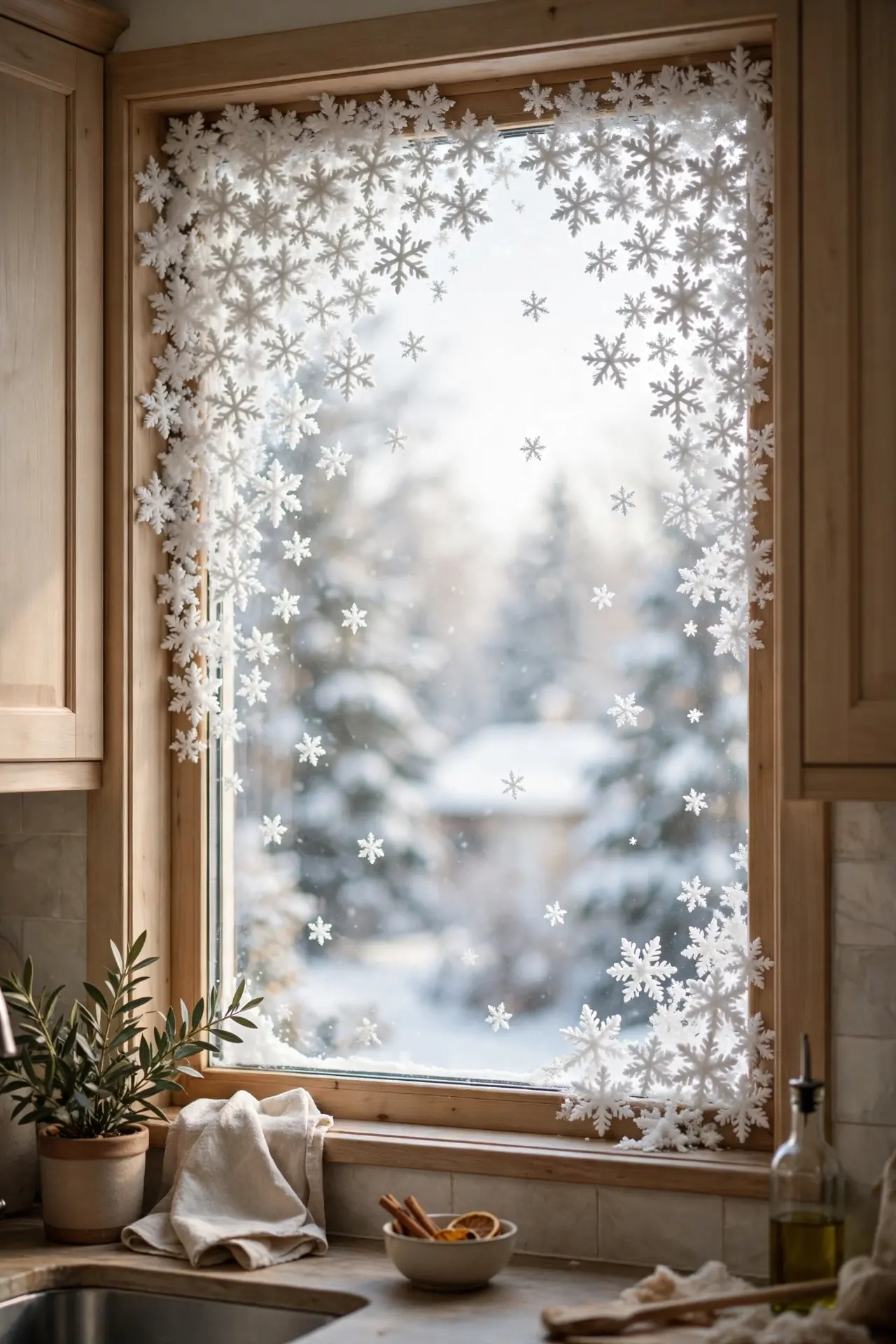
Snowflake Clings Like Falling Snow
Scatter snowflake clings across the whole window, dense at the top corners and thinning toward the middle, and the glass itself looks like weather. Vary the sizes, a few large statement flakes among many small ones, because real snowfall is not uniform. This is the best use of a window you do not want to block, like a kitchen window over the sink.
Try it: Cluster a small group low in one corner, as if snow is drifting. One drift cluster turns random flakes into a scene.
21
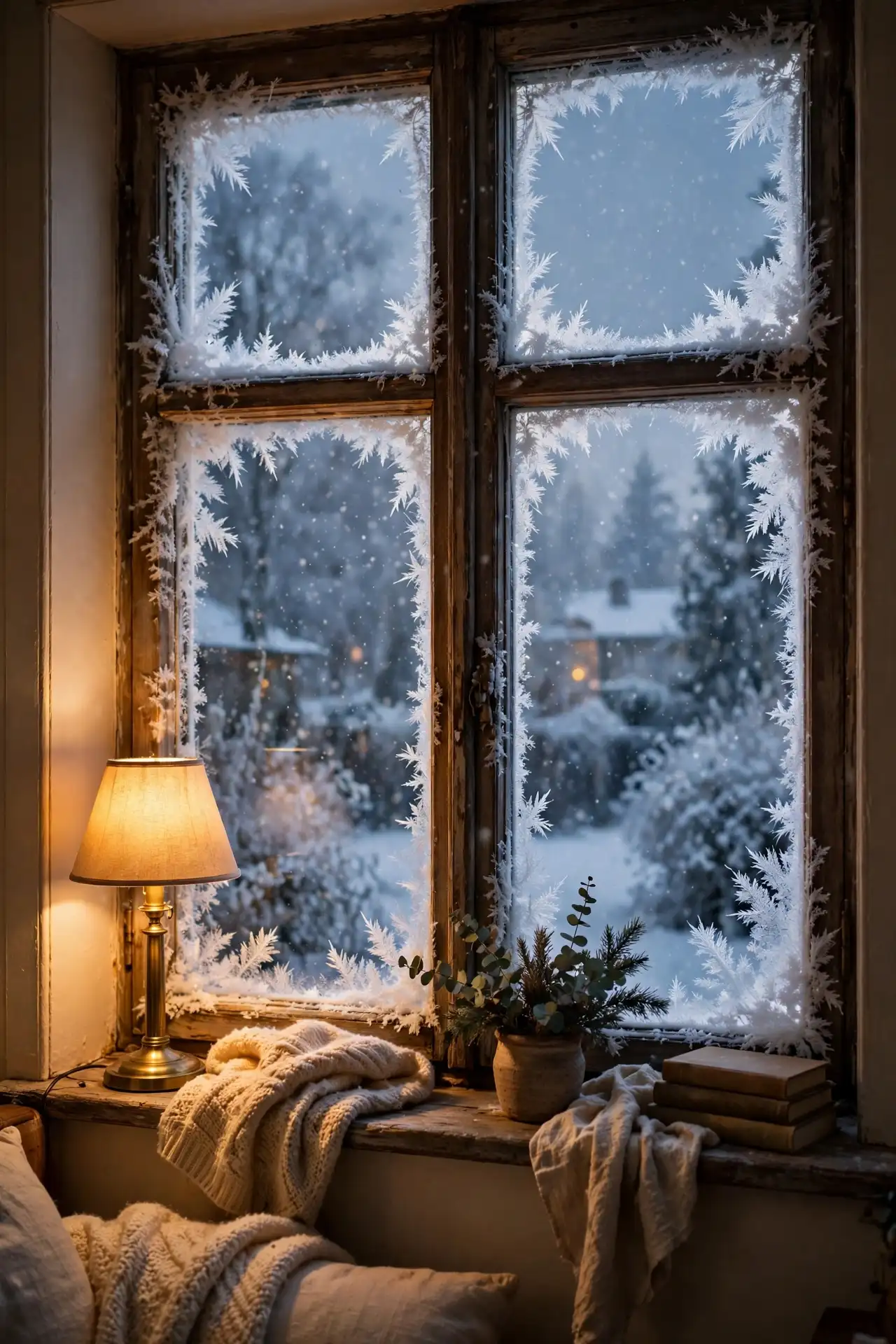
Frost Spray in the Corners
A stencil and a can of snow spray frost the corners and edges of the glass, leaving the center clear for the view. It costs about $5, survives the whole season indoors, and wipes off with a damp cloth in January. Corner frosting suits traditional houses especially, where it recalls real frost on old single panes.
Try it: Spray lightly in two passes instead of one heavy coat. Heavy spray runs and blobs; two light passes build a frost that looks grown, not sprayed.
22
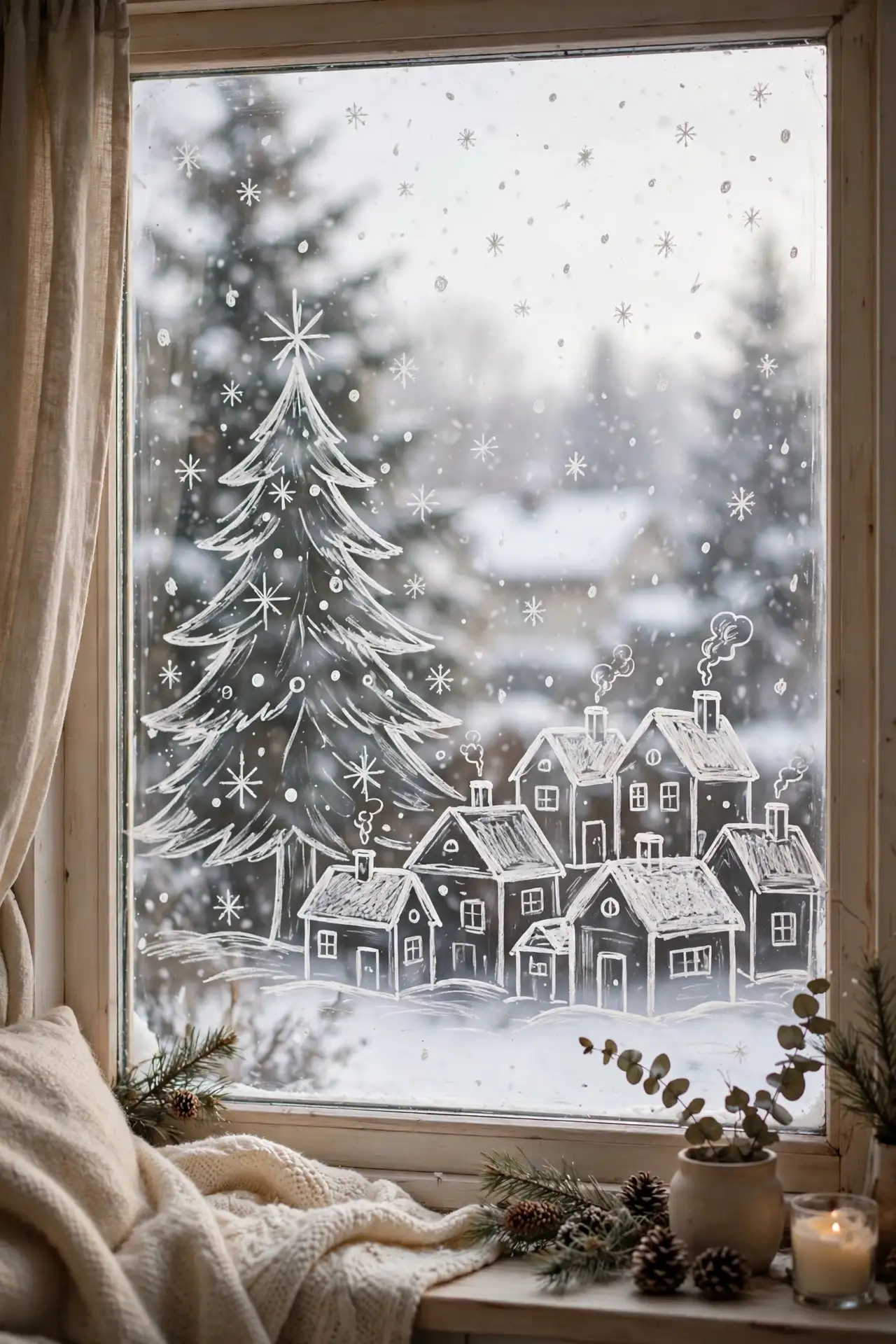
Draw It Yourself With Chalk Markers
Liquid chalk markers turn the window into a sketchbook: a tree, a row of houses, falling snow, a greeting written to be read from the street (write it reversed, or draw from outside). It is the most personal idea here and a genuine afternoon project with kids. Mistakes wipe off with a damp cloth, which is the whole point.
Try it: Sketch the design on paper first at window scale. Freehand confidence is real, but a paper plan keeps the tree centered and the letters even.
23
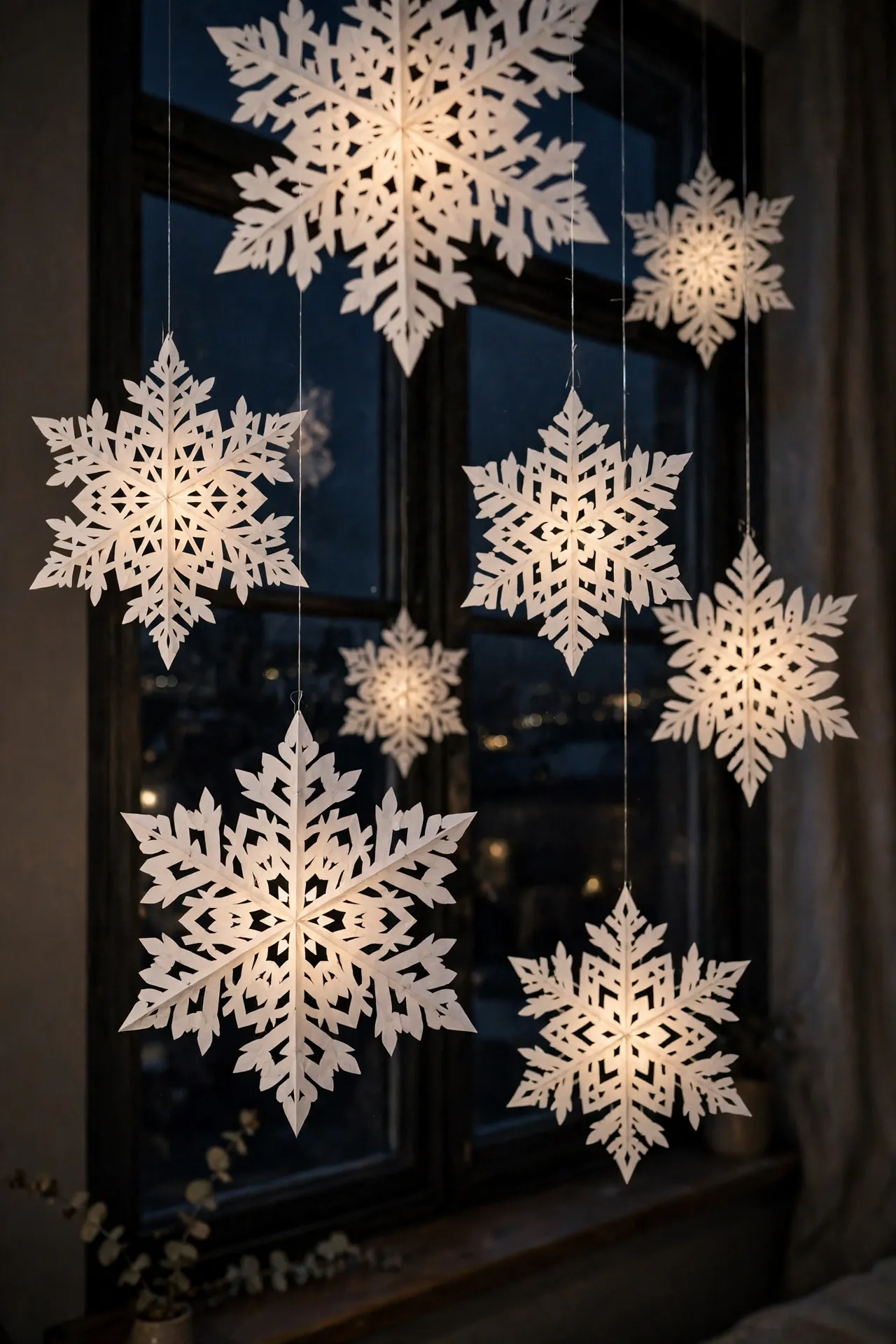
Big Paper Snowflakes
Folded paper snowflakes are a cliché because they work, but size is everything: cut them large, 8 to 12 inches across, from proper cardstock, and they read as design instead of craft time. White and silver paper glow against dark evening glass. Hang them at varied heights on clear thread rather than taping every one flat.
Try it: Iron finished snowflakes flat under a heavy book overnight. Crisp, flat flakes look printed; curled ones look like homework.
24
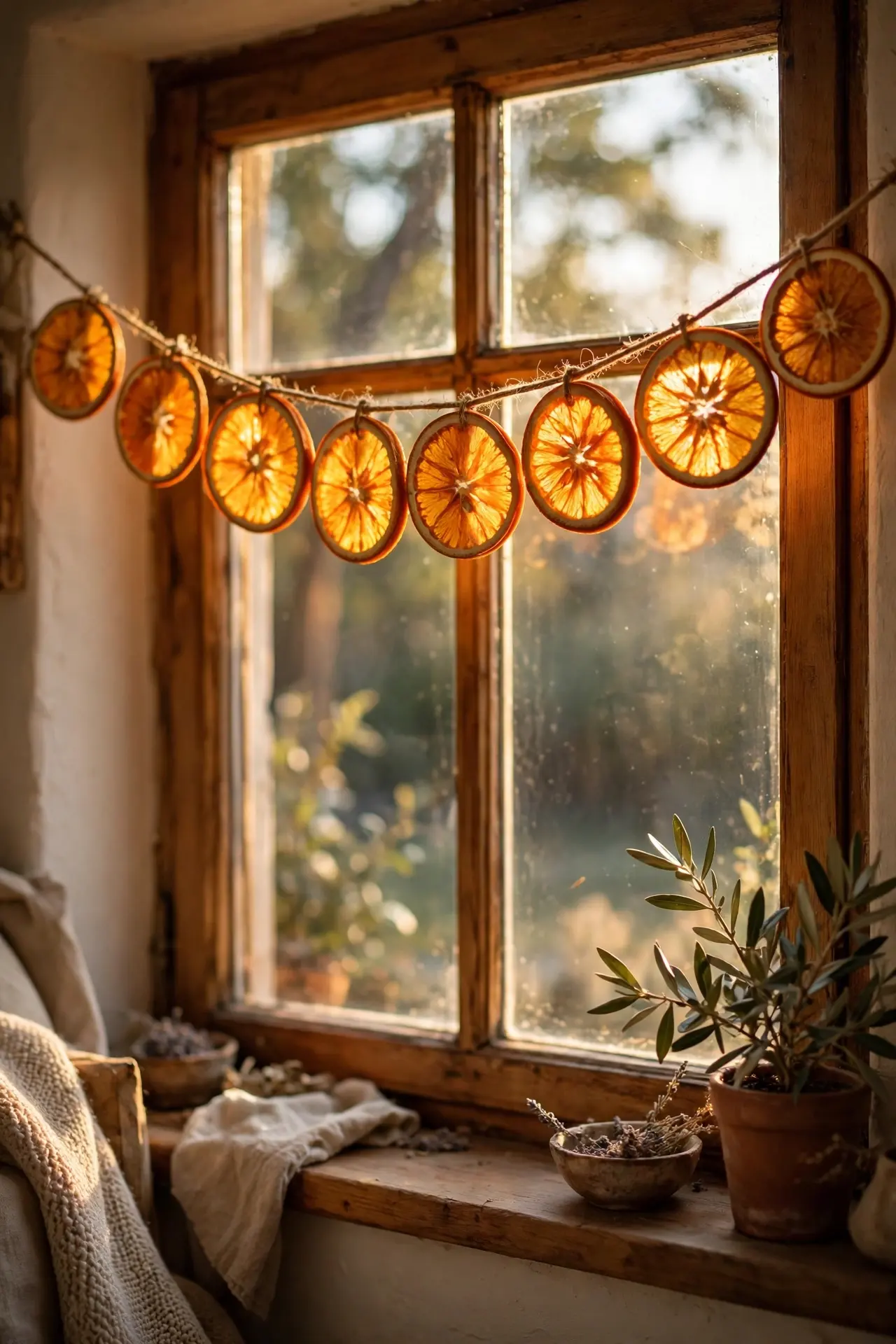
An Orange Slice Garland Across the Glass
Thread dried orange slices on twine and hang the garland across the upper third of the window, where daylight shines through the slices like stained glass. It is the prettiest natural decoration on this list and the only one that improves as the sun moves. A 5-foot garland takes about 15 slices, dried low and slow so they keep their color.
Try it: Dry slices at 200°F for 2 to 3 hours, turning hourly. Rushed, hotter drying browns the edges and dulls the glow.
25
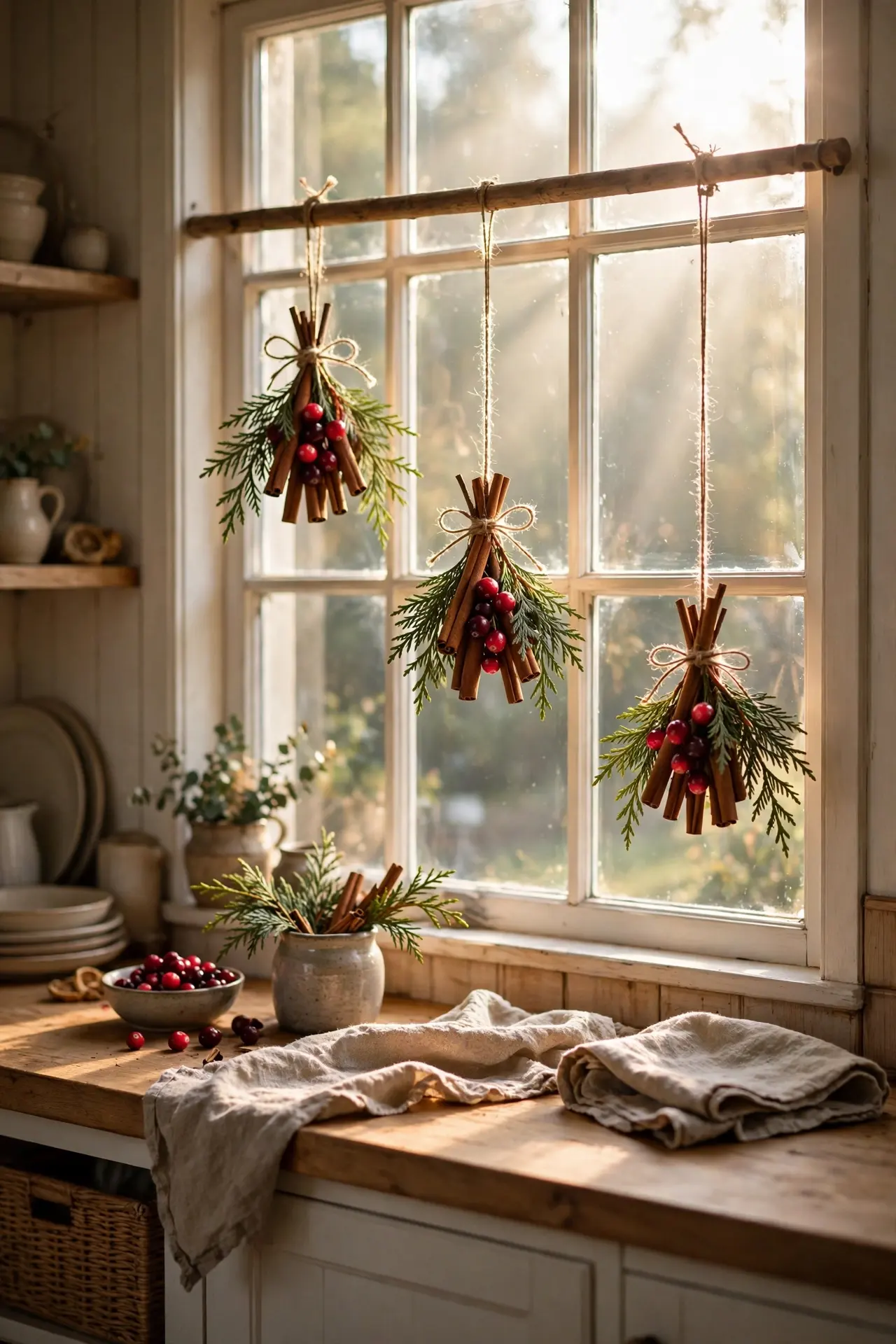
Cinnamon and Cranberry Bundles
Tie small bundles of cinnamon sticks, a few cranberries, and a sprig of cedar with twine, and hang them at uneven heights in a kitchen or dining window. They scent the room every time the sun warms the glass, which no plastic decoration has ever done. Make them fresh in early December and they last the season.
Try it: Hang bundles where morning sun hits the window. Warm cinnamon at breakfast is the whole argument for this idea.
26
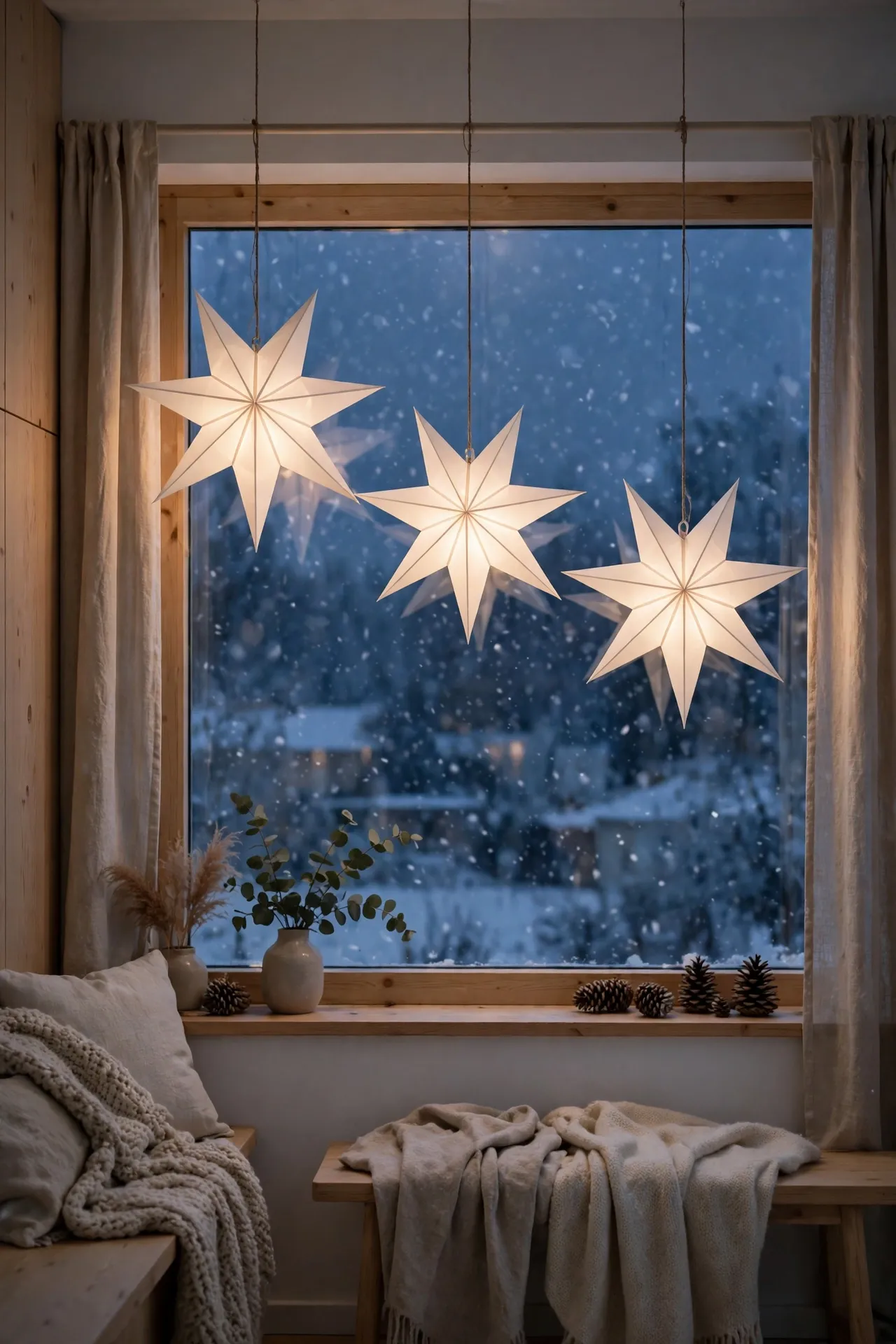
A Row of Paper Stars
Hang three paper star lanterns in a row across a wide window, lit or unlit, and you have the Scandinavian window: calm, geometric, unmistakably Christmas. Unlit by day they are sculpture; lit at dusk they are the room’s softest lamps. Keep the row to odd numbers and one color family, usually white or natural kraft.
Try it: Vary the drop lengths by just 2 inches across the row. A perfectly level row looks installed; a breathing row looks styled.
27
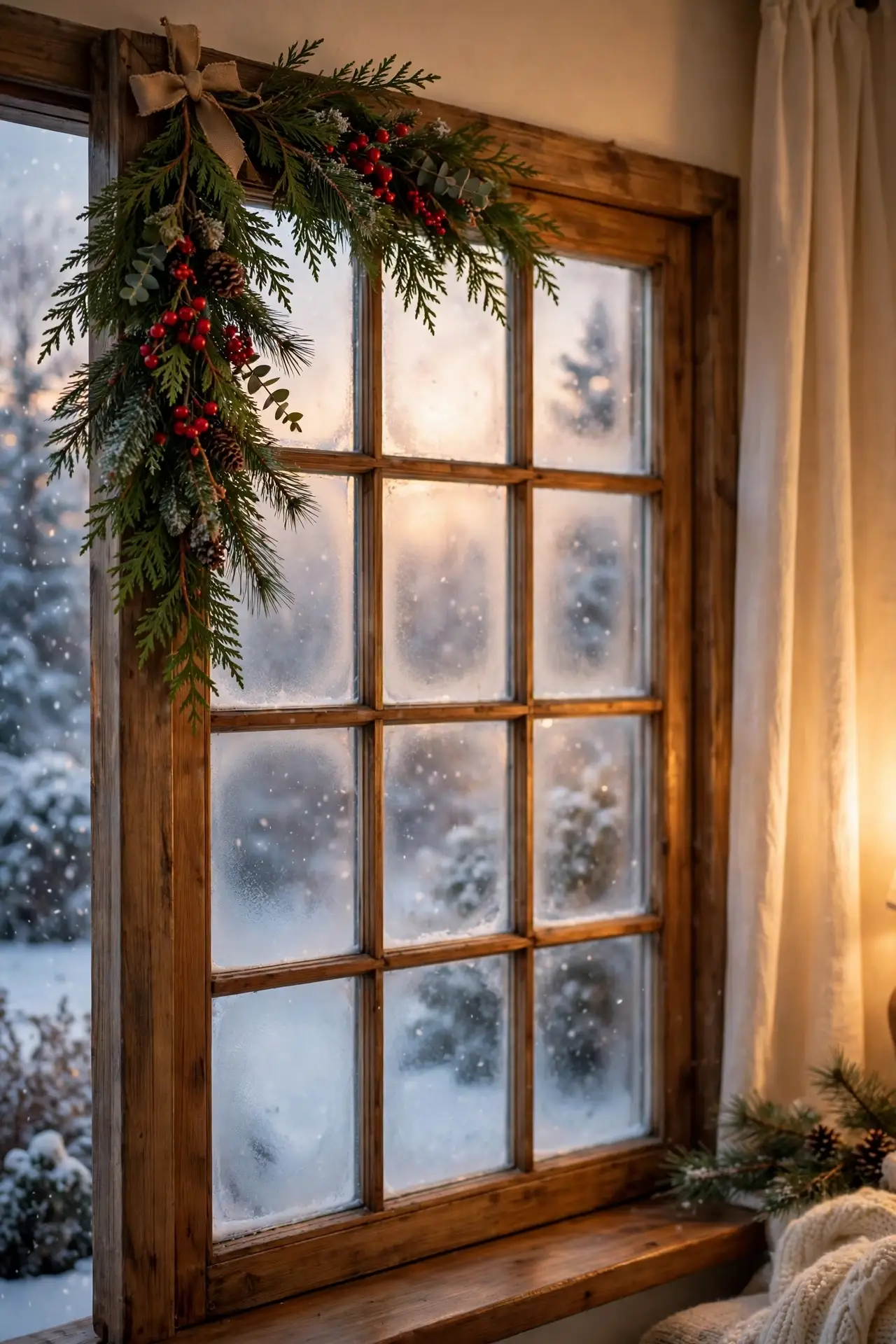
A Fresh Greenery Swag With Berries
A swag of real cedar or pine, wired with red berries and a bow, hung at the top corner of the frame brings the smell of a tree lot into the room for about $10 at a garden center. Fresh greenery indoors lasts two to three weeks before it crisps, so hang it in mid-December, not November. Mist it when you water the plants.
Try it: Hang the swag at one corner, not the center. Asymmetry at the corner feels like a florist did it; dead center feels like a door swag that wandered in.
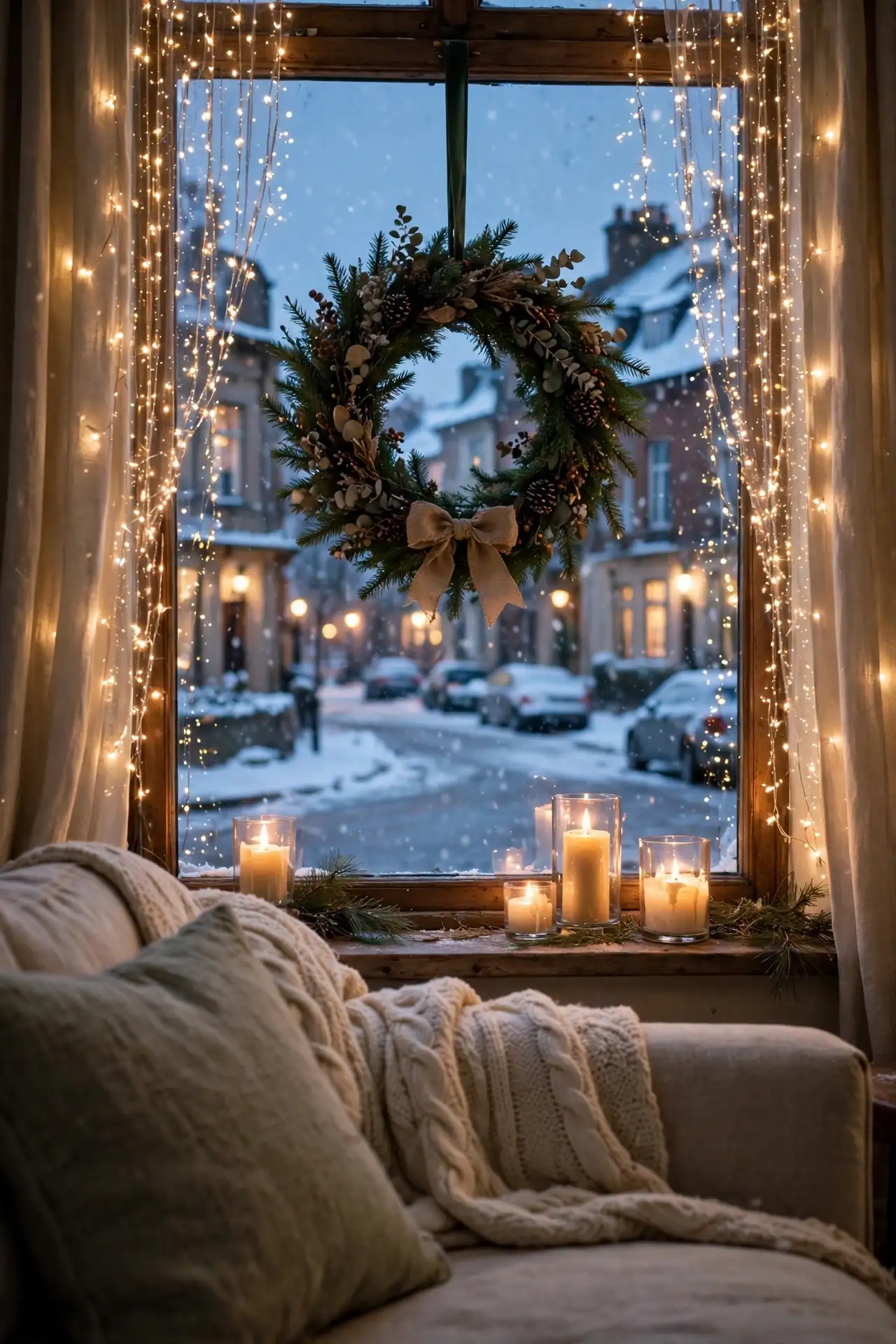
28
The Two-Sided Check That Fixes Every Window
Before you call any window done, look at it twice: once from the street at dusk and once from the room’s main seat. The street view wants symmetry, light, and size; the room view wants texture, detail, and nothing blocking the daylight. Every christmas decorations inside windows display that fails, fails on one of these two views, and both take ten seconds to check.
Try it: Photograph both views on your phone. The street photo shows sizing mistakes; the sofa photo shows clutter. Fix what the photos show, not what your eyes excuse.
Pro tip: Whatever you hang on the glass, test it on the coldest morning before committing to every window. Suction cups, static cling, and adhesive all behave differently on cold glass, and the window by the front door is always the coldest. One test window in November saves a house-wide redo in December.
If the planters outside your glass need their own moment, our christmas window box ideas cover the exterior side of the glass. For the full house, browse all our christmas decor ideas or the whole Christmas Decor collection.
Three rules for christmas window decor
- Size to the glass, not the shelf: A wreath at one-third to one-half the window’s width, a silhouette at about half, a village along the bottom edge. Decorations sized for mantels and doors shrink on glass; when in doubt, go one size up from your instinct.
- Light from behind or within: Every window display needs its light source inside the treatment: a candle behind the wreath, lights inside the garland, a tea light behind the village. A window lit only by the room looks flat from the street after dark.
- Keep the daylight deal: Windows still have a day job. Keep the center of at least the main windows mostly clear, concentrate decor at frames, tops, corners, and sills, and the room stays bright while the glass does the decorating.
After Christmas: the window reset
- Clings and decals first: Peel clings while the glass is at room temperature, lay them flat on their original backing sheets or wax paper, and store them flat in a folder. Folded or wadded clings never lie flat again.
- Candles and lights in one box: Window candles, curtain lights, and nets go in a single labeled window box with the suction cups and hooks in a zip bag taped inside the lid. Next year the whole window kit comes down in one trip.
- Wash the glass as you undecorate: January glass carries spray residue, adhesive ghosts, and cling outlines. A vinegar wash while the windows are bare resets them completely, and you start next December with invisible glass.
Questions readers ask
How do you hang a wreath on a window without damage?
Three damage-free ways: a suction cup rated at least twice the wreath’s weight on clean glass, a ribbon looped over the top sash and closed in the window, or a pair of magnetic hangers if the frame is metal. The ribbon method is the strongest and leaves nothing on the glass at all.
What size wreath is right for a window?
One that spans about one-third to one-half of the window’s width. For a standard 28 to 36-inch double-hung window that means a 12 to 16-inch wreath. Go smaller only in groups, as with the mini wreath row, where three small wreaths share one wide window.
Are candles in windows safe?
Electric and LED window candles are completely safe, and they are what almost everyone uses: no flame, no heat, and timers that run them only from dusk. If you love real flame, keep it on the sill in a jar, away from curtains, and never leave it burning unattended.
How do I make window decor look good from both sides?
Choose decorations with a finished back or a silhouette shape: wreaths, candles, lit garlands, and ornaments all read from both directions. Then check both views at dusk, from the street and from the room’s main seat, and adjust size and light for whichever view looks weaker.
Do window clings damage glass or leave residue?
No. Static clings grip with static alone, no adhesive, and peel off cleanly after weeks on the glass. Apply them to clean, dry glass and store them flat on wax paper or their backing sheets, and a set lasts for years.
What are the best lights for a christmas window display?
Curtain lights for full coverage, a mini strand for framing the glass, and battery fairy lights behind curtains or in jars. Keep everything warm white in one window; mixing color temperatures in a single frame of glass is very visible from the street.
How do I decorate a window that is hard to reach?
Decorate from the sill and the glass you can touch: suction-cup pieces at arm’s height, a curtain light hung from a tension rod inside the frame, and sill displays that need no height at all. Skip anything that needs a ladder on stairs; a lit sill and one good wreath carry a high window fine.
How should I store window decorations?
Clings flat between sheets of wax paper, candles and silhouettes in their boxes or wrapped in tissue, lights coiled and labeled by window, all in one window kit box. Window decor is small and flat by nature, so one medium box holds a whole house’s worth.
People Also Ask
Should every window have the same decoration?
On the front of the house, yes: identical wreaths or identical candles in every window is what creates the calm, classic look. On the sides and back, mix freely; those windows are for the household, and variety there feels personal instead of inconsistent.
Can you see window clings at night?
Plain clings fade at night unless light falls on them from inside the room. If your windows are mainly seen after dark, back the clings with the room’s lamplight, choose frosted or white designs that catch light, or pair the cling window with a sill candle so the scene stays visible.
How early can I put up christmas window decorations?
The weekend after Thanksgiving is standard, and window pieces are the easiest to justify early because they come down in minutes. Fresh greenery swags are the exception: hang those in mid-December so they are still green on Christmas Day.
loved these ideas? ✿
Save this guide for later
Pin it to your board so it’s there when you’re ready to recreate it.

Curated by
Hey! I'm Sanaullah — visual curator and content creator. I search, curate, and test the best aesthetic ideas across Pinterest so you can easily transform your living space, style daily outfits, and try simple creative DIYs without the overwhelm.