
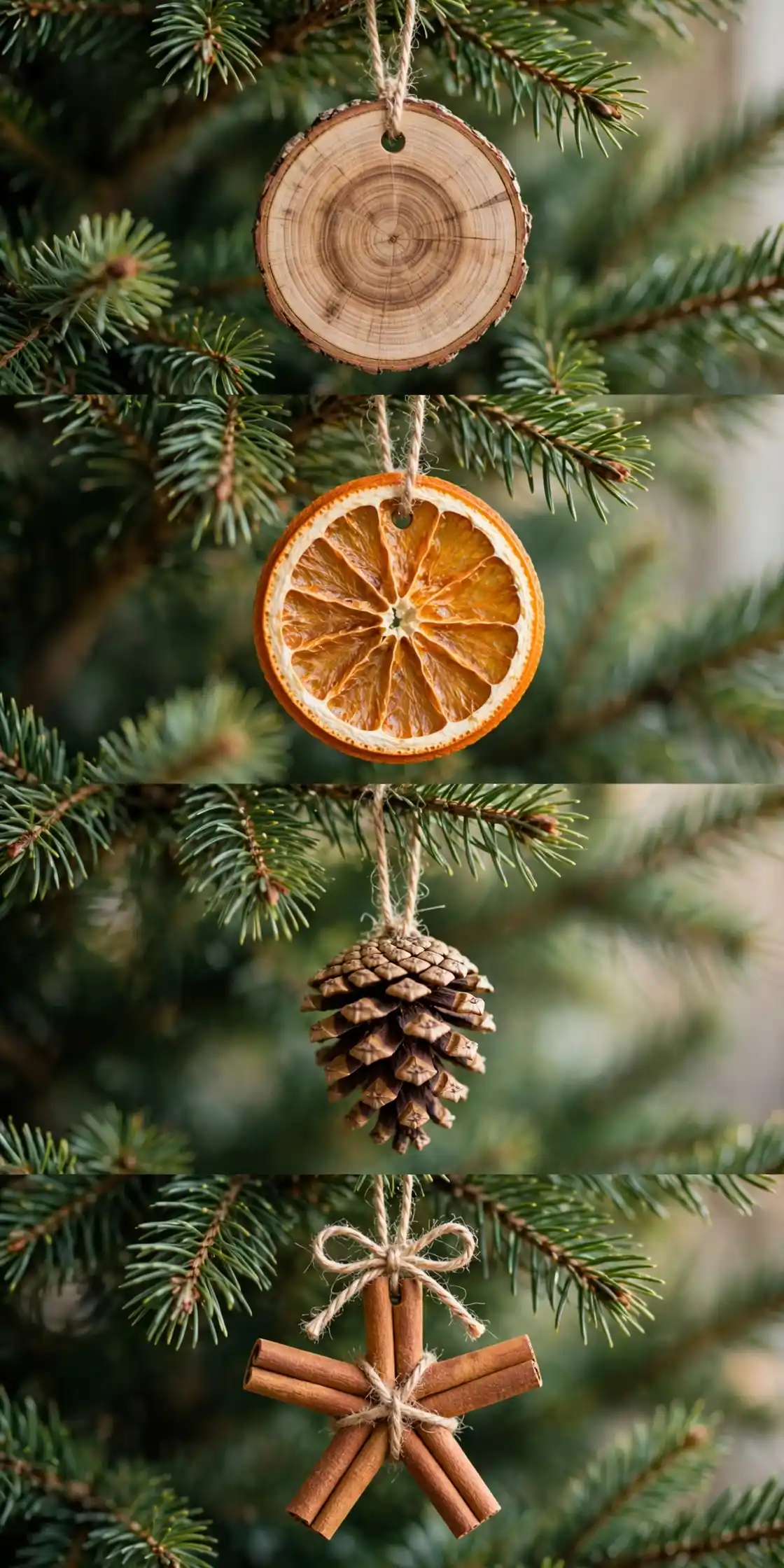
A tree dressed only in shiny plastic baubles can look like a shop window, because every ornament reflects the same light and nothing on the tree feels alive. A tree dressed with a natural christmas ornament looks like a real tree, because wood, dried fruit, pinecone, and wool carry texture, scent, and the marks of the hands that made them. Most natural christmas ornament attempts fail in the same way: people paint over the material they chose for its natural look, hang heavy pieces on weak branches, or bring damp foraged pieces indoors, and end up with ornaments that peel, fall, or smell musty by Christmas. This list works the other way around. These 20 natural christmas ornament ideas are grouped by material, wood, dried fruit, pinecone and foraged finds, cinnamon and spice, undyed wool and felt, and straw and natural fibre, and every idea keeps its material honest, unpainted, undyed, and recognisable, with real making steps. For the wider ornament picture, including baubles, themed sets, and keepsakes, see Christmas Ornament Ideas. Pick one material here, make a set of six, and your tree will smell and feel like Christmas, not like a catalogue.
- The key takeaway: Let the material be the decoration. A wood slice, a dried orange, or a pinecone already carries colour, texture, and scent, so the best natural ornaments add almost nothing, just a twine loop and a clean finish.
- The detail most people miss: Natural ornaments must be fully dry before they hang. A damp pinecone closes up, a half dried orange slice goes sticky, and a green twig moulds, while a fully dried piece keeps its shape and scent all season.
- What it costs or how long it takes: Most of these 20 ornaments cost $0 to $5 each, since foraged wood, pinecones, and dried fruit cost almost nothing, and each takes 5 to 30 minutes to make. A natural christmas ornament set is the cheapest way to dress a whole tree, because one afternoon of making fills every branch.
At a glance
| Group | Ideas | Materials | Best for |
|---|---|---|---|
| Wood, Unfinished and Foraged | 01-03 | Wood slices, driftwood, twigs, birch bark | Rustic trees and woodland themes |
| Dried Fruit and Citrus | 04-07 | Oranges, apples, lemons, cloves | Scented trees and kitchen trees |
| Pinecone and Foraged Finds | 08-11 | Pinecones, acorns, seed pods, dried flowers | Woodland trees and nature themes |
| Cinnamon and Spice | 12-14 | Cinnamon sticks, star anise, cloves | Scented trees and hallway trees |
| Undyed Wool and Felt | 15-17 | Wool roving, felt balls, jute, hessian | Soft trees and family trees |
| Straw and Natural Fibre | 18-20 | Straw, cotton twine, dried grass | Farmhouse trees and country trees |
jump to an idea ↓
- 01 Raw Bark-Edge Wood Slice
- 02 Driftwood Star
- 03 Twig Bundle Tree
- 04 Dried Orange Slice with Cinnamon
- 05 Dried Apple Slice Ornament
- 06 Dried Lemon Wheel with Star Anise
- 07 Clove Pomander Orange
- 08 Plain Pinecone with Jute Bow
- 09 Pinecone and Acorn Cluster
- 10 Seed Pod and Chestnut Ornament
- 11 Dried Flower Head Ornament
- 12 Cinnamon Stick Bundle
- 13 Cinnamon and Star Anise Star
- 14 Star Anise Snowflake
- 15 Undyed Wool Felt Ball
- 16 Wool Roving Angel
- 17 Jute and Hessian Star
- 18 Woven Straw Star
- 19 Cotton Twine Tassel
- 20 Dried Grass and Wheat Sheaf
Wood, Unfinished and Foraged
01
Raw Bark-Edge Wood Slice
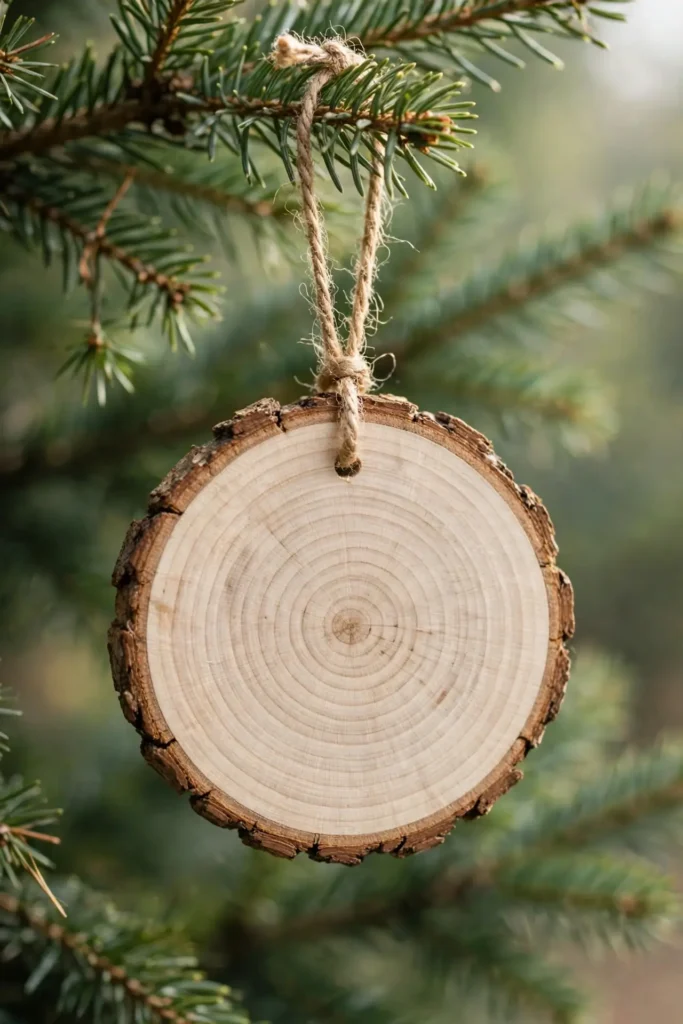
A painted wood slice can look like any other craft ornament, because the paint hides the very thing that made it wood. A raw bark-edge wood slice keeps its story, because the bark rim, the growth rings, and the pale grain are the whole decoration. Steps: 1. Cut or buy thin wood slices about 8 cm across, with the bark edge still on, and sand the flat faces lightly. 2. Drill a small hole near the top edge, thread natural twine through it, and knot a loop for hanging. 3. Rub the faces with a little beeswax or plain oil, leave them to dry overnight, and hang the slice on a sturdy lower branch. A natural christmas ornament like this suits a rustic natural christmas tree, because the wood echoes the tree itself.
Try it: Keep the bark on, but seal loose bark with a dab of clear glue. Bark that is left loose sheds on the carpet, while bark sealed at the edge stays put all season.
02
Driftwood Star
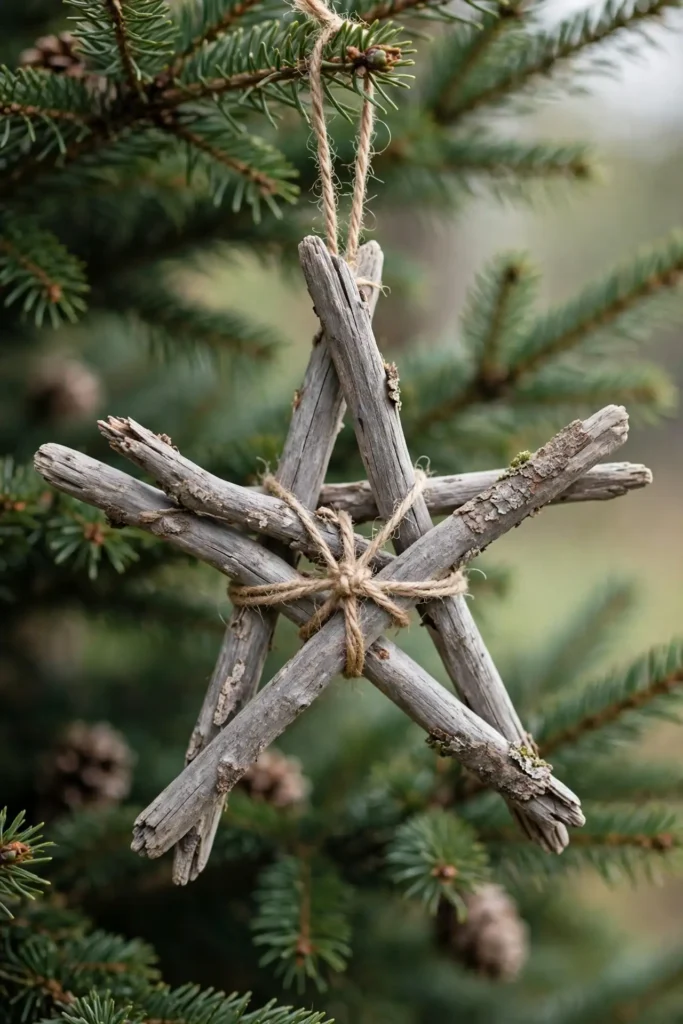
A shop bought star topper can look too perfect for a nature themed tree, because machine cut points give no hint of the beach or the woodland. A driftwood star fixes that, because five pieces of weathered driftwood tied at the centre read as found, not bought. Steps: 1. Collect five straight driftwood sticks of similar length, about 15 cm each, and let them dry fully indoors for a week. 2. Lay them in a star shape, tie the centre firmly with twine, and tie each crossing point where the sticks meet. 3. Add a twine loop at one point for hanging, and hang the star near the top of the tree or on a wall. Nature inspired christmas ornaments in driftwood suit a coastal or woodland home, because the grey wood carries its own colour.
Try it: Dry driftwood indoors for a full week before you tie it. Driftwood tied while damp shrinks as it dries, and the star loosens and droops.
03
Twig Bundle Tree
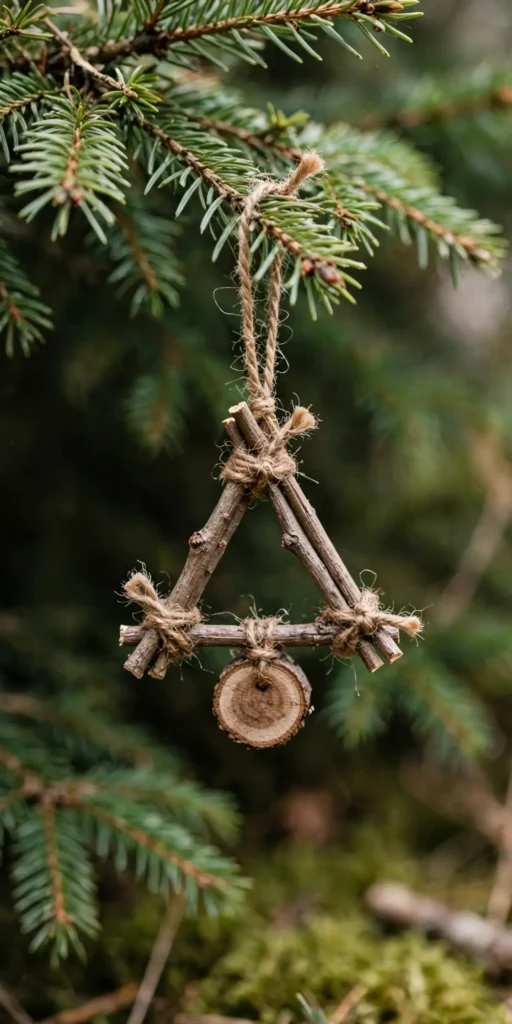
A tree dressed only with round baubles can look soft all over, because every ornament is a circle. A twig bundle tree breaks the roundness, because a tiny tree made of twigs reads as a tree on the tree. Steps: 1. Cut garden twigs into graduated lengths, from 15 cm down to 4 cm. 2. Lay them in a triangle, longest at the bottom and shortest at the top, and tie them together down the middle with twine. 3. Add a small wood slice as a trunk at the base, tie a twine loop at the top, and hang the twig tree on an outer branch where its shape shows. Natural christmas tree ornaments in twig form suit a nature themed christmas tree, because the twigs echo the branches around them.
Try it: Tie the twigs down the centre spine, not at the ends. Twigs tied at the ends splay apart, while twigs tied down the spine hold a clean triangle.
Dried Fruit and Citrus
04
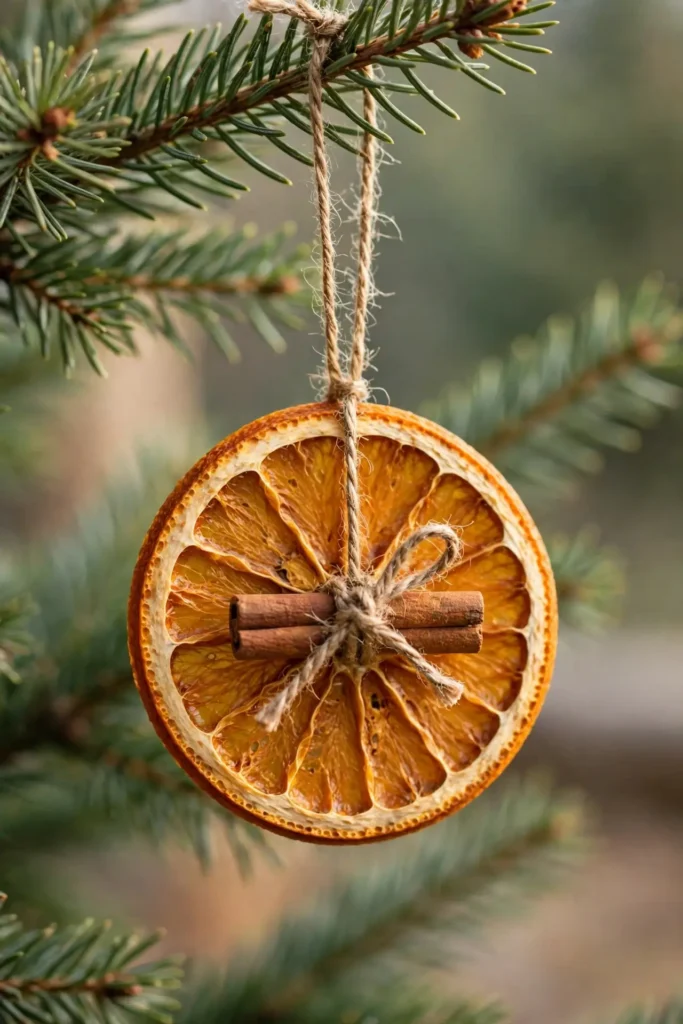
Dried Orange Slice with Cinnamon
A tree with no scent can feel like a picture of Christmas rather than Christmas itself, because the eye gets everything and the nose gets nothing. A dried orange slice with cinnamon fixes that, because the orange and the spice release scent for weeks. Steps: 1. Slice oranges about 5 mm thick and dry them in a low oven until fully crisp, turning them once. 2. Thread twine through the top of each slice, tie a small cinnamon stick across the front with the same twine, and knot a hanging loop. 3. Hang the slices on outer branches, away from direct heat, and replace any slice that softens. Diy natural christmas ornaments in dried orange are the classic natural ornament, because they are cheap, scented, and beautiful against green.
Try it: Dry the slices until fully crisp, not just warm. Half dried slices go soft and sticky within a week, while fully crisp slices stay firm all season.
05
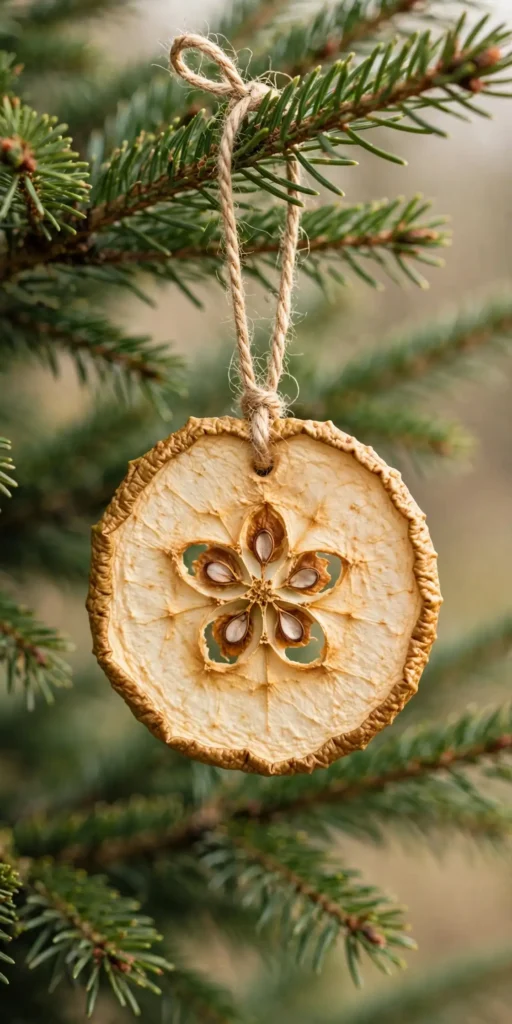
Dried Apple Slice Ornament
A dried orange slice on every branch can look one note, because one fruit repeated gives one colour. A dried apple slice adds a second fruit, because apple dries to a warm cream with a star shaped core. Steps: 1. Slice apples crosswise, about 5 mm thick, so the star core shows in the centre. 2. Dry them in a low oven until crisp, turning them once, and let them cool fully. 3. Thread twine through the top, add a small dried leaf or a cinnamon stick if you like, and hang the slices on mid height branches. Homemade natural christmas decorations in dried apple suit a kitchen tree best, because the apple reads as food, not as craft.
Try it: Slice the apple crosswise, not lengthwise. A lengthwise slice shows no star, while a crosswise slice shows the star core that makes the ornament.
06
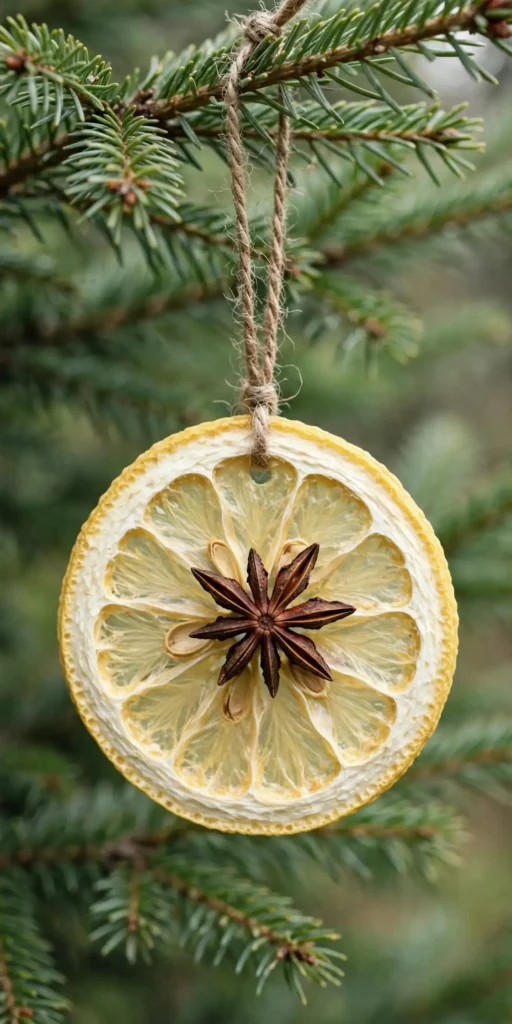
Dried Lemon Wheel with Star Anise
A tree dressed in warm oranges and reds can look heavy, because warm colours dominate every branch. A dried lemon wheel lightens the tree, because pale yellow lemon with a dark star anise reads as a bright accent. Steps: 1. Slice lemons thinly and dry them in a low oven until fully crisp. 2. Glue or tie one star anise to the centre of each lemon wheel with a short length of twine. 3. Thread a hanging loop through the top of the wheel, and hang the lemons on outer branches where the light catches them. Natural christmas decor in lemon and star anise suits a pale or white themed tree, because the yellow lifts the whole palette.
Try it: Use one star anise per wheel, not two or three. A wheel crowded with spice looks busy, while one star anise reads as a deliberate centre.
07
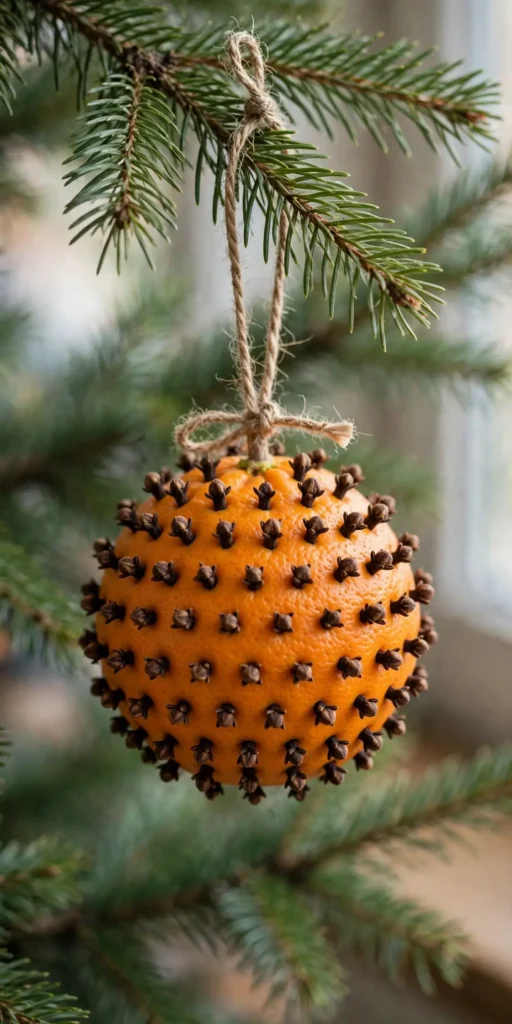
Clove Pomander Orange
A whole fresh orange on a tree can look like a mistake, because a round orange reads as fruit left on the tree, not as an ornament. A clove pomander orange turns the fruit into an ornament, because cloves studded all over it make a spiced, patterned ball. Steps: 1. Take a small, firm orange and push whole cloves into the skin in a pattern, lines, a star, or a full covering. 2. Leave a small gap at the top, thread twine around the orange in a cross, and knot a hanging loop. 3. Hang the pomander on a sturdy branch and let it dry slowly on the tree, where it will shrink slightly and harden. Natural christmas ornaments for tree use in pomander form suit a hallway tree, because the clove scent greets visitors before they see the tree.
Try it: Push the cloves in close together, with no bare skin showing between them. A sparsely studded orange looks half finished, while a fully studded orange reads as a jewel.
Pinecone and Foraged Finds
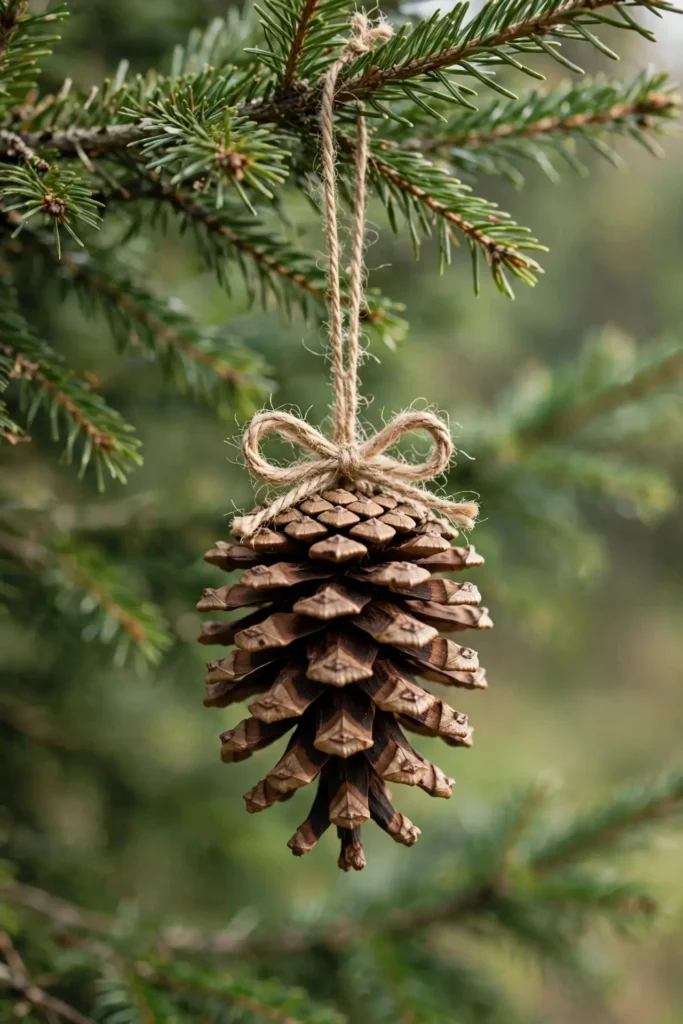
08
Plain Pinecone with Jute Bow
A pinecone painted gold can look like a craft project, because the paint hides the scales that made it a pinecone. A plain pinecone with a jute bow keeps the scales, because the only addition is a rough bow at the top. Steps: 1. Collect pinecones, bake them briefly in a low oven to open the scales and kill any insects, and let them cool. 2. Tie a small jute bow around the top of each pinecone, and thread a twine loop through the bow. 3. Hang the pinecones on sturdy branches, since a pinecone is heavier than a bauble. Natural pinecone ornaments in plain form suit a rustic natural christmas tree, because the pinecone is the tree’s own fruit.
Try it: Bake foraged pinecones in a low oven before you hang them. Unbaked pinecones can hide insects and stay closed, while baked pinecones open fully and stay clean.
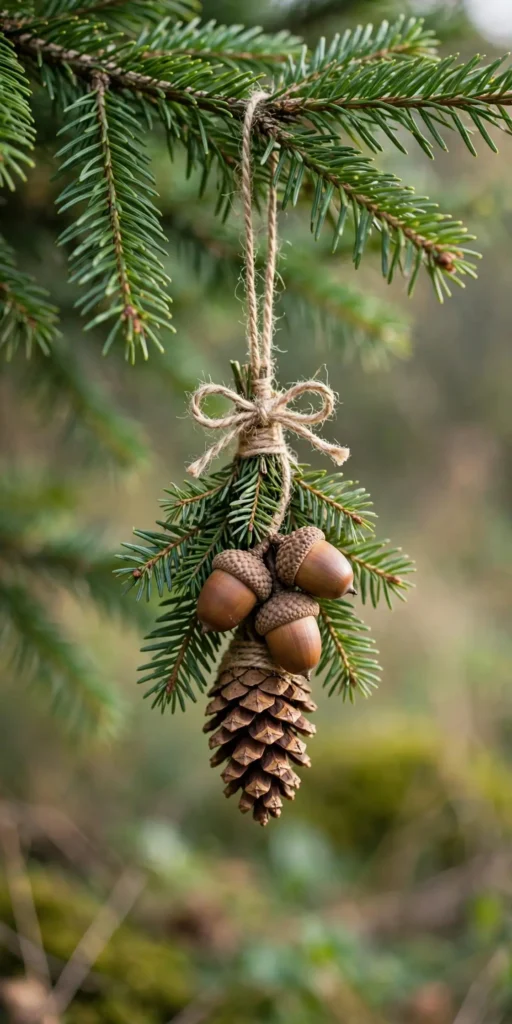
09
Pinecone and Acorn Cluster
A single pinecone on a branch can look lost, because one small cone gives the eye almost nothing. A pinecone and acorn cluster fills the branch, because a small bunch of cones and acorns tied together reads as a gathered posy. Steps: 1. Take one small pinecone, three acorns, and a sprig of fir or dried moss. 2. Wire the stems together at the base with florist wire, keeping the pinecone at the centre. 3. Tie a twine bow over the wire, add a hanging loop, and hang the cluster on an outer branch. Natural christmas tree decorations in cluster form suit a woodland tree, because the cluster reads as something gathered on a walk.
Try it: Wire the cluster at the base, not at the tips. A cluster wired at the tips falls apart, while a cluster wired at the base holds its shape.
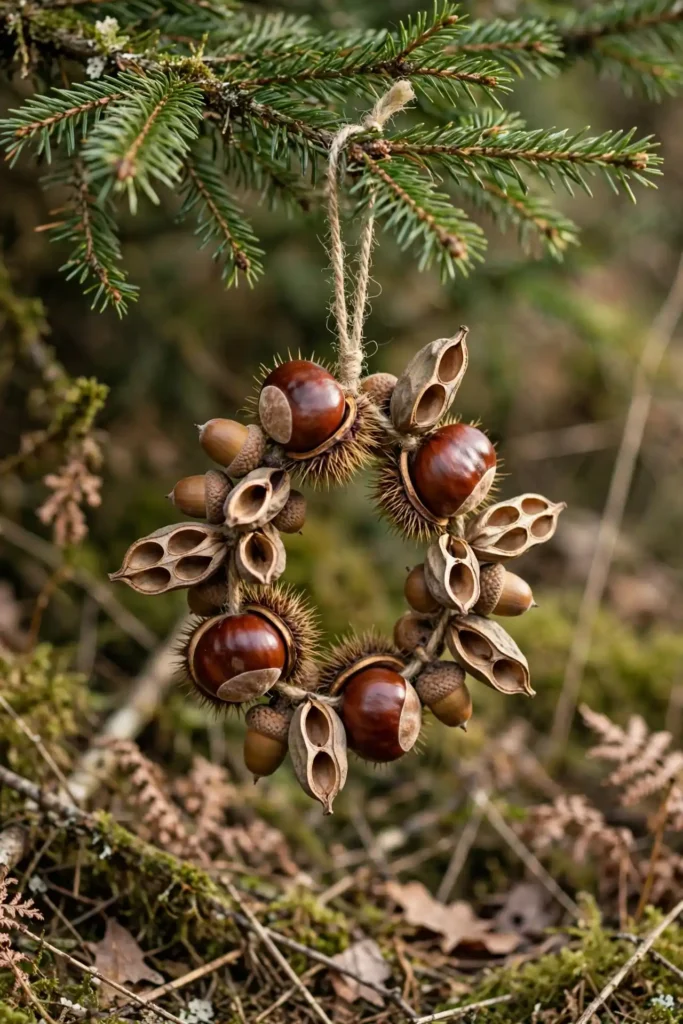
10
Seed Pod and Chestnut Ornament
A tree dressed only with pinecones can look like one forest repeated, because pinecones are the only seed the tree carries. A seed pod and chestnut ornament widens the forest, because chestnuts, seed pods, and acorns together read as a whole woodland floor. Steps: 1. Collect chestnuts, empty seed pods, and acorns, and dry them fully indoors. 2. Drill or wire each piece, thread them onto a twine loop in a small bunch, and knot the twine at the top. 3. Hang the bunch on a mid height branch, where the mixed shapes show against the green. Christmas wildlife ornaments in seed form suit a nature inspired tree, because the seeds are the food woodland animals gather.
Try it: Dry every piece fully before you string it. A damp chestnut moulds inside its shell, while a fully dried chestnut keeps for years.
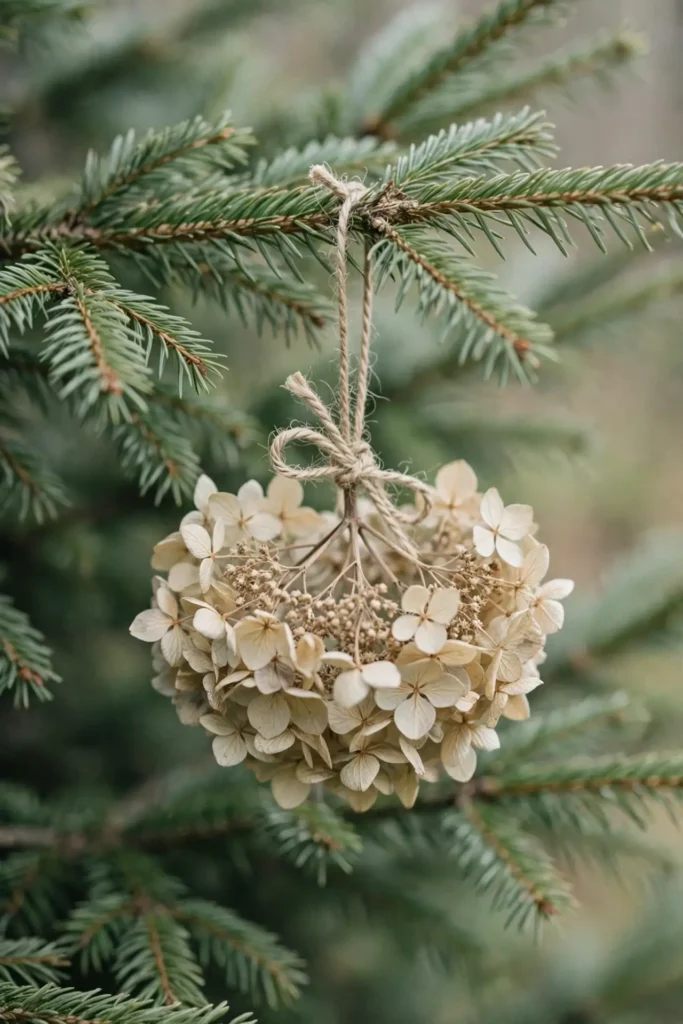
11
Dried Flower Head Ornament
A tree dressed only in green and brown can look dark, because no pale colour breaks the branches. A dried flower head lightens the tree, because hydrangea, lavender, and strawflower heads give soft colour without paint. Steps: 1. Dry flower heads fully, hanging them upside down for two weeks, or buy them ready dried. 2. Tie a twine loop around each stem, and trim the stem short so the head sits close to the branch. 3. Hang the flower heads on outer branches, away from heavy ornaments that could crush them. Nature inspired christmas decor in dried flower form suits a cottage tree, because the flowers read as summer kept for winter.
Try it: Hang dried flowers on outer branches only, not deep inside the tree. A flower head buried inside the branches gets crushed, while one on the outside shows its full shape.
Cinnamon and Spice
12
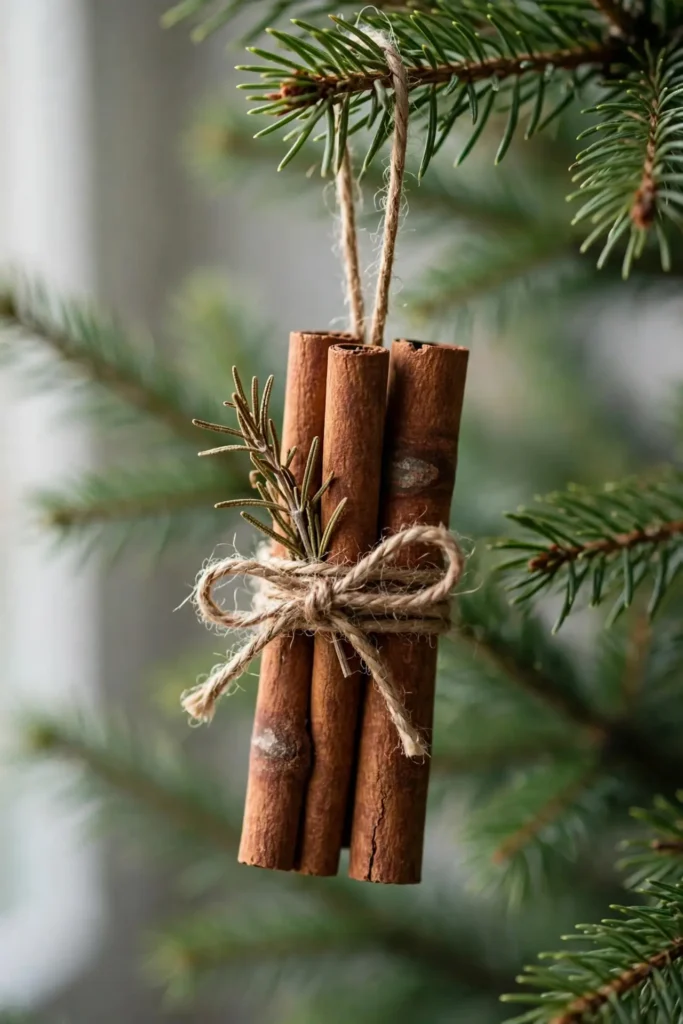
Cinnamon Stick Bundle
A tree with no scented ornament can smell of nothing, because plastic and glass give off no fragrance. A cinnamon stick bundle fixes that with the simplest scented ornament, because three cinnamon sticks tied together smell of Christmas from across the room. Steps: 1. Take three cinnamon sticks of similar length and tie them together at the middle with twine. 2. Tie a small sprig of fir or dried rosemary into the bundle, and knot a twine loop at the top. 3. Hang the bundle on a mid height branch, and refresh it each year by adding one new stick. Natural christmas decor ideas in cinnamon form suit any tree, because cinnamon is the scent most people link to Christmas.
Try it: Tie the bundle at the middle, not at the ends. A bundle tied at the ends splays open, while a bundle tied at the middle holds tight.
13
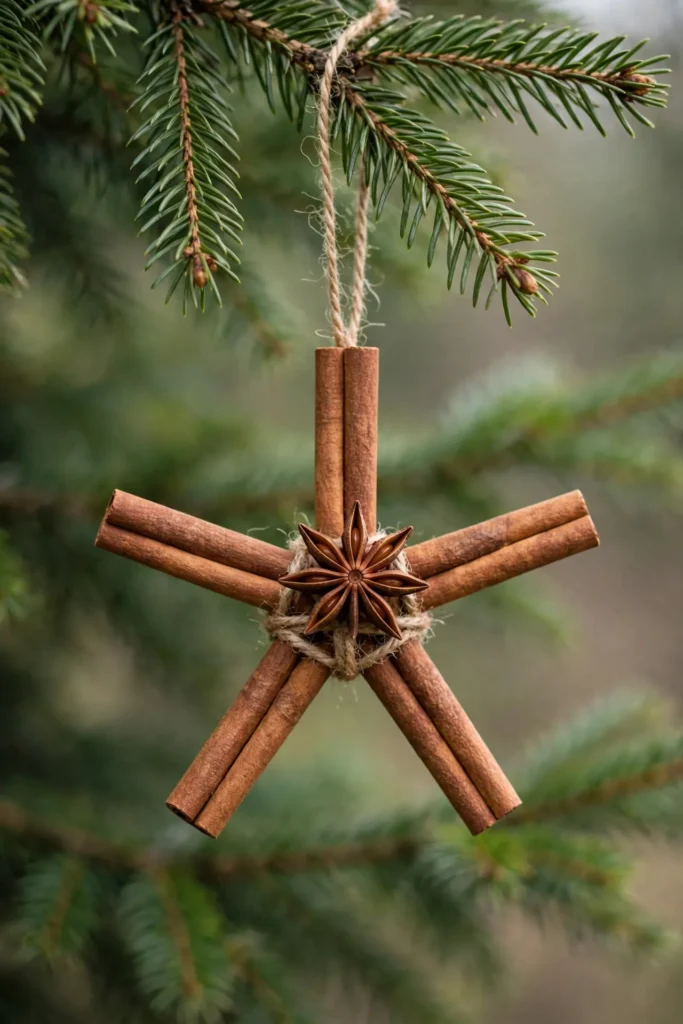
Cinnamon and Star Anise Star
A cinnamon bundle can look like a cooking ingredient hung on the tree, because a bundle of sticks reads as pantry, not as ornament. A cinnamon and star anise star turns the spice into a shape, because sticks laid as a star with star anise at the centre read as a star first. Steps: 1. Lay five short cinnamon sticks in a star shape, crossing them at the centre. 2. Tie the centre firmly with twine, and glue or tie one star anise over the centre knot. 3. Add a twine loop at one point, and hang the star near the top of the tree. Eco friendly tree decorations in spice form suit a scented tree, because the whole ornament composts in January.
Try it: Use short sticks of equal length, about 10 cm each. Unequal sticks make a lopsided star, while equal sticks make a star that hangs level.
14
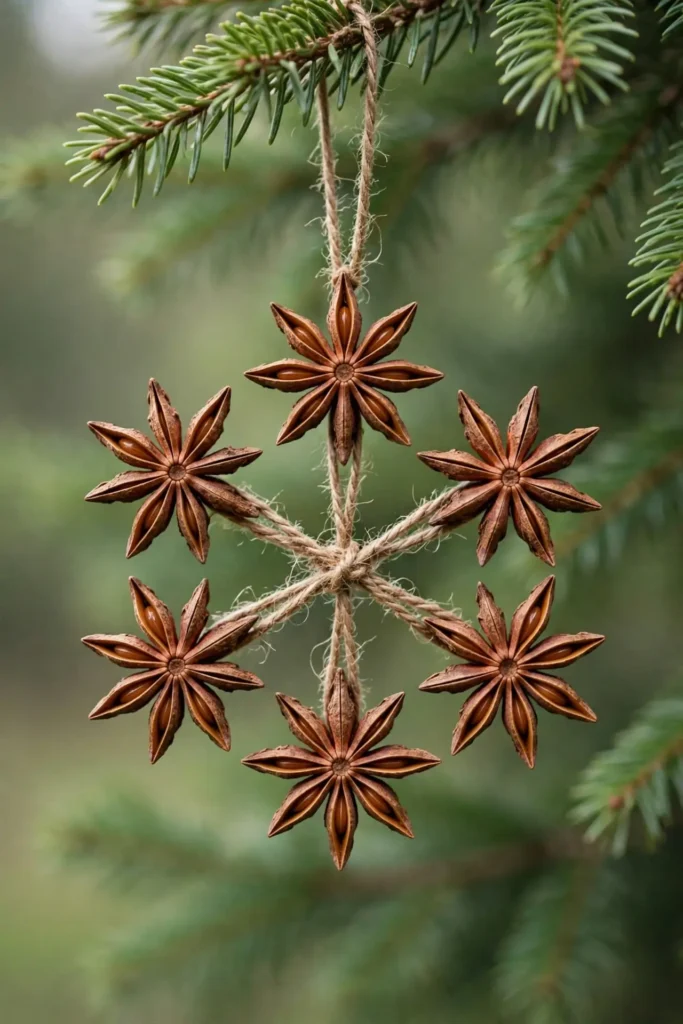
Star Anise Snowflake
A star made only of cinnamon can look brown all over, because one spice gives one colour. A star anise snowflake widens the spice palette, because star anise arranged in a snowflake reads as a dark, patterned flower. Steps: 1. Lay six star anise pieces in a circle, points outward, on a flat surface. 2. Glue or wire them together at the centre, and add a small cinnamon stick behind the centre for strength. 3. Thread a twine loop through the centre, and hang the snowflake on an outer branch where its shape shows. Rustic natural christmas tree decorations in star anise form suit a small tree, because the snowflake is light and detailed.
Try it: Glue the star anise pieces to a small felt or card disc behind the centre, not just to each other. Star anise glued edge to edge breaks apart, while star anise glued to a disc holds firm.
Undyed Wool and Felt
15
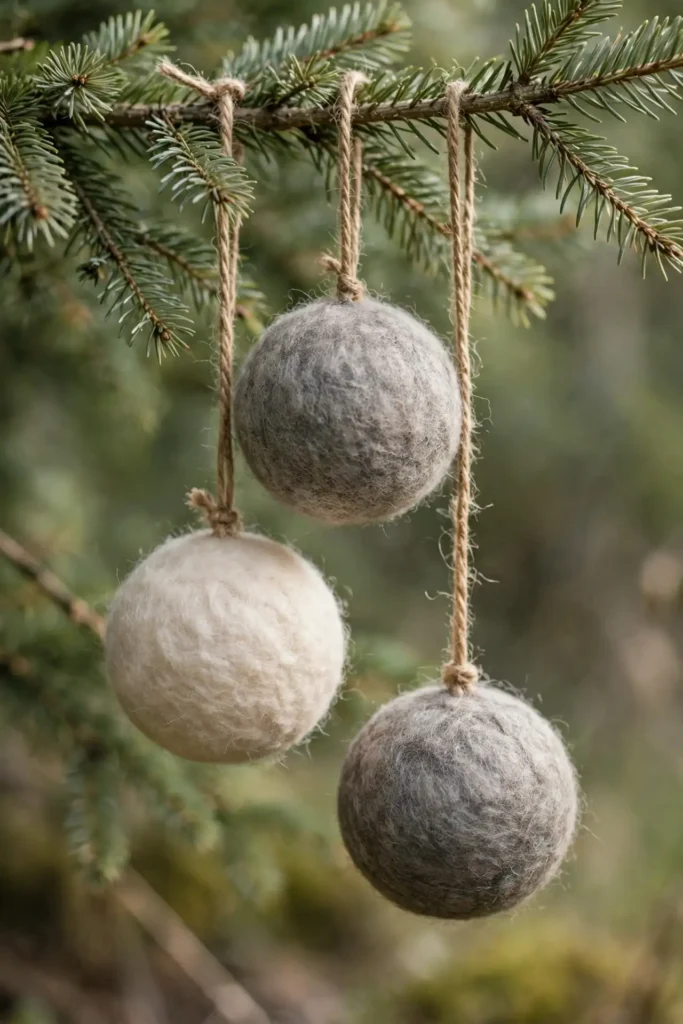
Undyed Wool Felt Ball
A felt ball dyed bright red can look like any other craft ornament, because the dye hides the wool. An undyed wool felt ball keeps the wool honest, because natural cream and grey wool reads as sheep, not as shop. Steps: 1. Take undyed wool roving and roll it into a firm ball, felting it with warm soapy water until it holds its shape. 2. Thread a needle with twine, pass it through the top of the ball, and knot a hanging loop. 3. Hang the felt balls in groups of three on different branches, mixing cream and grey. Natural ornaments in undyed wool suit a soft, family tree, because the balls are safe for small hands and pets.
Try it: Felt the ball until it is firm, not soft. A soft felt ball squashes flat in storage, while a firm felt ball keeps its round shape for years.
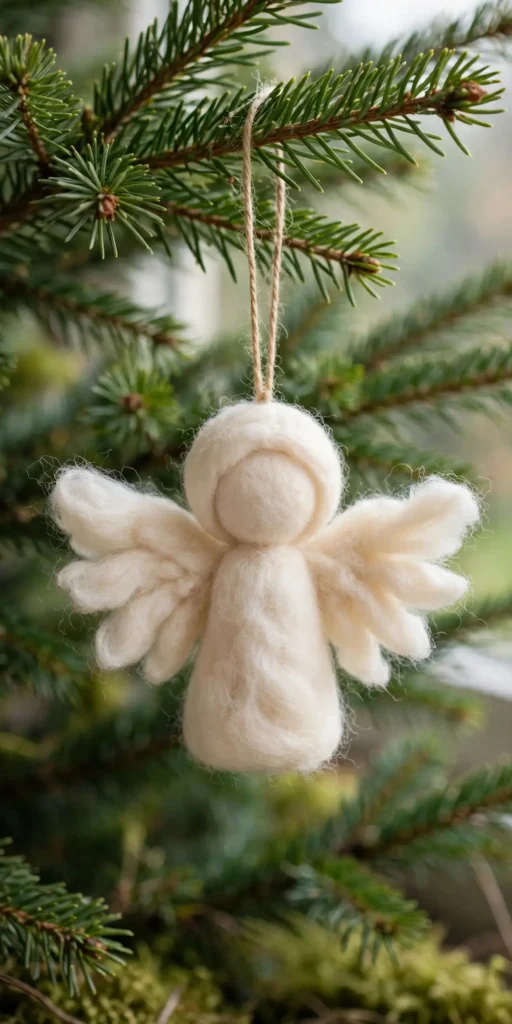
16
Wool Roving Angel
A plastic angel topper can look cold on a natural tree, because shiny plastic fights wool, wood, and dried fruit. A wool roving angel warms the tree, because soft undyed wool shaped into an angel reads as handmade and gentle. Steps: 1. Take a bundle of undyed wool roving, fold it in half for the body, and tie a small ball of roving at the top for the head. 2. Pull two small wings of roving out at the sides and tie them in place with twine. 3. Add a twine loop at the back of the head, and hang the angel on an upper branch or as a tree topper. Natural xmas decorations in wool angel form suit a family tree, because the angel is soft enough for children to handle.
Try it: Tie the head ball tightly, or it slides down the body. A loosely tied head droops within days, while a tightly tied head stays at the top.
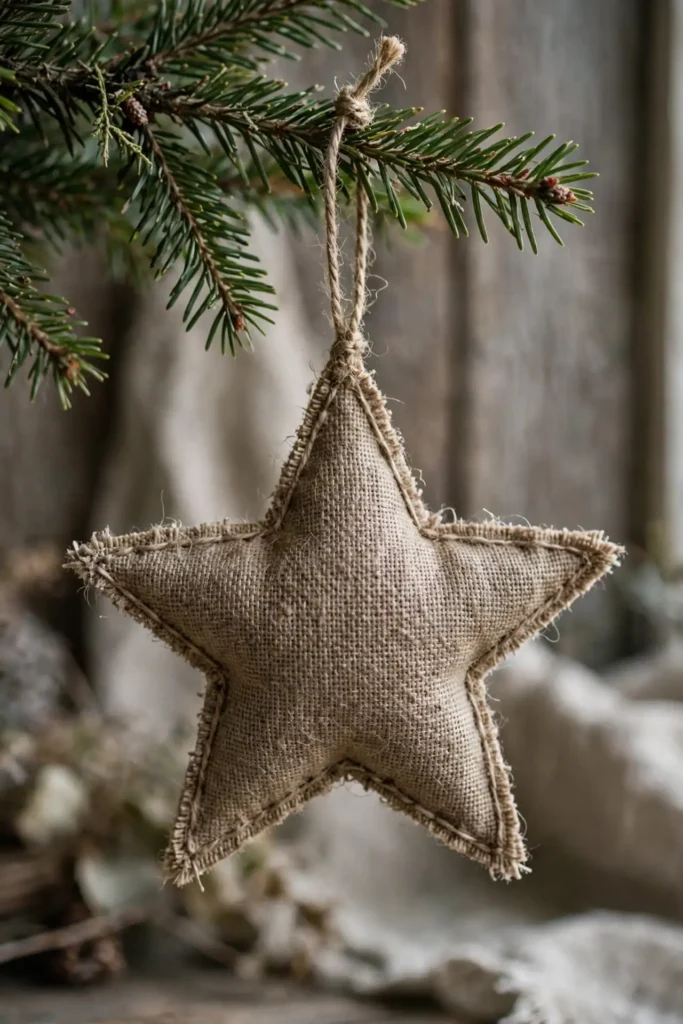
17
Jute and Hessian Star
A star cut from shiny card can look flat on a natural tree, because card gives no texture. A jute and hessian star gives texture, because rough woven fibre reads as farmhouse against smooth branches. Steps: 1. Cut two identical stars from hessian fabric, slightly larger than your hand. 2. Sew or glue them together around the edges, leaving a small gap, stuff lightly with wool, and close the gap. 3. Sew a twine loop to one point, and hang the star on an outer branch. Natural christmas decor in hessian form suits a farmhouse tree, because the rough weave echoes burlap and linen elsewhere in the room.
Try it: Stuff the star lightly, not firmly. A firmly stuffed hessian star looks like a cushion, while a lightly stuffed star keeps its flat star shape.
Straw and Natural Fibre
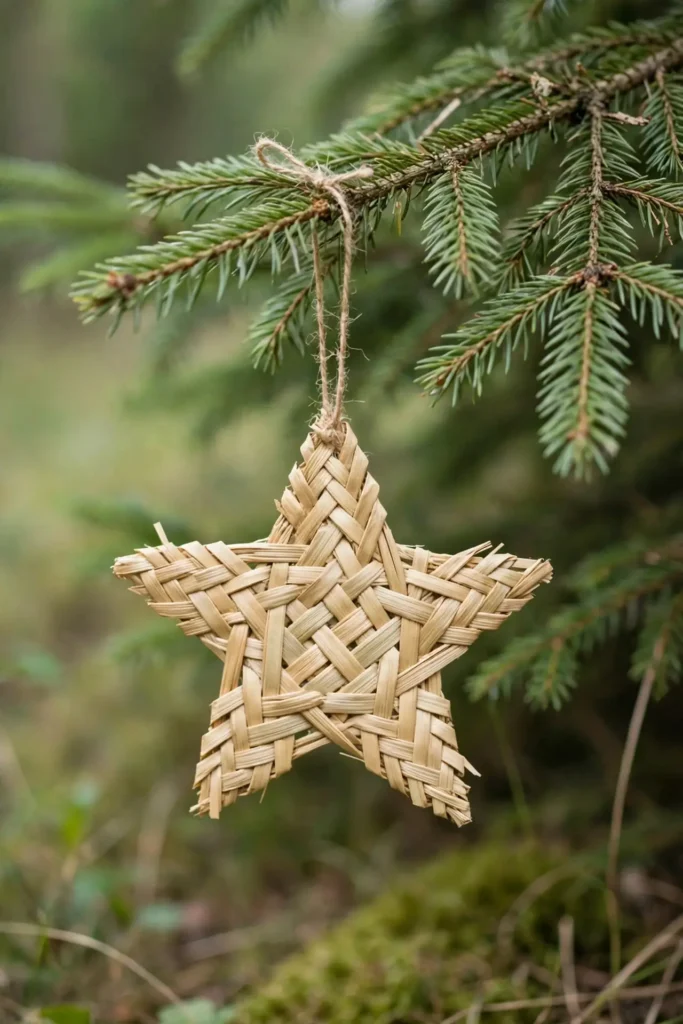
18
Woven Straw Star
A straw star bought from a shop can look machine made, because perfect straw gives no hint of the hands that wove it. A woven straw star made at home shows its weaving, because slightly uneven straw reads as craft. Steps: 1. Soak wheat straw in warm water until flexible, about 30 minutes. 2. Weave four straws into a flat star, following a simple over under pattern, and tie the centre and each point with fine twine. 3. Trim the straw ends evenly, add a twine loop at one point, and hang the star on an upper branch. Natural tree decorations in straw form suit a country tree, because straw is the oldest Christmas decoration material.
Try it: Soak the straw until fully flexible, not just damp. Straw woven while stiff snaps at the bends, while straw soaked soft bends cleanly.
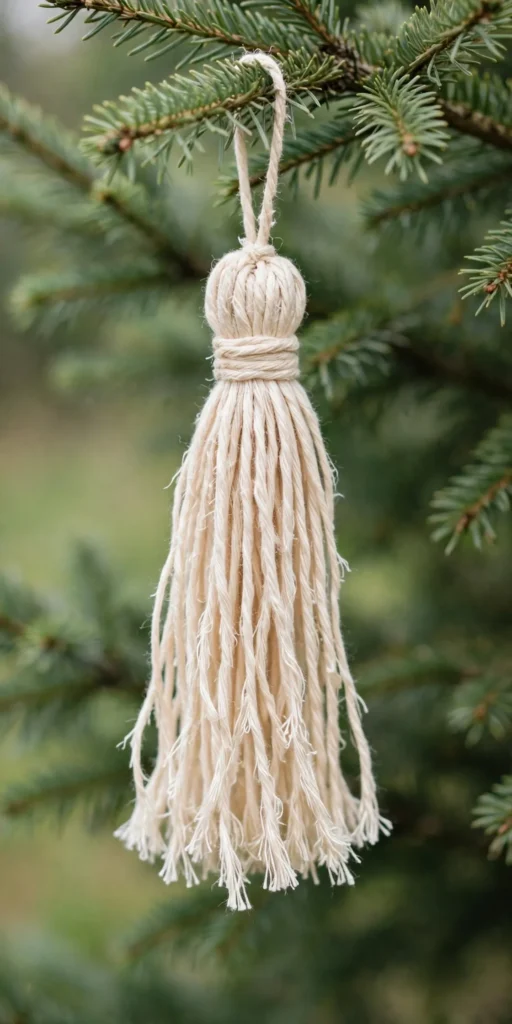
19
Cotton Twine Tassel
A tree dressed only with flat ornaments can look two dimensional, because flat shapes give no movement. A cotton twine tassel adds movement, because the hanging threads sway when the tree is brushed. Steps: 1. Wrap unbleached cotton twine around a small piece of card about 20 times. 2. Tie the top of the bundle firmly, slide it off the card, and tie a second band near the top to form the tassel head. 3. Cut the bottom loops open, trim the ends evenly, and hang the tassel from its top loop. Real christmas tree decorations in twine form suit a minimalist natural tree, because the tassel is plain, pale, and quiet.
Try it: Wrap the twine at least 20 times, not fewer. A tassel wrapped only a few times looks thin, while a tassel wrapped 20 times reads as full.
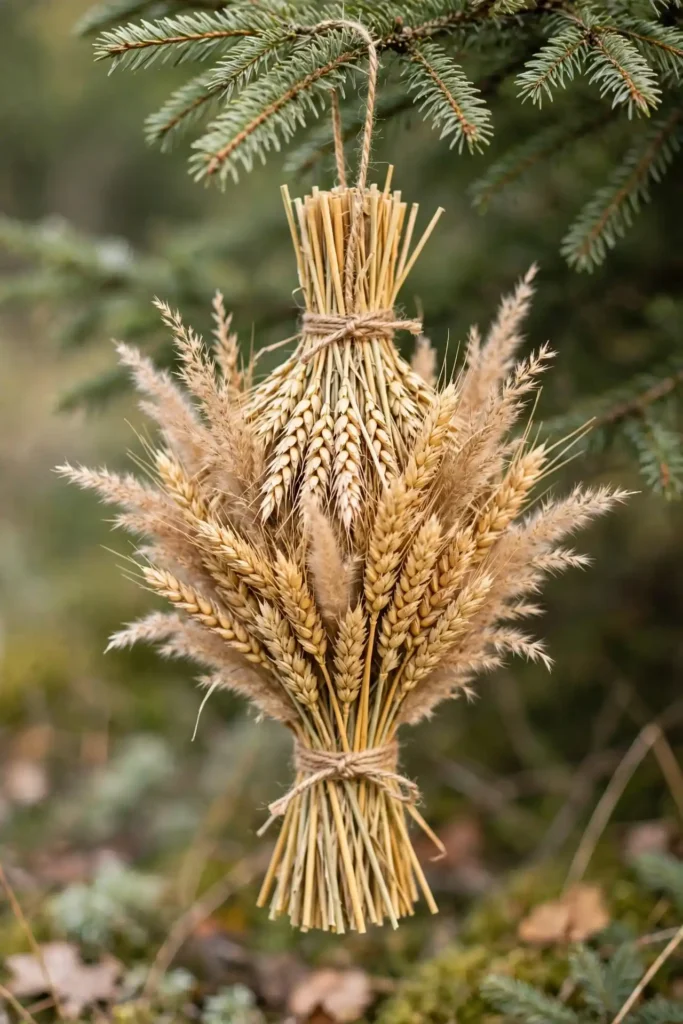
20
Dried Grass and Wheat Sheaf
A single straw star can look lonely on a large tree, because one small ornament gives the eye almost nothing. A dried grass and wheat sheaf fills a branch, because a tied bunch of wheat and dried grass reads as a harvest posy. Steps: 1. Gather dried wheat stems and ornamental grass, all similar length, about 25 cm. 2. Tie them together near the base with twine, fan the heads out slightly, and tie a second band higher up. 3. Add a twine loop at the top, and hang the sheaf on a sturdy outer branch. Natural christmas tree decoration ideas in wheat form suit a farmhouse tree, because the sheaf carries the harvest into Christmas.
Try it: Tie the sheaf at two points, base and middle, not one. A sheaf tied once splays apart, while a sheaf tied twice holds a clean bunch shape.
Pro tip: Make natural ornaments in sets of six, not one at a time. A single natural ornament looks like an accident on the tree, while six of the same ornament spaced around the tree read as a collection, and six is also the number that fits one baking tray of dried fruit.
Three rules for natural ornaments that look intentional, not gathered
Most natural christmas ornaments look unfinished for the same three reasons, and all three are fixable.
- First, dry everything fully before it hangs. A damp pinecone, a half dried orange, and a green twig all fail on the tree, while a fully dried piece keeps its shape, colour, and scent all season.
- Second, hang heavy pieces low and light pieces high. A pinecone, a pomander, and a wheat sheaf need sturdy lower branches, while a straw star, a tassel, and a dried flower head suit the light upper branches, because a heavy ornament on a weak tip droops the whole branch.
- Third, keep the palette natural. Wood, cream wool, dried orange, and pinecone already give a full palette, while one painted or dyed piece among them reads as a mistake, because the eye spots the fake material at once.
Storing and reusing your natural Christmas ornaments
Natural Christmas ornaments last for years if you store them properly, and the storage step is part of the making, not an afterthought.
- First, store ornaments in tissue, not loose in a box. Dried fruit, pinecones, and straw stars crush and snag each other, so wrap each ornament in tissue and lay them in a single layer.
- Second, compost what has failed, keep what has lasted. A soft orange slice, a mouldy twig, and a crushed flower head should be composted in January, while wood slices, pinecones, cinnamon stars, and felt balls keep for years.
- Third, keep stored ornaments dry and away from damp. Natural materials absorb moisture in a garage or loft, so store them in a dry cupboard in a lidded box, and check them once before hanging each year.
Questions readers ask
What are natural christmas ornaments?
Natural christmas ornaments are ornaments made from wood, dried fruit, pinecone, cinnamon, wool, and straw, left unpainted and undyed, because the material itself is the decoration. A natural christmas ornament suits a real tree best, since the materials echo the tree they hang on.
How do you dry orange slices for ornaments?
You dry orange slices for ornaments by slicing oranges about 5 mm thick and drying them in a low oven until fully crisp, turning them once. A slice dried until fully crisp stays firm all season, while a half dried slice goes soft and sticky within a week.
Are natural ornaments safe for a real tree?
Yes, natural ornaments are safe for a real tree, as long as every piece is fully dry and heavy pieces hang on sturdy branches. Keep dried fruit and cinnamon away from direct heat, and keep foraged pinecones baked and clean, so nothing on the tree moulds or drops.
How long do natural christmas ornaments last?
Natural christmas ornaments made from wood, pinecone, cinnamon, and felt last for years with dry storage, while dried fruit ornaments last one to three seasons. A dried orange slice kept dry can hang for a second Christmas, but a slice that softens should be composted and replaced.
Can I make natural ornaments with children?
Yes, you can make natural ornaments with children, and the best ones are dried orange slices, pinecone clusters, and undyed felt balls, because they need no sharp tools beyond a blunt needle. Let an adult handle the oven drying and any drilling, and let children tie, thread, and arrange.
What natural ornaments smell the best?
The natural ornaments that smell the best are dried orange slices with cinnamon, clove pomander oranges, and cinnamon stick bundles, because citrus, clove, and cinnamon are the three scents most people link to Christmas. Hang one scented ornament near the door side of the tree, so the scent greets visitors.
How do I hang heavy natural ornaments without drooping branches?
You hang heavy natural ornaments without drooping branches by hanging pinecones, pomanders, and wheat sheaves on sturdy lower branches, and by tying them with twine looped over the branch, not hooked on a tip. A heavy ornament tied over a thick branch stays level, while one hooked on a thin tip pulls the branch down.
Are natural ornaments eco friendly?
Yes, natural ornaments are eco friendly, because wood, dried fruit, pinecone, cinnamon, wool, and straw all compost or break down naturally. Eco friendly tree decorations made from natural materials leave no plastic behind, and most of them can be composted in January when they finally wear out.
People Also Ask
What is the 70/30 rule for natural christmas ornaments?
The 70/30 rule for natural christmas ornaments means roughly 70 percent of the tree stays as natural ornaments, and 30 percent carries one accent, such as fairy lights or a single colour of ribbon. The rule is a guide, not a law, but a tree that follows it will read as natural rather than cluttered.
How do I make my natural ornaments look collected, not messy?
You make your natural ornaments look collected, not messy, by making them in sets of six, keeping one natural palette across the whole tree, and hanging heavy pieces low and light pieces high. A tree with matched sets, a clear palette, and balanced weight reads as collected, while mixed singles in random spots read as leftovers.
What natural ornaments should beginners avoid?
Beginners should avoid woven straw stars and wool roving angels on a first attempt, because each of those needs soaking, weaving, or felting skill to look clean. Start with dried orange slices, plain pinecones with jute bows, and cinnamon stick bundles, and save straw weaving and wool felting for a second season.
loved these ideas? ✿
Save this guide for later
Pin it to your board so it’s there when you’re ready to recreate it.

Curated by
Hey! I'm Sanaullah — visual curator and content creator. I search, curate, and test the best aesthetic ideas across Pinterest so you can easily transform your living space, style daily outfits, and try simple creative DIYs without the overwhelm.