
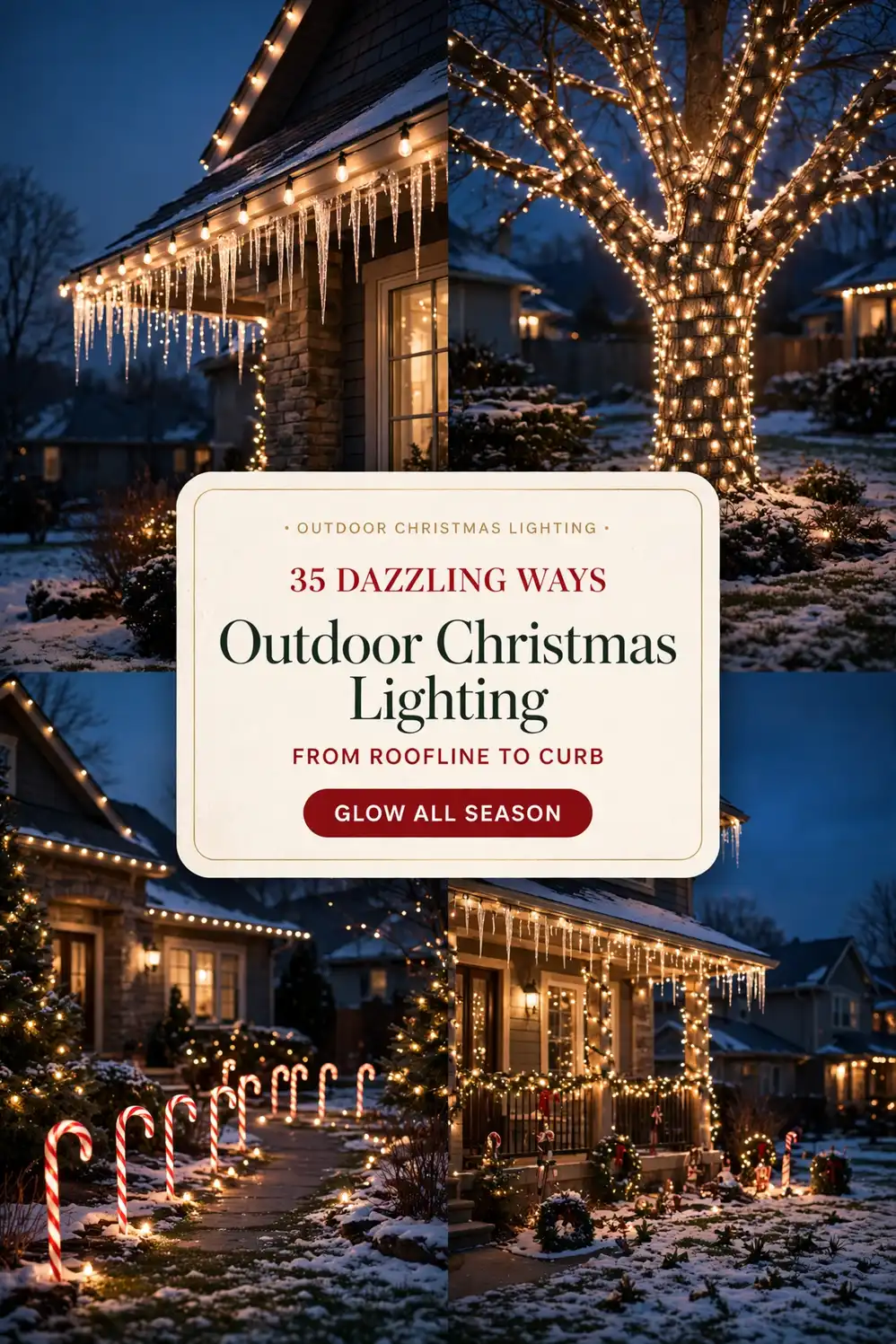
The houses people remember in December are not the ones with the most decorations. They are the ones with the best light. Good outdoor christmas lighting works in layers: a clean roofline, glowing trees and bushes at eye level, a lit path to the door, and one or two moments that make drivers slow down. This guide builds those layers in order, with the bulb counts, strand lengths, and costs that keep you from making a second trip up the ladder. Follow it and your house will be the one the whole street walks down to see.
Quick Idea Summary
- The key takeaway: Light in layers, not all at once. Roofline first, then trees and bushes, then the path and the door. Three finished layers of exterior christmas lights beat a yard full of scattered pieces every time.
- The detail most people miss: Outdoor displays fail at the connections, not the bulbs. Every plug sitting in a puddle or an open socket is a tripped breaker waiting to happen, so plan where each strand starts and ends before you hang anything.
- What it costs or how long it takes: A classic two-layer display (roofline plus trees) runs $80 to $250 in LED strands and goes up in one Saturday. Solar and battery pieces add glow with zero wiring and zero electricity cost.
At a glance
| Zone | Ideas | Budget |
|---|---|---|
| Roofline and eaves | 01–06 | $30–$150 |
| Trees, bushes and greenery | 07–13 | $15–$90 |
| Porch, path and entry | 14–20 | $10–$70 |
| Yard scenes and statement pieces | 21–27 | $25–$200 |
| Solar, smart and no-outlet lighting | 28–35 | $12–$90 |
The ideas
01
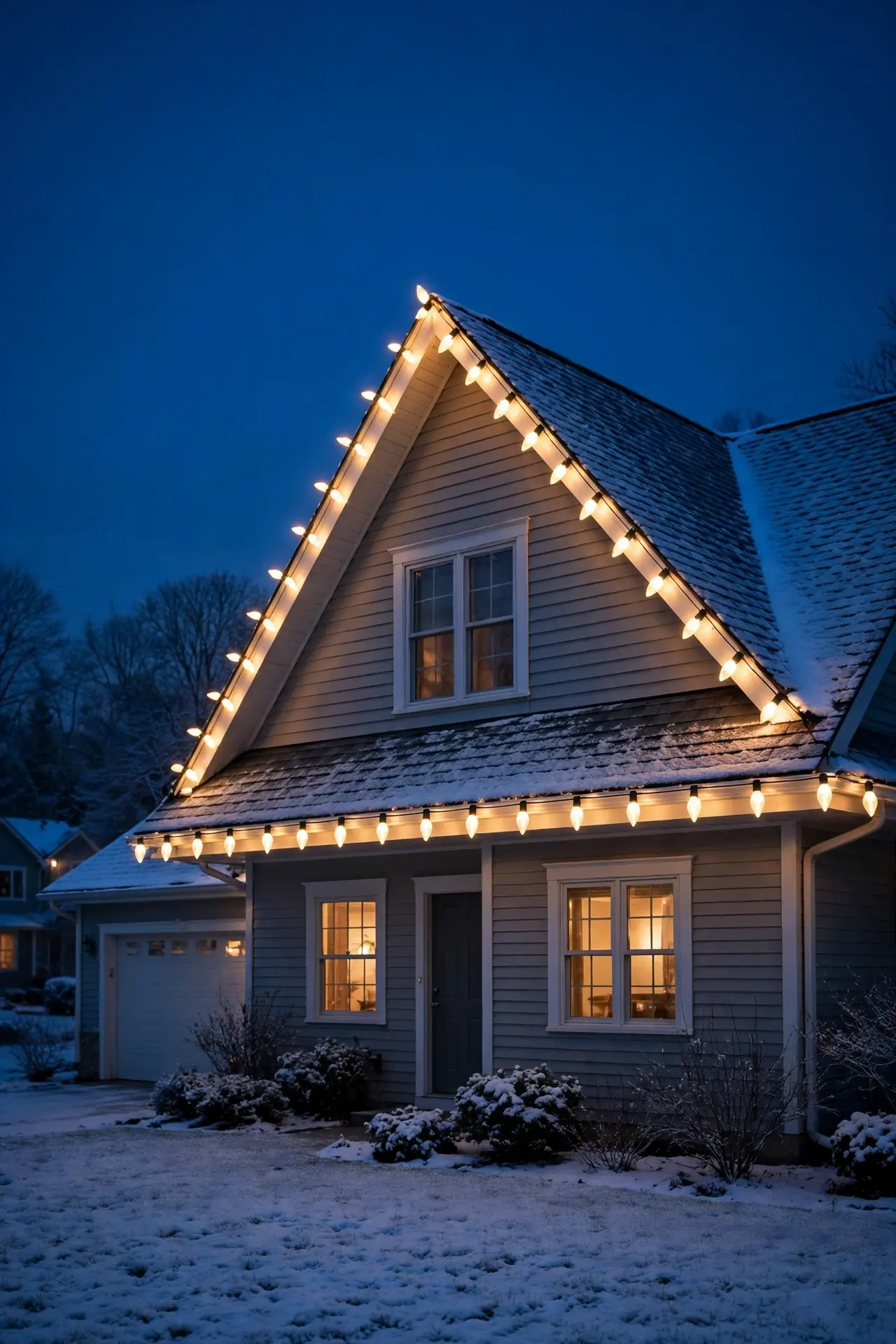
The Classic C9 Roofline
Big C9 bulbs along the eaves are the outline every other light hangs on. Measure before you buy: a 40-foot front eave with one gable peak takes about 55 feet of stringer once you add the peak and the drop to the outlet. Space clips one per bulb, and keep the line pulled straight; a sagging roofline ruins the whole effect no matter how good the rest looks.
Try it: Clip every single bulb, even where the strand feels secure. Wind works on the unclipped sections first, and one drooping loop shows from the street.
02
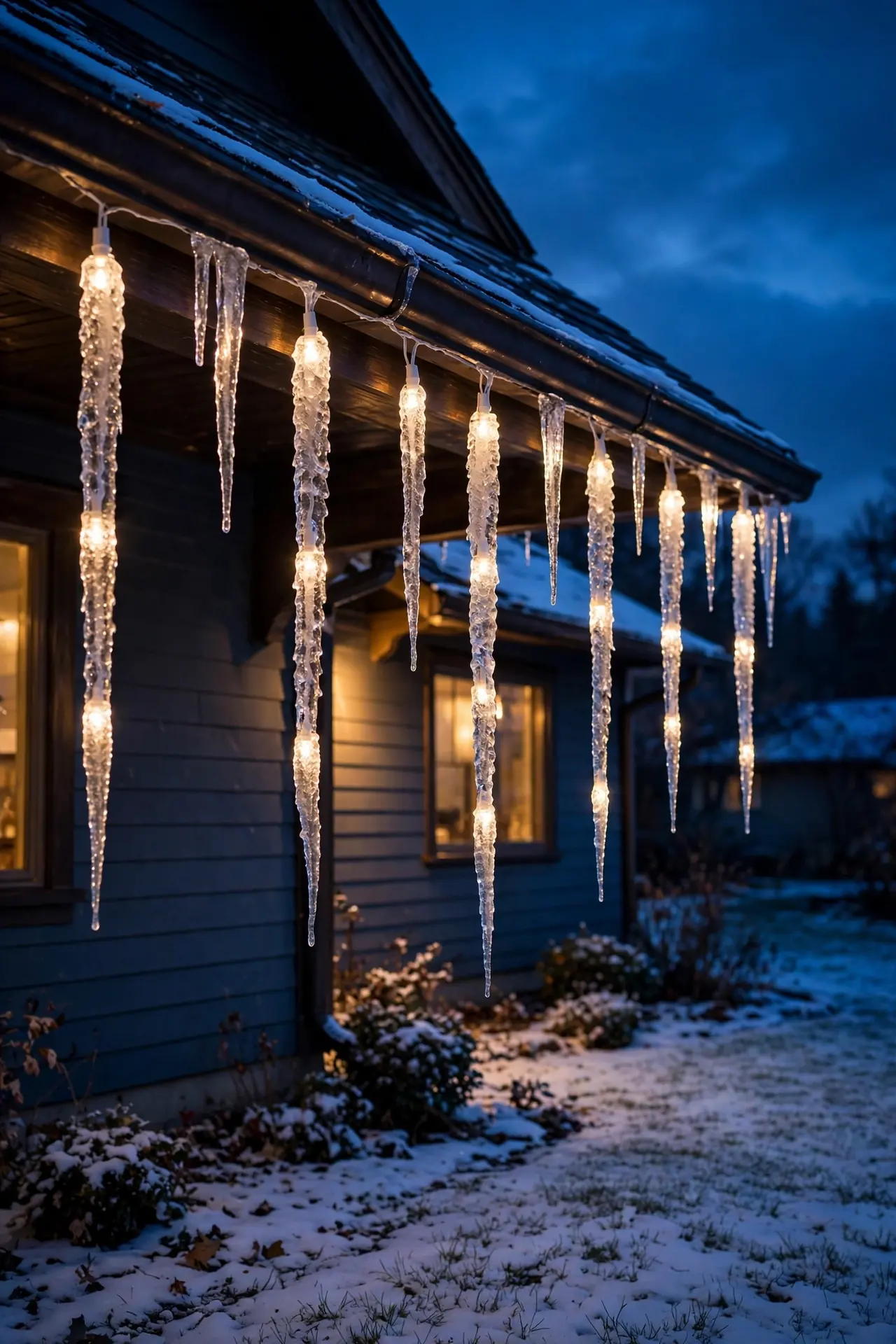
Icicle Lights Along the Eaves
Icicle strands give a flat roofline dimension, with drops that vary from 12 to 24 inches so the edge looks like real ice instead of a fringe curtain. Warm white reads as candlelit; pure white reads as frost. Count roughly one 10-foot strand per 9 feet of eave, because the drops bunch as they hang.
Try it: Mix two drop patterns instead of one uniform strand. Alternating long and short drops is what separates a styled roofline from a store-bought look.
03
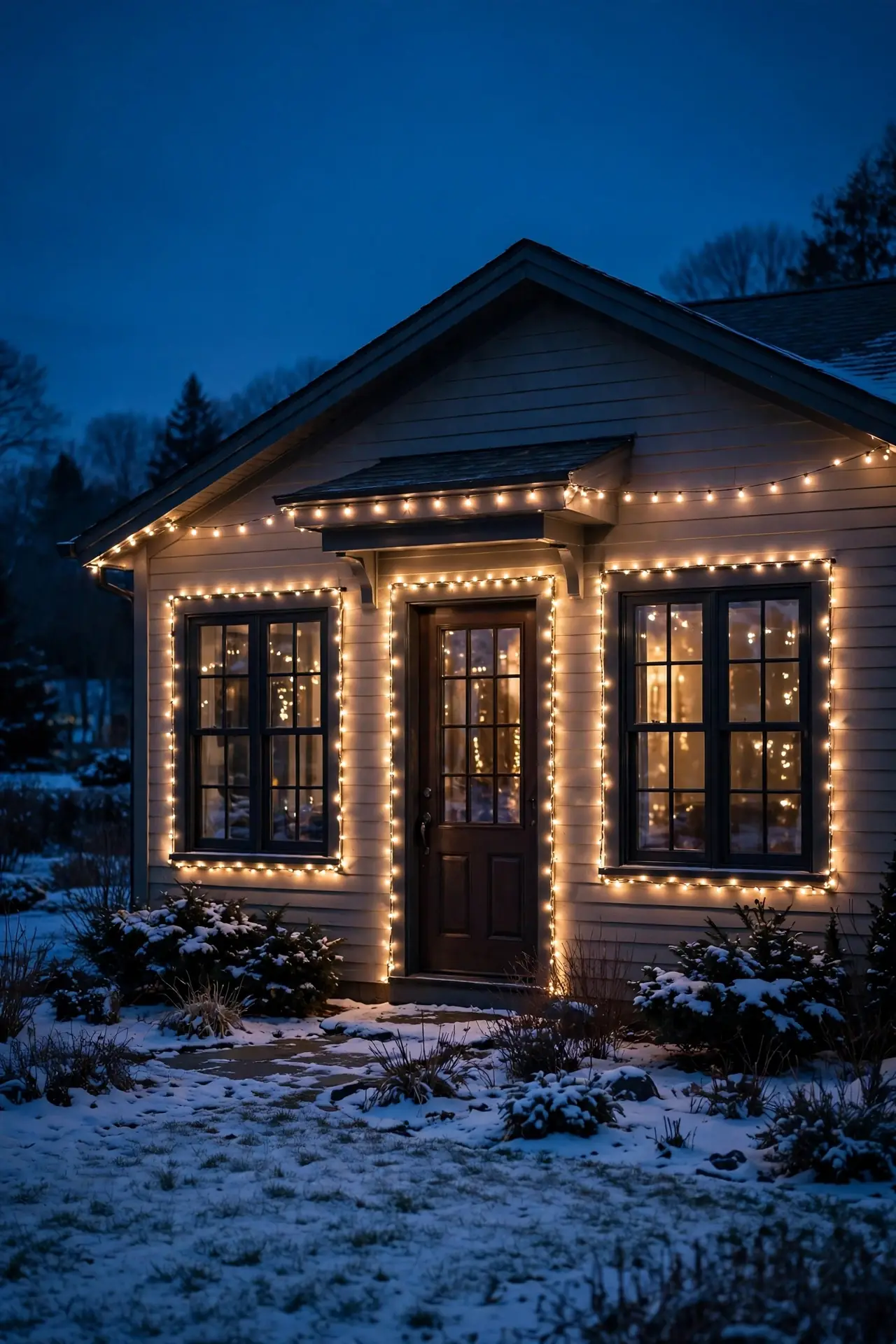
Outline the Windows and Door With Light Strings
Trace the front windows and the door frame with mini light strings outdoor displays rely on for their architecture. The house’s own lines do the design work; you are just underlining them. A standard double window takes about 25 feet of strand, and the outline glows in reflections on the glass after dark.
Try it: Use the same bulb color as the roofline here. The outline is architecture, not a feature, and it should match the house’s frame exactly.
04
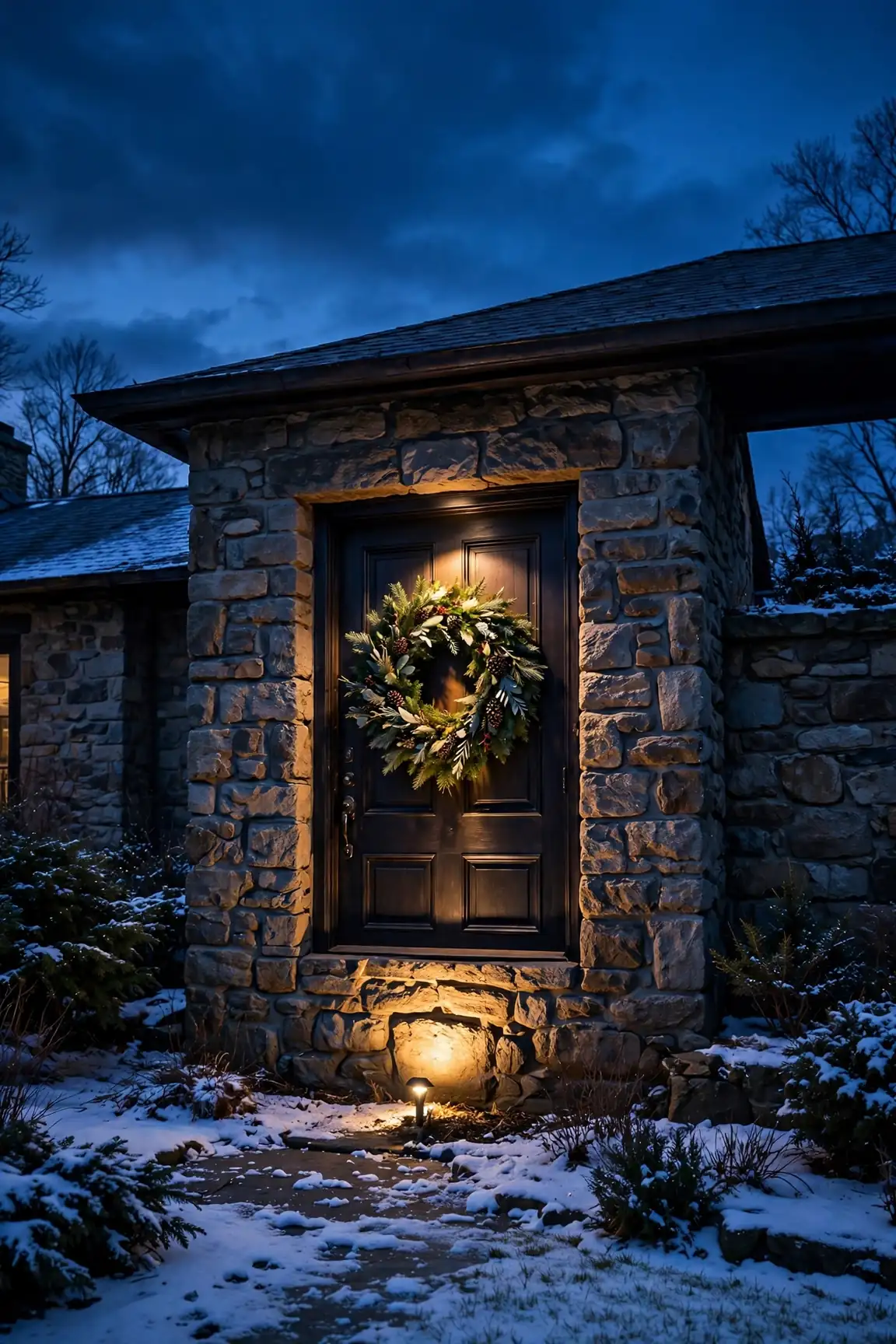
Wash the Facade With a Spotlight
One or two LED spotlights staked in the garden bed wash the whole front of the house in soft light, so the siding, stone, or brick becomes part of the display. Aim one at the door wreath and let the spill light the wall around it. A single warm spotlight costs under $20 and does the work of three decorative pieces.
Try it: Set the spotlight 6 to 8 feet out from the wall and angle it up at 45 degrees. Closer makes a hot spot; farther makes a flood.
05
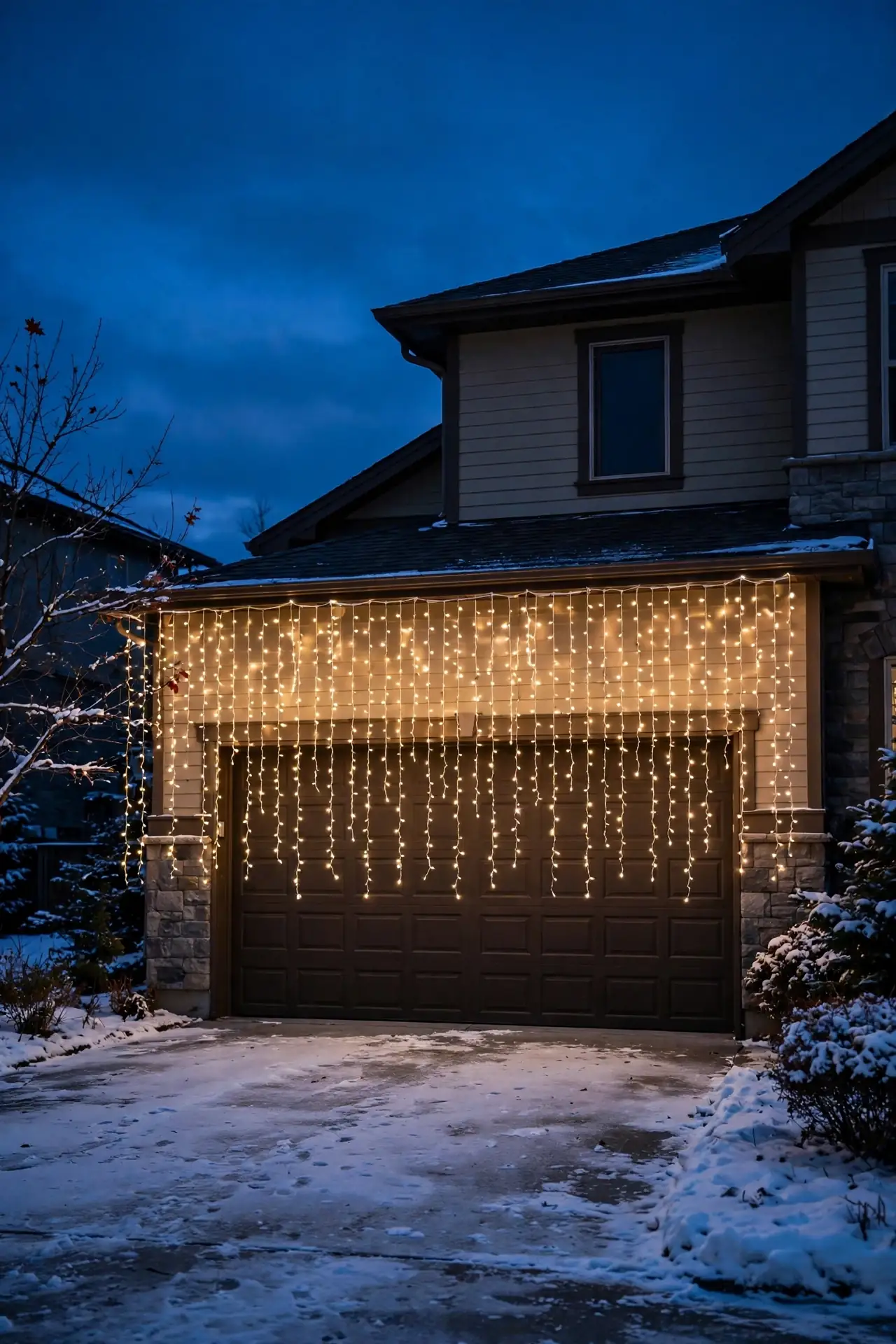
Curtain Lights Across the Garage
The garage door is the biggest blank canvas on most houses, and a curtain of warm lights turns it into a glowing backdrop. Hang the curtain from the trim above the door, never on the door itself, so it still opens. A 16-foot double garage takes two 10-by-10-foot curtain sets side by side.
Try it: Leave the bottom 12 inches of the curtain slightly loose. A curtain pulled drum-tight looks industrial; a soft fall looks like light rain.
06
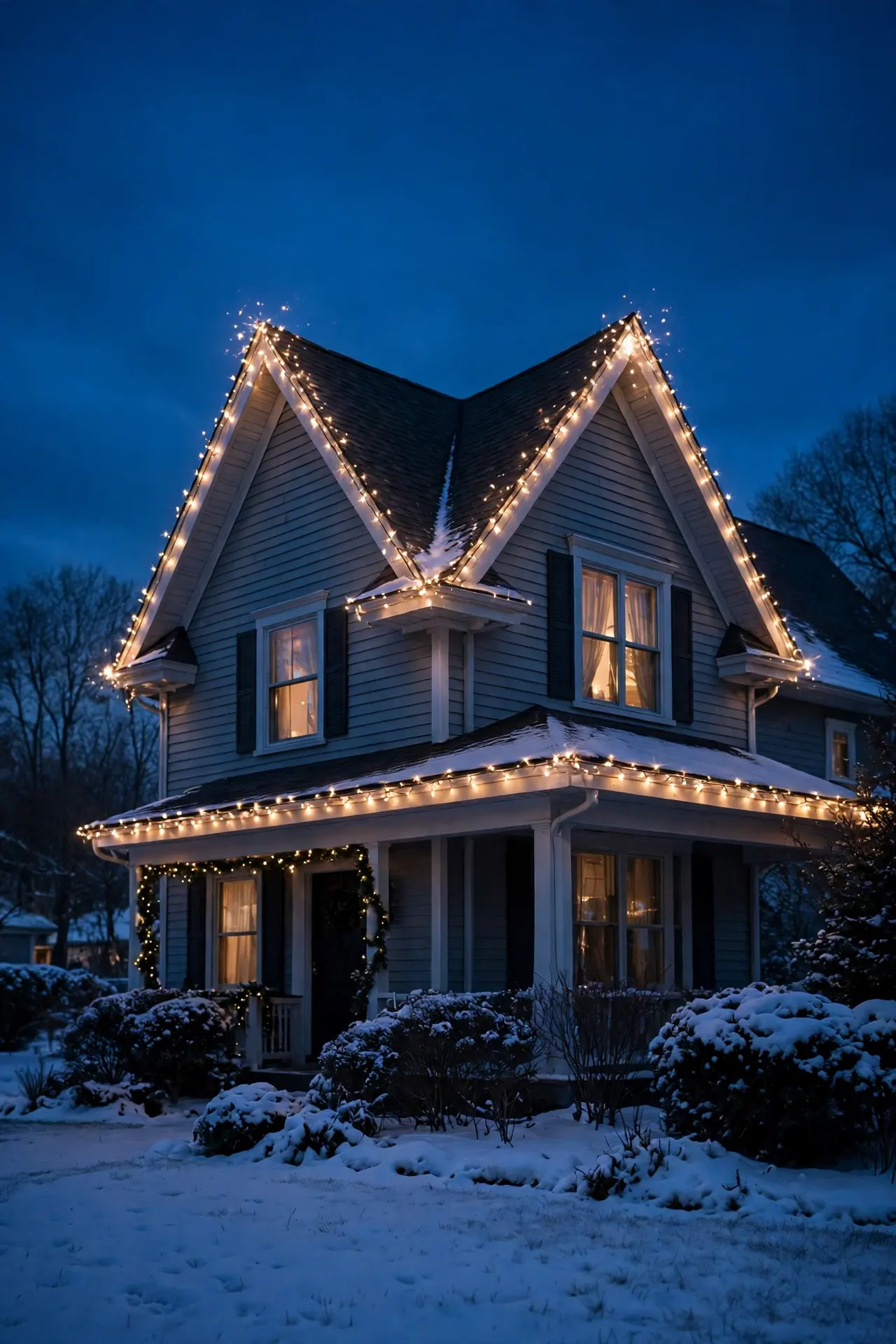
Mix Twinkle Into the Roofline
An all-steady roofline looks flat in photographs, and an all-twinkle one looks restless. The professional ratio is one twinkle strand for every four steady strands, scattered so the shimmer appears in different spots each time you look. Most twinkle strands randomize about 20 percent of their bulbs.
Try it: Put the twinkle strands at the peaks and corners. Movement at the edges frames the steady center and draws the eye across the whole house.
07
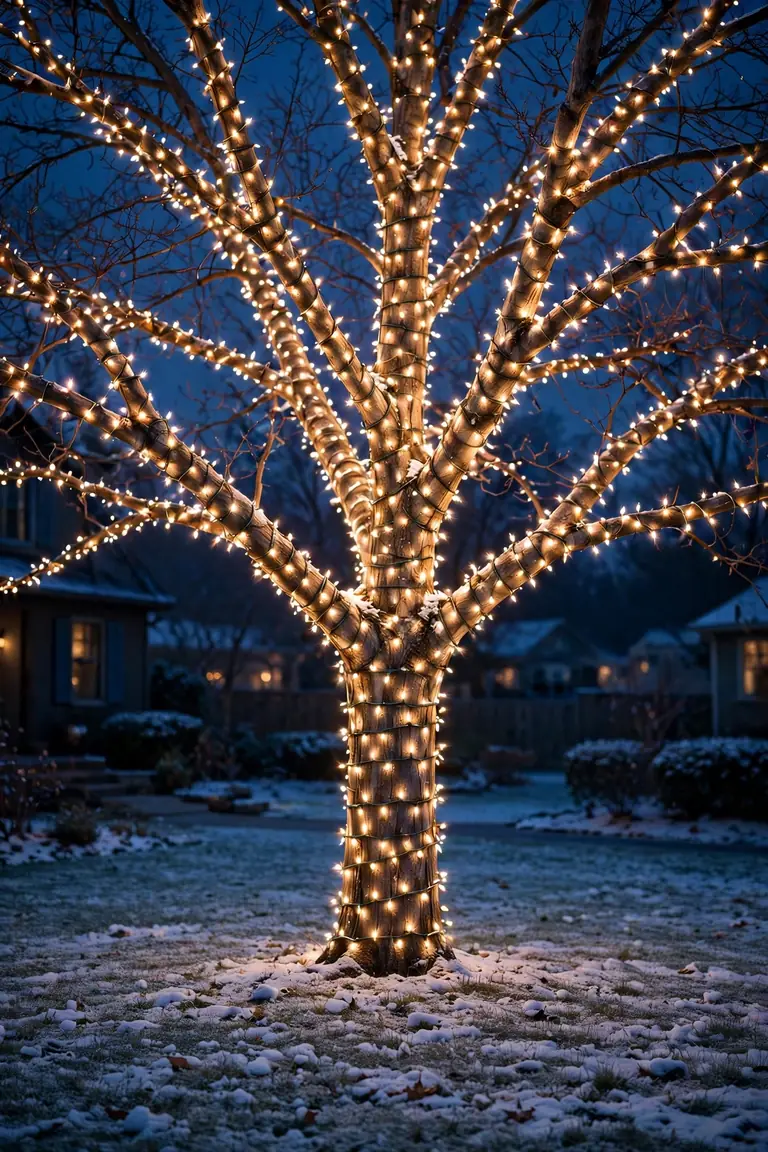
Wrap the Trunk, Then the Branches
A wrapped tree is the yard’s second Christmas tree, and the wrap is a formula: start at the base, wind upward with 4-inch spacing between passes, then run each main branch out to about two-thirds of its length. A 12-foot yard tree takes 6 to 8 strands of 100 lights for a full, dense wrap. Tight and even beats thick and sloppy.
Try it: Wrap in daylight but plug in at dusk to check your spacing. Gaps invisible at noon glow like missing teeth at night.
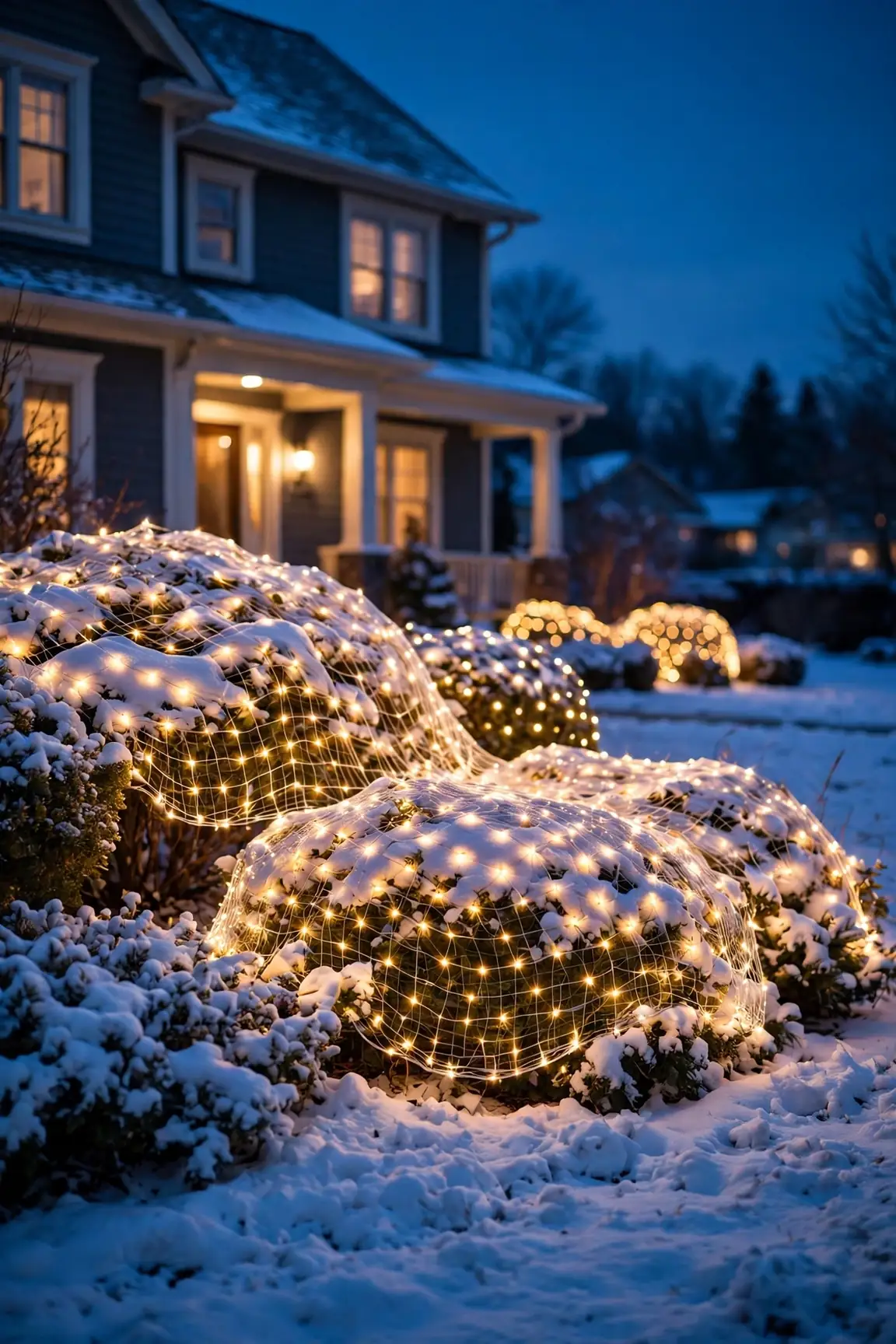
08
Net Lights Over the Bushes
Net lights drape over shrubs like a blanket of snow made of light, and they are the fastest idea on this list: one 4-by-6-foot net covers a medium bush in about two minutes. Lay the net over the top and let the edges fall; do not stretch it tight or the grid pattern shows. Count your bushes in November, because nets sell out first.
Try it: Overlap two nets on large foundation shrubs instead of centering one. The double layer at the seam reads as depth, not as a join.
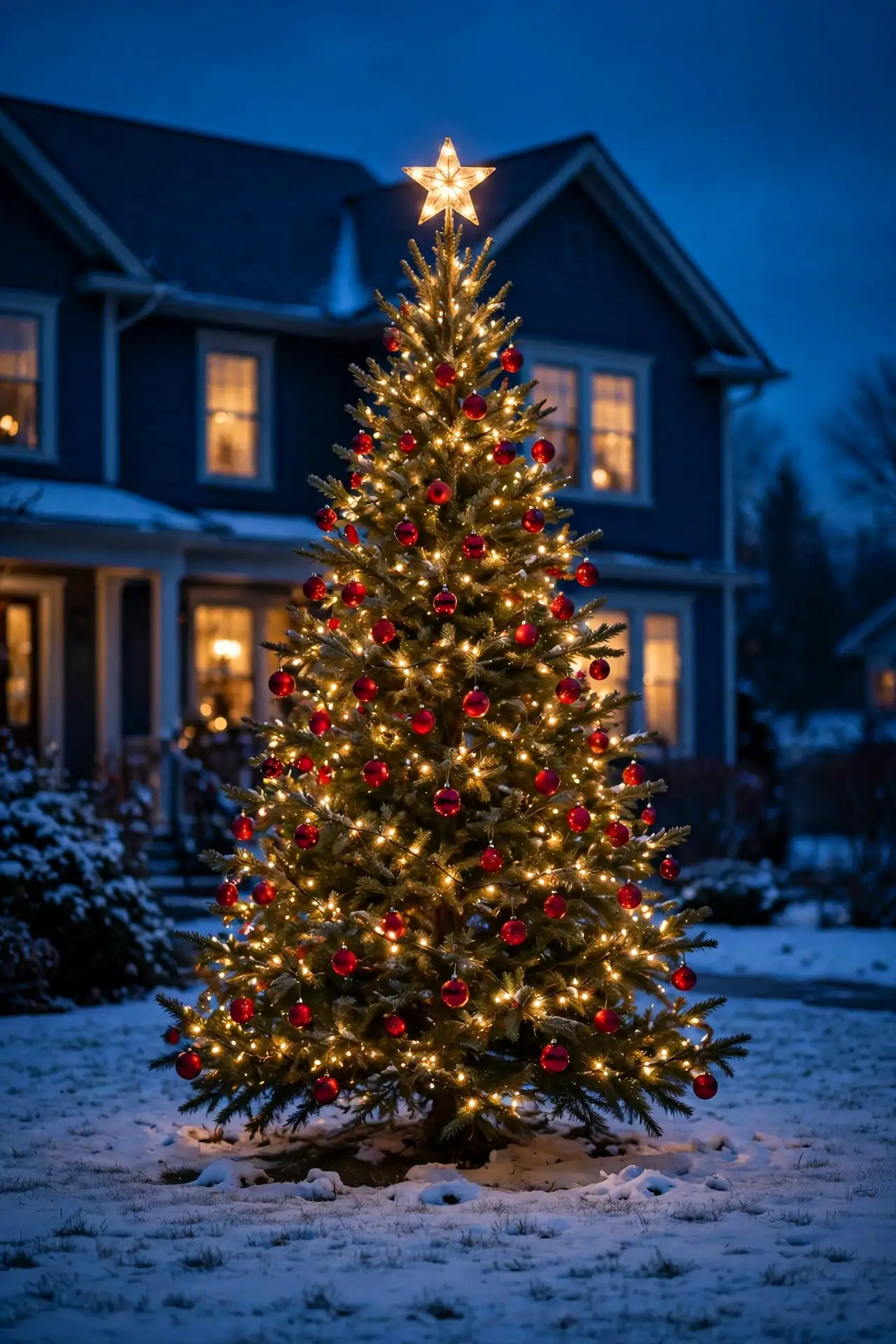
09
Plant a Real Outdoor Christmas Tree
An outdoor christmas tree in the yard, a potted spruce or a weatherproof artificial tree anchored on the lawn, gives the display a hero that is not the house itself. Go bigger than feels right: a tree that reads perfectly from the sidewalk is at least 6 feet. Anchor it with three guy lines or a ground stake, because December wind treats a yard tree like a sail.
Try it: Put the yard tree on the opposite side from the indoor tree’s window. Two lit trees on one sightline compete; separated, they bookend the house.
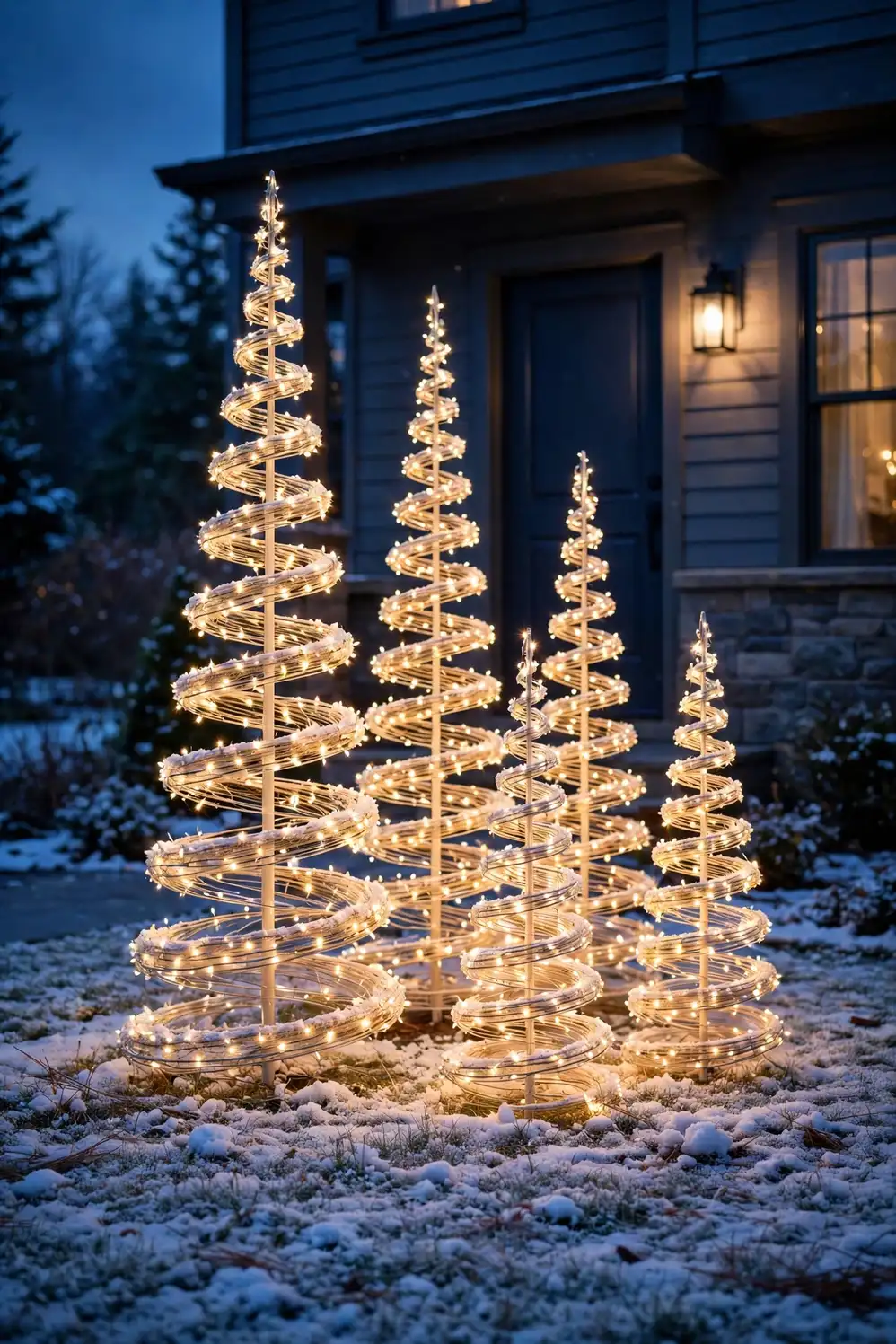
10
A Grove of Small Lit Trees
Group three to five spiral or cone trees at staggered heights, 3, 4, and 6 feet, near the entry or around the yard tree. Odd numbers and mixed heights make the cluster look grown rather than placed. The set costs less than one large figure and stores flat or nested.
Try it: Put the tallest cone at the back and angle the group toward the street. A straight line of cones looks like a product display; a triangle looks like a grove.
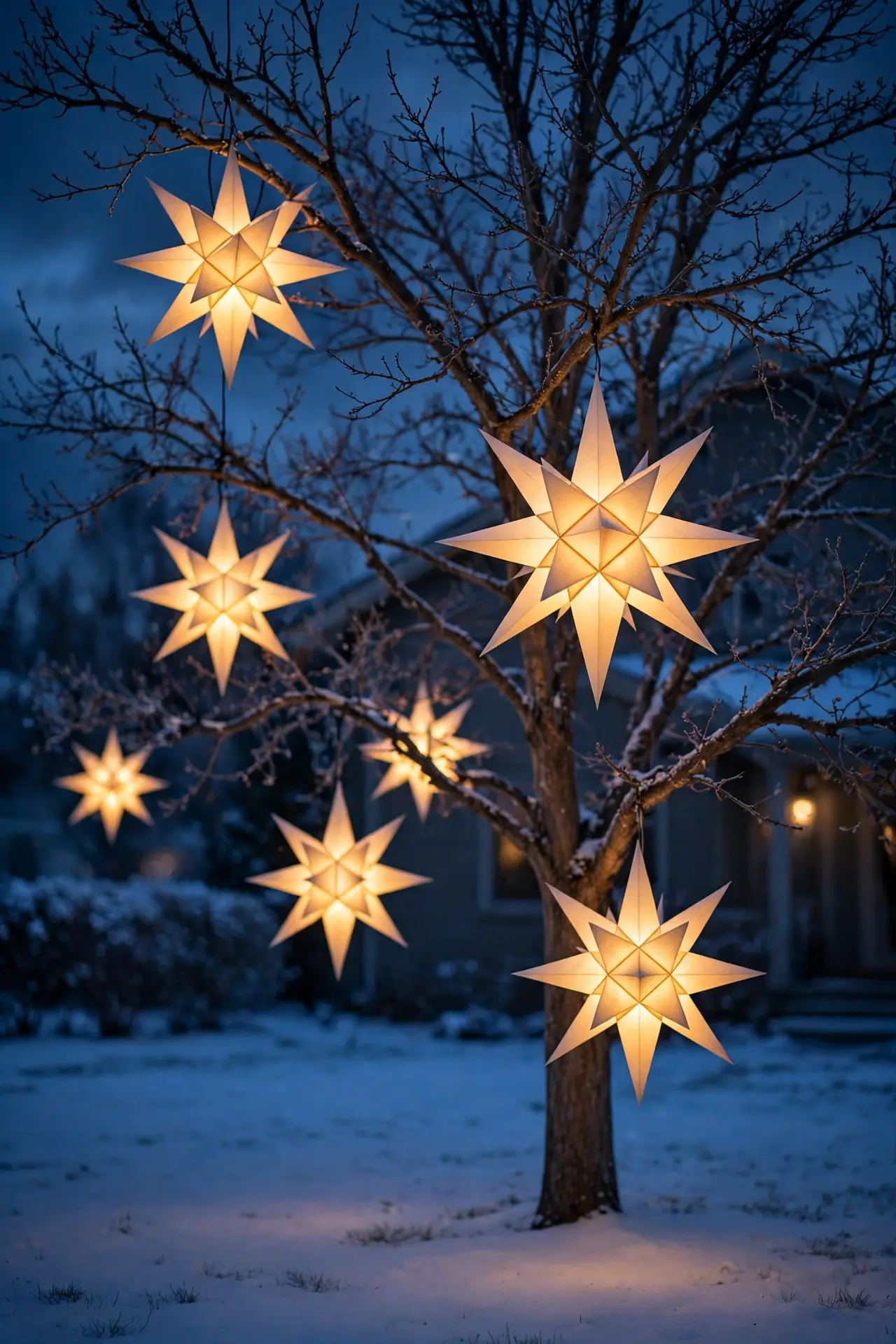
11
Hang Stars in the Bare Tree
A leafless winter tree is a chandelier waiting to happen. Hang three to five Moravian stars or starburst lights from the branches at different heights on outdoor-rated cords. From the street they float; from the house they frame every window view. Weatherproof paper stars work, but sealed plastic ones survive the whole season without a rescue mission.
Try it: Hang stars at heights you can reach from the ground with a hook pole. If a star needs a ladder to hang, it needs a ladder to fix, and it will need fixing.
12
Uplight the Evergreens
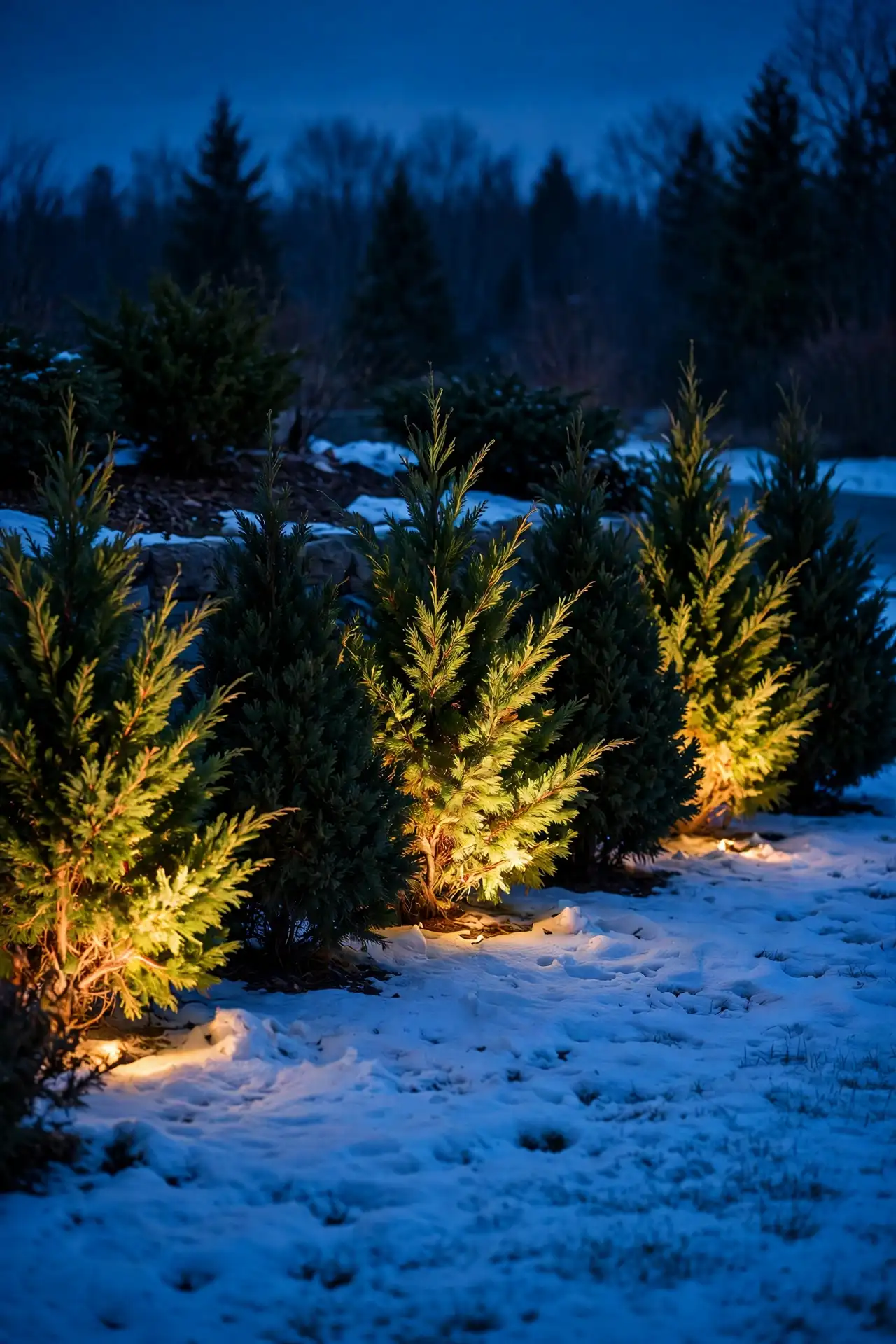
Evergreen shrubs and conifers are dark masses at night until you light them from below. One solar or plug-in uplight per specimen, set a foot from the trunk and angled into the foliage, turns each tree into a green lantern. This is the landscaper’s trick, and it works on the plainest foundation planting.
Try it: Light every other evergreen, not all of them. Alternating lit and dark trees create rhythm; lighting everything flattens the yard into a stage set.
13
Wrap the Palm Tree Anyway
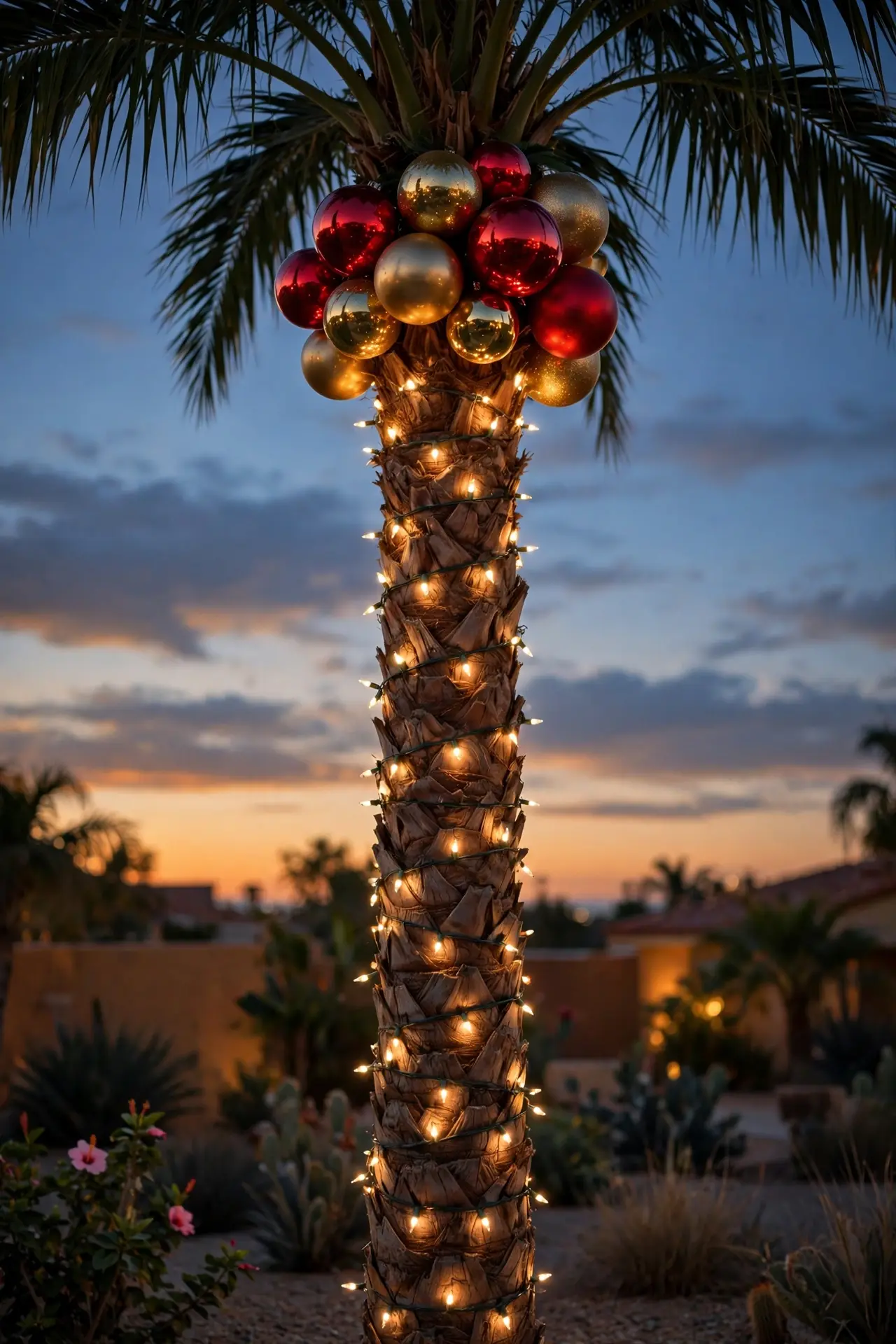
No snow does not mean no display. Wrap a palm trunk in warm white lights with wide 6-inch spacing, then hang a cluster of oversized ornaments or a star from the fronds’ base. In warm climates the wrapped palm is the roofline’s replacement: the vertical line of light the whole street navigates by.
Try it: Use commercial-grade strands on palms. The trunk grows and sheds bark all season, and cheap sockets crack under the movement.
14
Candy Cane Path Lights
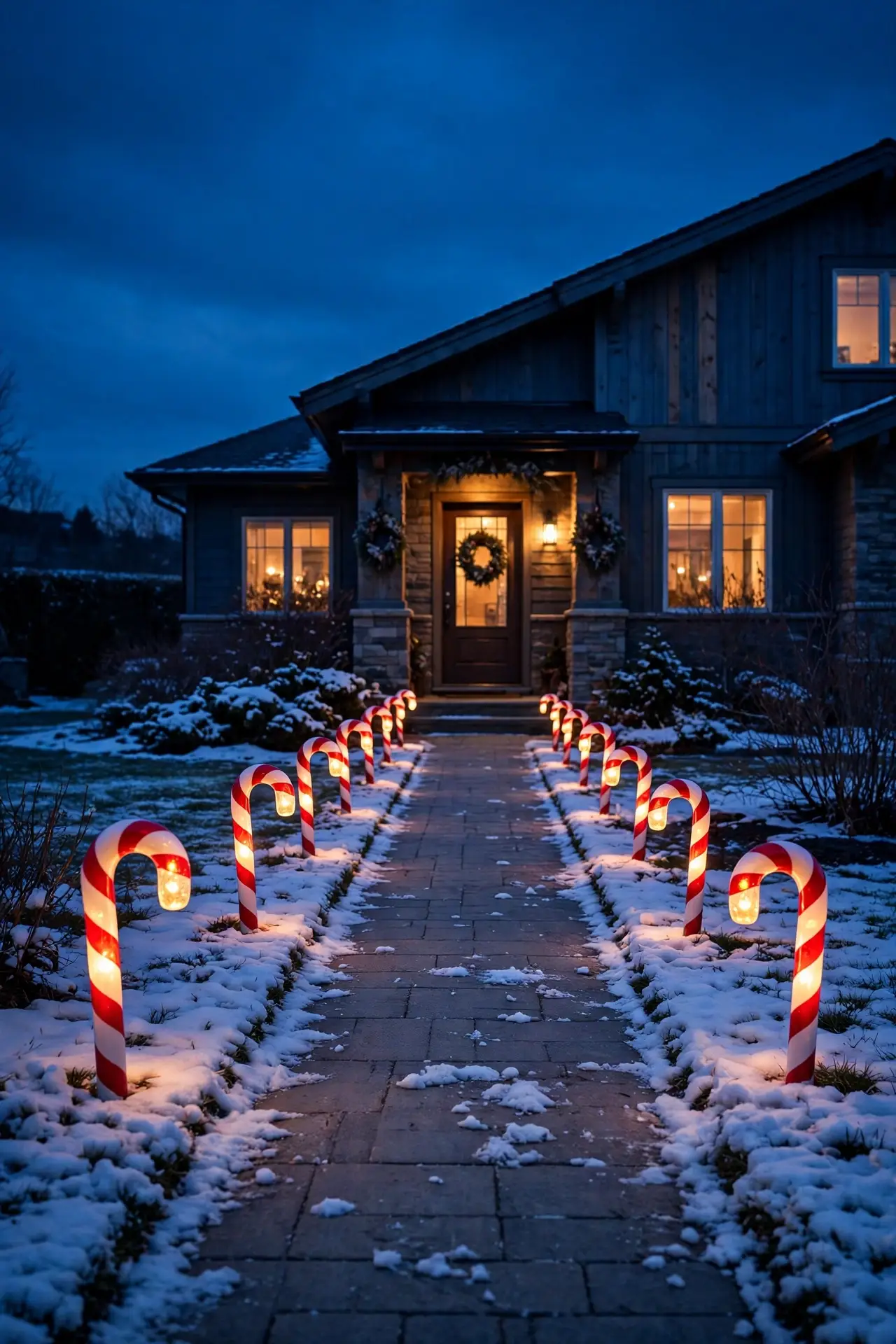
Candy cane stakes along the walkway are the friendliest lights on the street and the ones children remember. Space them evenly, about 3 feet apart, on alternating sides of the path for a runway effect or on both sides for a formal entry. A 20-foot walk takes seven canes and about 20 minutes to install.
Try it: Push the stakes in before the ground freezes, even if you decorate later. Mid-December soil in cold zones turns installation into a construction project.
15
Lanterns Up the Steps
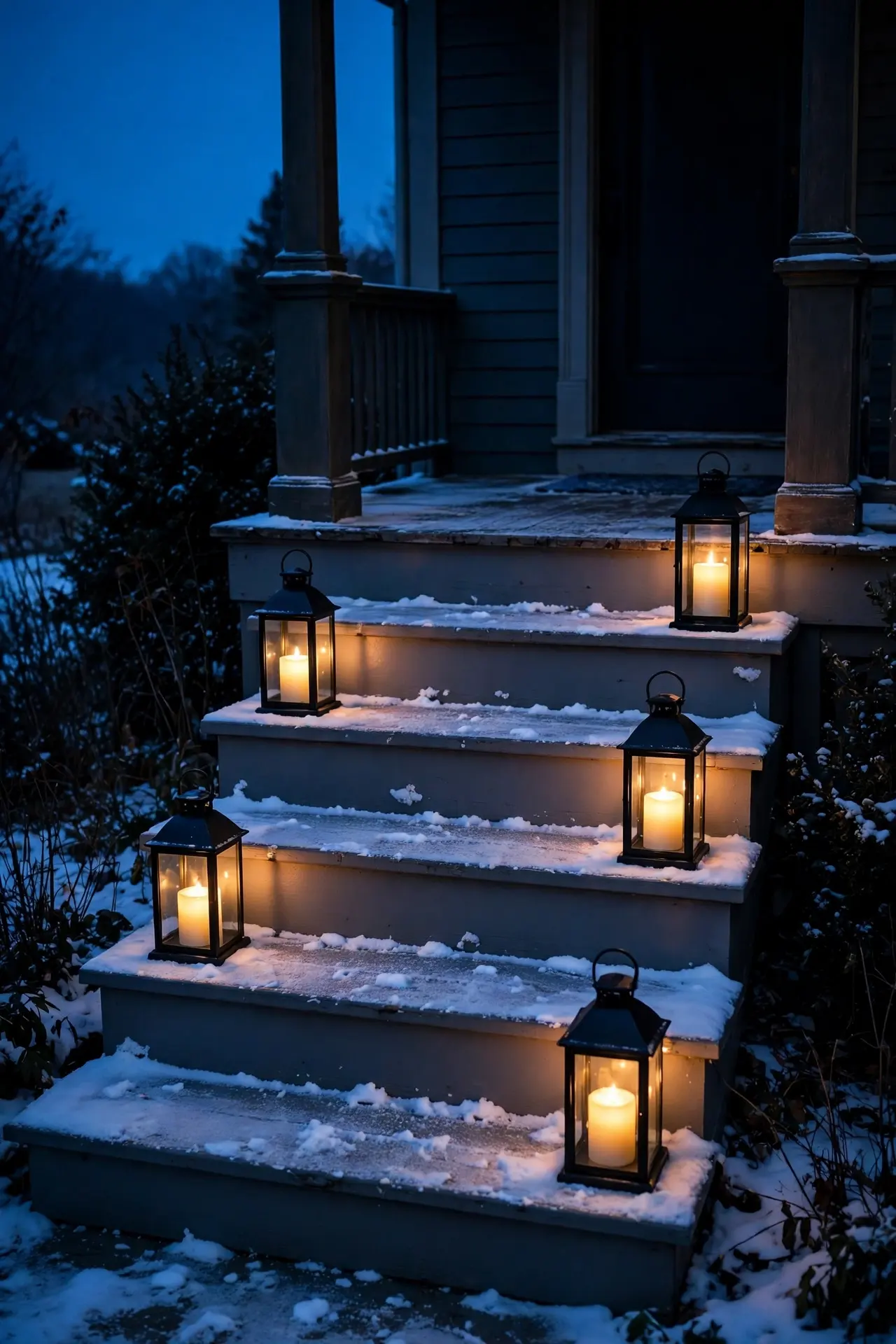
Line the front steps with lanterns, one per step on alternating sides, each holding a flameless candle on a timer. Think of each lantern as a small outdoor christmas lamp: steady, warm, and exactly where feet need light. Lanterns also survive wind that flattens lesser decorations, because the candle sits behind glass.
Try it: Set all the lantern timers to the same start time. Steps that light up one by one over an hour look haunted; steps that glow together look designed.
16
Luminaries for the Big Nights
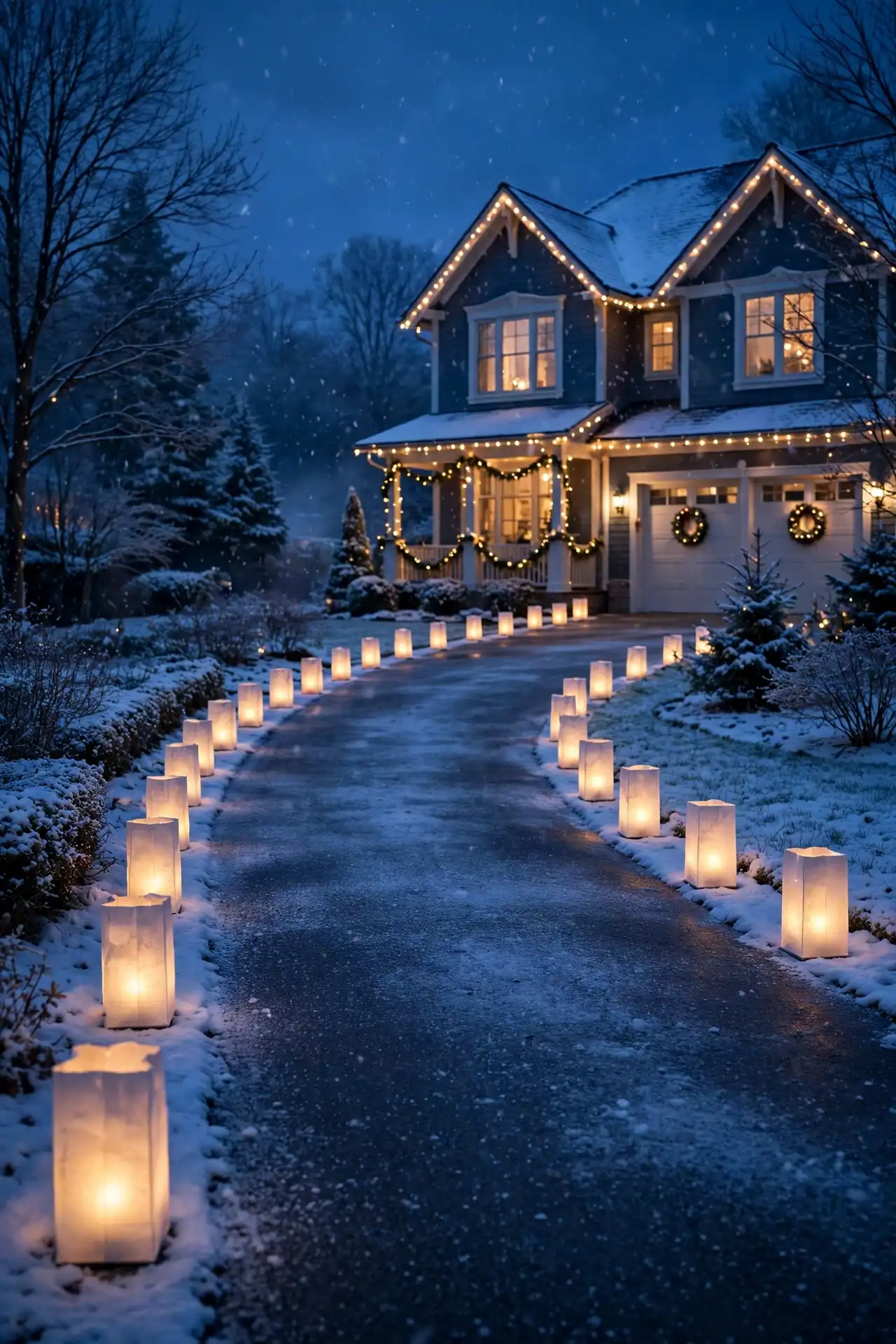
Paper or reusable plastic luminaries along the driveway and walk are a Christmas Eve tradition that costs almost nothing: a bag, a handful of sand, and an LED tea light every 4 feet. Save them for the nights that matter rather than all season, because their power is in being occasional. A 40-foot driveway takes ten per side.
Try it: Use warm LED tea lights, never real flames in paper. The glow is identical and the fire risk drops to zero.
17
Garland and Lights on the Porch Railings
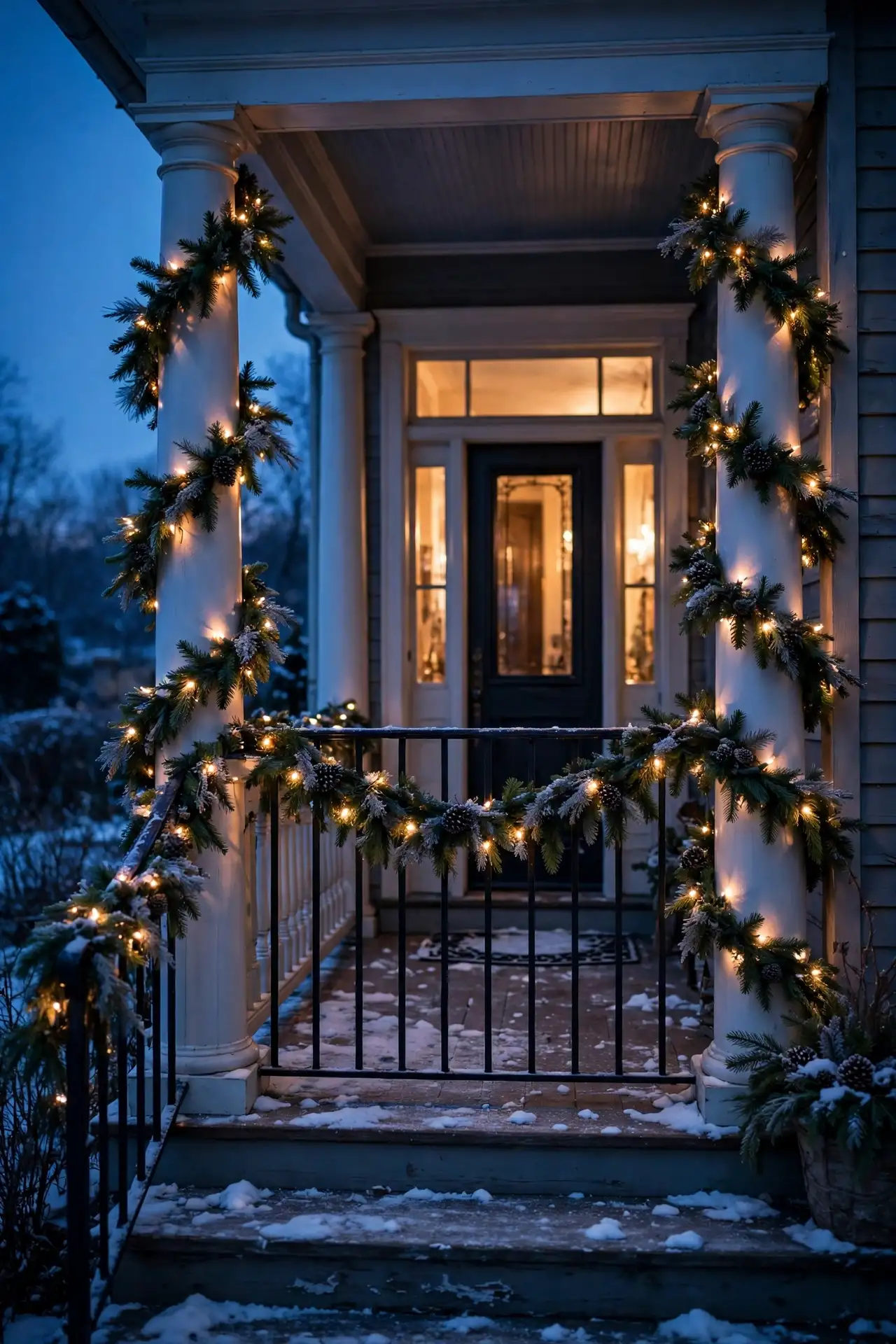
Wrap the porch railings and columns with garland, then weave a strand of mini lights through it. The porch becomes a lit frame for the door, and anyone standing in it is inside the display. Prelit garland saves a step, but separate garland and lights let you replace a dead strand without losing the greenery.
Try it: Wrap columns in a spiral with wide spacing, about one turn per 2 feet. Tight spirals eat garland and look like a barber pole.
18
Wrap the Door Frame in Golden Light
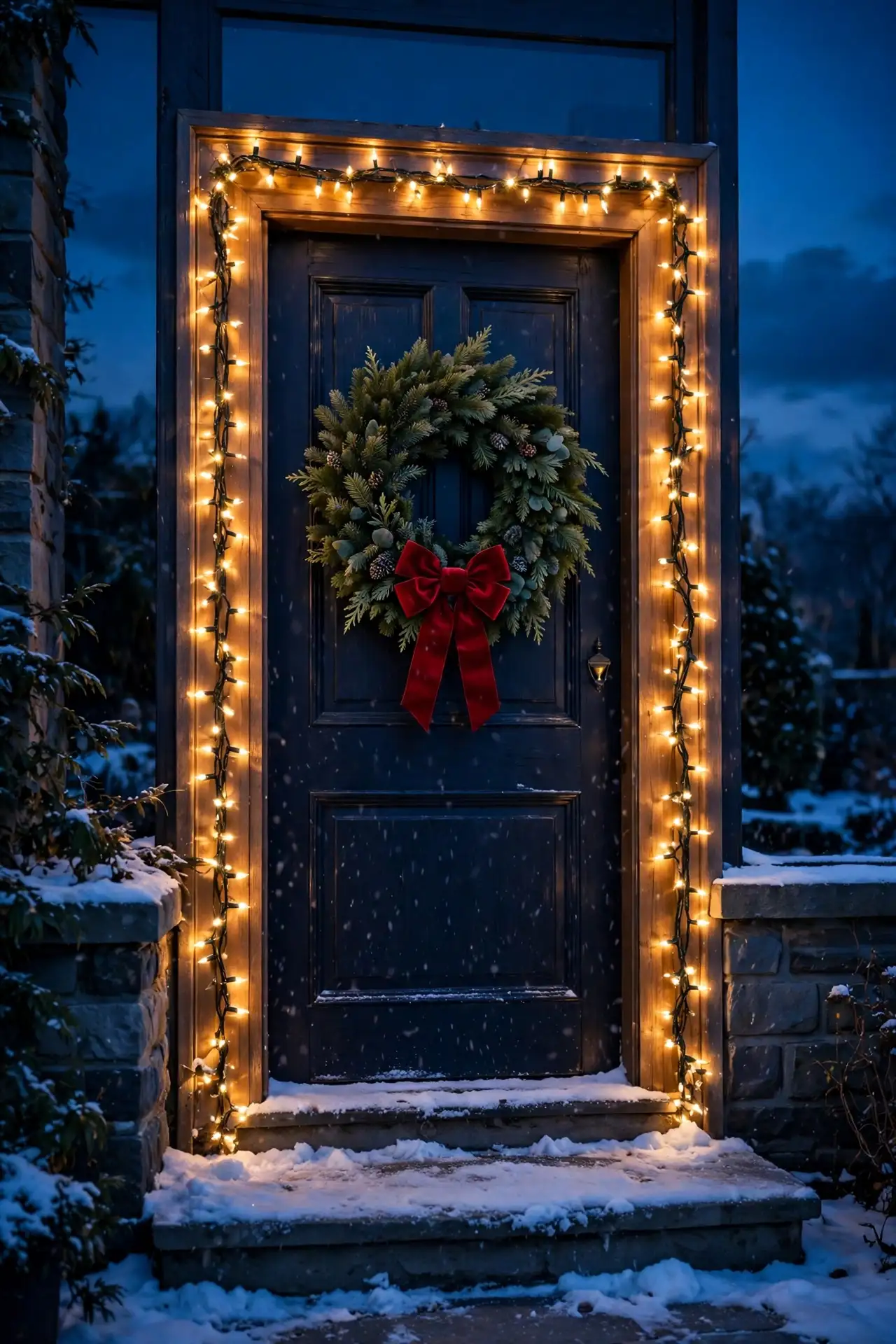
Run a strand around the full door frame and center a wreath on the door itself, and the entry becomes the display’s focal point at any house size. Warm white or soft gold suits a door; save color for the yard. Attach with brick clips or removable outdoor hooks so January leaves no holes.
Try it: Add a second, slimmer strand in a deeper gold on the inside edge of the frame. The double line gives the doorway depth after dark.
19
Star Stakes Along the Driveway
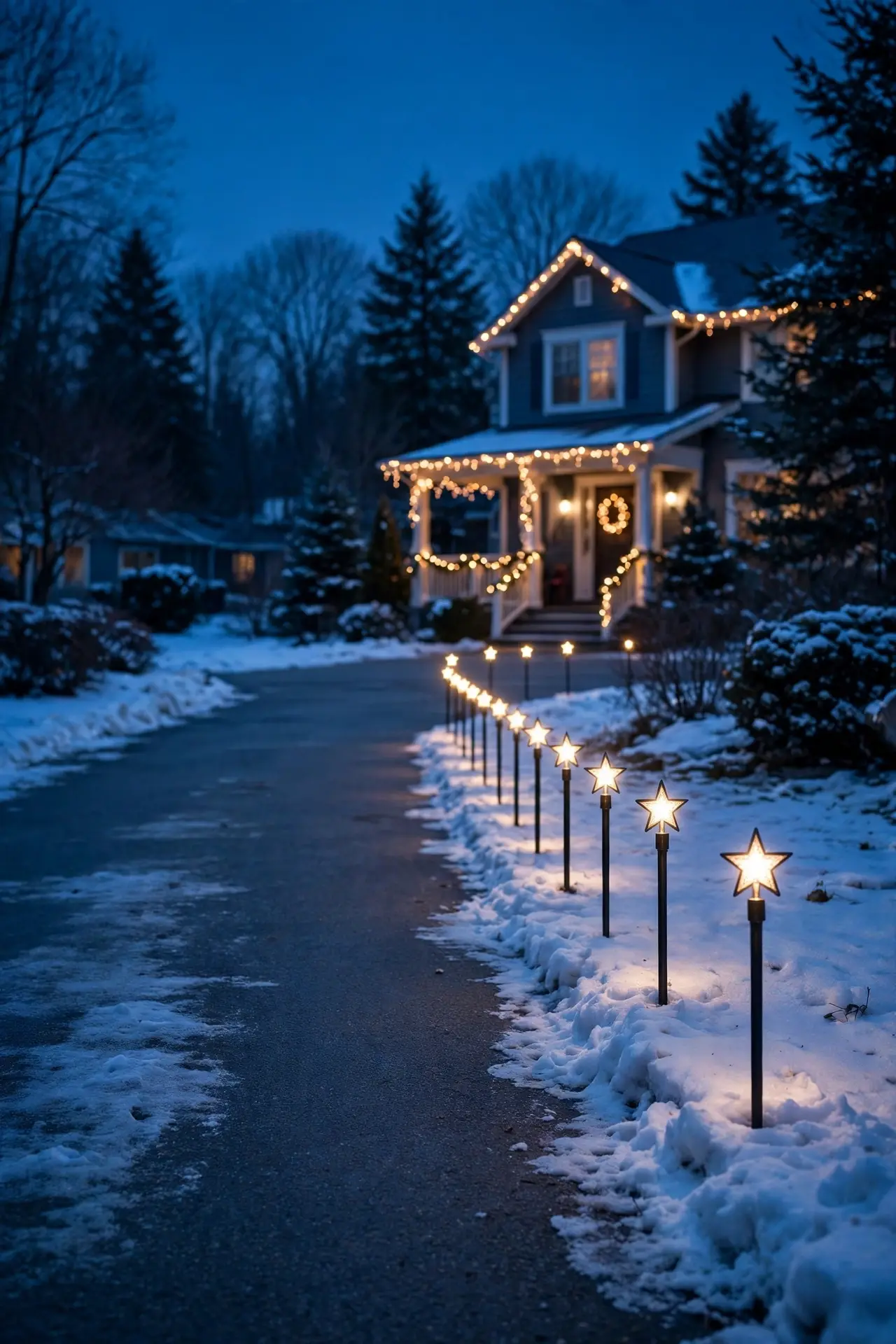
Most people light the walk and forget the driveway, which is half the frontage. Star-topped stake lights every 5 feet down one side of the drive carry the display to the street and give guests a lit route from the car. Solar versions make this a ten-minute job with no cord crossing the concrete.
Try it: Light only one side of the driveway. Both sides lit reads as a landing strip; one side reads as a guide.
20
Lit Planters Flanking the Door
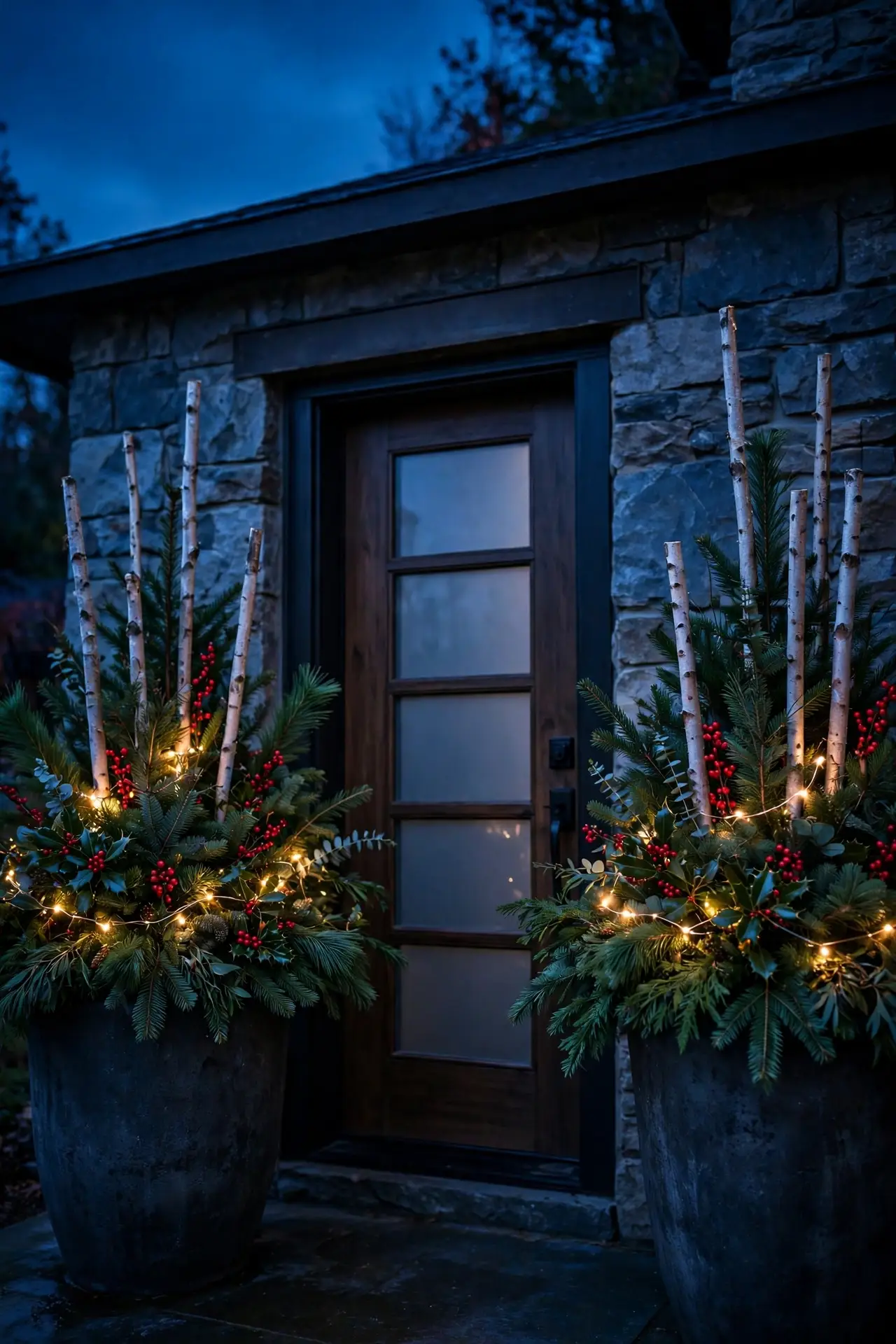
Fill the two front-door planters with evergreen cuttings, birch poles, and red berries, then push one short strand of battery lights into each. The planters frame the door all day and glow all evening. Battery strands on timers mean no cord across the threshold, which is both safer and cleaner.
Try it: Sink the battery pack in a small zip bag inside the planter. Weather finds every exposed pack by the second week.
21
The Reindeer and Sleigh Grouping
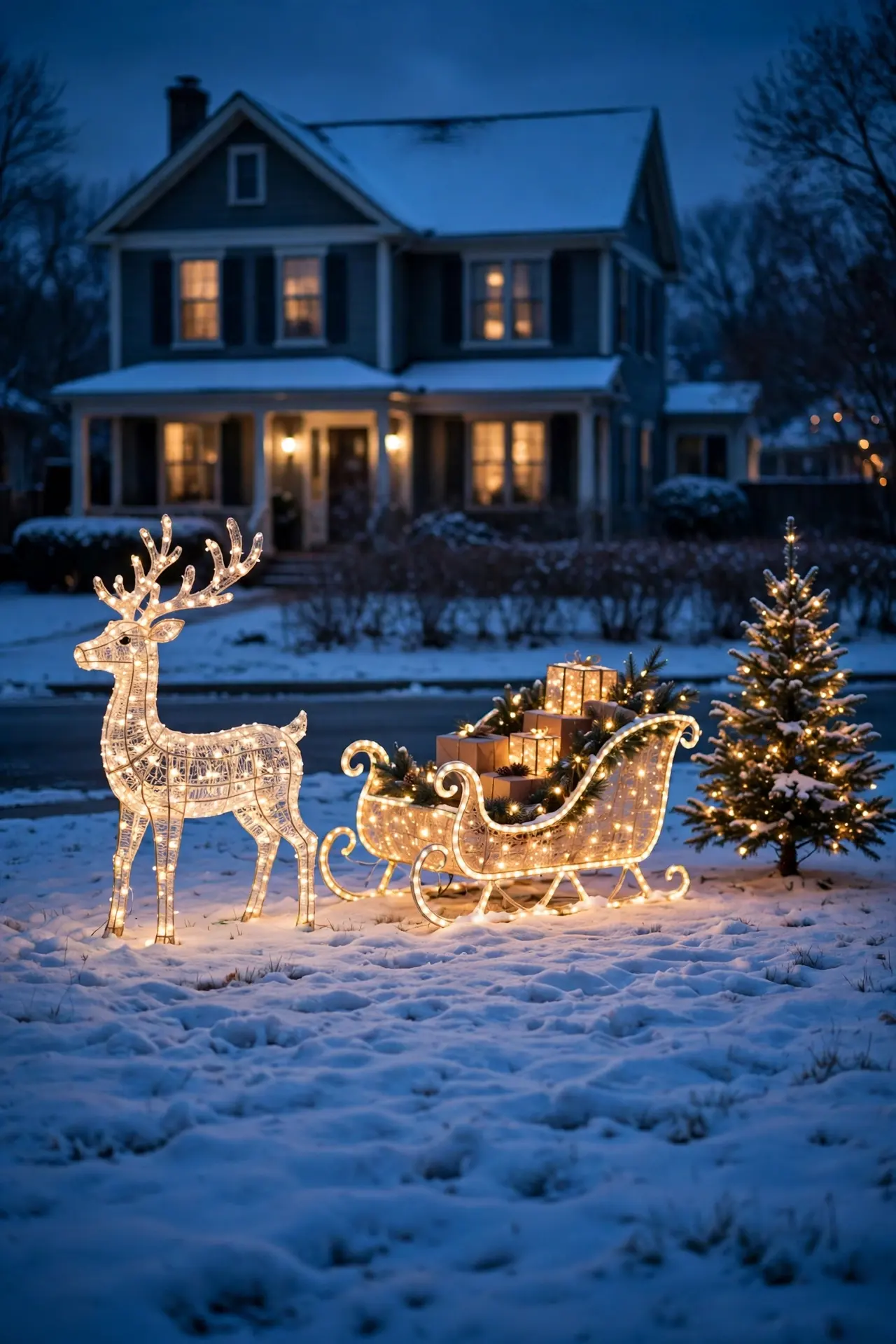
One lighted reindeer reads as a figure; a reindeer, a sleigh, and a small lit tree read as a scene. Group figures tightly, within a few feet of each other, on the lawn’s most visible corner, and graze them with one spotlight so they share a pool of light. Scenes scattered across a whole yard lose each other; scenes grouped tell a story.
Try it: Angle the reindeer’s head toward the street. Figures facing the house look like they are leaving; figures facing out greet arrivals.
22
A Snowman Trio With Its Own Glow
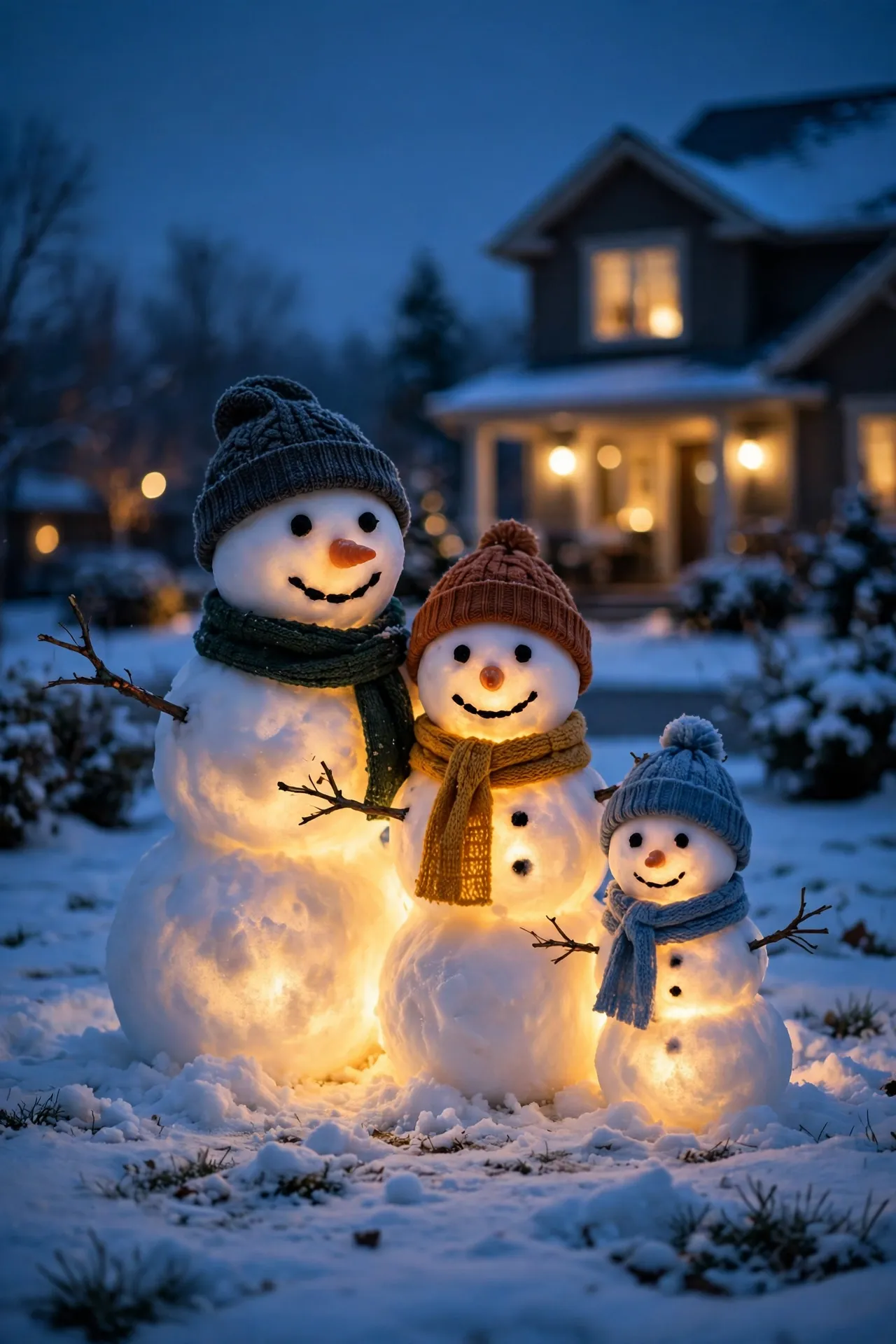
Internally lit snowmen are the display’s warmth: soft, round, and visible from half a block. Cluster three at different heights like a family, close enough to share a power source and a patch of lawn. Their built-in glow means they need no spotlight, which frees your spots for the trees.
Try it: Put the snowmen where headlights sweep them as cars turn the corner. A figure that lights up in passing headlights gets noticed twice.
23
Spotlight the Nativity, Do Not Outline It
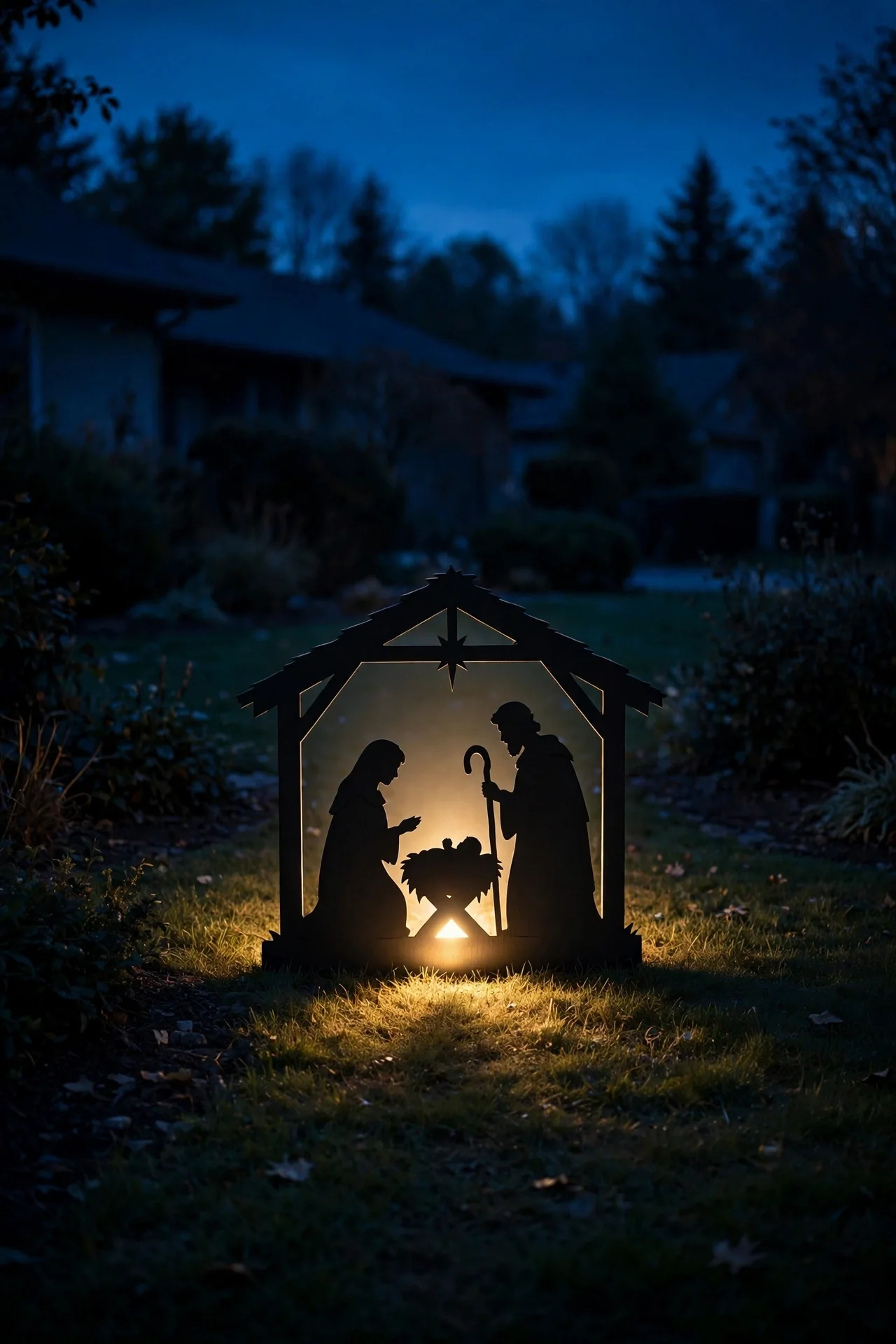
A nativity scene looks best lit like artwork: one warm spotlight from the front, low and close, instead of strands strung over the figures. Keep every other light within ten feet of it dim or absent so the scene holds its own quiet pool of light. Simple silhouettes read better at distance than detailed figures.
Try it: Use a timer so the nativity lights with the rest of the display at dusk. A dark nativity in a lit yard looks forgotten.
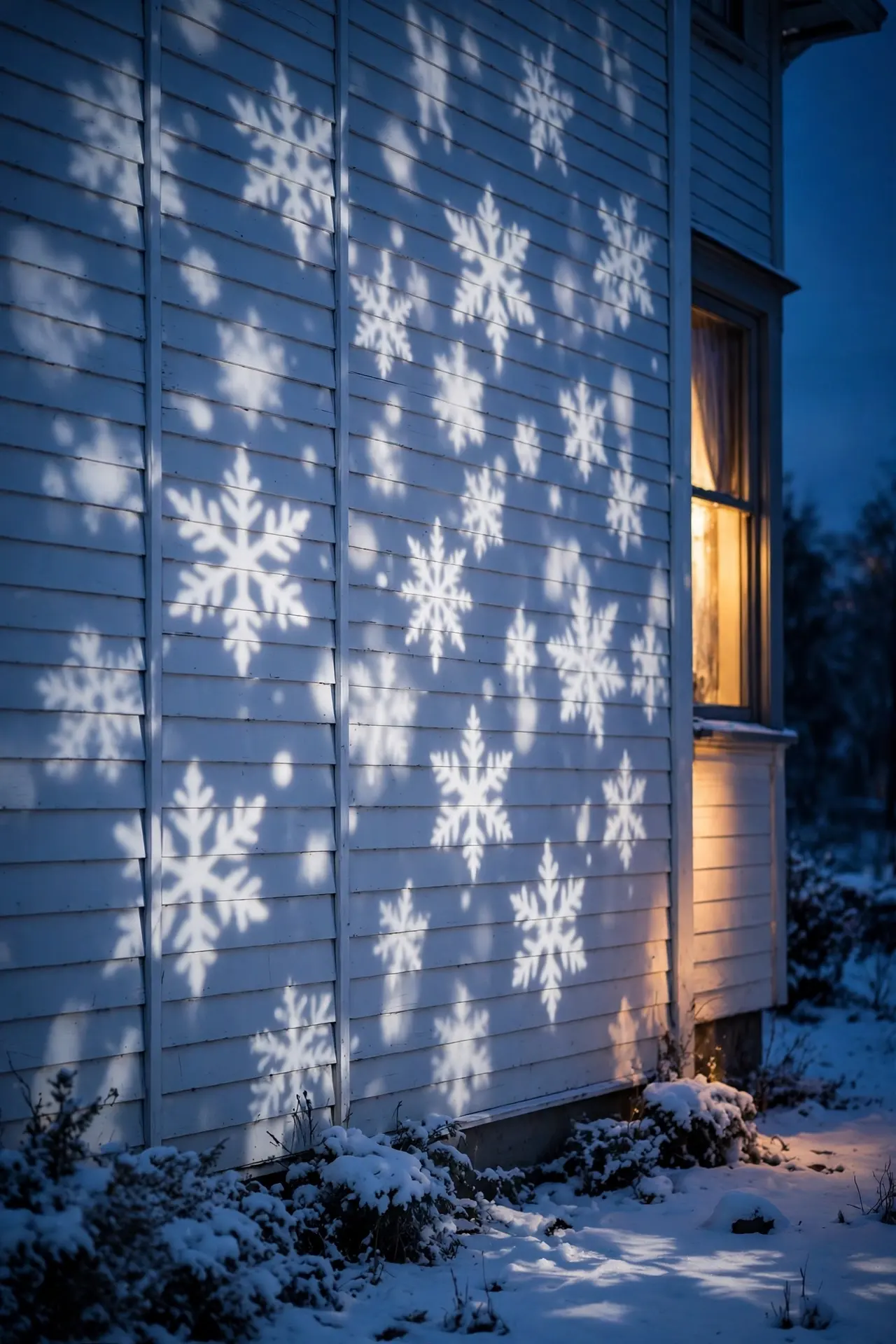
24
Project Falling Snow on the Blank Wall
Every house has one big blank wall, and a projector fills it with drifting snowflakes for the price of a pizza. Stake the projector 10 to 15 feet from the wall and keep the pattern slow; fast-moving projections read as alarms, slow ones read as weather. It is the highest-coverage, lowest-effort idea on this list.
Try it: Aim the projector at the wall section with the fewest windows. Snowflakes crossing lit windows look broken; on blank siding they look like a blizzard.
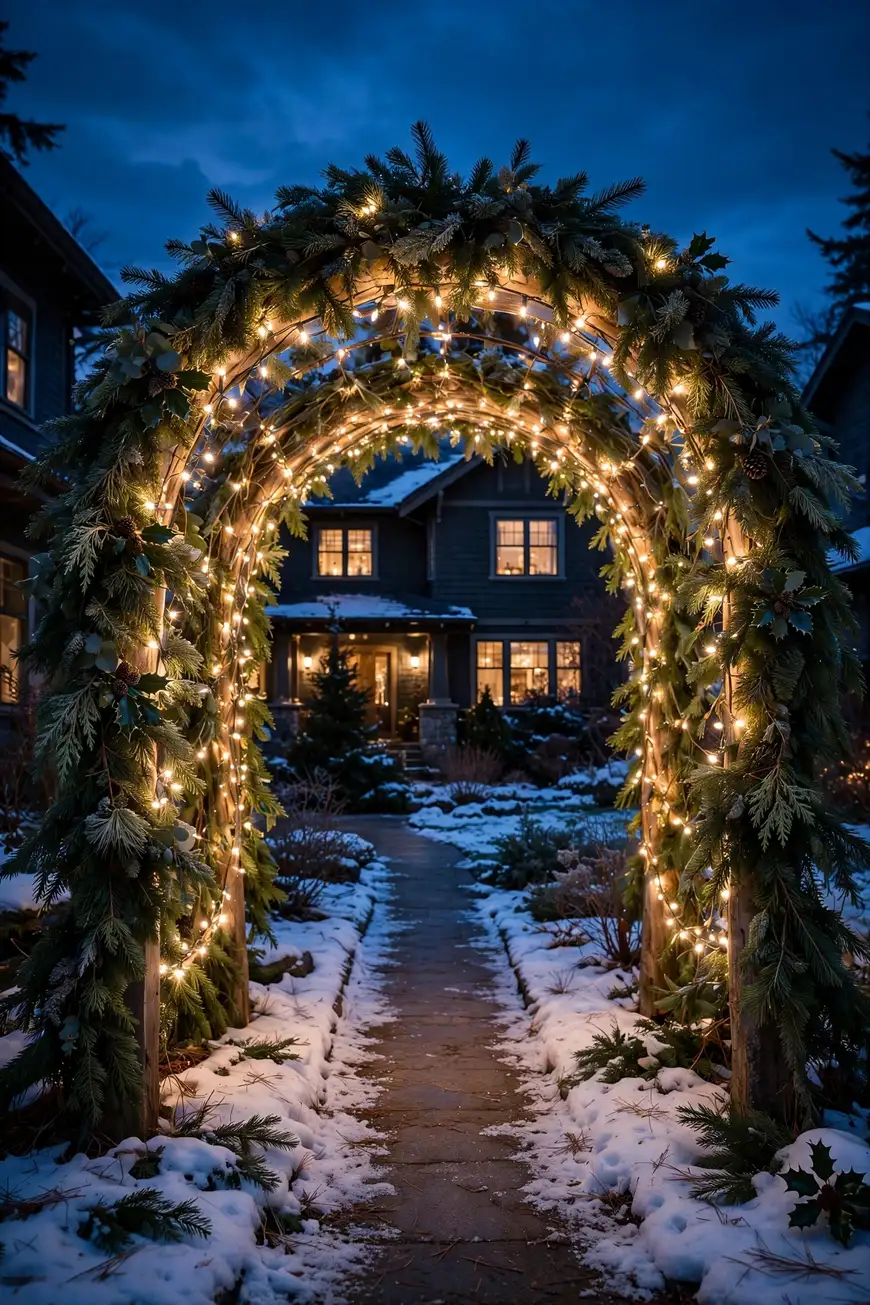
25
Build a Light Arch Over the Walk
An arch of evergreen garland and lights over the front walk turns arriving into an event. Use a garden arch frame or two shepherd’s hooks joined by swagged garland, and weave in two strands of mini lights. Keep the clearance at least 7 feet at the center so tall guests and delivery drivers pass without ducking.
Try it: Light the arch on both sides, front and back. A one-sided arch glows for the street and goes dark for the people walking through it.
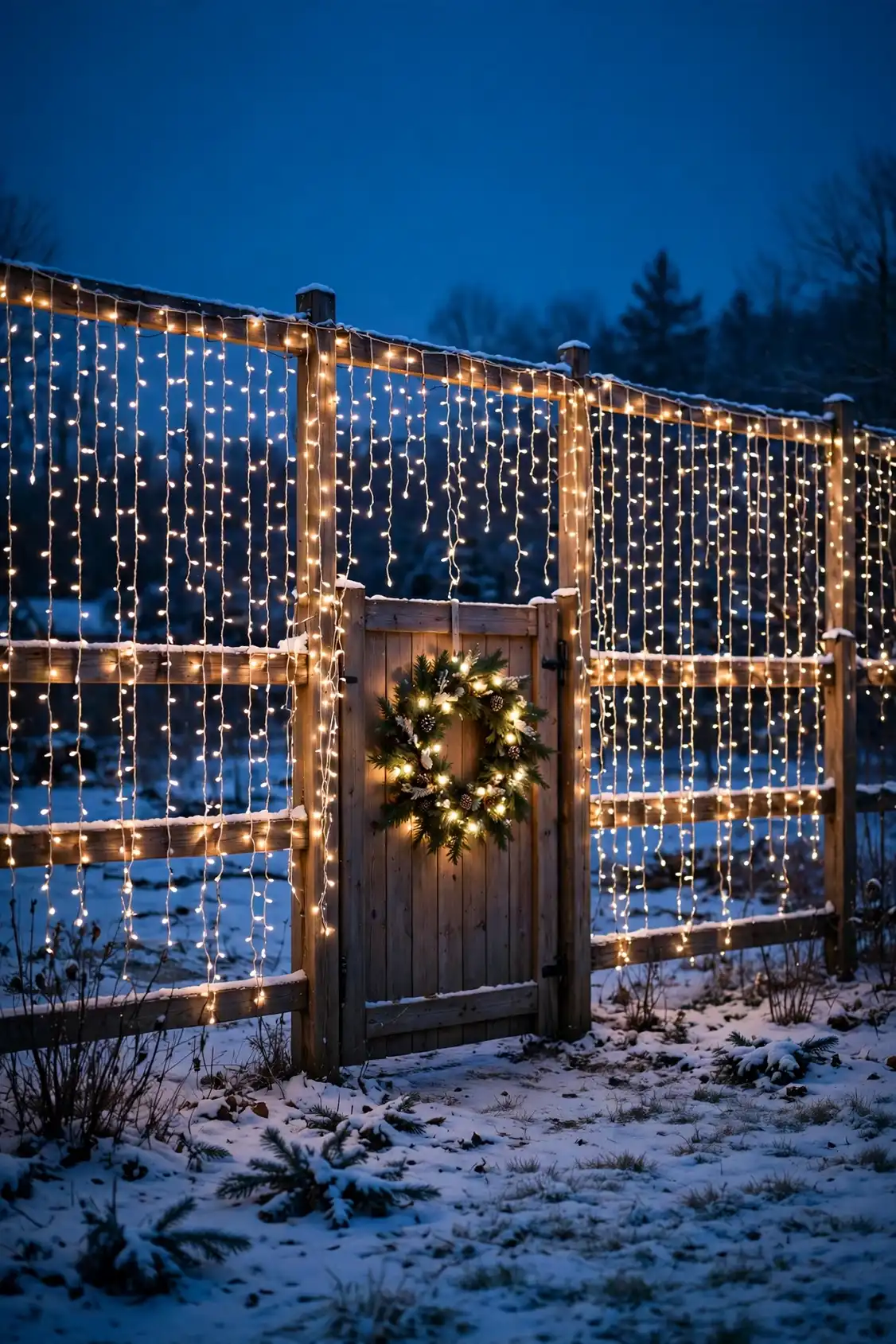
26
A Curtain of Lights on the Fence
The fence is the yard’s back wall, and a curtain of warm lights along it gives the whole display a horizon. This matters most for corner lots and houses whose yards face the street. Run the curtain along the top rail with drops hanging inside the yard, so the glow belongs to you and the silhouette belongs to the street.
Try it: Break the curtain with one lit wreath at the gate. An unbroken wall of light looks like a barrier; a wreath makes it an entrance.
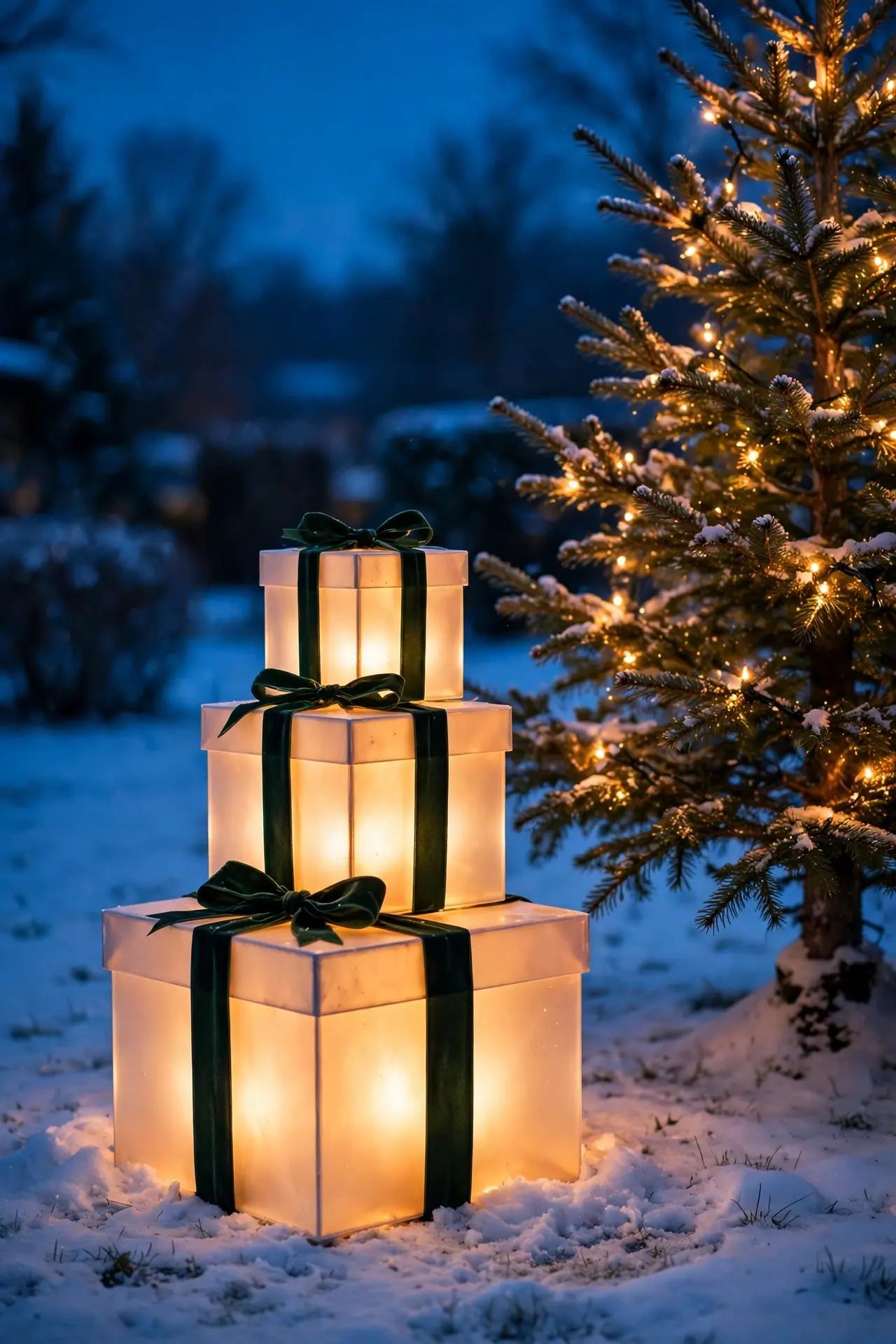
27
A Stack of Glowing Gift Boxes
Lighted gift boxes, weatherproof cubes wrapped in ribbon with the light inside, fill the dark space under the yard tree or beside the door. A stack of three at graduated sizes costs under $40 and photographs like a department-store window. They also hide the tangle of extension cords at the base of a display beautifully.
Try it: Weight each box with a brick inside. Lightweight glowing boxes migrate across lawns in December wind, usually to the neighbor’s yard.
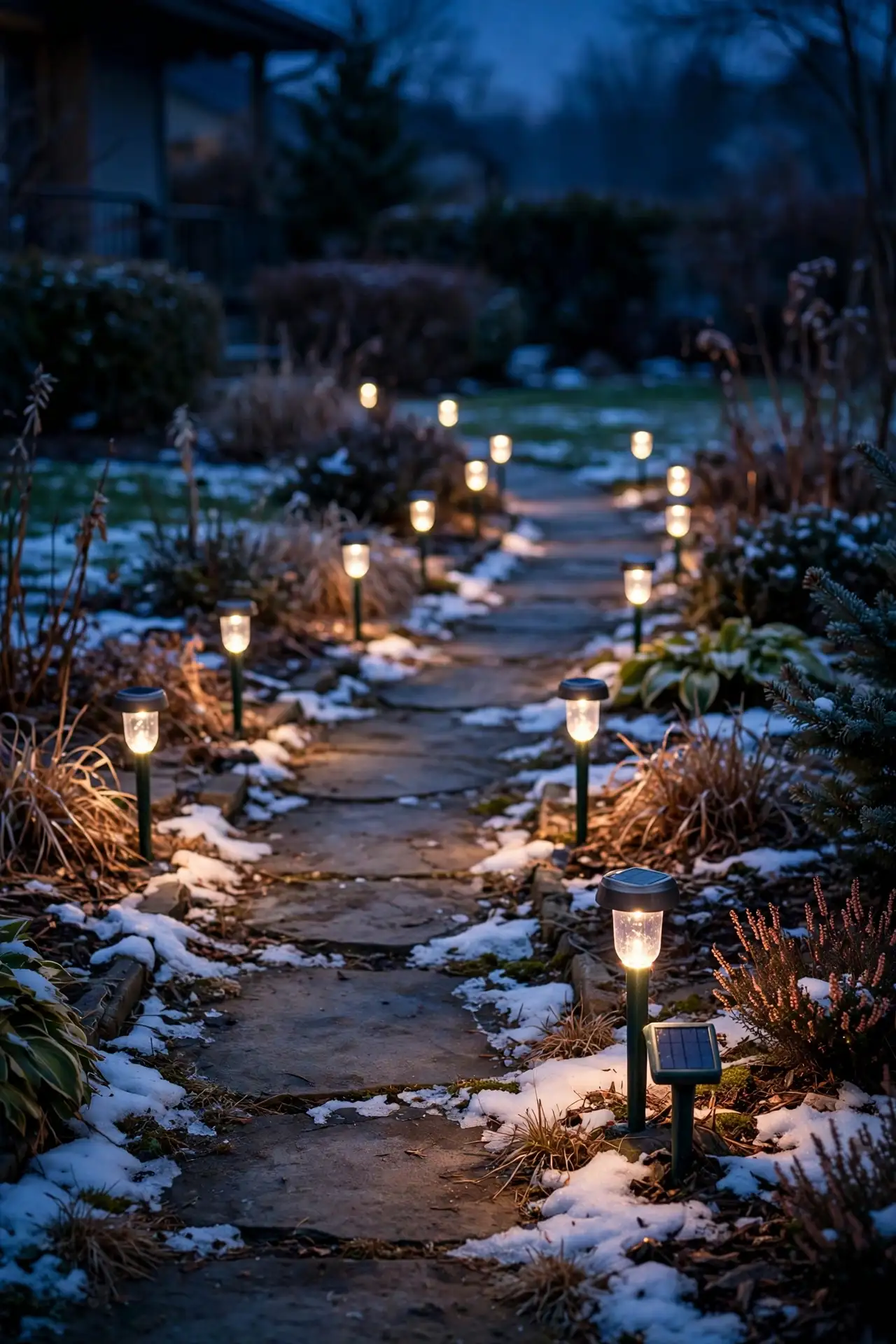
28
Solar Lights Where the Cord Cannot Reach
The far corner of the yard, the mailbox, the end of the drive: these are the spots plug-in strands never reach, and solar christmas lights are built exactly for them. Modern solar strands charge in 6 hours of daylight and run 6 to 8 hours after dark, which covers the evening display window completely. Expect to pay $15 to $25 per strand, then nothing ever again.
Try it: Face every solar panel due south and wipe it weekly. A dusty or north-facing panel is the entire reason solar lights get bad reviews.
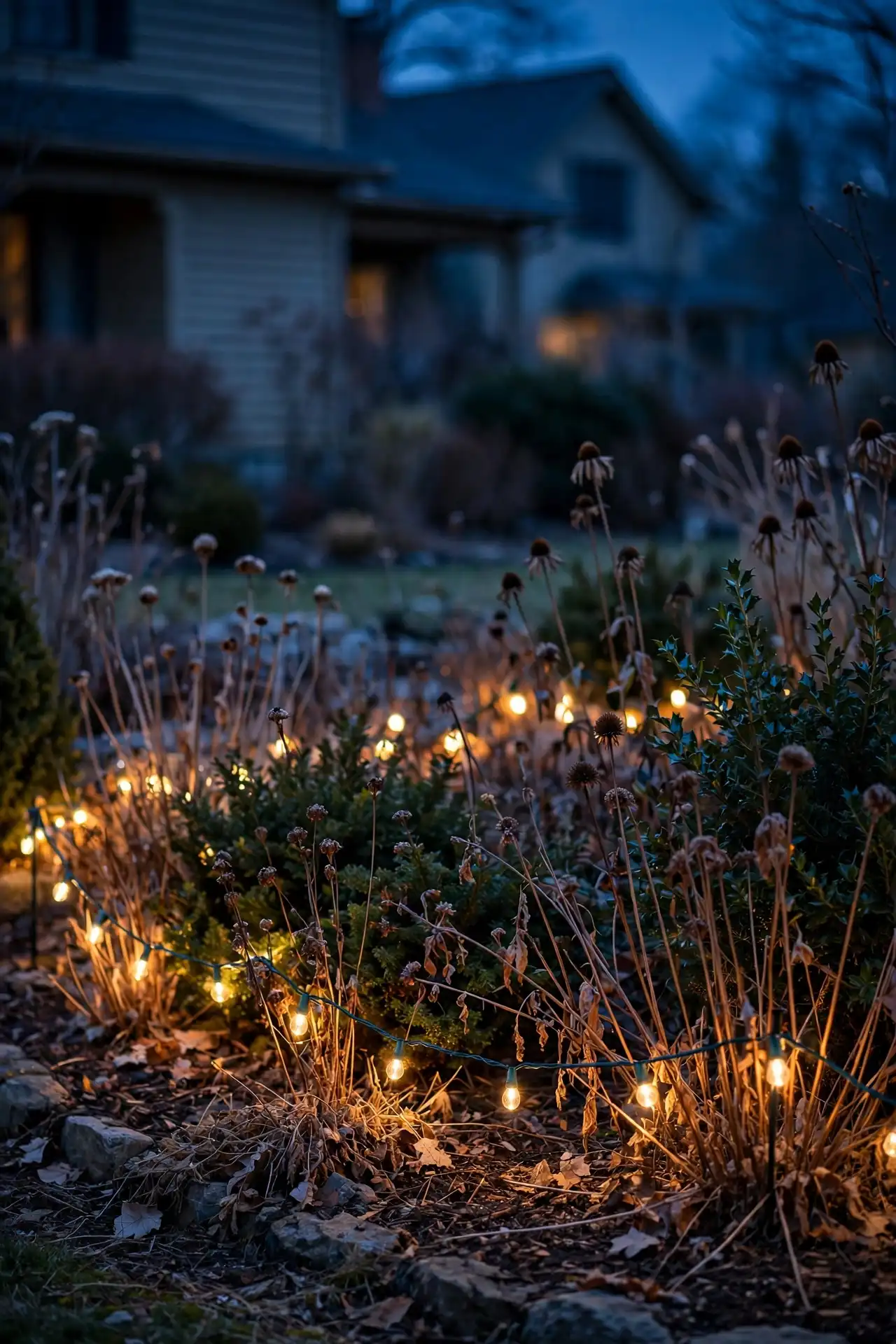
29
Solar String Lights Through the Beds
Run solar powered christmas lights low through the front garden beds, weaving them among the shrubs and winter stems. At ankle height they light the planting itself instead of the house, which gives the display its ground layer. Two 30-foot solar strands cover a typical front bed end to end.
Try it: Set solar strands to steady, not flashing. Low lights in motion feel like an alarm; low steady light feels like embers.
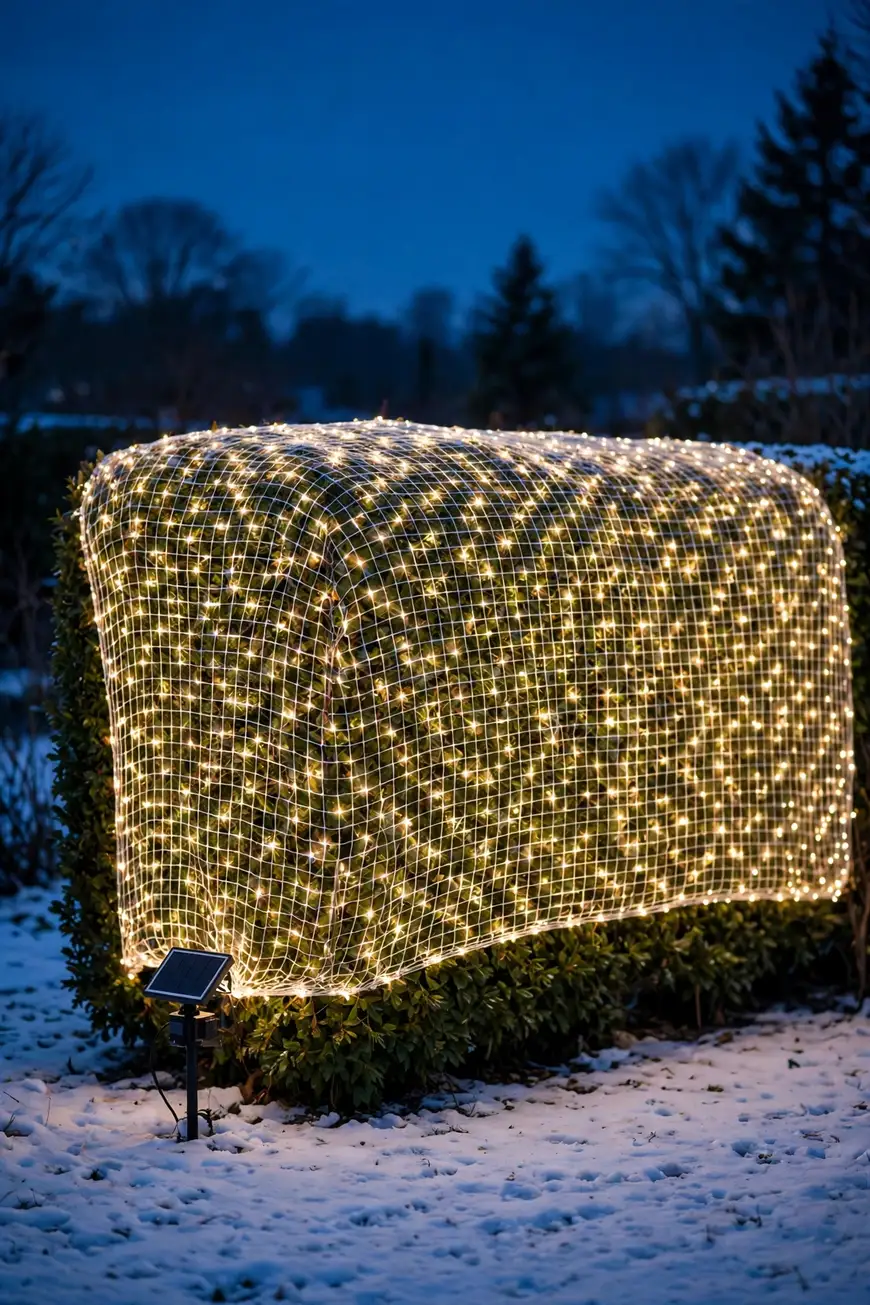
30
Solar Net Lights on the Hedge or Fence
A solar net combines the two easiest ideas on this list: drape it over a hedge or hang it on a fence section and the panel does the rest. It is the one-net solution for rentals and for anyone whose only outdoor outlet is already full. A 5-by-5-foot solar net covers the street-facing side of a large shrub.
Try it: Hang fence nets from the top rail with zip ties, not draped over bushes you cannot reach. Retrieving a slipped net from inside a holly bush is a December rite of passage nobody needs.
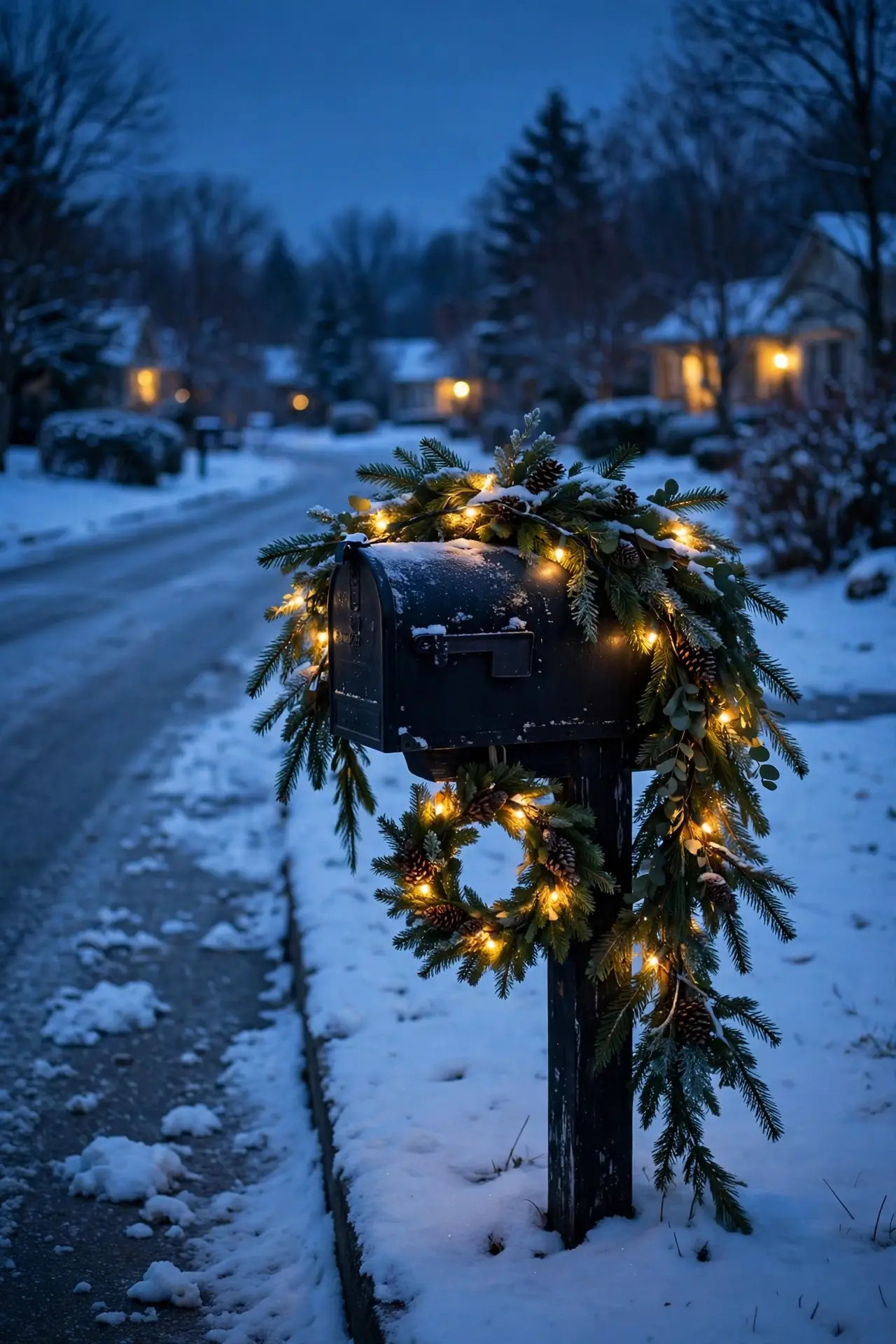
31
Battery Strands With Timers for the Details
The mailbox wreath, the gate swag, the far lantern: small accents far from the house run best on battery strands with built-in timers, set once to glow 6 hours from dusk. One set of batteries lasts most battery christmas lights about 3 to 4 weeks on the timer cycle. Buy the strand and the timer is free; that is the whole trick.
Try it: Set all battery timers at the same minute on the same afternoon. Your whole display then switches on within moments, like one system.
32
Put the Whole Display on a Smart Plug
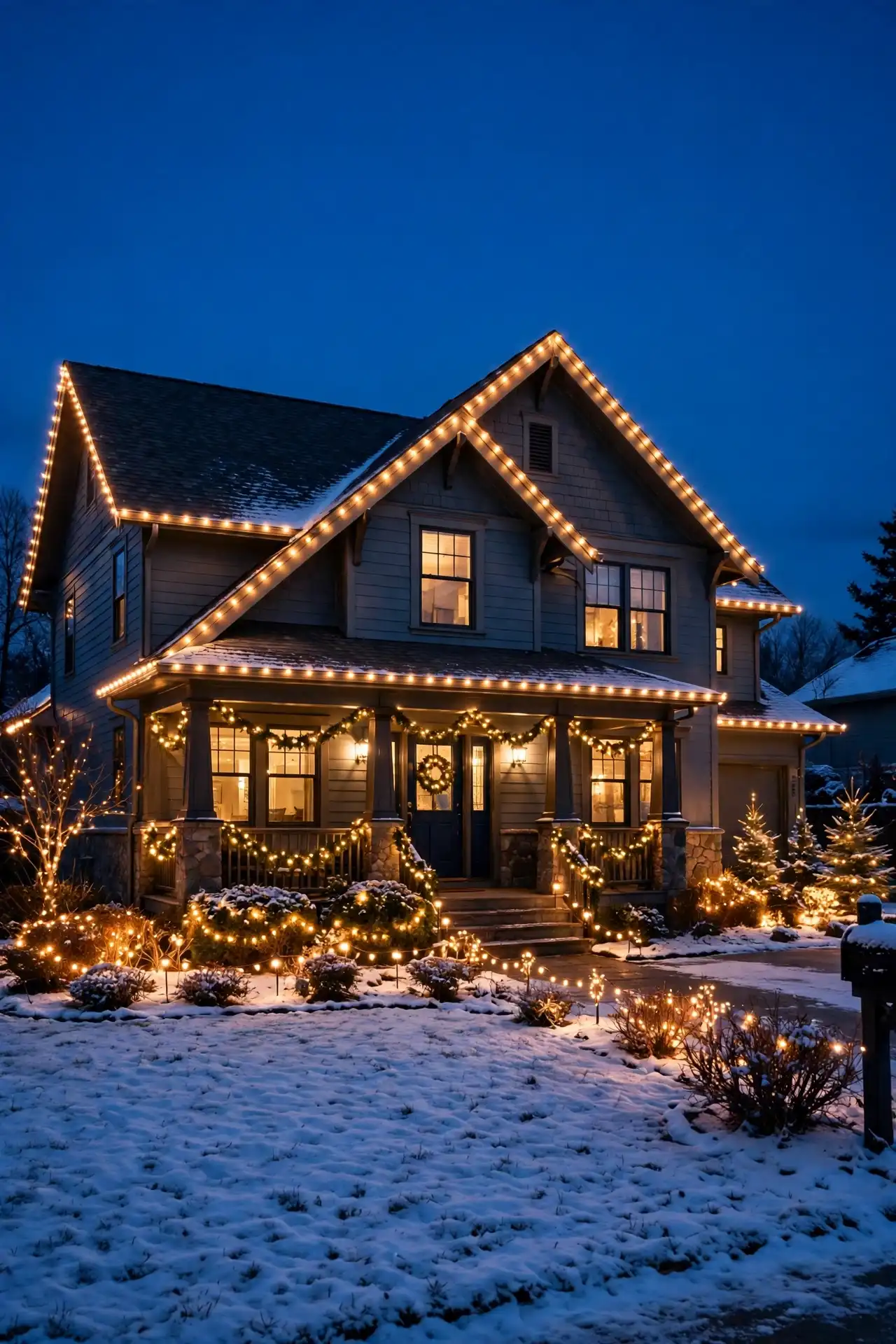
One outdoor smart plug on the main outlet, set to dusk-to-10-pm, replaces the nightly walk outside in the cold. Split the display across two plugs by zone, roofline on one and yard on the other, and a tripped circuit never blacks out the whole house. Smart plugs rated for outdoor use cost about $15 each and pay for themselves in forgotten all-night displays.
Try it: Set the off time to 10 pm on weeknights and 11 on weekends. All-night displays waste power and annoy the neighbors whose bedrooms face your yard.
33
Swap the Porch Bulb for a Smart Bulb
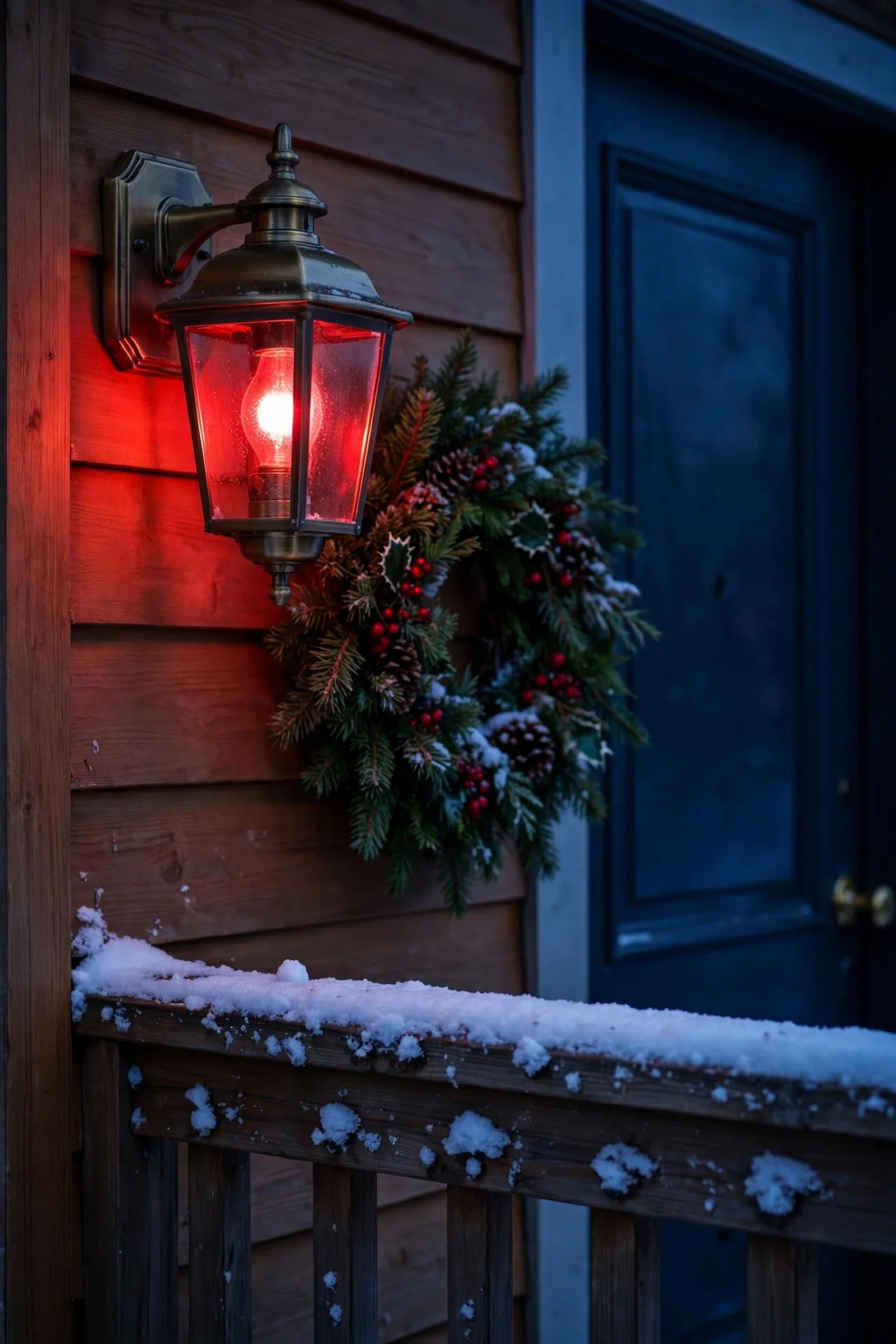
The porch lamp is the one fixture that burns every night, so make it festive: a color-changing smart bulb in the outdoor christmas lamp by the door lets you run warm white on ordinary evenings and deep red or green for party nights. It takes ninety seconds and no ladder. Keep the original bulb in a labeled bag for January.
Try it: Match the porch bulb’s warm white to your strands’ temperature, around 2700K. A mismatched porch light makes every strand near the door look the wrong color.
34
Program Two Looks: Classic and Party
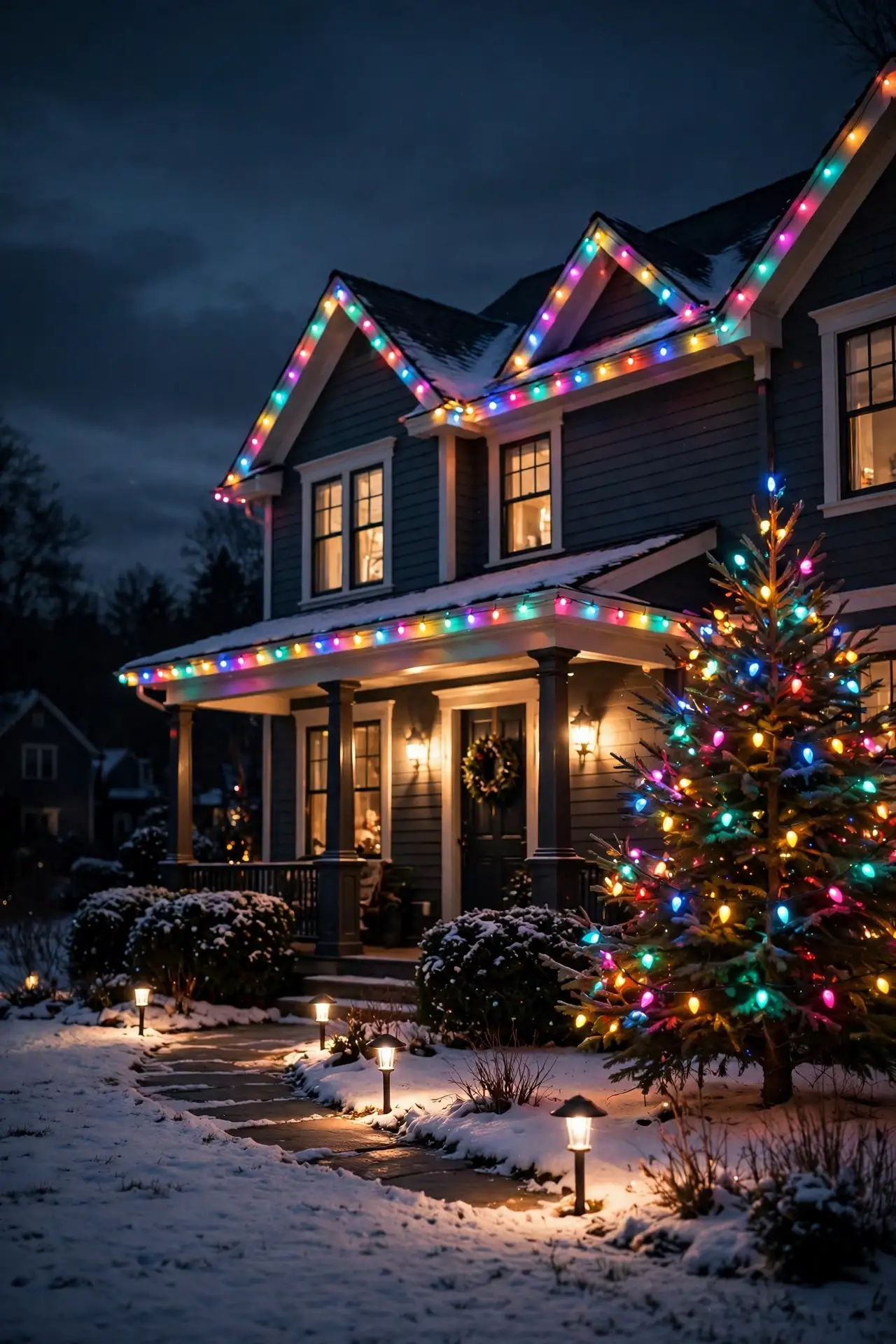
Smart strands and bulbs let one display wear two outfits. Run the timeless look, warm white everywhere, on weeknights, and switch rooflines and trees to soft multicolor for weekends and party nights. The neighbors get variety, the street gets a rhythm, and you get a display that never feels stale by December 20.
Try it: Keep the path and step lights warm white in both looks. Guests navigate by those lights; changing their color confuses feet in the dark.
35
The Three-Layer Rule That Ties It Together
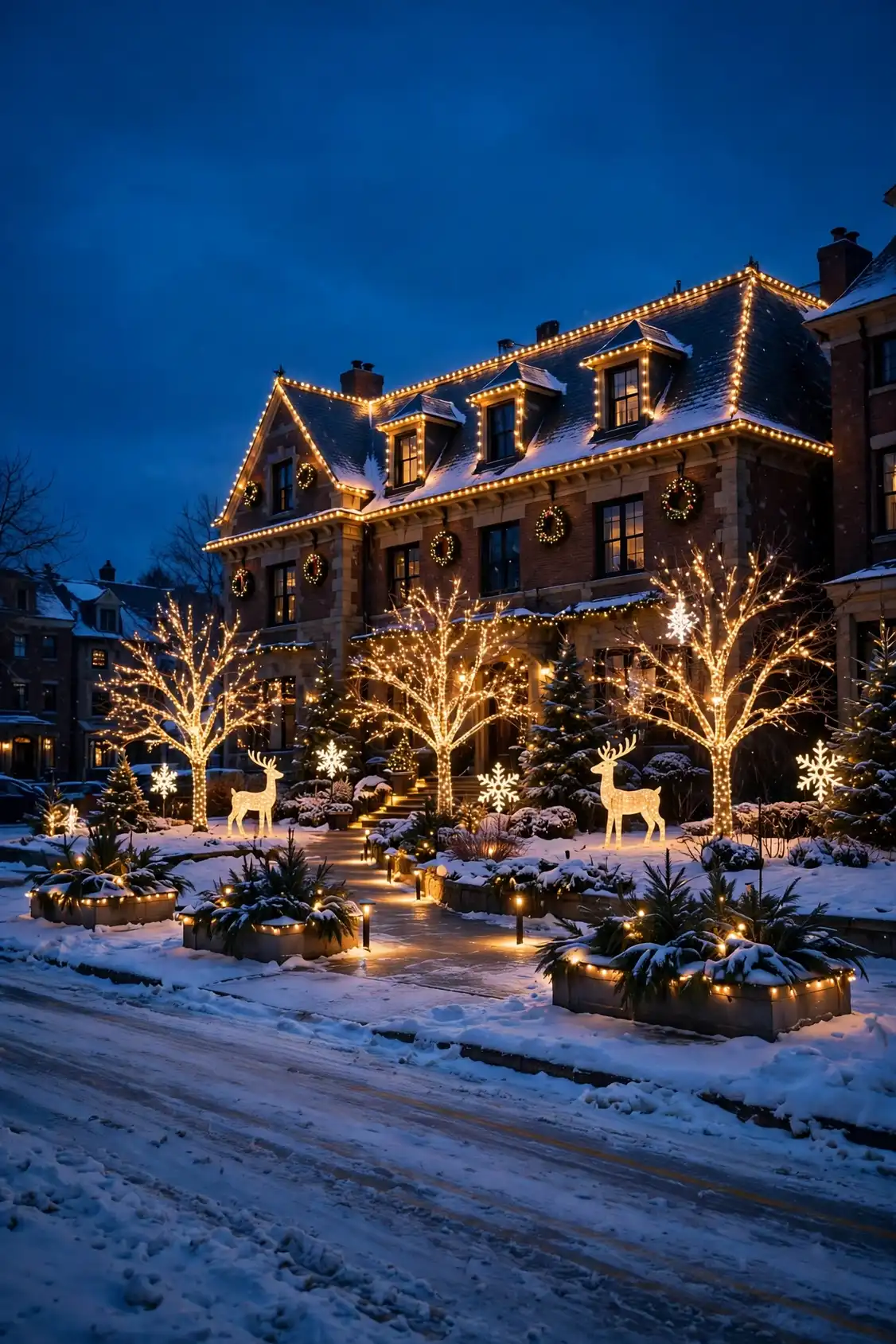
Stand at the street and sort everything you hung into three layers: roofline and facade above, trees and figures in the middle, path and planters at the ground. A display with all three layers present looks finished from every distance; one missing layer is exactly what makes a yard feel almost right. Add to the empty layer before you add anything to a full one.
Try it: Take the dusk photo from across the street every year. It is the best design tool you own and the only view your neighbors ever get.
Pro tip: Photograph your house from the street at full dark, then look only at the dark spots. Every great display is just a series of fixed dark spots: the gap between the tree and the porch, the black corner by the garage. One lit piece per dark spot, in that order, beats any shopping spree.
Keep the glow going outside with our outdoor christmas decor ideas for the full yard picture, our christmas yard decor ideas for lawn scenes and figures, and our christmas patio decor ideas for the back of the house. Browse the whole Christmas Decor collection for more.
Three rules for outdoor Christmas lighting
- Weatherproof every connection: Plugs belong off the ground, in weatherproof covers or raised on a brick, with drip loops so water runs away from sockets. Outdoor-rated strands (look for the outdoor listing on the tag) are not optional outside, ever.
- Count your load before you hang: Add up strand wattages and stay under 80 percent of the circuit and the strand’s own connect limit. LED strands typically allow 20 or more connected in a run; old incandescent strands allow 3 to 5. The box always tells you, so read it before the ladder, not after the breaker trips.
- One color temperature per zone: Warm white is a family, not a single color; mixing 2700K strands with icy 5000K strands in the same view looks like a mistake even when every piece is beautiful. Buy a spare strand of each type you hang, from the same batch, every year.
After Christmas: the outdoor reset
- Coil, do not ball: Wind each strand around your elbow-to-hand loop or a cardboard reel, clip the ends together, and it will unroll tangle-free next November. A balled strand is next year’s first argument.
- Label by zone: Tag each coil with its home (roofline, big tree, path) and its length. Next year’s you, standing in the cold, will hang the roofline in half the time.
- Test before you store: Plug every strand in while it is coiled in January and replace dead ones in the post-Christmas sales at half price. December-you is busy; January-you has the sales.
Questions readers ask
How many feet of christmas lights for outside do I need for my roofline?
Measure the eaves you plan to light and add 10 percent for peaks, corners, and the drop down to the outlet. A typical single-story front needs 50 to 75 feet of roofline stringer. C9 bulbs sit 12 inches apart, so one foot of eave equals roughly one bulb.
What are the best exterior christmas lights for a house?
LED C9s for the roofline, LED mini strings for wrapping and outlining, and net lights for bushes. Look for an outdoor rating on every strand, commercial-grade sockets if your roofline is long, and one consistent warm white (around 2700K) across brands so the house matches itself.
Do solar christmas lights work in winter?
Yes, with two conditions: the panel needs direct sun, ideally south-facing, and expectations need adjusting for short days. A well-placed panel charges in about 6 hours and runs the strand 6 to 8 hours after dark, which covers the whole evening display window in December.
How do I hang outdoor lights without damaging shingles or siding?
Use all-in-one clips that grip the shingle edge or gutter, brick clips on brick, and removable outdoor hooks on siding and frames. Never staple through the wire or drive screws for a temporary display; clips hold a C9 every 12 inches through normal winter wind.
How many strands can I connect together?
Follow the number printed on the strand’s tag, because it varies. Most LED strands allow 20 to 40 connected end to end; incandescent strands usually allow only 3 to 5. When in doubt, run a second line from the outlet instead of a longer chain.
How much does it cost to run outdoor christmas lights all season?
Less than most people fear with LED. A 300-watt display running 6 hours a night for 35 nights uses about 63 kilowatt-hours, roughly $10 at average US rates. An identical incandescent display can draw five times that.
Are warm white or multicolor lights better outside?
Neither is better; they are different styles. Warm white reads classic and architectural, multicolor reads playful and nostalgic. The rule that matters is commitment: pick one for the house itself, and if you want both, give color its own zone like the yard tree.
How do I store outdoor lights so they do not tangle?
Coil each strand around a reel, a piece of cardboard, or your hand and elbow, clip the ends, label the coil by zone, and store it in a lidded bin indoors. Five minutes per strand in January saves an hour of untangling next November.
People Also Ask
When should outdoor christmas lights go up?
The weekend after Thanksgiving is the classic window: the ground is rarely frozen yet, the weather is workable, and you get five full weeks of display. In cold climates, hang clips and roofline strands in early November warmth and simply plug them in later.
Can I leave exterior christmas lights up all year?
You can, but the sun wins eventually. UV fades sockets and wire insulation in one to two summers, even on outdoor-rated strands. Permanent channel systems are the exception, built for year-round exposure with replaceable bulbs.
How do I light a very tall tree outside?
Work from the ground with an extension pole or light-hanging tool for the high wraps, light only the street-facing two-thirds of the canopy, and let uplights finish the top. A 30-foot tree fully wrapped is a professional job; a 30-foot tree lit in layers is a Saturday.
loved these ideas? ✿
Save this guide for later
Pin it to your board so it’s there when you’re ready to recreate it.

Curated by
Hey! I'm Sanaullah — visual curator and content creator. I search, curate, and test the best aesthetic ideas across Pinterest so you can easily transform your living space, style daily outfits, and try simple creative DIYs without the overwhelm.