
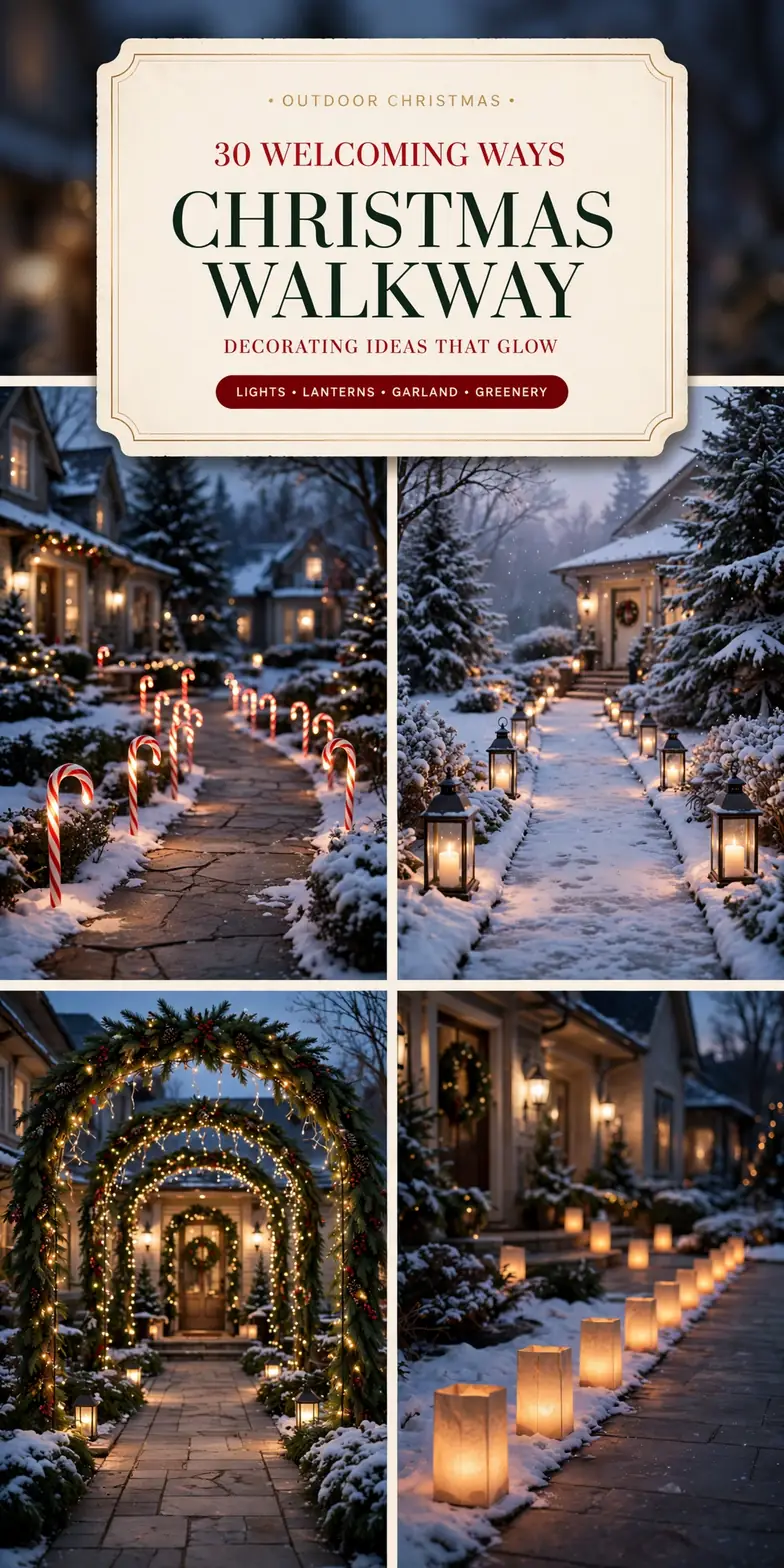
Your front walk is the first thing every guest, caroler, and delivery driver experiences at your house in December, and most homes leave it completely bare. These christmas walkway decorating ideas fix that with lights, lanterns, greenery, and figures arranged along one simple route, so the path feels as festive as the porch it leads to. Work through them and your walkway will be the part of the display people photograph before they ever knock.
Quick Idea Summary
- The key takeaway: A great walkway is a lit route, not random decor. Line both edges with pathway christmas lights, anchor the start and the steps with bigger pieces, and the whole front yard suddenly looks planned.
- The detail most people miss: Spacing and height matter more than brightness. Stakes every 3 to 4 feet at a consistent 12 to 18 inches tall read as one designed line; random heights and gaps read as leftovers.
- What it costs or how long it takes: Most ideas below cost $10 to $40 and take under 30 minutes. A full 25-foot walkway transformation fits into one afternoon and about $75.
At a glance
| ZONE | IDEAS | BUDGET |
|---|---|---|
| Classic pathway lights | 01–07 | $20–$80 |
| Lanterns, luminarias and glow | 08–13 | $10–$60 |
| Greenery and garland borders | 14–18 | $15–$70 |
| Figures and festive characters | 19–23 | $25–$90 |
| Steps, edges and the front door finish | 24–27 | $10–$50 |
| Power, timers and upkeep | 28–30 | $10–$40 |
The ideas

01
Candy Cane Pathway Lights
Nothing says Christmas path faster than candy cane pathway lights marching up both sides of the walk. A set of 10 stakes costs $15 to $25, pushes into the soil in minutes, and the red and white glow is visible from the street. Space them 3 feet apart and alternate the hook direction so the row looks deliberate, not duplicated.
Try it: Run candy canes on the street half of the walk and plain warm stakes near the porch. The mix keeps the look playful at a distance and calm up close.
02
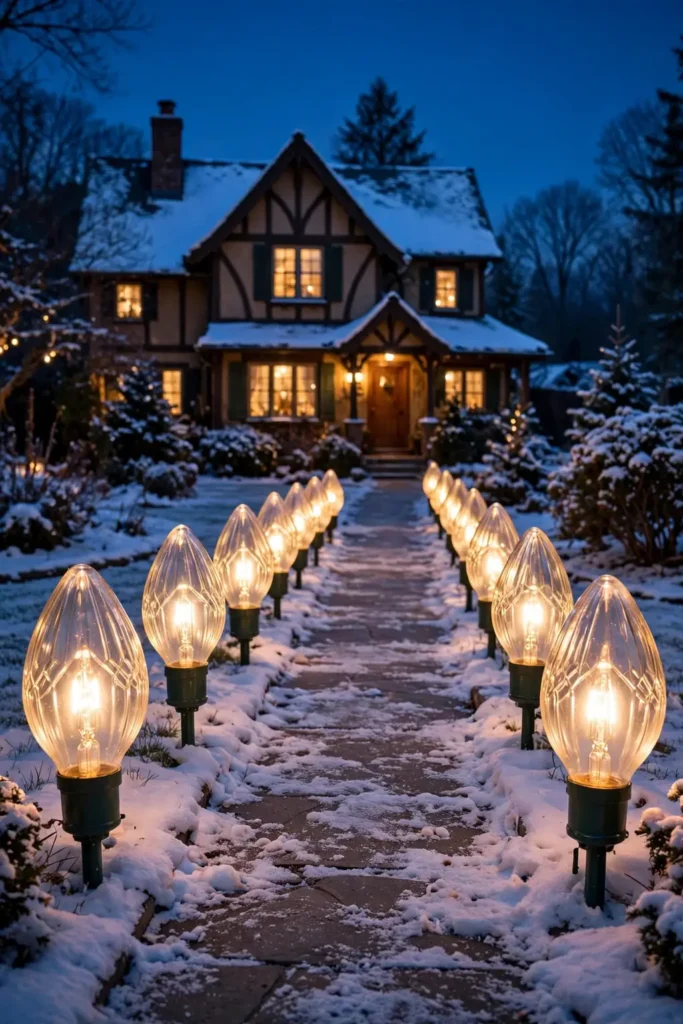
Oversized C9 Bulb Stakes
Stake-mounted C9 bulbs give you the classic roadside Christmas glow in a tidy row. The big bulbs read clearly from a moving car, which small fairy lights never do, and warm white keeps it elegant while multicolor leans nostalgic. A 25-foot strand of 12 stakes runs about $25 to $35.
Try it: Choose faceted bulbs. The cut surface throws sparkle in every direction and hides the filament, so the row looks jewel-like instead of bare-bulb harsh.
03
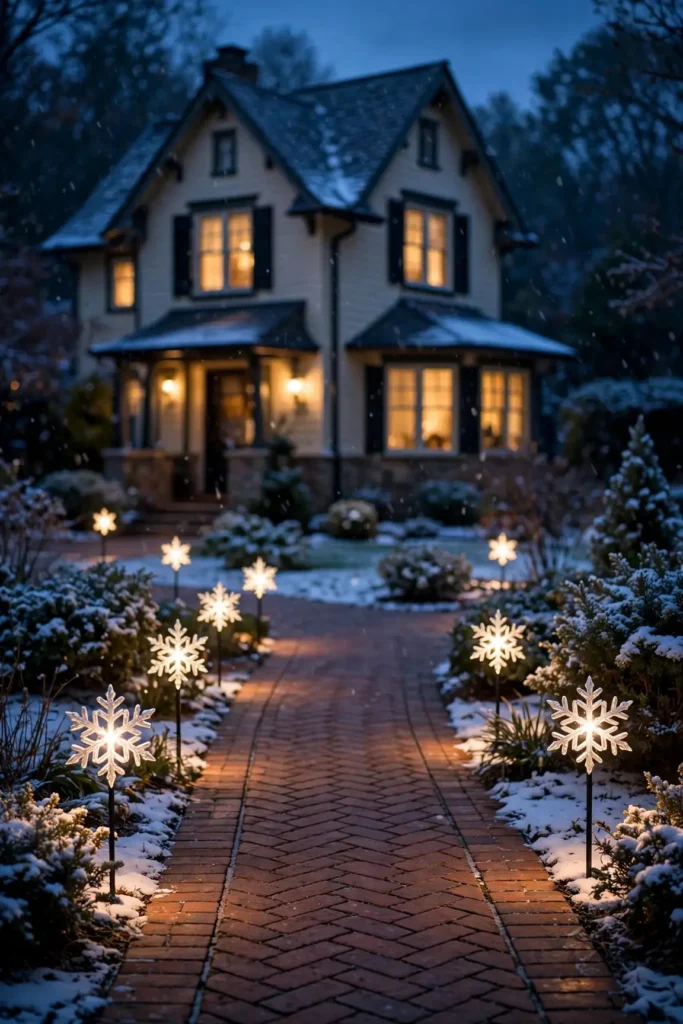
Snowflake Stake Lights
Snowflake stakes are the elegant middle ground between plain bulbs and full characters. Cool white reads frosty against snow, warm white suits brick and stone paths, and the shape stays festive even before dark. Sets of 8 to 12 cost $20 to $30 and most are solar or battery powered, so no outlet math is required.
Try it: Keep snowflakes to one side of the walk and plain stakes on the other if your porch is busy. Asymmetry with a pattern still looks designed.
04
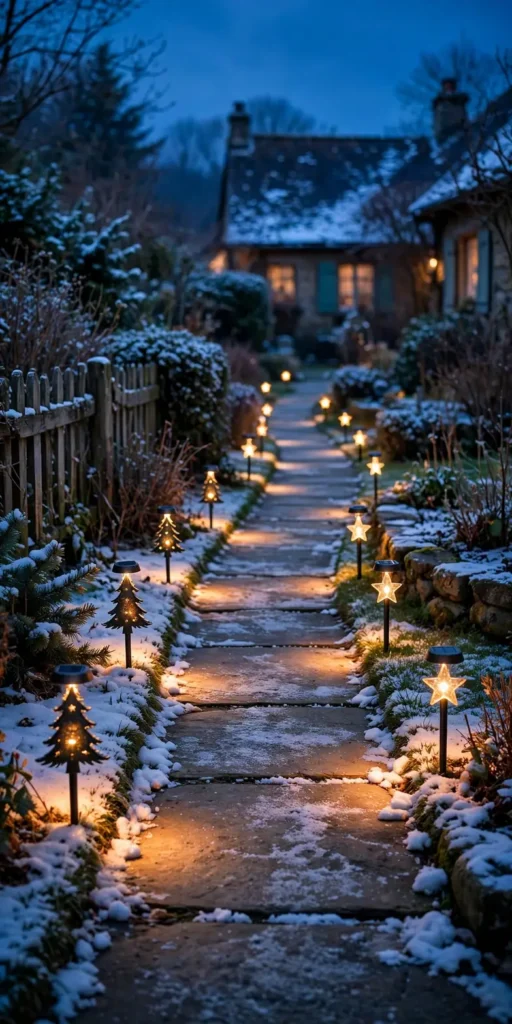
Solar Pathway Christmas Lights
Solar pathway christmas lights are the zero-effort backbone of a decorated walk: stake them once and they charge by day and glow from dusk for 6 to 8 hours. An 8-pack of Christmas-themed solar stakes (trees, stars, snowflakes) costs $20 to $35. They are dimmer than plug-in lights, so treat them as the gentle base layer rather than the whole show.
Try it: Wipe the solar panels weekly and angle them toward the midday sun. A dusty or shaded panel is the number one reason solar stakes disappoint by mid-December.
05
Rope Light Edging for a Continuous Line
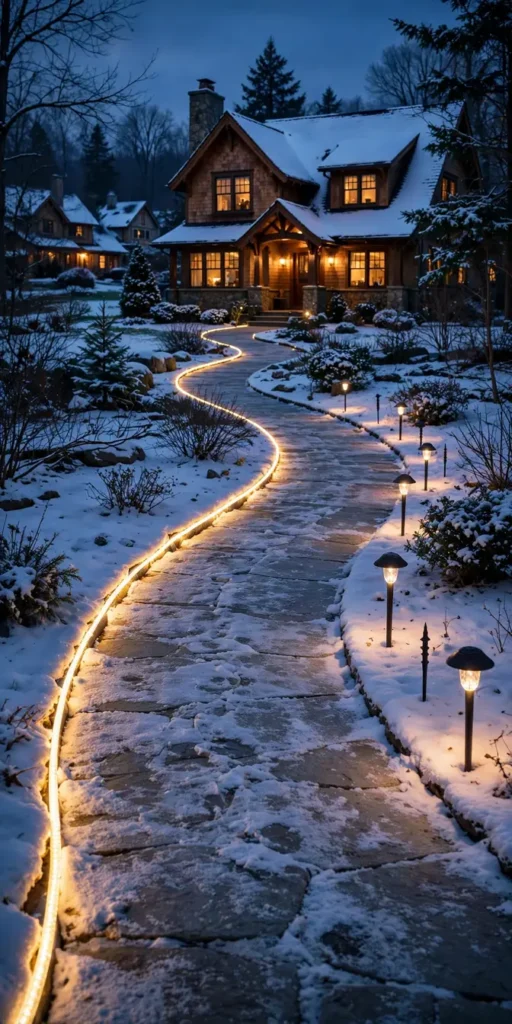
Where stake lights give you dots, rope light gives you one unbroken glowing line that traces every curve of the path. It is the cleanest answer for christmas lights on walkway edges that bend or step, and a 25-foot LED rope costs $12 to $20. Pin it with landscape staples every 18 inches so the line stays crisp instead of wandering.
Try it: Put rope light on the garden-bed side only, with stakes opposite. One continuous line plus one dotted line is the combination professional displays use.

06
Globe String Lights on Low Stakes
Globe bulbs strung between short stakes give the walk a bistro-at-Christmas feel that stake singles cannot match. Keep the swag shallow, about 2 inches of dip between stakes 4 feet apart, so the line feels tailored. A 25-foot globe strand runs $25 to $40 and the frosted versions double as glowing snowballs after a snowfall.
Try it: Use metal garden stakes, not plastic. Globe strands are heavy for their length and plastic stakes lean by the second week.

07
The Both-Sides Rule for Walkway Christmas Lights
Walkway christmas lights only look finished when both edges of the path are lit; one-sided lighting reads as unfinished from every angle except one. Match the two sides exactly, same stake, same height, same spacing, and stagger them so each light faces a gap on the opposite side. Symmetry with a stagger is what makes a $30 set of lights look like a designed installation.
Try it: Measure your spacing with a cut piece of string or a spare stake laid flat. Eyeballing is how rows drift from 3 feet to 5 feet by the porch.
08
Paper Bag Luminarias
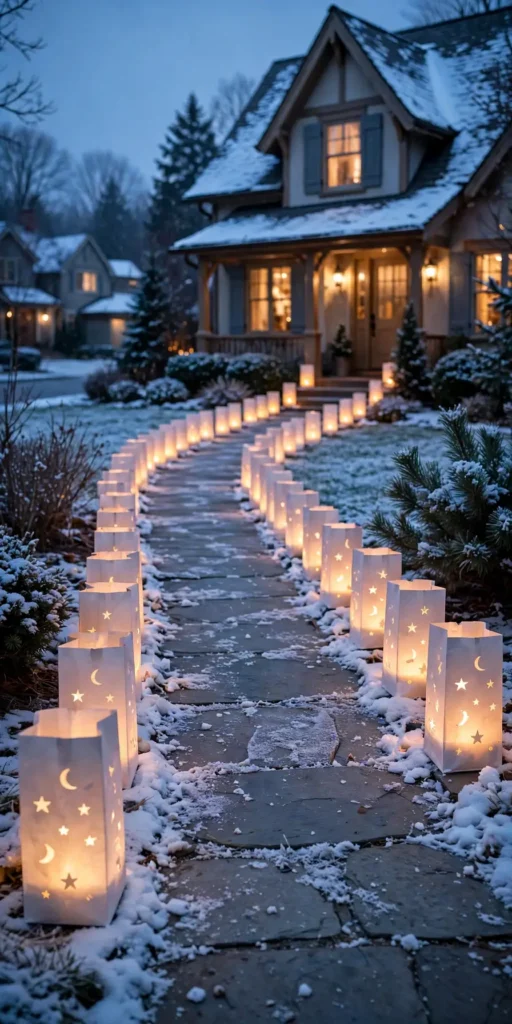
Luminarias are the oldest walkway decoration there is: a paper bag, a cup of sand, and an LED tea light, repeated down the path. A 24-pack of bags costs under $10 and the whole row takes 20 minutes to build. The low, flickering glow flatters stone and brick and never competes with the porch lights.
Try it: Use white bags for a modern look or kraft bags for a rustic one, and stamp or stencil a simple star or tree on each. Never use real candles in paper, even outdoors.

09
Mason Jar Fairy Lights
A mason jar with a battery fairy light cork inside is a pocket lantern you can make for about $2 a jar. Line them along the path edge or hang them from low hooks, and the glass throws a soft, firefly glow that stake lights cannot imitate. Use warm white strands; cool white in glass reads blue and cold.
Try it: Add a spoonful of faux snow or a few cranberries to each jar before the lights. The fill hides the battery pack and doubles the sparkle.
10
Shepherd’s Hook Lanterns
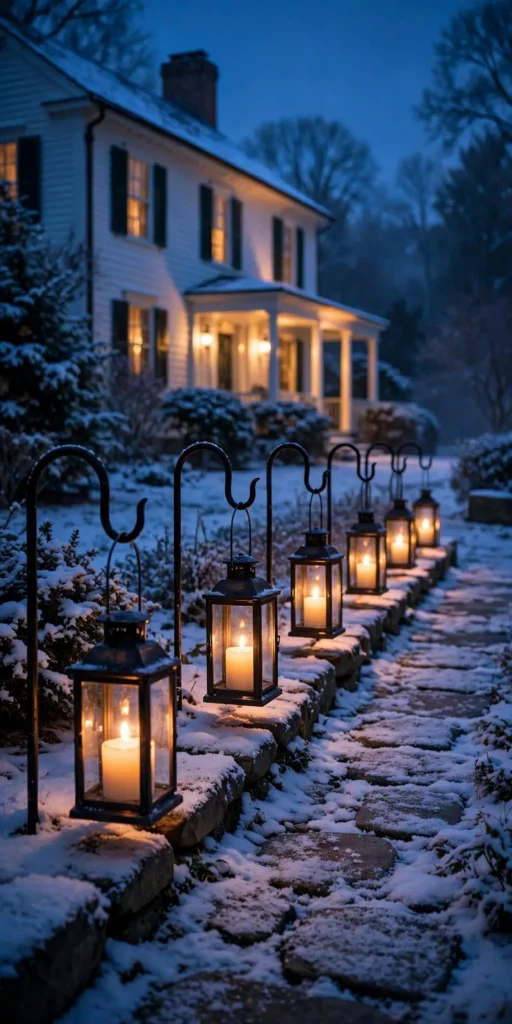
Short shepherd’s hooks with hanging lanterns lift the light up to knee height, where it lights faces as well as feet. It is the most traditional look on this list and suits colonial, farmhouse, and brick homes especially well. Hooks cost $5 to $8 each and lanterns with flameless candles run $8 to $15, so a six-hook row lands around $75.
Try it: Keep lanterns at one consistent height and let only the candle flicker vary. Uniform height is what separates a lantern row from yard clutter.
11
Frosted Globe Snowball Lights
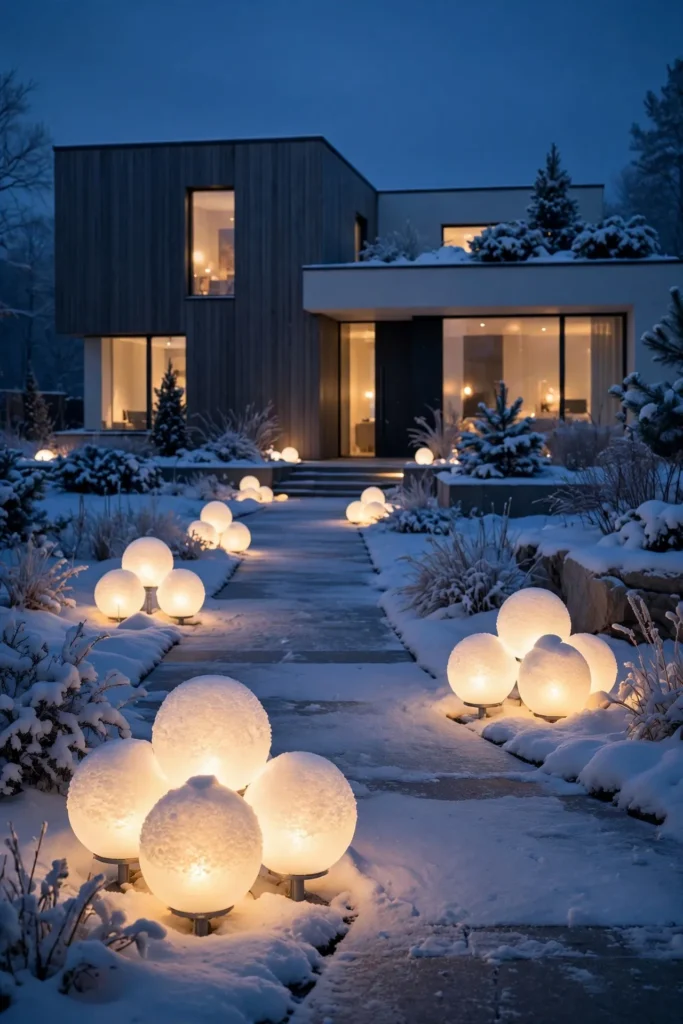
Frosted globe path lights look like a row of snowballs that glow from inside, and after real snow falls they nearly disappear into the landscape until dusk. They suit modern and minimalist homes that find candy canes too literal. Sets of 6 to 10 cost $25 to $45, and the diffused light is the gentlest on this list for neighbors’ windows.
Try it: Cluster globes in threes at the path’s start and finish, singles between. Clusters mark the entrances; singles just guide.
12
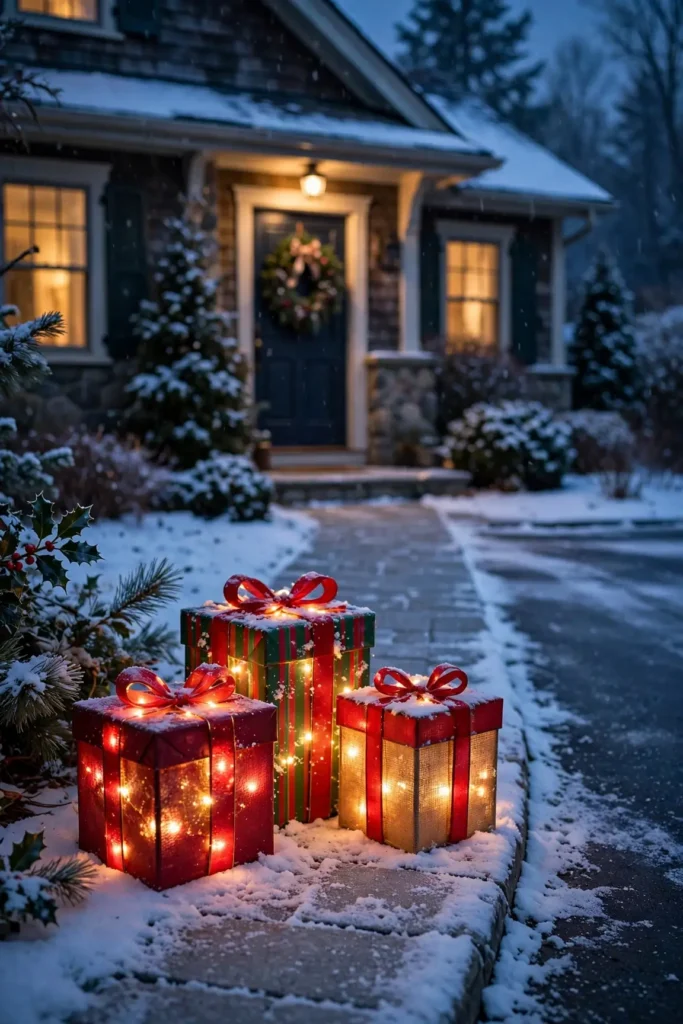
Glowing Gift Boxes at the Path Edge
Lighted gift box trios placed where the walk meets the driveway and again at the porch turn a plain path into a story: presents arriving. A pre-lit set of three costs $30 to $50 and takes two minutes to place. Choose one wrap color that matches your door wreath so the yard and the porch read as one display.
Try it: Weight gift boxes with a brick inside the largest one. December wind relocates lightweight boxes into the street with embarrassing reliability.

13
Oversized Ornament Orbs
Oversized shatterproof ornaments, 8 to 12 inches across, scattered along the path borders look like the tree shed its decorations on the way in. Lighted versions ($15 to $25 each) glow; unlit ones still shine if your stake lights hit them. Keep them on the bed side of the edge so nobody steps on one in the dark.
Try it: Use odd numbers per cluster, 3 or 5, in two colors maximum. Ornament scatter looks random fast; color discipline keeps it styled.

14
Garland Swags on a Low Fence or Rail
If your walk has a low fence, rail, or hedge, swag garland along it and weave in battery fairy lights. The greenery gives the path a border in daylight, which pure lights never do, and the swag rhythm sets the walking pace. A 9-foot garland costs $10 to $20; two usually cover a front walk’s fence run.
Try it: Hang swags from the same measured points, 4 feet apart, with the dip centered between posts. Uneven dips are the fastest way to make garland look hungover.
15
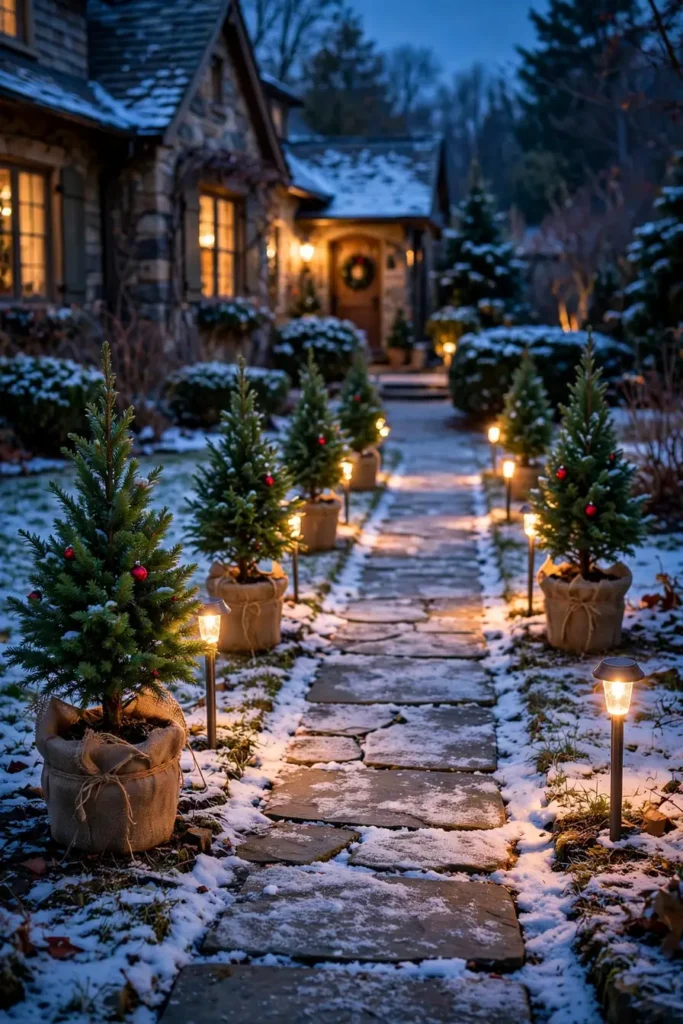
Mini Potted Evergreens Down the Line
Small potted evergreens, real or faux, spaced down the walk give you height, structure, and a place to hang a few ornaments. Real 2-foot spruces in pots cost $15 to $25 each at garden centers in December and can be planted in spring. Wrap each pot in burlap or a red plaid blanket square to hide nursery plastic.
Try it: Alternate tree, light stake, tree, light stake. The rhythm reads designed from the street and neither element has to carry the whole row.

16
Statement Planters Where the Walk Begins
The start of the walk, at the driveway or sidewalk, is where guests decide your house is festive, so spend your biggest pieces there. Two large planters filled with evergreen branches, red berries, birch poles, and fairy lights frame the entrance like a gate. Build them in your summer planters for $20 to $30 of greens if you gather the branches yourself.
Try it: Push a solar spotlight behind each planter aimed up through the branches. Uplighting makes $25 of greenery look like a landscape installation.
17
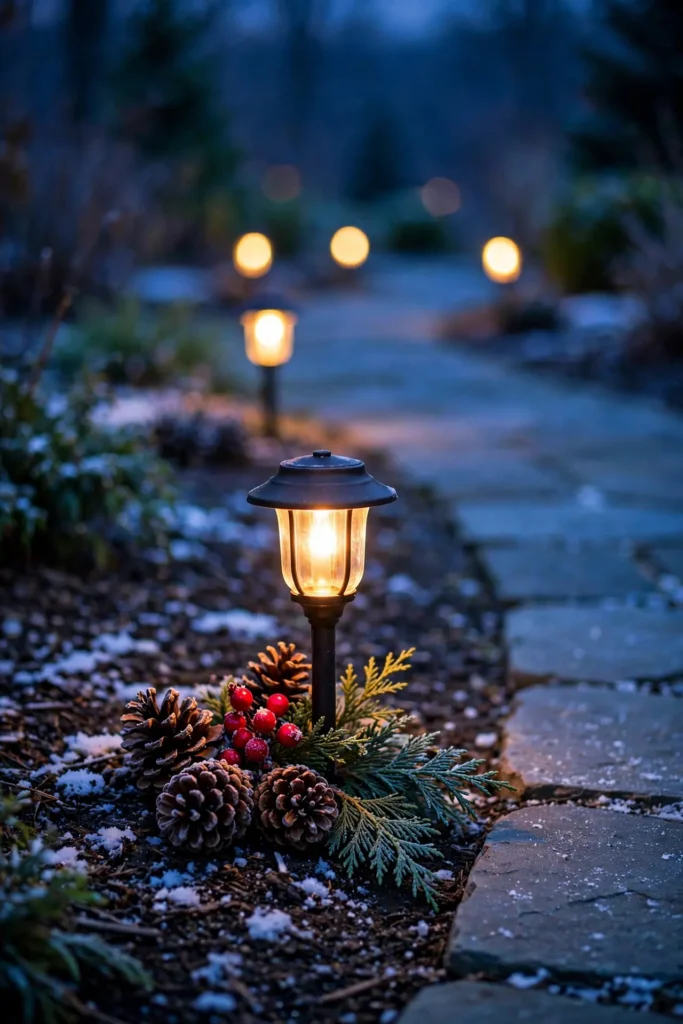
Pinecone and Berry Clusters at Every Stake
A small cluster of pinecones, faux berries, and a cedar sprig tucked at the base of each stake hides the plastic hardware and makes every light look planted on purpose. It costs almost nothing if you gather cones, and it is the detail that makes neighbors ask who did your yard. Work in a sprig of real cedar where you can; its scent greets people before the door does.
Try it: Build clusters on a tray indoors at the kitchen table, one per stake, then place them in a single walk down the path. Ten minutes, no cold fingers.

18
A Lit Wreath Marker at the Path Entrance
Hang one battery-lit wreath on a post, mailbox, or gate where the walk begins. It works as a signpost: guests arriving in the dark aim for the wreath the way they aim for a porch light. A 16 to 20 inch pre-lit wreath costs $20 to $35 and one is enough; repetition lives in the stakes, the wreath is the punctuation.
Try it: Match the wreath’s bow to your front door wreath exactly, same ribbon, same knot. The echo ties the street view to the door view in one glance.

19
Lighted Snowman Stakes
Snowman stakes are the family favorite: friendly faces at knee height that kids navigate by. A set of 4 to 6 costs $20 to $35 and most are solar, so they can anchor the far end of the walk where outlets do not reach. Keep faces turned slightly toward the street, not the house, so arriving guests get the greeting.
Try it: Give the lead snowman a real scarf in your family’s plaid. One dressed figure looks like a character; six dressed figures look like a choir.

20
A Reindeer Pair at the Path Bend
Every walk has a bend, a step, or a wide spot, and that is where a lighted reindeer pair belongs. Two figures, one grazing and one looking up, create the scene guests slow down for. A pair of 24 to 32 inch lighted reindeer costs $50 to $90 and anchors the yard side of the display so the path lighting has something to lead to.
Try it: Stake reindeer legs with the long landscape staples from the box, plus one extra per leg in soft soil. Reindeer are the most stolen-looking but actually most wind-toppled figures in December.

21
Nutcracker Sentries at the Steps
Two nutcrackers flanking the porch steps close the walkway’s story: the path leads somewhere guarded and grand. Outdoor-rated nutcrackers of 24 to 36 inches cost $35 to $70 each; solar-lit versions remove the last cord problem. Symmetry matters here more than anywhere: same height, same distance from the steps, same angle.
Try it: Stand nutcrackers on flat paving stones, never straight on soil or mulch. A level base is the difference between a sentry and a leaner by Christmas week.

22
Spiral Mini Trees at the Entrance
Spiral light trees, 3 to 4 feet tall, are the modern alternative to flank planters: clean lines, one stake, instant height. A pair costs $40 to $60 and their continuous coil of light photographs like a designer installation. Place them where the walk meets the porch so their height hands guests off to the door wreath.
Try it: Choose warm white spirals if your path lights are warm, cool white only if everything else is cool. Mixing color temperatures is the most common walkway mistake.
23
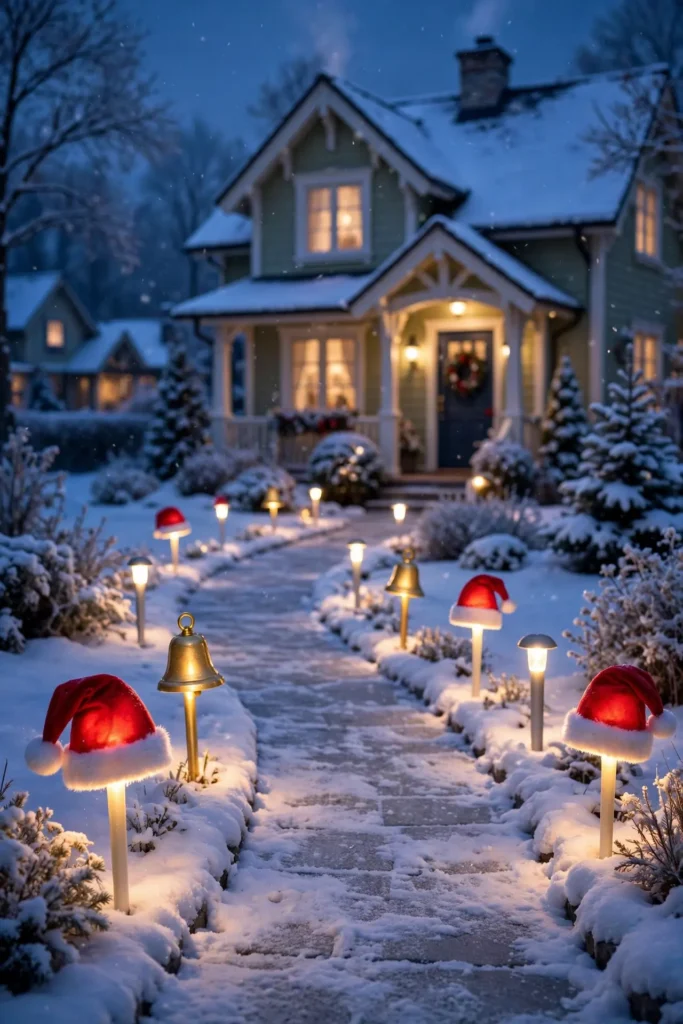
Santa Hat and Bell Stakes for the Kids’ Vote
If children have any say in your decorating, hat and bell stakes win the vote: cheerful, unbreakable, and readable from the school bus. Sets run $18 to $28 and mix well with plain warm stakes, two character stakes then one plain, in a repeating pattern. Save the full character row for the backyard if your street style runs traditional.
Try it: Let kids place this row themselves with a measuring string for spacing. A row they built is a row they will defend from the dog all season.

24
Light Every Step Edge
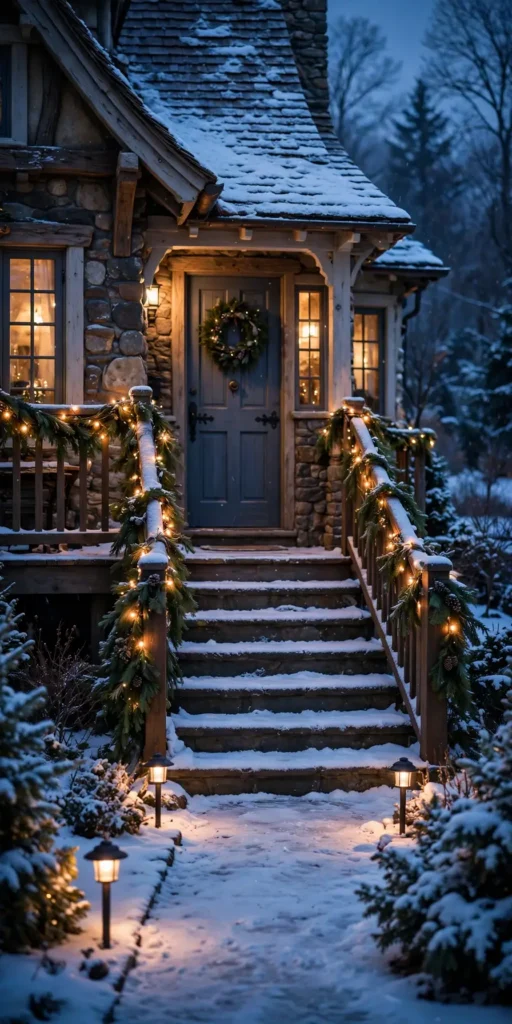
Steps are where guests actually fall in December, so treat step lighting as decor that earns its keep. Run a rope light or a strip of warm micro lights along the underside or front edge of each tread so every step reads clearly in the dark. It takes one 16-foot rope light ($12 to $18) to do a typical 4-step porch stoop.
Try it: Mark the top and bottom steps with double light density. Those two transitions are where missteps happen, and the extra glow looks intentional.
25
Garland on the Step Railings
Wind garland with woven fairy lights down the railings that flank your steps and the path suddenly has a ceiling line that guides the eye to the door. A 9-foot pre-lit garland costs $15 to $25 and attaches with clear zip ties in about 10 minutes. It also gives wet or icy hands a prettier thing to grab, which is not nothing in December.
Try it: Wrap the garland around the railing’s top rail only, not the balusters. Top-rail wraps look tailored and take half the greenery.
26
The Doormat Finish
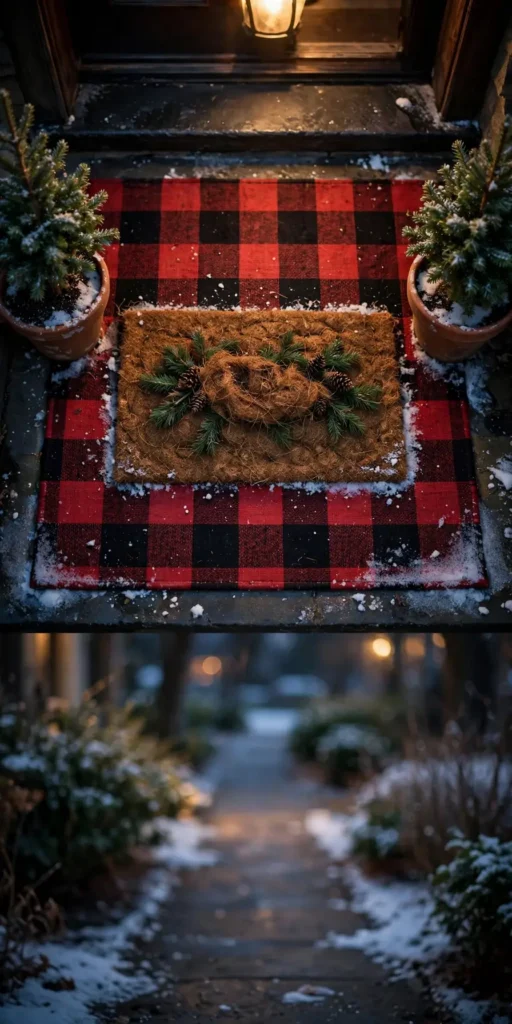
End the walk with a layered doormat moment: a large buffalo plaid or striped outdoor rug ($15 to $25) under a Christmas coir mat ($10 to $15). It tells guests they have arrived, gives muddy boots a generous landing zone, and ties the path palette to the door. Flank it with the two smallest potted evergreens from idea 15 if your stoop is wide enough.
Try it: Size the bottom rug at least 6 inches wider than the mat on every side. A stingy border looks like a mistake; a generous one looks like a stylist did it.
27
An Arch Moment Over the Path
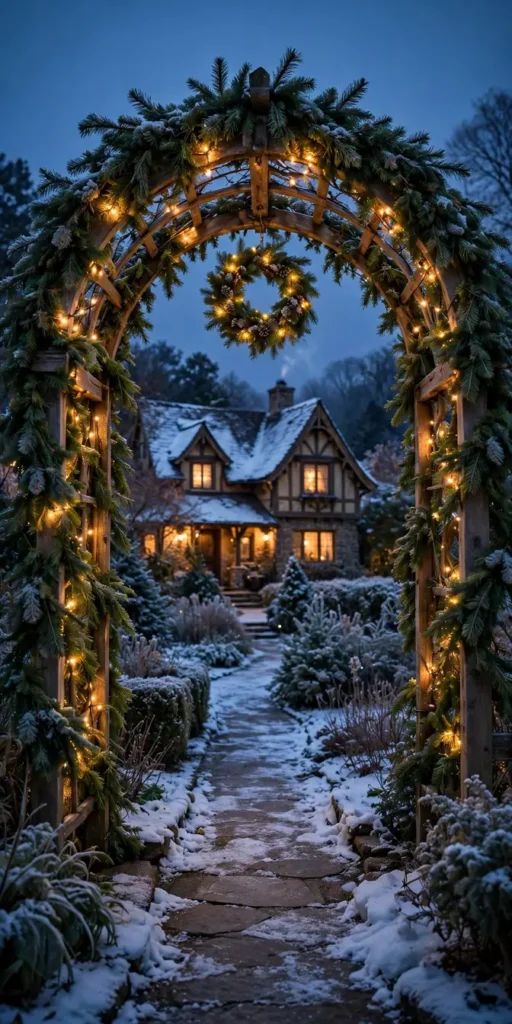
If your walk passes a gate, a garden arch, or two trees close together, wrap that overhead point in garland and lights to make a doorway in the yard. Guests physically walk through your display instead of just looking at it, and it is the single most photographed idea on this list. A basic metal garden arch costs $30 to $50 and stores flat.
Try it: Hang three oversized ornaments or one small lit wreath at the arch’s center point. A center ornament gives the camera, and the eye, a place to land.
28
Put the Whole Walk on Timers
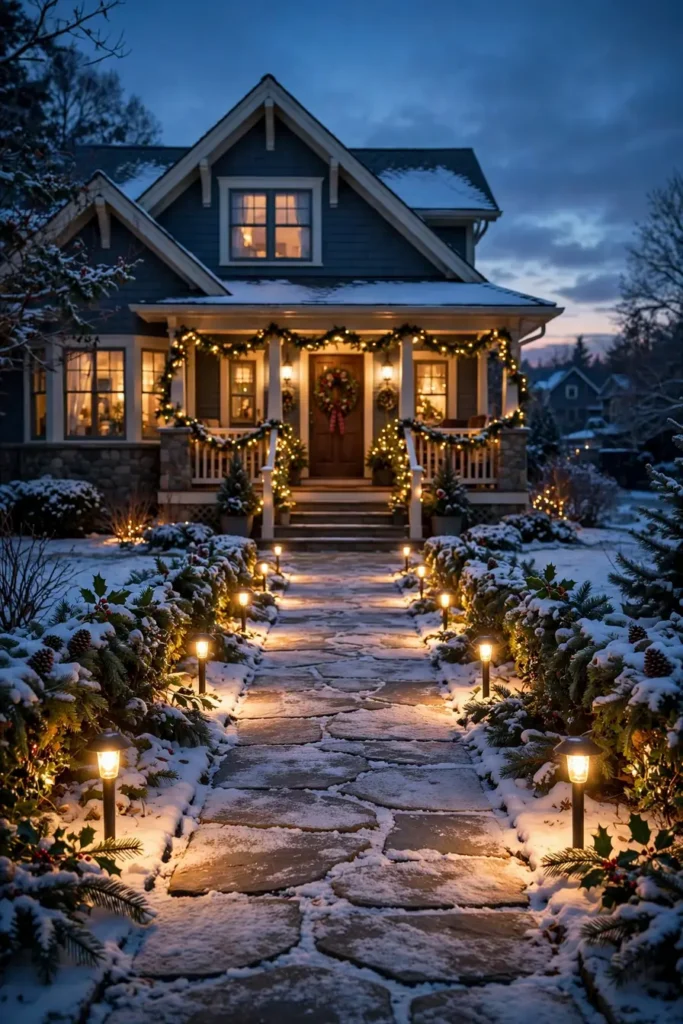
Outdoor walkway christmas lights should run on timers, full stop: on at dusk, off at 11 pm, every night, with nobody remembering anything. An outdoor timer or smart plug costs $10 to $15 and pays for itself in saved electricity and saved trips out in slippers. Set the path lights 15 minutes earlier than the porch lights so the route is lit before the destination glows.
Try it: Photograph your timer settings once they work. January-you will not remember which outlet ran which zone, and next December-you will not either.
29
The Two-Circuit Rule for Cords
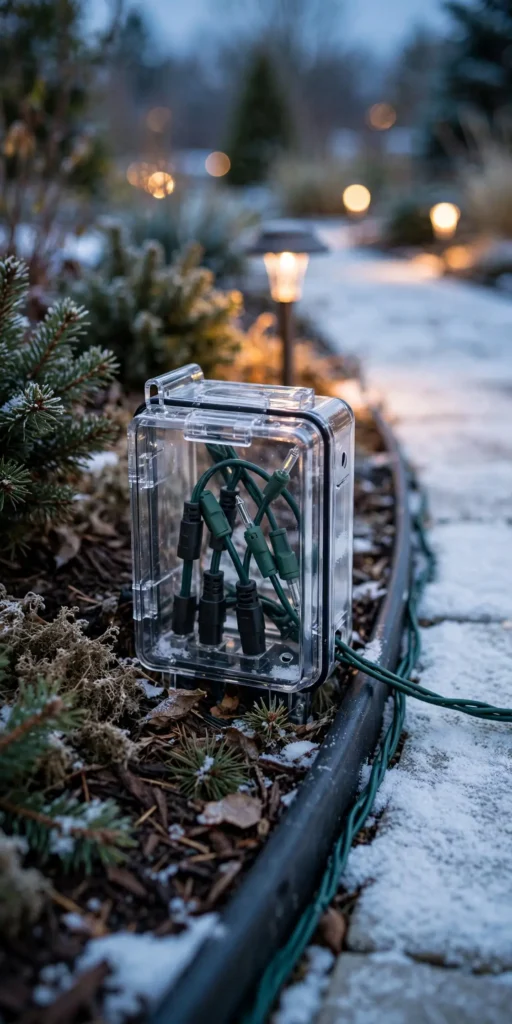
Walkway displays fail for electrical reasons more than design ones, so plan the power like you planned the look. Run the two sides of the path on two separate circuits or outlets, never daisy-chain more than three strands end to end, and keep every connection off the ground in a $5 cord protector box on a GFCI outlet. No cord should ever cross the walking surface; route along the bed edge and cross only under a step or mat.
Try it: Sketch the walk on paper and draw the cords before you buy anything. The sketch reveals the one extra extension cord every walkway secretly needs.
30
The After-Storm Reset Routine
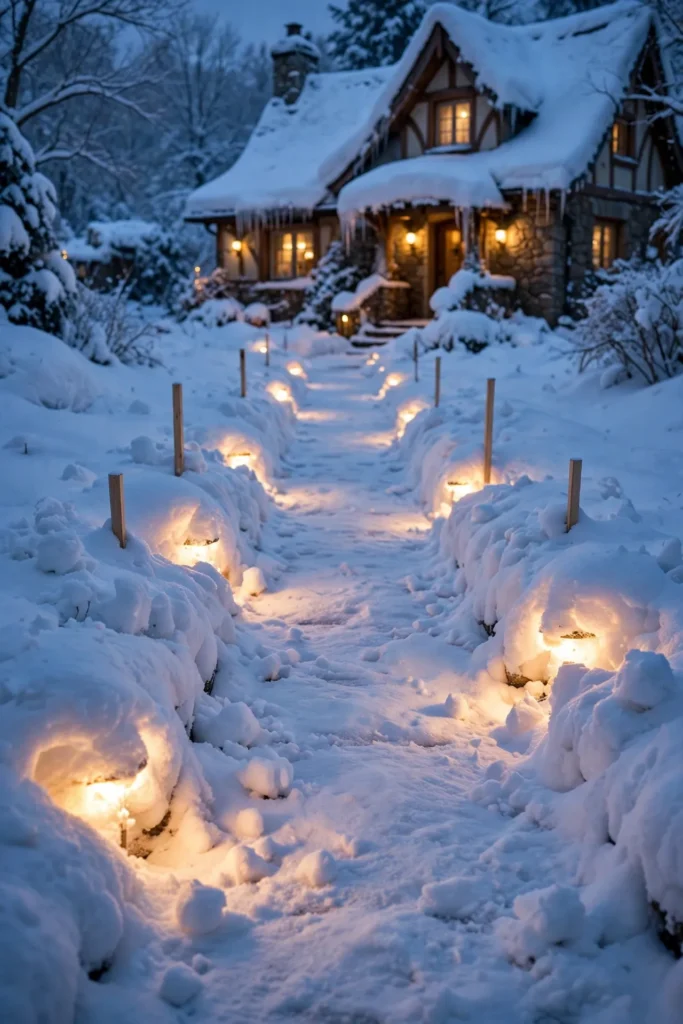
Snow, wind, and delivery drivers will rearrange your walkway all season, so build the reset into the plan: after every storm, walk the path in daylight, stand fallen stakes back up, shake snow off solar panels and globes, and re-center the figures. It takes 10 minutes and is the difference between a display that looks loved all month and one that peaks on December 3rd.
Try it: Keep a small spares kit by the door: 6 replacement stakes, spare batteries, zip ties, and one extra strand. Storm repairs happen at dusk in the cold; the kit is what makes them happen at all.
Pro tip: Stand at the street at full dark and walk your own path slowly, the way a guest in dress shoes would. Every dark gap, low branch, and uneven step announces itself at walking pace, and those three fixes matter more than any new decoration you could buy.
Three rules for christmas walkway decorating
- Light both edges, always: One lit edge is a suggestion; two lit edges are a route. If budget forces a choice, light both sides with cheaper stakes rather than one side with premium ones.
- Keep light low and warm: Path lights belong at 12 to 18 inches in warm white (2700K to 3000K). Light at eye level glares guests into squinting, and cool white makes a home look like a parking lot.
- Nothing crosses the walking surface: No cords, no stakes, no ornament sits where a foot lands. Decor lives in the beds and on the edges; the path itself stays clear, dry-looking, and safe in the dark.
After Christmas: walkway takedown and storage
- Photograph both sides before you touch anything: Two phone photos, one from the street and one from the porch, are next year’s entire installation guide. Your spacing, clusters, and cord routes will be right there.
- Coil rope lights and strands around cardboard: Wrap each strand around a flat cardboard rectangle, label the rectangle with its zone (left side, right side, steps, arch), and the tangle problem disappears forever.
- Store stakes and solar lights clean and charged: Pull stakes, rinse off soil, and store solar lights somewhere they get a little light or recharge them monthly. Solar batteries left dead in a dark garage all winter often never recover.
More ideas you’ll love: outdoor christmas decor ideas, christmas yard decor ideas, christmas front porch ideas, and plenty more in the Christmas Decor archive.
Questions readers ask
How do I decorate my walkway for Christmas?
Start with light on both edges, then layer: pathway christmas lights or solar stakes every 3 to 4 feet, one anchor piece where the walk begins (planters or a lit wreath), one scene at the bend (reindeer or gift boxes), and a finished landing at the door. Most walks need only those four layers to look complete.
What are the best lights for a christmas walkway?
LED stake lights in warm white are the best all-rounders: visible from the street, safe, and cheap to run. Rope lights win on curved paths because they trace the edge continuously, and solar pathway christmas lights win where no outlet reaches. Match color temperature across everything you mix.
How far apart should pathway lights be spaced?
Stake lights look best 3 to 4 feet apart on a straight residential walk, closer (2 to 3 feet) on curves and near steps. Rope lights run continuously with staples every 18 inches. Consistent spacing matters more than the exact number, so measure with a string instead of eyeballing.
Are solar pathway christmas lights bright enough?
Yes for guidance and glow, no for task lighting. A typical solar stake gives a soft pool of light for 6 to 8 hours, plenty to read the path by, but steps and level changes deserve one plug-in light source as backup. Keep panels clean and sun-facing or output drops by half.
How do I run christmas lights on a walkway without cords across the path?
Run cords along the garden-bed edge, never across the walking surface, and cross only beneath a step or a doormat. Split the two sides onto two outlets, keep connections raised in weatherproof cord boxes, and use a GFCI-protected outlet for every run. Battery and solar stakes handle any stretch where a cord route does not exist.
What can I use to decorate a walkway besides lights?
Luminarias, garland swags, mini potted evergreens, statement planters, and figures all decorate a walk with zero wiring. Greenery borders do the daylight work that lights cannot, and pinecone and berry clusters at each stake make even a plain light row look planted and deliberate.
How much does it cost to decorate a front walkway for Christmas?
A simple, good-looking walkway costs $40 to $90 total: one set of stake lights ($20 to $35), luminaria supplies (under $10), and greenery you may already own. A full layered display with lanterns, figures, and planters lands between $150 and $300, and almost all of it is reusable for years.
How do I keep walkway christmas lights safe in snow and rain?
Use only outdoor-rated lights and cords, plug into a GFCI outlet, and keep every connection off the ground inside a weatherproof cord box. Choose flameless candles in luminarias and lanterns, keep light low so guests are not blinded, and walk the path after each storm to reset fallen stakes before someone trips on one.
People Also Ask
What is the best way to line a walkway with christmas lights?
The best way is two matched rows of warm white stake lights, 3 to 4 feet apart and staggered so each light faces a gap on the other side. Add rope light on any curve, keep every cord in the beds, and put the whole run on a timer.
Do pathway lights need to be on both sides of the walkway?
Yes, both sides are what make a path read as decorated rather than half-finished. If the budget is tight, light both sides with a basic set instead of one side with a premium set; the route effect comes from the pairing, not the price tag.
When should I put out walkway christmas decorations?
The weekend after Thanksgiving is the sweet spot: the ground is usually still workable for stakes, and you get a full month of evenings from the display. In snowy regions, set stakes a week earlier if a hard freeze is forecast, because frozen soil refuses stakes entirely.
loved these ideas? ✿
Save this guide for later
Pin it to your board so it’s there when you’re ready to recreate it.

Curated by
Hey! I'm Sanaullah — visual curator and content creator. I search, curate, and test the best aesthetic ideas across Pinterest so you can easily transform your living space, style daily outfits, and try simple creative DIYs without the overwhelm.