

Cottagecore christmas decor is Christmas made by hand and gathered from the garden: dried oranges on twine, popcorn strings, a quilt with a history, and greenery that looks like it was picked on a morning walk, because it was. It asks for almost no shopping and forgives every imperfection; in fact, imperfection is rather the point. These 25 ideas build the look piece by piece: the cottagecore christmas tree, the garlands, the kitchen table, the cozy corners. Start anywhere and your home ends up feeling like the inside of a well-loved storybook by the first week of December.
Quick Idea Summary
- The key takeaway: Cottagecore is natural materials plus handmade pieces plus soft layers, repeated room to room. If it could have been made, foraged, or inherited, it belongs; if it arrived as a matching set, it does not.
- The detail most people miss: Restraint with color. Cream, sage, dusty red, and faded gold carry the look, while bright scarlet and glitter are the fastest way to break the spell.
- What it costs or how long it takes: Most ideas cost $0 to $20 in kitchen supplies and thrift finds. The garlands and ornaments take one slow afternoon each, which is rather the point of them.
At a glance
| Zone | Ideas | Budget |
|---|---|---|
| The cottagecore tree | 01–05 | $5–$40 |
| Garlands, wreaths and gathered greens | 06–10 | $0–$30 |
| Kitchen and table | 11–15 | $5–$35 |
| Textiles and cozy layers | 16–20 | $10–$45 |
| Handmade and vintage finishing touches | 21–25 | $0–$25 |
The ideas

01
The Cottagecore Christmas Tree, Slightly Wild
A cottagecore christmas tree is not styled into symmetry: it leans a little, thins in places, and wears ornaments that were made, found, or handed down rather than bought as a set. A real tree with character suits it best, but any tree softens under handmade ornaments and natural garlands. Resist fixing the bare patches; they are where the homemade pieces get to be seen.
Try it: Leave a few gaps in the decorating on purpose. A slightly wild tree is the cottagecore signature, not a problem waiting for more ornaments.

02
Handmade Cottagecore Christmas Ornaments
Salt dough stars, felt mittens, crocheted snowflakes, and cinnamon bundles tied with twine: cottagecore christmas ornaments are a craft afternoon, not a purchase. They cost almost nothing, weigh nothing on the branches, and survive drops that would end a glass bauble. Make a few more each year and the tree becomes a family archive.
Try it: Salt dough is 2 cups flour, 1 cup salt, and 1 cup water. Roll, cut, and bake at 250°F for 2 hours; stored dry, the ornaments keep for years.

03
Dried Orange Slice Ornaments
Single dried orange slices on twine loops are the cottagecore ornament that behaves like stained glass. Hung where light passes behind them, on the tree near a strand of lights or along a window, they glow amber. A batch of 4 oranges makes about 30 slices, enough for the tree and a small garland besides.
Try it: Choose firm, thin skinned oranges and slice them a quarter inch thick; thick slices dry cloudy and never glow properly.

04
Popcorn and Cranberry Strings
The oldest handmade garland is still the most charming: plain popcorn and fresh cranberries threaded on waxed string, draped in easy swags. Three cups of popcorn yields roughly 6 feet of garland, and a tree wrapped in it smells faintly like a winter kitchen. It is slow work, and cottagecore would not have it any other way.
Try it: String day-old popcorn, never fresh. Fresh kernels crumble on the needle; day-old popcorn threads cleanly and holds all season.

05
A Tree Collar of Lace and Burlap
Skip the bought tree skirt and drape a thrifted lace tablecloth around the base, over a layer of plain burlap for body. The lace reads as heirloom, the burlap keeps it grounded, and together they hide the stand better than any skirt. A vintage tablecloth costs about $4 secondhand, less than the ribbon on a new skirt.
Try it: Let the lace pool slightly onto the floor rather than tucking it neat. The soft puddle of fabric is what sells the gathered, unstudied look.
06
Dried Orange and Bay Leaf Garland
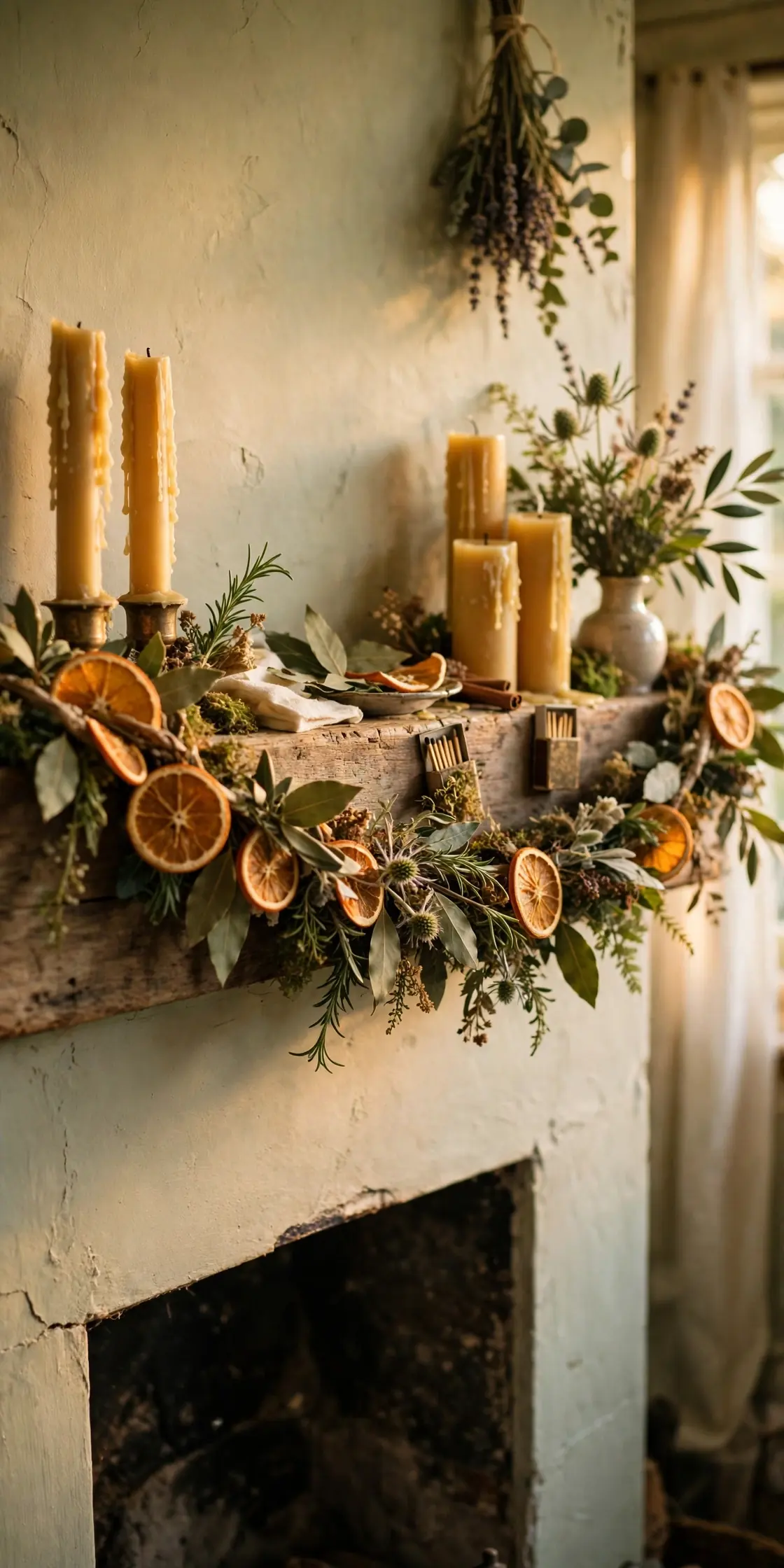
For the mantel, thread dried orange slices with bay leaves between them; the bay adds a deep green rhythm the oranges alone cannot. Slice oranges a quarter inch thick, pat them dry, and bake at 200°F for 3 to 4 hours, flipping once, until dry but still pliable. Six feet of garland takes about 5 oranges and one afternoon of mostly waiting.
Try it: Thread the slices while they are still slightly flexible, soon after they cool. Fully hardened slices crack at the needle hole.

07
Foraged Greenery Swags Tied With Velvet Ribbon
Small bundles of cedar, pine, and ivy, tied with a short length of velvet ribbon and hung on door handles, bedposts, chair backs, and cupboard knobs, spread Christmas through the house for the price of a walk. Swags beat one grand arrangement because they put greenery in six places instead of one. Keep them wild and slightly uneven; trimmed swags look like a florist visited, and nobody in a cottage has a florist.
Try it: One basket of foraged greenery makes about 6 swags. Gather once, tie them all at the kitchen table, and hang them in a single round.

08
A Woodland Wreath With Dried Flowers
Build a wreath on a plain grapevine base with dried flowers, moss, pinecones, and a few sprigs of greenery tucked in loosely. It should look gathered from a hedgerow, not arranged in a workshop. Hang it on the front door, over the mantel, or in a window where the dried petals catch the light.
Try it: Treat the wreath as a growing thing: add this year’s dried flowers to last year’s base. A wreath that accumulates is more cottagecore than a new one each December.

09
Pinecones in Bowls, Baskets and Garlands
Gathered pinecones are the free building block of the whole style: heaped in a wooden bowl, wired into garlands, standing in for place cards at the table. Their texture does the work that bought ornaments do in other styles. A frosted tip of white paint on a few of them hints at snow without a can of flocking anywhere.
Try it: Bake found pinecones at 200°F for 30 minutes before bringing them inside. The heat opens them fully, melts the sap, and deals with any small residents.
10
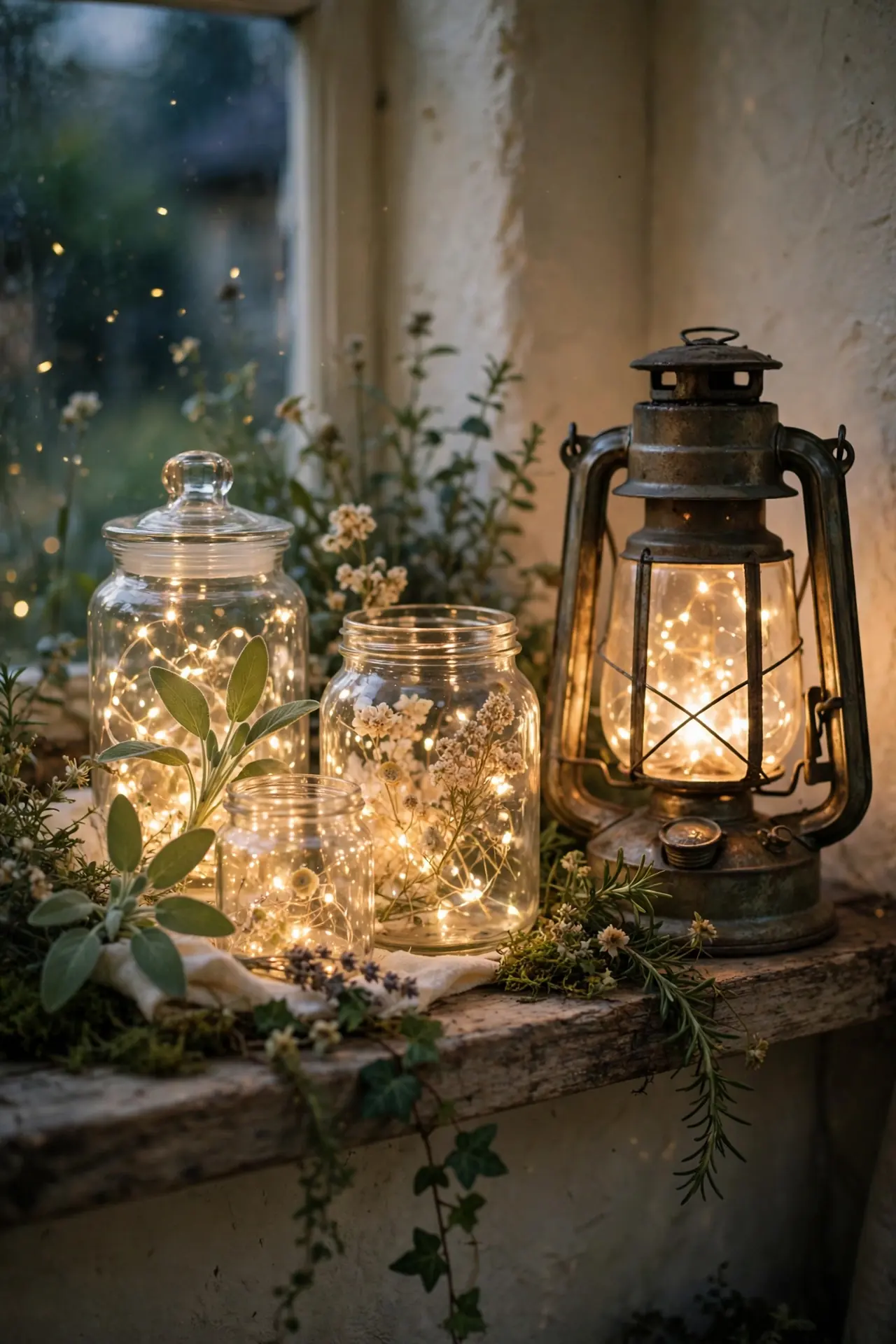
Fairy Lights in Jars and Lanterns
Warm fairy lights coiled inside glass jars, lanterns, and old bottles give cottagecore rooms their firefly glow without a cord in sight. Battery strands with timers mean each jar wakes at dusk on its own. Set them where bought decor would feel too formal: the pantry shelf, the bathroom sill, the stairs.
Try it: One jar per room corner, timers set for dusk. The house then glows room by room as the evening lands, which no single lamp can do.
11
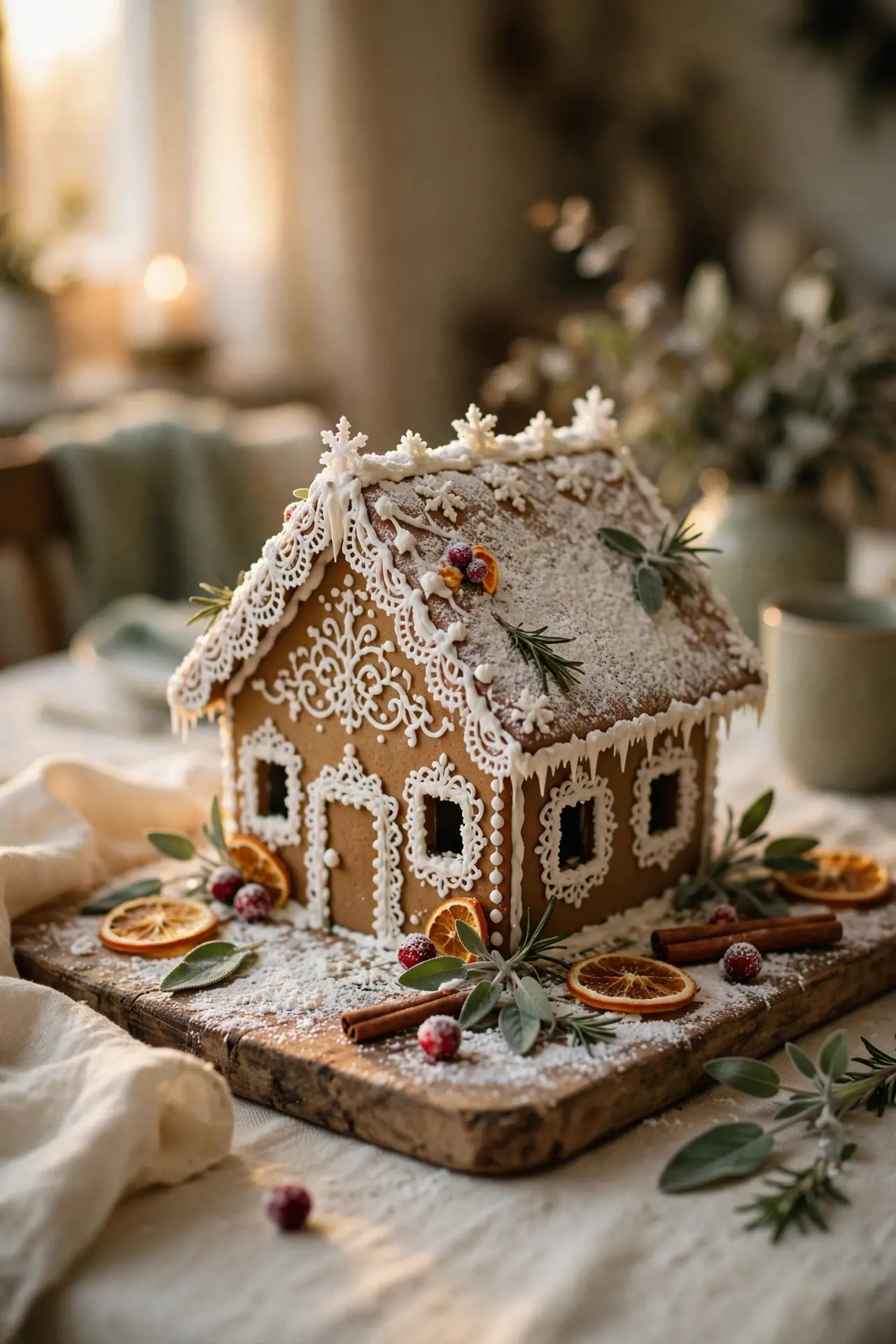
The Gingerbread House as Table Centerpiece
A cottagecore gingerbread house is decor you bake: crooked walls forgiven, royal icing piped into lace patterns, and a dusting of powdered sugar snow. Set it on a cake stand or wooden board in the middle of the table and let it hold court until it gets eaten. One house anchors the whole dining room; nothing else on the table needs to try hard.
Try it: Pipe the icing lace onto the walls while they are still flat, before assembly. Decorating a standing house is three times the work for half the neatness.

12
Ironstone and Enamelware Filled With Greens
White ironstone pitchers, chipped enamel jugs, and old creamware filled with greenery are the cottagecore kitchen in one move. The chips are not damage here; they are credentials. Fill generously and let a few fronds escape the arrangement, because containment is not the aesthetic.
Try it: Chipped ironstone costs a fraction of perfect pieces at thrift stores, and the chips disappear completely under a generous fill of greenery.
13
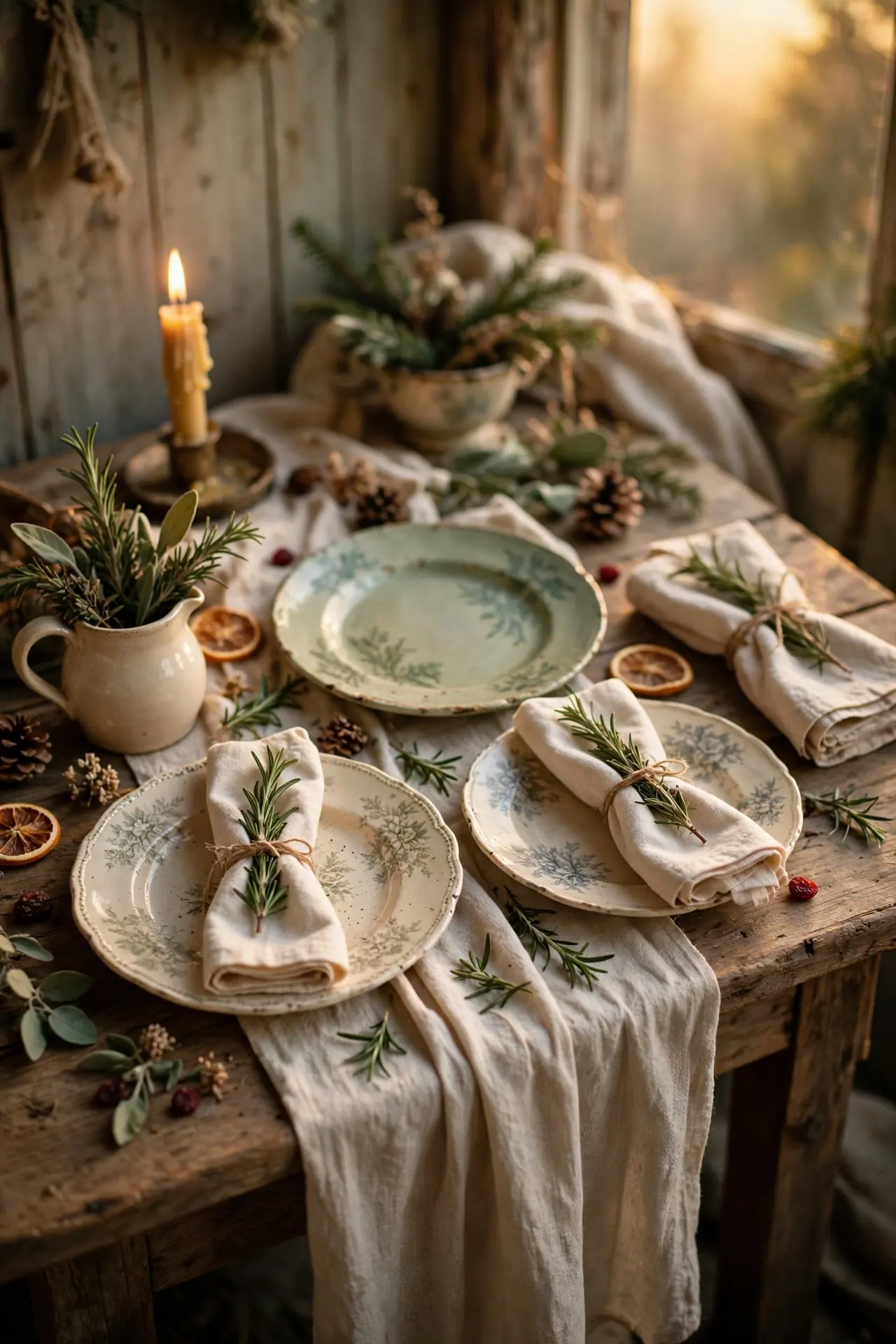
A Linen Runner and Twine-Tied Napkins
A plain linen runner down the table, cotton napkins tied with twine and a sprig of rosemary, and mismatched vintage plates give you the cottagecore table setting. Nothing matches and everything belongs, which is the entire trick. Wooden chargers or bare wood under the plates keep it grounded.
Try it: Skip ironing the linen. A soft crease in the runner is part of the look, and it saves you twenty minutes of fussing before guests arrive.
14
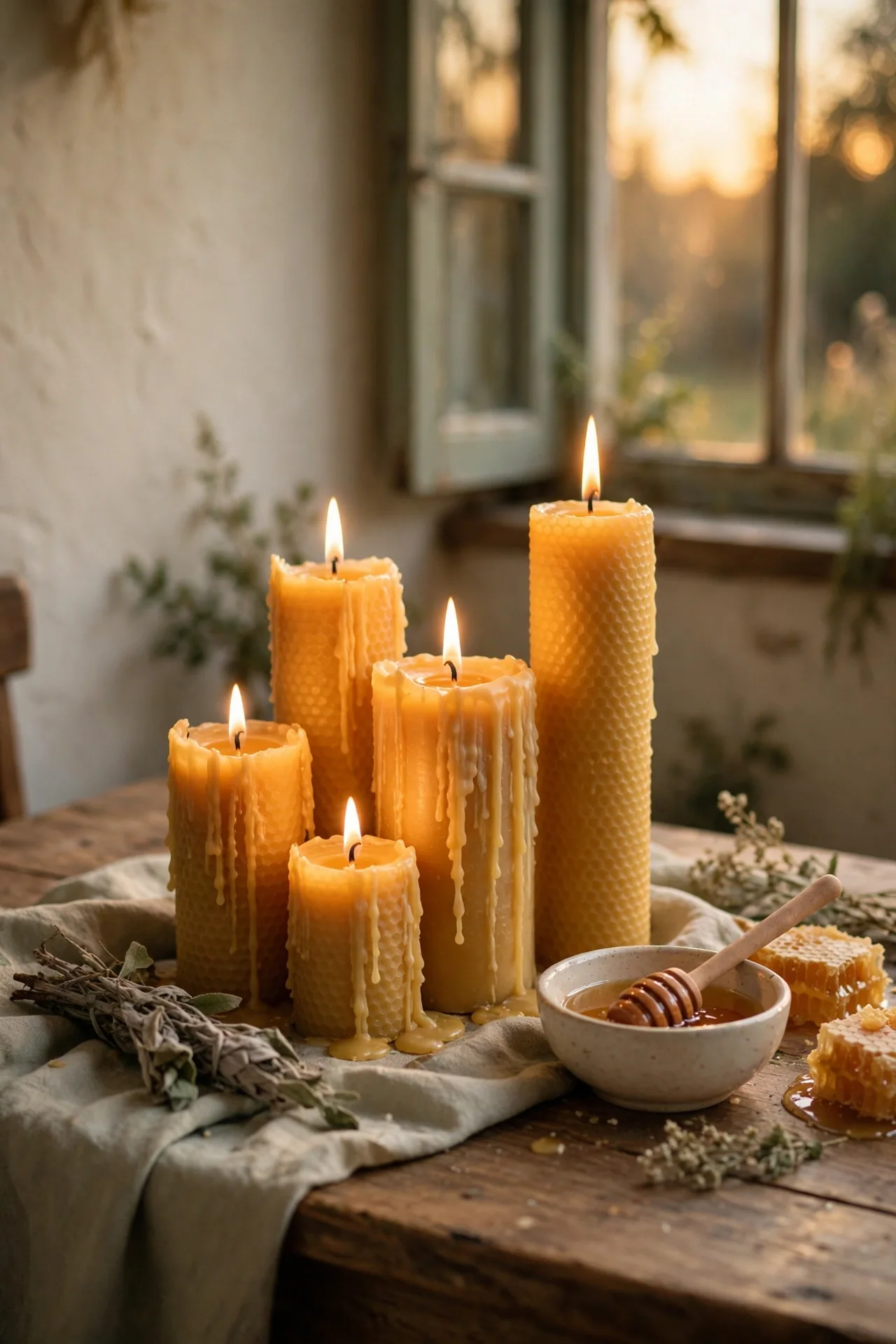
Beeswax Candles on the Table
Hand-rolled beeswax candles burn with a faint honey smell no scented candle has ever honestly copied, and their natural gold color suits the cream and sage palette exactly. Cluster them in odd numbers down the table or on the mantel. Flameless candles cannot do this job; the scent is half the decoration.
Try it: Roll your own from beeswax sheets at about $2 a candle and 10 minutes each. It is the easiest handmade piece in this entire article.

15
Vintage Tins and a Basket of Baking
Old cookie tins and biscuit tins, stacked in threes with a sprig of greenery on top, are instant cottagecore sculpture, and a basket of oranges and walnuts beside them doubles as decor and supplies. The tins carry the graphics and nostalgia; the fruit carries the color. If you bake, one tin actually holding cookies completes the story.
Try it: Group tins by size into one stack of three rather than scattering singles. A collected stack reads as a collection; scattered tins read as clutter.
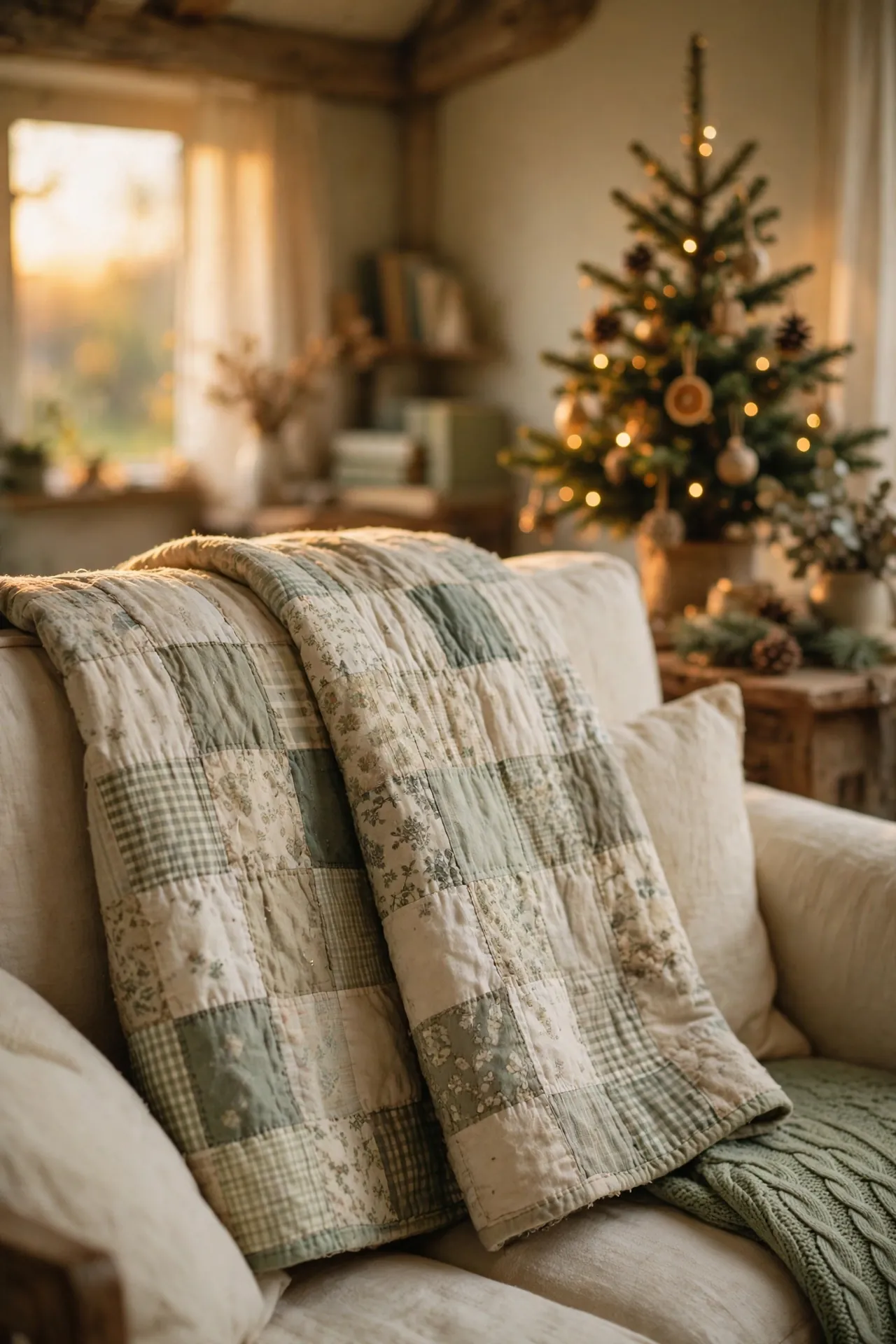
16
The Patchwork Quilt, Front and Center
Every cottagecore room needs one quilt with a past: draped over the sofa back, folded at the foot of a bed, or spread under the tree in place of a skirt. Hand quilting, faded patches, and one visible repair are all points in its favor. The quilt is the room’s warmth made visible.
Try it: A quilt too worn for a bed is perfect folded over a sofa arm. In this style, worn is the aesthetic, not a flaw to apologize for.
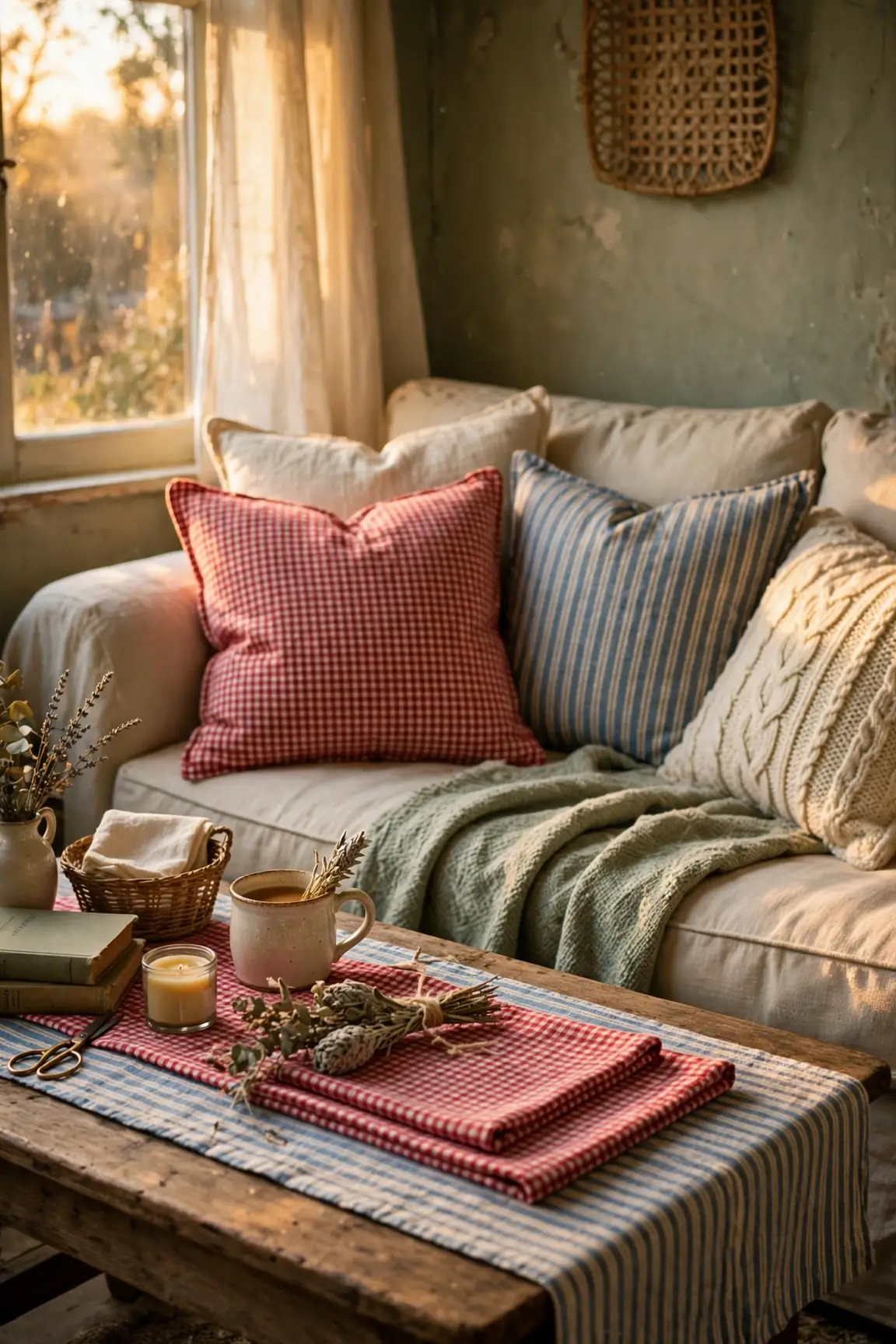
17
Gingham and Ticking Stripe Layers
Red gingham and blue ticking stripe are the two working patterns of the style: cushions, runners, ribbon, and napkins in one of them, repeated gently through the house. Patterns this humble never clash with handmade ornaments or foraged greens. Choose one pattern per house and let it recur, rather than collecting both everywhere.
Try it: Repeat your chosen pattern in exactly three rooms. Three sightings tie a house together; six make it a theme park.

18
Crochet Doilies Under Everything
A crochet doily under every candle, jar, and bowl turns plain objects into vignettes and echoes the snowflake shapes of the season. Layer two sizes under a candle jar and the lace throws a soft shadow in the light. Thrift stores sell them for pennies because nobody else knows what to do with them; now you do.
Try it: Starch doilies flat before the season starts. A doily that lies flat under glass looks like lace; one that curls looks like laundry.
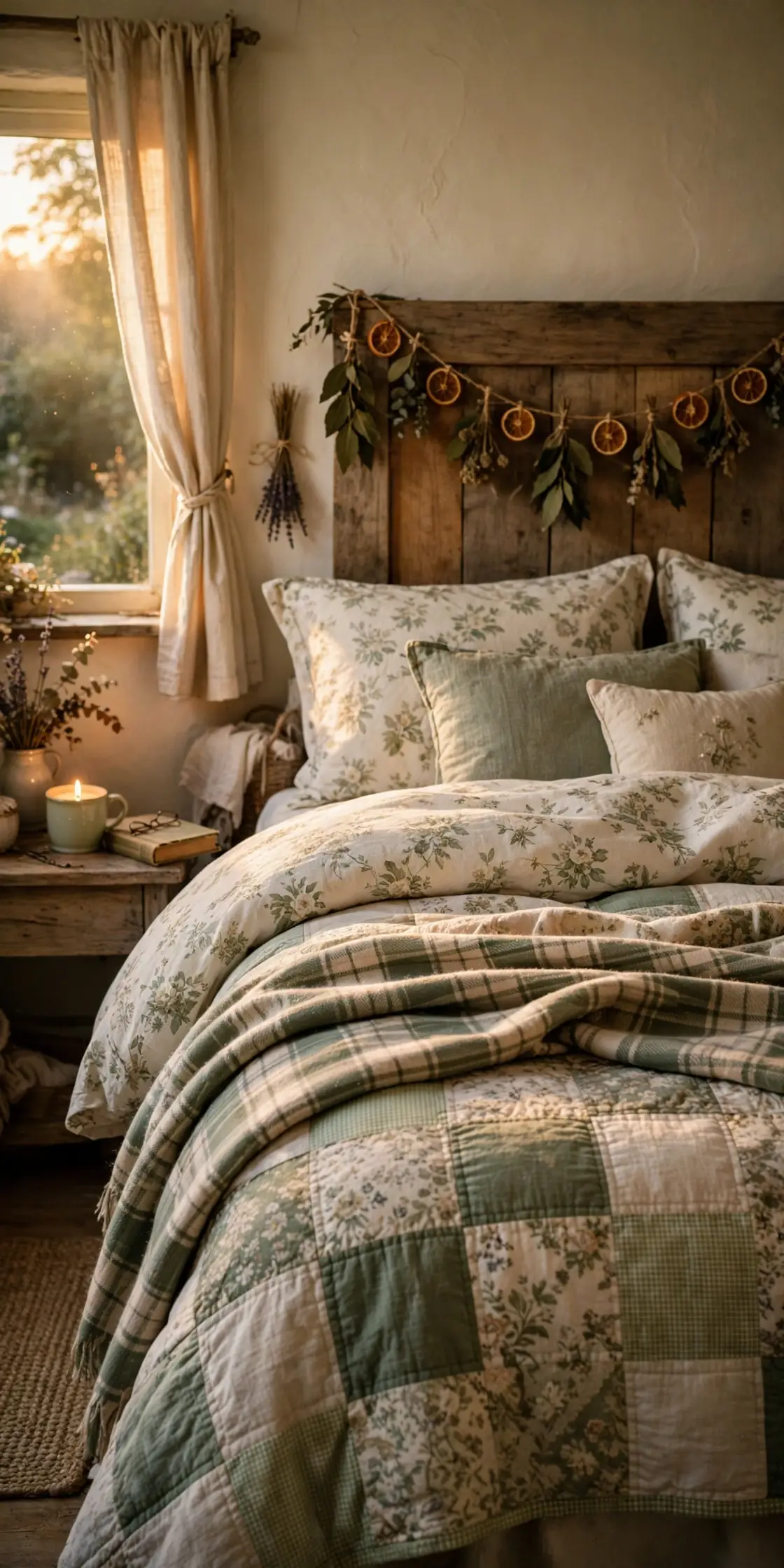
19
A Bed Dressed for a Winter Story
Layer the bed like a nest: floral linen, a thick quilt, a plaid throw at the foot, and a hand-tied garland of dried oranges and bay leaves across the headboard. Fresh evergreen sprigs in a bottle on the nightstand finish it. The bedroom should feel like the softest chapter of the same story the living room is telling.
Try it: Keep bedroom decor to textiles plus one garland. Bedrooms should feel softer than the living room, not match it piece for piece.

20
Stockings Sewn From Scraps
Stockings sewn from fabric scraps, a worn flannel shirt, a faded tablecloth, a child’s outgrown dress, carry more Christmas than any matching set. Give each person a different fabric and the mantel becomes a row of small biographies. Oversized is correct; cottagecore stockings are built for actual filling.
Try it: Cut the stocking body from a worn flannel shirt and the cuff from lace or linen. A stocking with a past life beats a new matching set every time.
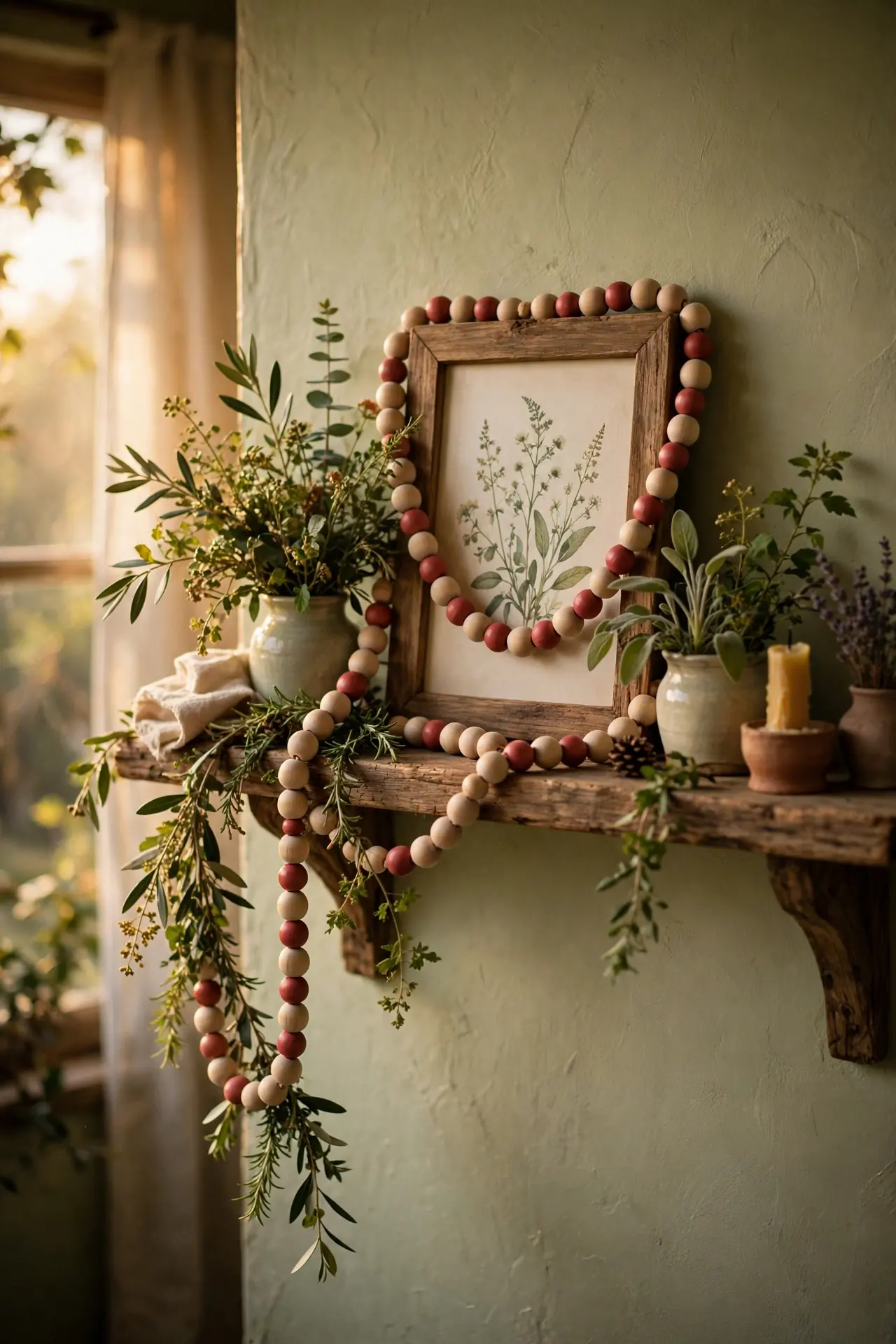
21
Wooden Bead Garlands
Strings of natural wooden beads drape softly over the tree, across shelves, and around picture frames, adding warmth and texture without a hint of shine. They are the garland for people who find tinsel loud. A strand takes an hour to string and lasts decades.
Try it: Paint every tenth bead a dusty red. The quiet rhythm of color looks handmade in exactly the right way, and it ties the garland to your palette.

22
Vintage Books, Stacked and Candlelit
A stack of old books with red and green cloth spines, a candle on top, and a sprig of greenery makes a vignette anywhere: side table, mantel end, windowsill. Books you have actually read are better than bought decorative ones; the titles are part of the home’s story. Three books is a stack; seven is a library display.
Try it: If the spines clash with your palette, wrap the books in plain linen or kraft paper. The stack keeps its shape and loses the visual noise.

23
Dried Flowers in Bottles on the Windowsill
Vintage glass bottles holding dried lavender, baby’s breath, and wheat stems, lined along a windowsill, are the cottagecore mood in a single image, especially backlit at dusk. The bottles can be old medicine bottles, milk bottles, or jam jars; uniformity would ruin it. Dried flowers from summer carry the garden into December for free.
Try it: Group bottles in odd numbers at varied heights. A row of identical bottles looks like a shop shelf; a gathered cluster looks like a windowsill in a cottage.
24
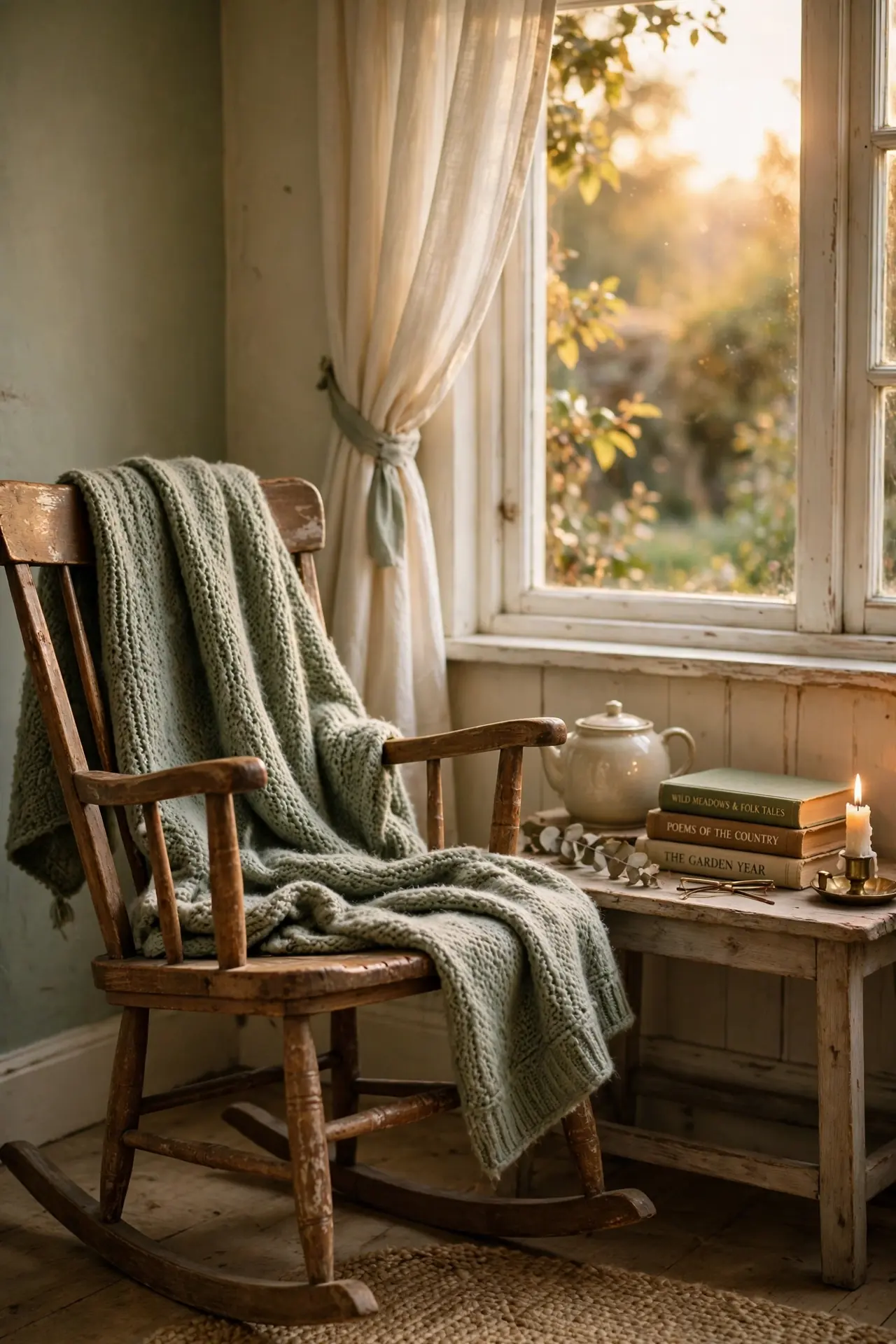
The Reading Nook: Rocking Chair, Wool Blanket, Teapot
Claim one corner for the cottagecore vignette that is also a place to sit: a rocking chair or worn armchair, a wool blanket, a small table with a teapot and a stack of books, and a candle. It is the corner guests photograph and the chair everyone quietly competes for. Every home has one underused corner; this is what it was for.
Try it: Put the nook beside your best natural light. Cottagecore corners live or die by soft daylight, and no candle fully substitutes for a window.
25
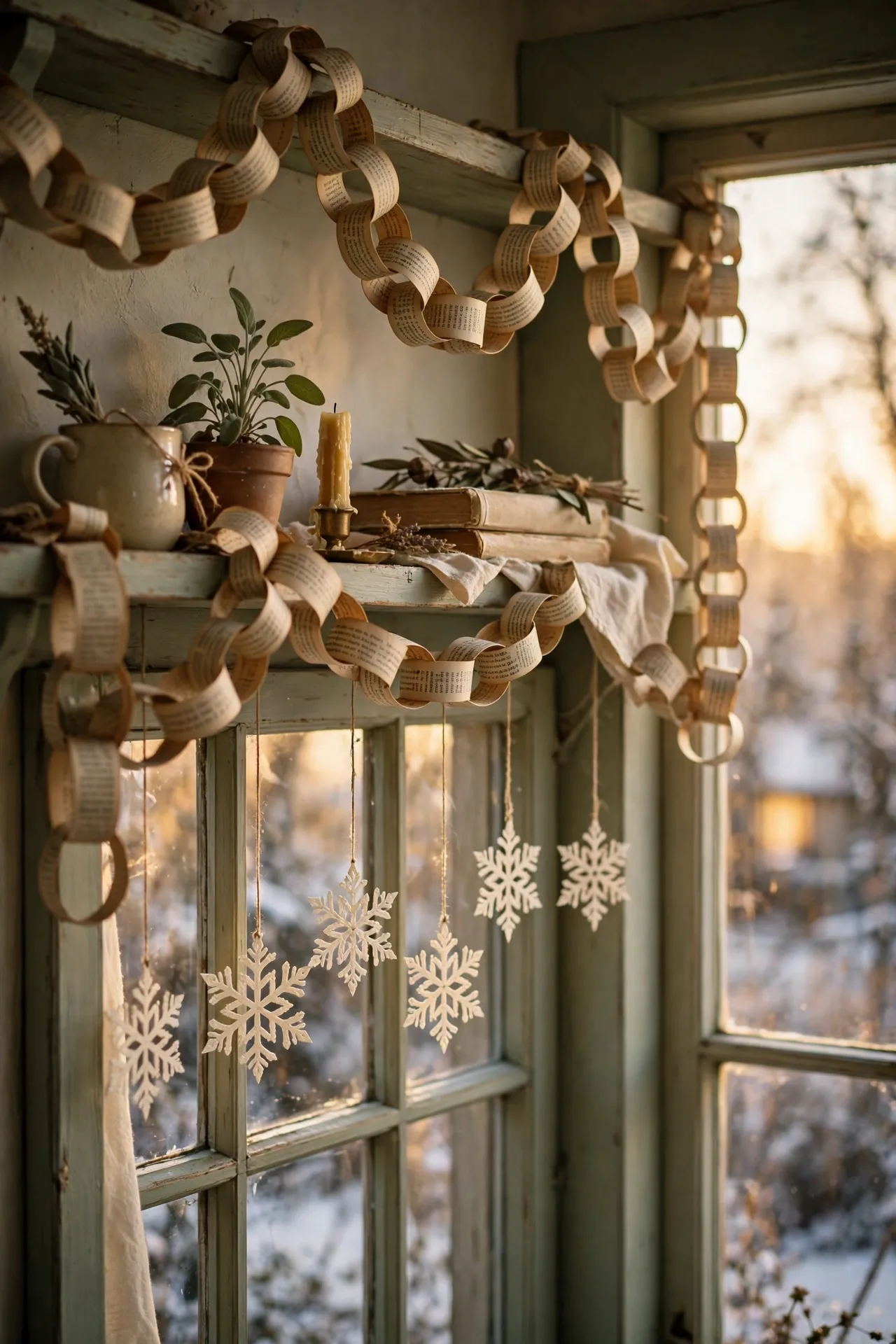
Paper Chains and Hand-Cut Snowflakes
End where the style begins: paper chains looped along a shelf and hand-cut snowflakes in the windows, made from old book pages, kraft paper, or sheet music. They cost almost nothing, children can make half of them, and their slight irregularity is the whole charm. A house with paper chains up has clearly been decorated by its people, not by a store.
Try it: Cut snowflakes from coffee filters instead of printer paper. They fold thinner, cut lacier, and look more like doilies, and a pack costs about $1.
Pro tip: Take one walk with a basket before you buy a single thing. Half of this look, pinecones, branches, berries, and greenery, is lying on the ground in December waiting to be gathered, and the pieces you forage will always look more cottagecore than anything that arrived in a shipping box.
Three rules for true cottagecore
Cottagecore looks effortless, but it follows stricter rules than any matching set style.
- Handmade, foraged, or inherited, two of three in every display: Each arrangement should combine at least two of the three sources. A display that is only bought reads as a theme; mixed sources read as a life.
- Imperfection is a feature: Asymmetry, chips, fading, and mismatched patterns are the aesthetic itself. The moment everything matches and gleams, the cottagecore spell breaks.
- Nature leads, Christmas follows: Greenery, wood, citrus, and wool do nearly all the decorating, while overtly Christmassy pieces stay rare. One Santa per room is plenty; the forest does the rest.
After Christmas: keeping the handmade things
Handmade and natural decor stores differently from bought ornaments, and one careless box undoes a season of making.
- Dry before you box, and skip the plastic: Natural pieces go into storage bone dry, in breathable boxes or paper bags. Sealed plastic traps moisture and grows mold on citrus, cones, and greenery by spring; dried orange pieces are best composted in January and remade fresh next year.
- Flat and dark for textiles: Quilts, doilies, and stockings store folded flat and out of light. Sunlight through a storage window fades patchwork and gingham in a single season.
- Photograph every vignette first: The nook, the sill, the table, the headboard: take the photo before you dismantle it. Cottagecore looks accidental but is carefully placed, and the photos are next December’s instructions.
More ideas you’ll love: Cottage Christmas Decor Ideas, Rustic Christmas Decor Ideas, Vintage Christmas Decor Ideas, More in Christmas Decor
Questions readers ask
What exactly is cottagecore christmas decor?
It is Christmas decorating built on handmade, natural, and vintage pieces gathered slowly rather than bought as a set: dried orange garlands, foraged greenery, patchwork textiles, ironstone, and candlelight. The feel is a storybook countryside cottage, slightly imperfect, deeply cozy, and personal in a way matched sets never are.
What is a cottagecore christmas tree?
A tree dressed almost entirely in handmade and natural ornaments: salt dough and felt pieces, popcorn and cranberry strings, dried orange slices, wooden beads, and a lace or burlap skirt. It is usually a little sparse and slightly wild rather than perfectly symmetrical, and no two branches carry the same combination.
How do I get the cottagecore look on a small budget?
Start with a foraging walk and your own kitchen. Pinecones, branches, and greenery are free; dried oranges, popcorn strings, and salt dough ornaments cost a few dollars in supplies; thrifted lace, ironstone, and quilts fill the rest for pennies. A convincing cottagecore christmas is one of the cheapest styles there is, at $20 to $50 total for most homes.
What colors define cottagecore christmas?
Cream, sage green, dusty red, faded gold, and natural wood tones. The palette is deliberately muted, like colors that have lived in sunlight for years. Bright scarlet, pure white, and glitter sit outside it and will make everything else look wrong.
How do I make a dried orange garland?
Slice oranges a quarter inch thick, pat the slices dry, and bake them at 200°F for 3 to 4 hours, flipping once, until dry but still slightly pliable. Thread them on twine with a large needle, adding bay leaves or cranberries between slices if you like, and hang the garland within the hour, before the slices harden completely.
Can cottagecore work in a modern home or a small apartment?
Yes, and contrast helps it. Do one corner or one room completely, a reading nook, a kitchen shelf, the tree, and let the rest of the home stay modern. A concentrated cottagecore vignette reads as intentional styling; a thin spread of it everywhere reads as unfinished.
Where do I find cottagecore christmas ornaments?
Thrift stores, flea markets, family attics, and your own craft table, in that order. Look for wood, felt, straw, crochet, and aged glass, and avoid anything glossy, glittered, or part of a matched set. If you buy handmade, local makers and craft fairs carry exactly this style.
Do natural decorations go bad or attract pests?
Not if they are prepared and stored dry. Bake foraged pinecones at 200°F for 30 minutes before use, dry citrus fully until it is hard and light, and store everything bone dry in breathable boxes. Dried orange pieces are a one season decoration: enjoy them, compost them in January, and remake them next year.
People Also Ask
What is the difference between cottagecore and cottage christmas decor?
They overlap heavily. Cottage is a decorating style rooted in cottage interiors, English or French country, while cottagecore is a wider aesthetic movement centered on handmade, self-sufficient, nostalgic rural life. In December they share about ninety percent of their pieces; cottagecore leans harder into the handmade and foraged side, cottage into the collected vintage side.
Is cottagecore christmas decor still popular?
Yes. It has settled from a passing trend into a durable style, carried by thrift culture, handmade marketplaces, and the appeal of a Christmas that costs little and means more each year. Styles built on gathering rather than buying do not date the way product driven trends do.
How do I make christmas decor look handmade if I am not crafty?
Use the no-skill projects: string popcorn, tie greenery into swags with ribbon, coil fairy lights into jars, and fill bowls with pinecones and oranges. None of them needs a craft skill beyond tying a knot, and all of them read as handmade because they are.
loved these ideas? ✿
Save this guide for later
Pin it to your board so it’s there when you’re ready to recreate it.

Curated by
Hey! I'm Sanaullah — visual curator and content creator. I search, curate, and test the best aesthetic ideas across Pinterest so you can easily transform your living space, style daily outfits, and try simple creative DIYs without the overwhelm.