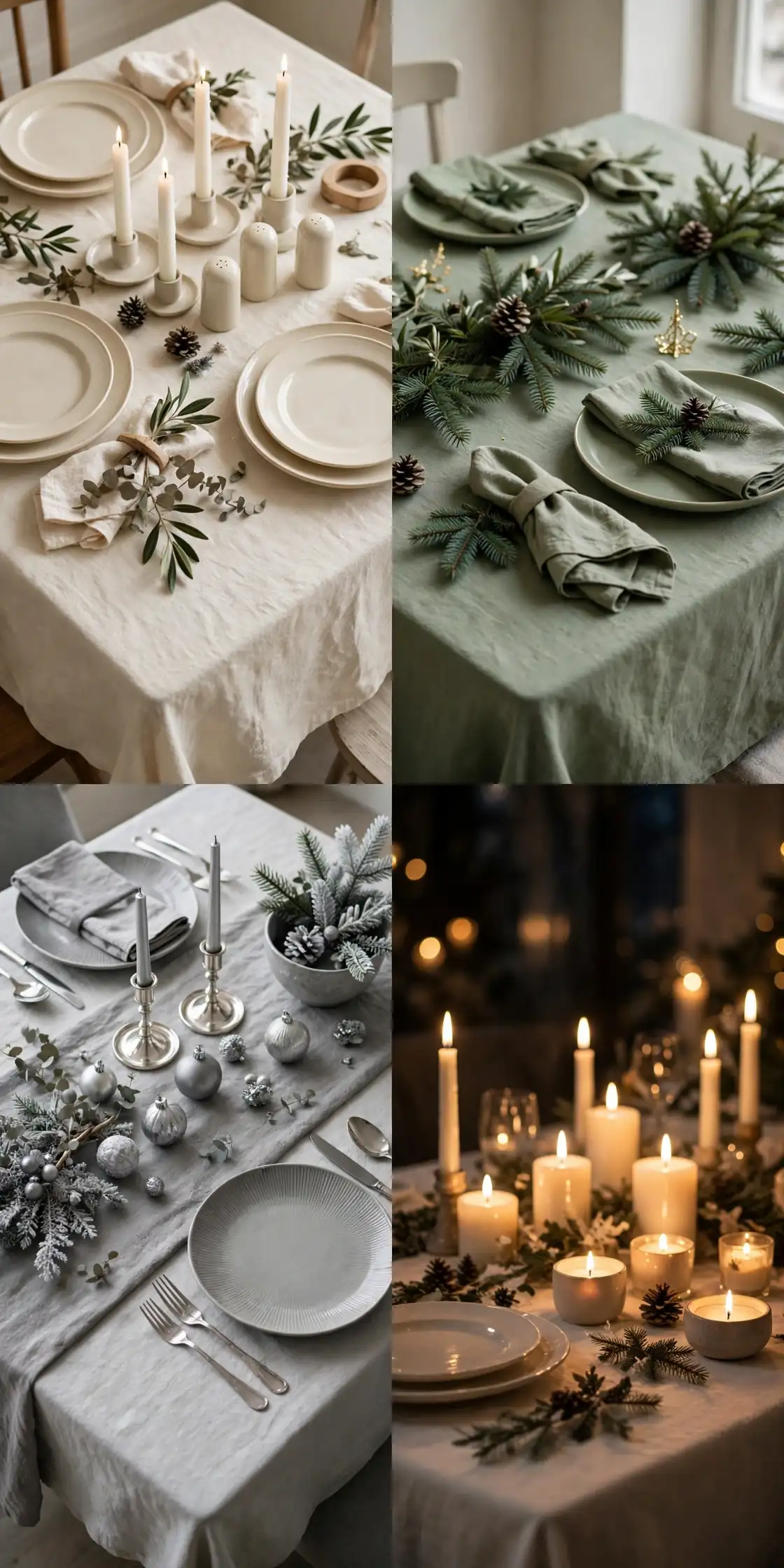

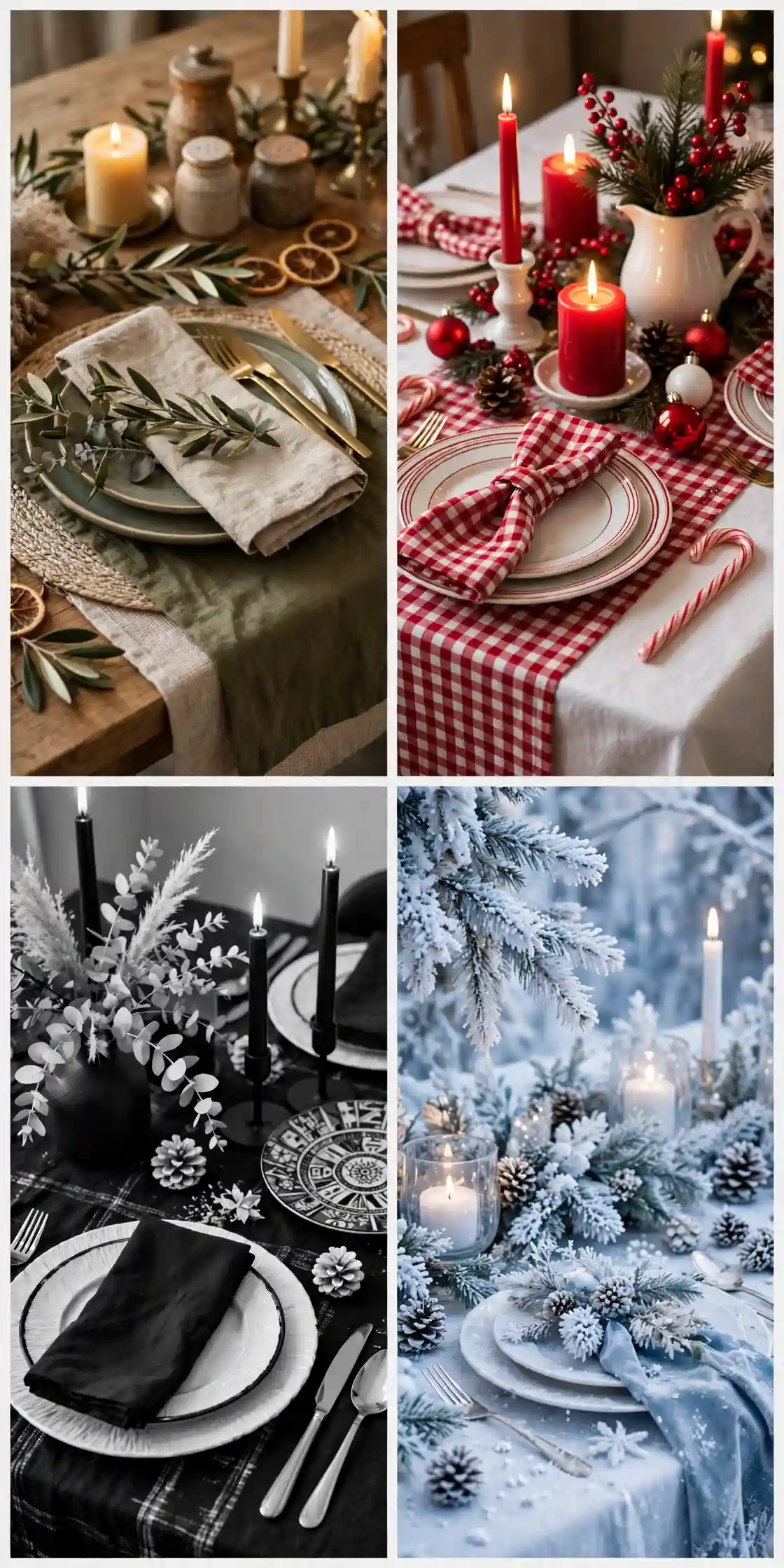
A Christmas table dressed with random decorations can look like a storage box tipped onto a tablecloth, because every piece was bought alone and nothing ties them together. A table styled as a christmas tablescape looks different, because the layers, the heights, the textures and the colours were chosen as one composition, and the eye reads the whole table at once. Most christmas tablescape attempts fail in the same way: people buy a centrepiece that is too tall, set plates on a bare cloth with nothing beneath them, mix three colour stories at once, or crowd the table so no plate fits, and end up with a table that looks busy and leaves guests passing dishes around a forest. This list works the other way around. These 22 christmas tablescape ideas are grouped by composition angle, layering foundations, height and balance, colour cohesion, texture mixing, runner and placemat art, candle and light placement, napkin and detail art, and finished styled looks, and every idea explains the layering order, the heights, and the cohesion trick behind the look, so you can build a table that looks styled rather than assembled. Pick one composition here, lay it in order from cloth to last sprig, and your table will look finished the moment guests walk in.
- The key takeaway: Layer in order, cloth first, then runner, then placemats, then chargers, then plates, then candles, then greenery last. A tablescape built in order reads as a designed composition, because each layer frames the next, while pieces placed in random order read as clutter.
- The detail most people miss: Height belongs at the edges of the centre, not in the middle. Tall candles at the ends of a runner and a low centre in the middle let guests see each other, while one tall centrepiece blocks faces and kills conversation.
- What it costs or how long it takes: Most of these 22 tablescapes cost $30 to $150 in decorations, and each takes 45 minutes to 2 hours to lay. A bare-wood runner tablescape sits at the bottom of the range, while a layered gold and crystal tablescape sits at the top, and every idea here beats the price of a hired table stylist for one dinner.
At a glance
| Group | Ideas | Composition angle | Best for |
|---|---|---|---|
| Layering Foundations | 01-03 | Cloth, runner, placemat and charger stacks | First-time stylers |
| Height and Balance | 04-06 | Low centres, tall edges, three heights | Tables that block faces |
| Colour Cohesion | 07-09 | One colour, three textures, two-colour stories | Rooms that clash |
| Texture Mixing | 10-12 | Velvet, linen, wood, metal, glass | Flat-looking tables |
| Runner and Placemat Art | 13-15 | Overlapping runners, placemat layers | Tables with no focal point |
| Candle and Light Placement | 16-18 | Clusters, weaves, lantern rows | Evening meals |
| Napkin and Detail Art | 19-20 | Folds, place cards, sprigs | Finishing touches |
| Finished Styled Looks | 21-22 | Modern minimal, winter wonderland | Whole-table inspiration |
jump to an idea ↓
- 01 Cloth Runner Placemat Layer
- 02 Charger Plate Bowl Stack
- 03 Bare Wood and Runner Contrast
- 04 Low Centre and Tall Candle Edges
- 05 Three Heights Rule
- 06 Round Table Centre Height
- 07 One Colour Three Textures
- 08 Red and White Tablescape
- 09 Black and White Tablescape
- 10 Velvet Linen and Wood Mix
- 11 Metallics Mixed Not Matched
- 12 Natural Greenery Against Glass
- 13 Overlapping Runners
- 14 Placemat Layering
- 15 No Runner Placemats Only
- 16 Candle Cluster Placement
- 17 Fairy Light Weave
- 18 Lantern Row Down the Centre
- 19 Napkin Fold as Focal Point
- 20 Place Card and Sprig Detail
- 21 Modern Minimal Tablescape
- 22 Winter Wonderland Tablescape
Layering Foundations
01
Cloth Runner Placemat Layer
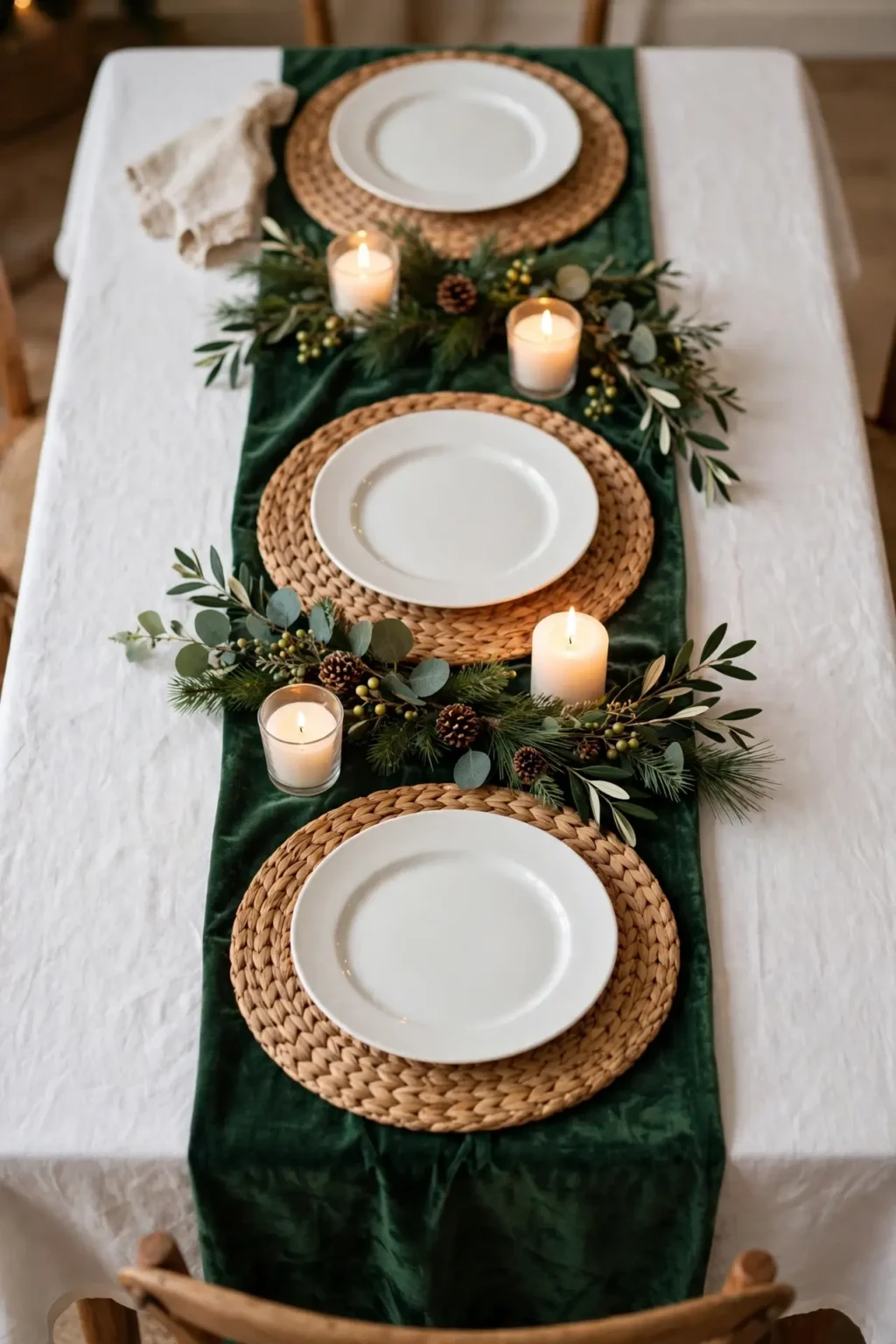
A table with plates set straight onto a cloth can look flat, because nothing frames the settings and the eye slides off the table. A cloth runner placemat layer fixes that, because a christmas tablescape built in three layers, a tablecloth, a runner down the centre, and a placemat at each place, gives every setting a frame. Lay the cloth first, centre the runner so it hangs evenly at both ends, then place one placemat per setting, aligned with the chair. The three layers read as depth, because the eye travels from cloth to runner to placemat before it reaches the plate. A layered foundation suits a first-time styler best, because the order is simple and the result looks deliberate at once.
Try it: Let the runner hang about 30 cm over each end of the table, not just to the edge. A runner that stops at the edge looks short, while one that drops over the ends reads as finished.
02
Charger Plate Bowl Stack
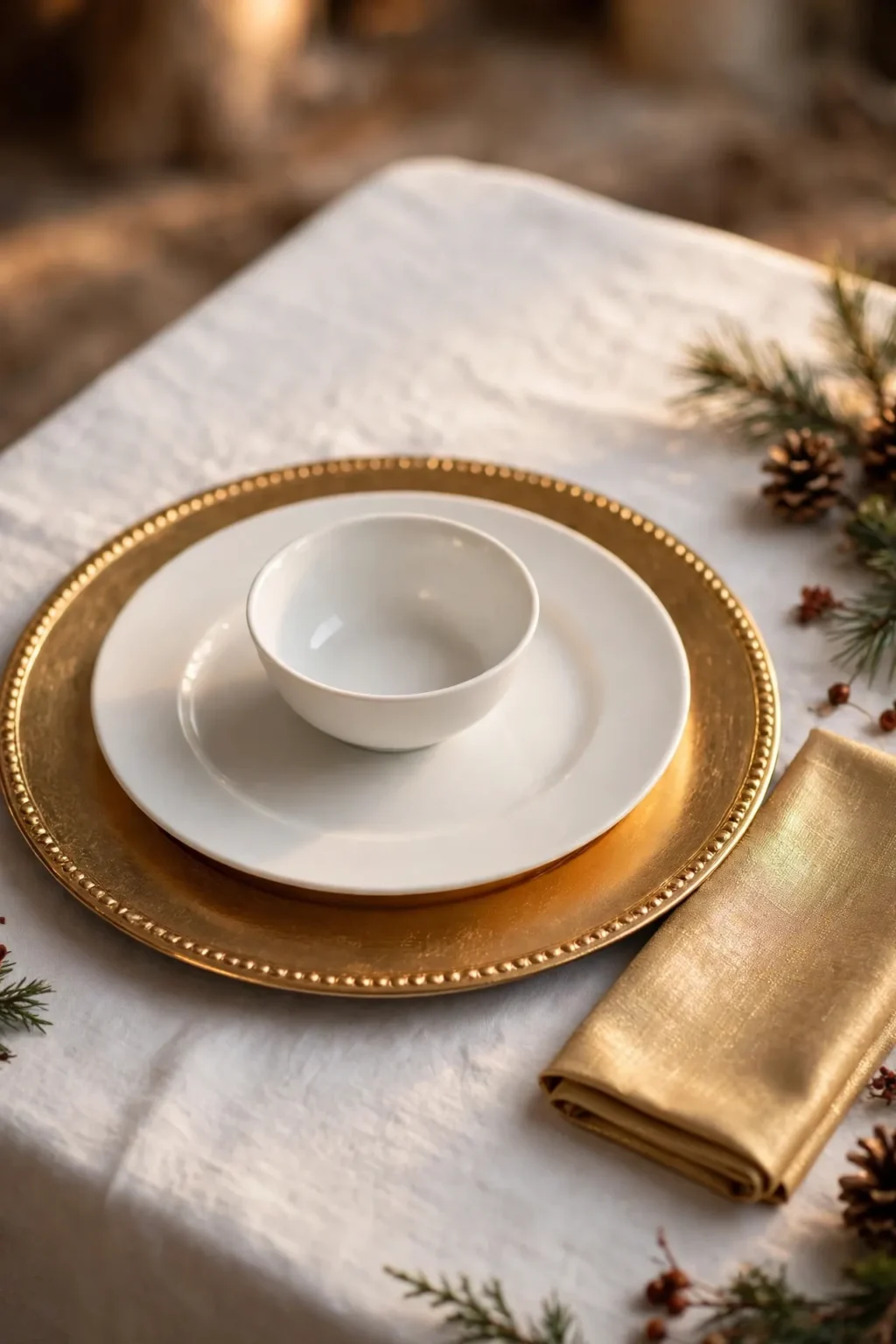
A single plate on a bare placemat can look lost, because the setting has no weight and no border. A charger plate bowl stack gives the setting its weight, because a large charger, a dinner plate, and a small bowl stacked in order build a pyramid that anchors each place. Lay the charger first, centre the dinner plate on it, and set the bowl on top only if the first course needs it, keeping the stack to three pieces at most. The stack reads as a finished setting, because the eye sees a composed place rather than a lone plate. A stacked setting suits a formal dinner best, because the layers say occasion before anyone sits down.
Try it: Keep the charger on the table through the main course, and lift only the plate and bowl. A charger removed with the plates leaves a bare placemat, while a charger left in place keeps the setting framed all evening.
03
Bare Wood and Runner Contrast
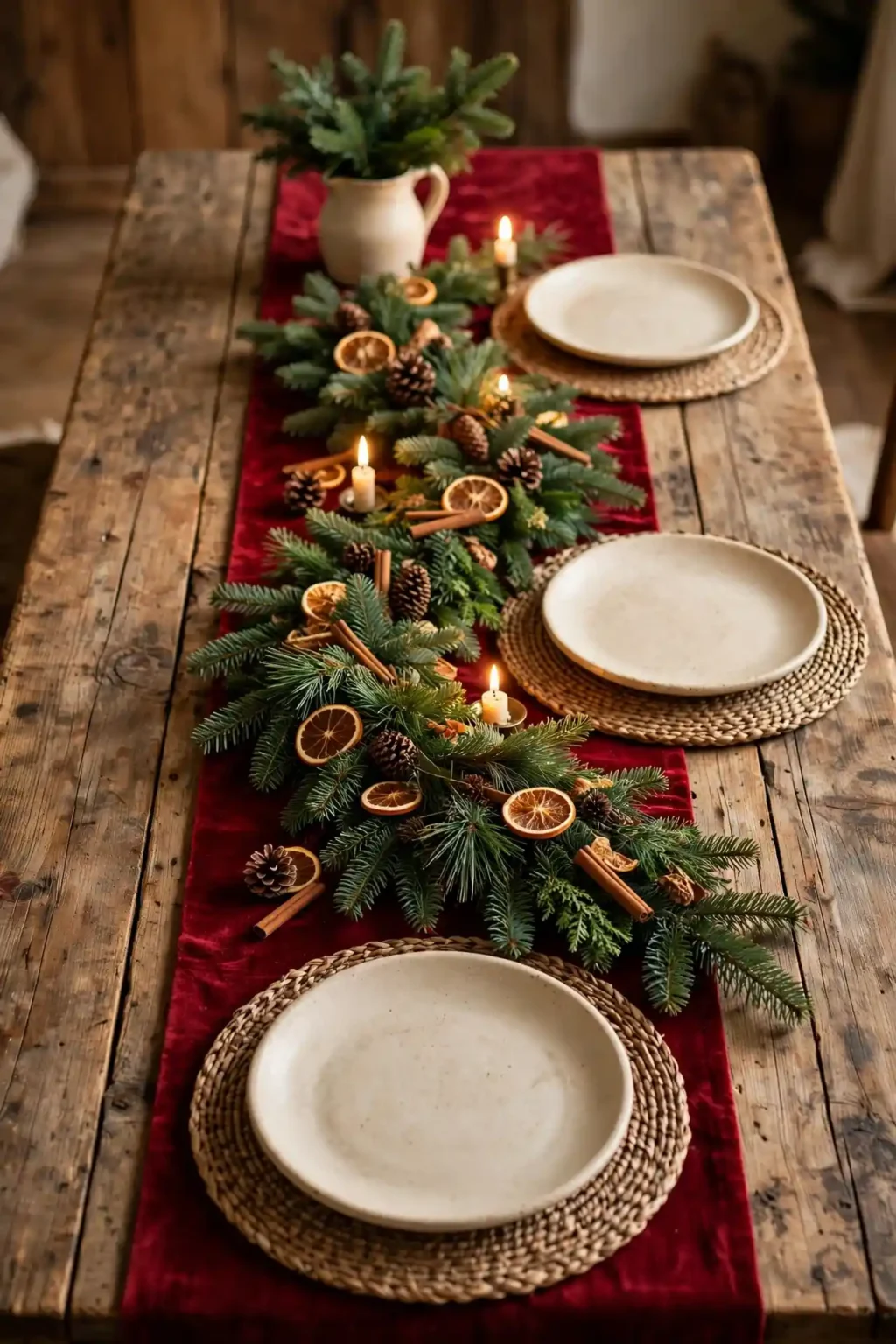
A table hidden under a full cloth can feel overdone in a relaxed home, because the cloth hides the table that gives the room its character. A bare wood and runner contrast lets the table show, because a christmas table set up with no cloth, one runner down the middle, and wood at the sides reads as farmhouse and welcoming. Lay the runner on the bare wood, place woven placemats at each setting, and keep the centre low so the wood stays visible. The contrast between wood and runner reads as texture, because the eye compares the two surfaces at once. A bare-wood tablescape suits a cabin, a farmhouse, or any home with a wooden table best, because the table itself becomes part of the decoration.
Try it: Choose a runner in a colour that contrasts with the wood, dark green on pale pine or cream on dark walnut. A runner that matches the wood disappears, while a contrasting runner frames the centre.
Height and Balance
04
Low Centre and Tall Candle Edges
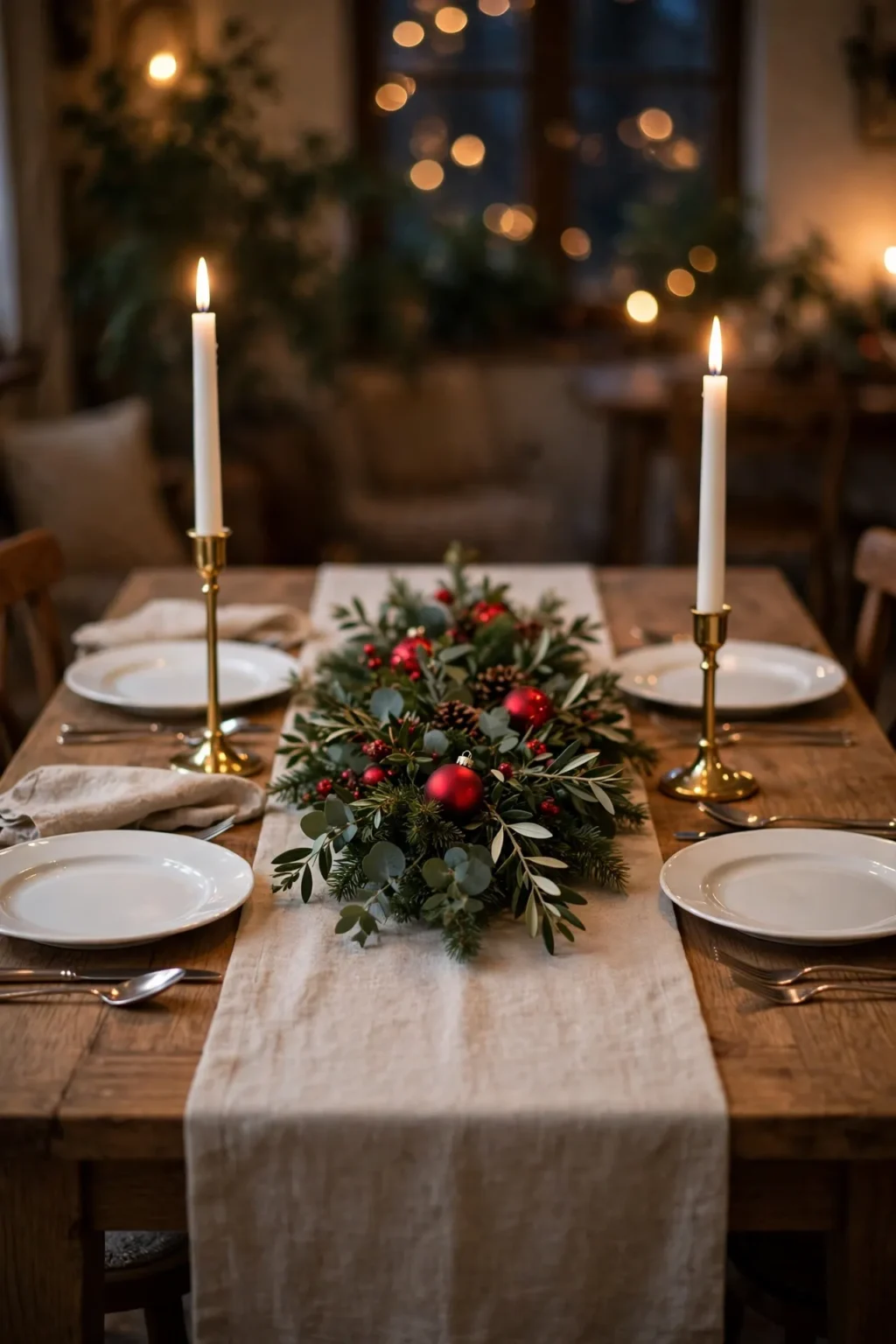
A table with one tall centrepiece can kill conversation, because guests cannot see the faces across from them. A low centre and tall candle edges fix the sightlines, because the middle of the table stays low, greenery and baubles under 25 cm, while tall taper candles stand at the two ends of the runner, where they block nobody. Place the low centre first, then add one tall candle at each end, and check the sightlines by sitting in a chair and looking across. The composition reads as balanced, because the height frames the table instead of filling it. A low-centre tablescape suits any dinner best, because conversation is the point of the table.
Try it: Sit in a chair and look across the table before guests arrive. A centre that looks low from standing height can still block a seated guest, while a seated check catches it in time.
05
Three Heights Rule
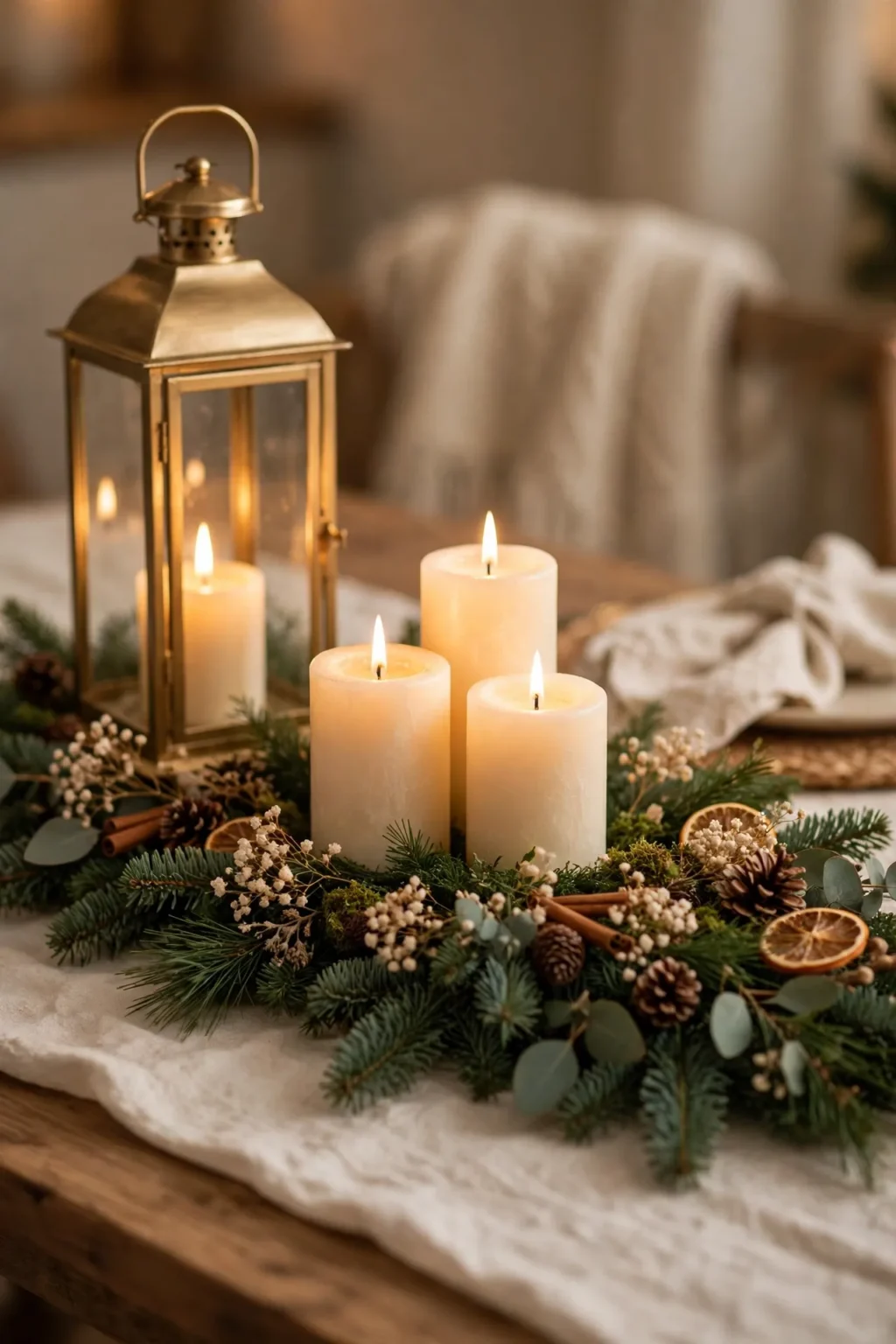
A table where every decoration sits at the same height can look like a fence, because nothing leads the eye and the composition feels flat. The three heights rule breaks the flatness, because the centre holds low greenery, medium candle holders, and one taller element, each at least 5 cm apart in height. Build the centre in three steps: lay the greenery low, add medium pillar candles, then place one taller lantern or branch at one end, never in the middle. The stepped heights read as a designed cluster, because the eye climbs the composition instead of stopping at a wall. A three-height centre suits a long table best, because the stepped profile carries the eye down its whole length.
Try it: Vary the heights by at least 5 cm each. Pieces only 2 cm apart read as the same height, while a clear 5 cm step reads as a deliberate layer.
06
Round Table Centre Height
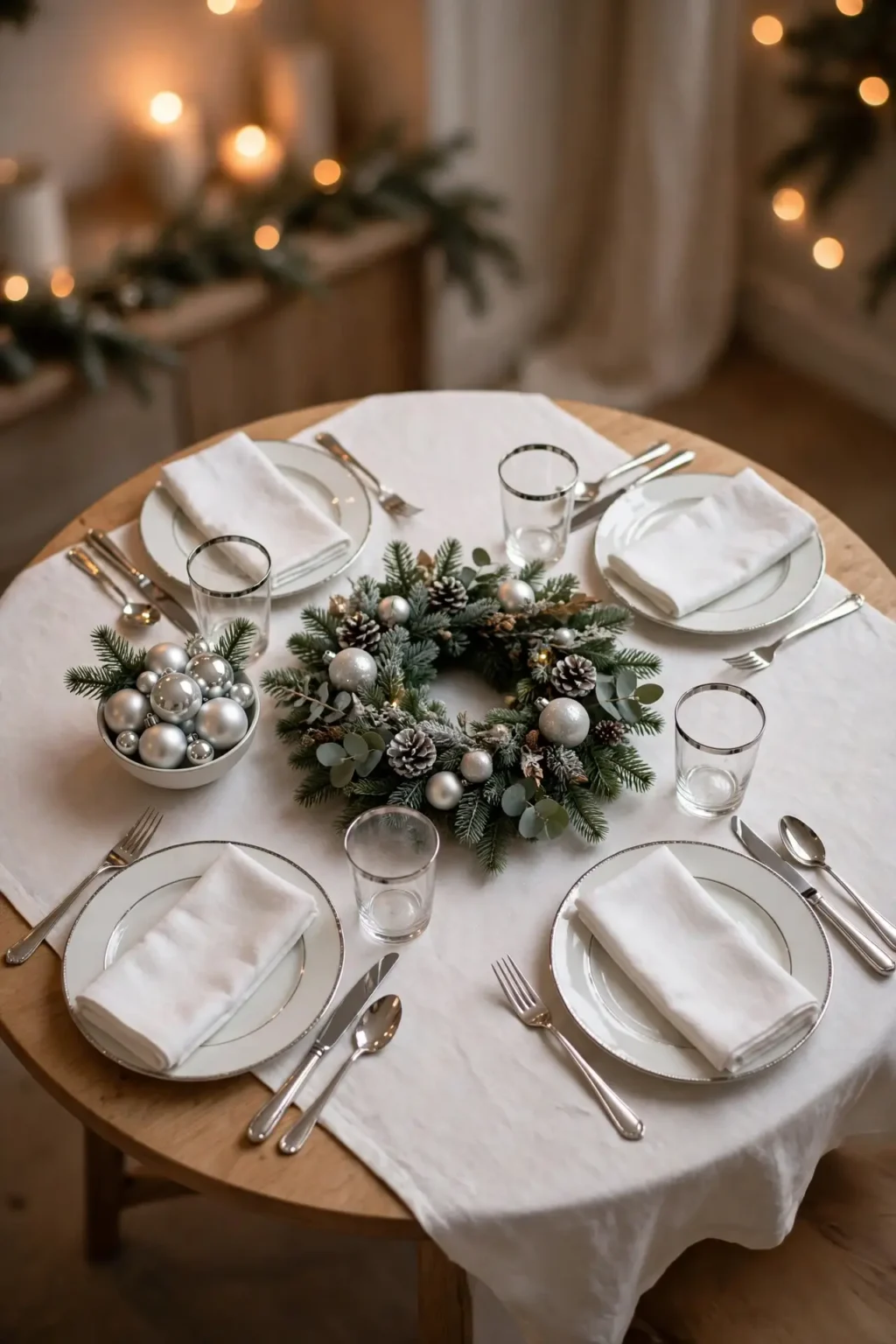
A round table dressed like a long table can look crowded, because a long runner and a row of candles do not fit a circle. A round table centre needs a round composition: one low centrepiece in the middle, settings spaced evenly around it, and nothing else competing for height. Use a round placemat or a small round cloth, a low bowl of baubles and fir as the centre, and keep the whole centre under 30 cm wide and under 25 cm tall. Christmas tablescapes for round tables built this way suit a small family dinner best, because every guest can reach the centre and see every face.
Try it: Keep the centrepiece under 30 cm wide on a round table for four. A centre wider than that eats the plates, while a small centre leaves room to eat.
Colour Cohesion
07
One Colour Three Textures
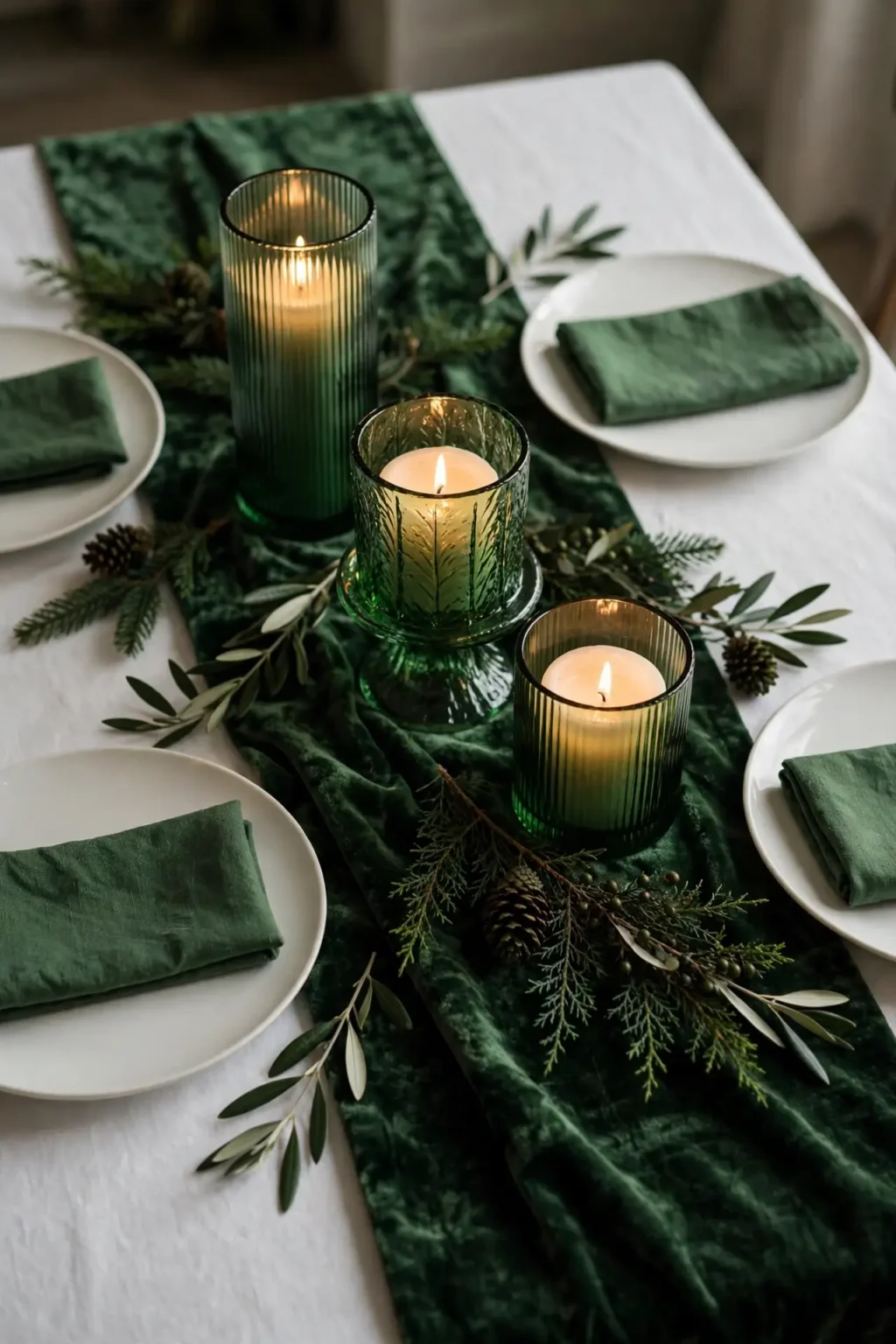
A table in five mixed colours can read as a jumble, because the eye spots the clash at once. One colour in three textures reads as rich instead, because the same colour in velvet, linen, and glass gives depth without competition. Pick one colour, deep green for example, then use it as a velvet runner, linen napkins, and glass candle holders in the same shade family. Keep the plates white so the colour has a quiet background. Elegant christmas table settings built on one colour suit a formal dinner best, because the restraint reads as confidence.
Try it: Test the three textures together in daylight before the party. Textures that match under shop lights can clash at home, while a daylight check catches the mismatch.

08
Red and White Tablescape
A red and green table can feel loud in a pale dining room, because strong colours fight light walls and white furniture. A red and white tablescape keeps the festive colour and drops the noise, because a white cloth, a red runner, white plates, red napkins, and a low centre of white flowers with red berries read as crisp. Lay the white cloth first, add the red runner, and keep all greenery out except a few fir sprigs, so the red and white story stays clean. Red and white christmas table decorations in tablescape form suit a modern dining room best, because the two-colour story matches pale walls and simple furniture.
Try it: Use one red, not three. A table in scarlet, burgundy, and cherry red looks muddled, while one clear red with white reads as a plan.
09
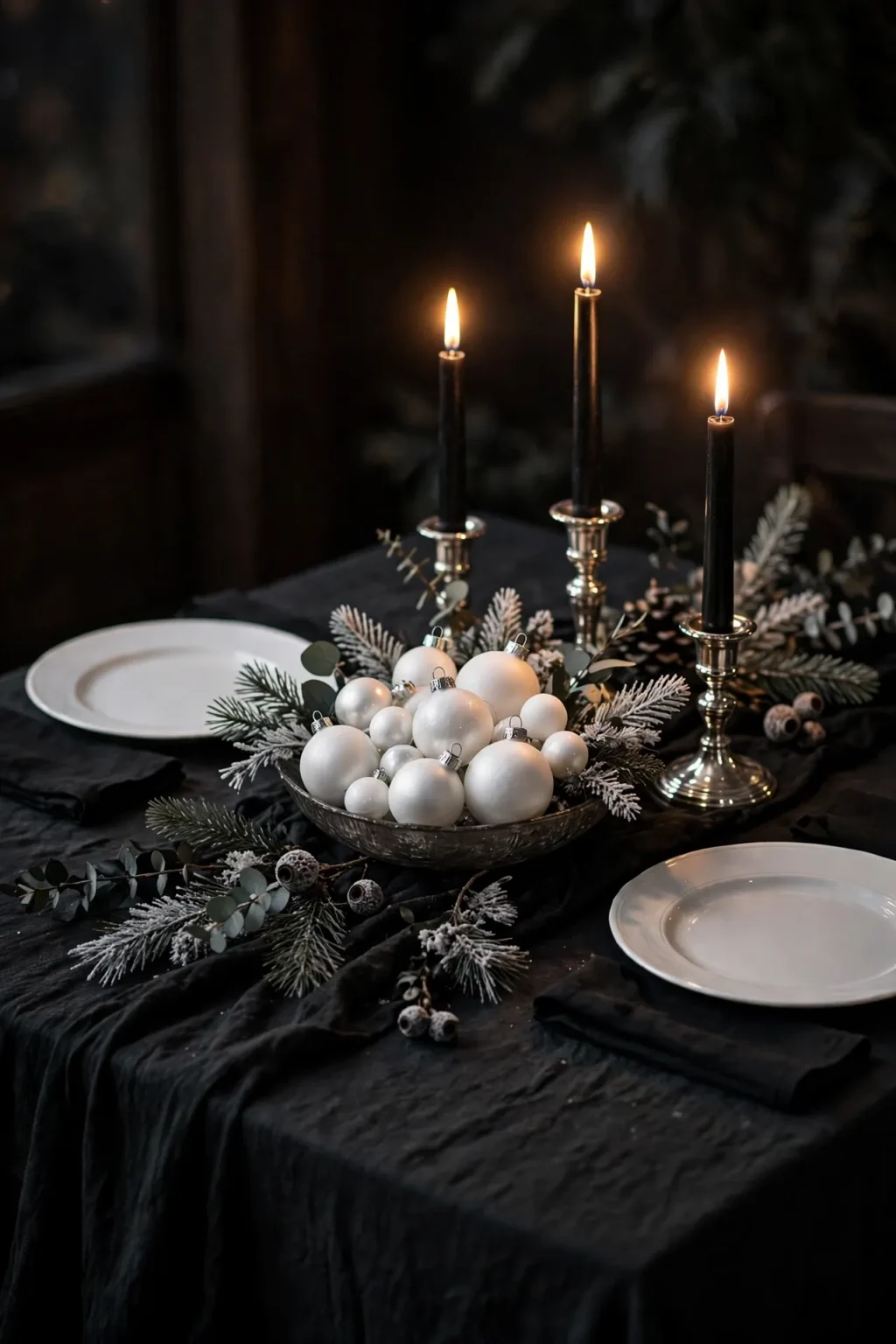
Black and White Tablescape
A white table can feel washed out under evening lights, because white reflects light instead of holding it. A black and white christmas tablescape holds the drama, because a black cloth, white plates, black candles in gold or silver holders, and a low bowl of white ornaments read as a New Year style composition. Keep the plates white so guests have a clear place to eat, and let the black cloth and candles carry the contrast. A black and white tablescape suits a late evening Christmas dinner best, because the dark palette glows under candlelight.
Try it: Keep black to the cloth and the candles only, not the plates as well. Black plates on a black cloth disappear, while white plates on black give guests a clear place to eat.
Texture Mixing
10
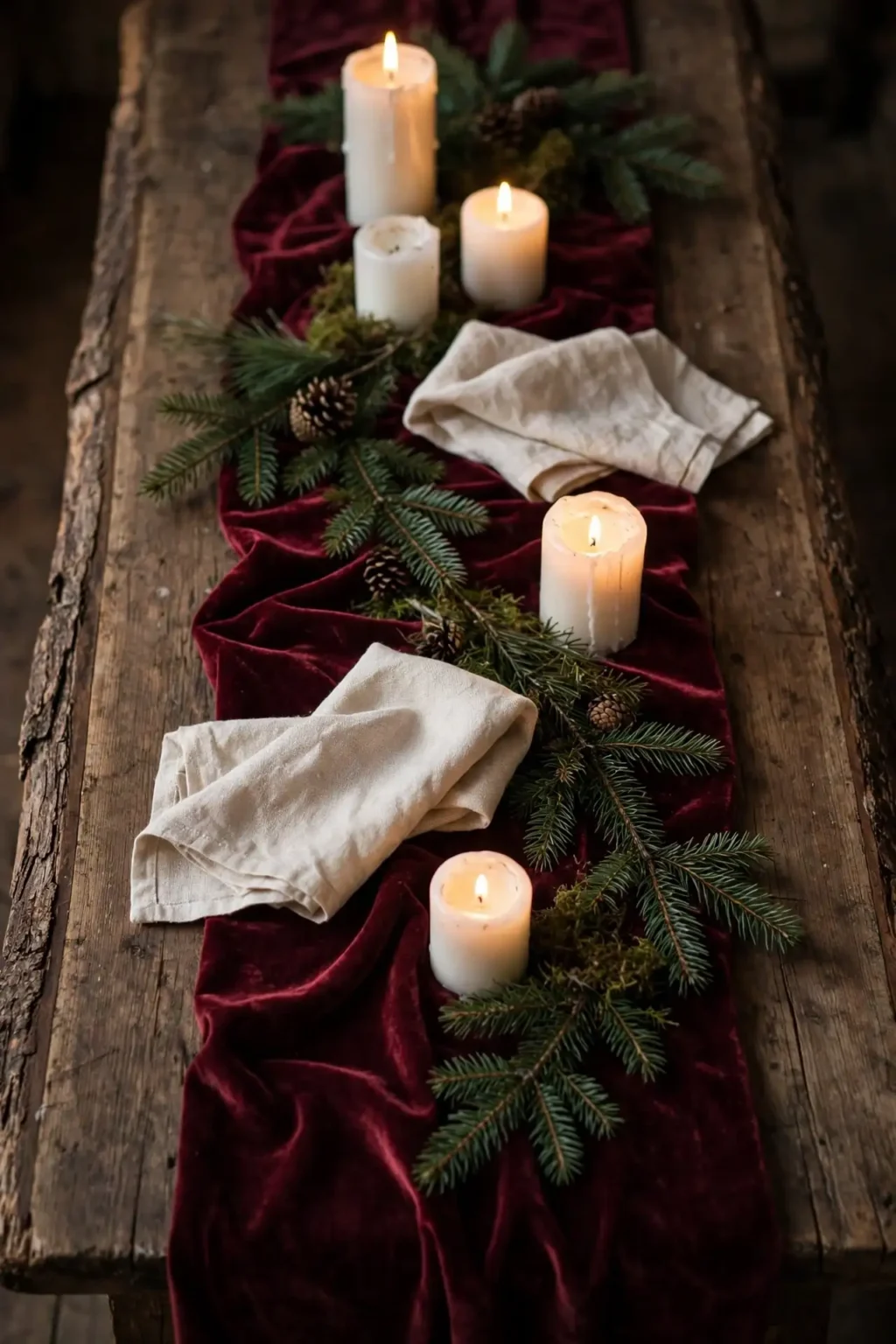
Velvet Linen and Wood Mix
A table dressed in one fabric can look flat, because a single texture gives the eye nothing to compare. A velvet, linen, and wood mix gives the table its depth, because a velvet runner, linen napkins, and a bare wood table edge each catch light differently. Lay the velvet runner down the centre, set linen napkins at each place, and leave the wood showing at the sides. The three textures read as layered, because the eye moves from soft velvet to matte linen to grainy wood. A rustic christmas table setting built on texture suits a relaxed family dinner best, because the mix feels collected rather than bought as a set.
Try it: Do not iron velvet flat or press it under plates. Velvet pressed flat loses its depth, while velvet left to drape reads as rich.
11
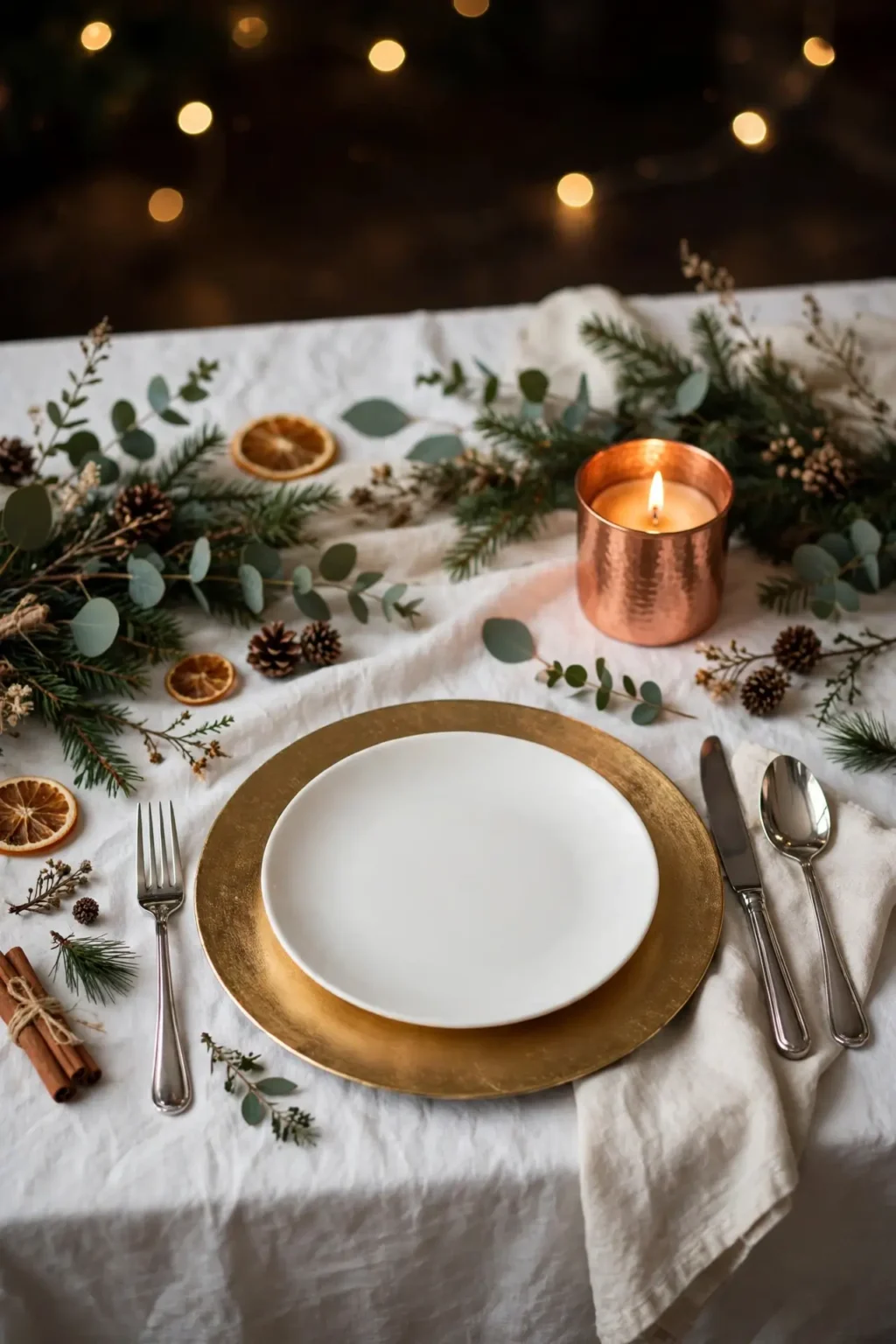
Metallics Mixed Not Matched
A table in one metal can look like a showroom, because gold on gold or silver on silver gives no contrast. Metallics mixed, not matched, give the table its sparkle, because gold chargers, silver cutlery, and a copper candle holder each catch light at a different temperature. Use one metal as the lead, gold for example, and the second metal as an accent at only two or three places, never half the table. A modern christmas tablescape built on mixed metals suits a contemporary dining room best, because the mix reads as styled rather than matched from a box.
Try it: Keep the second metal to two finishes at most, shiny and matte. A third metal finish turns the mix into a sale bin, while two finishes read as a plan.
12
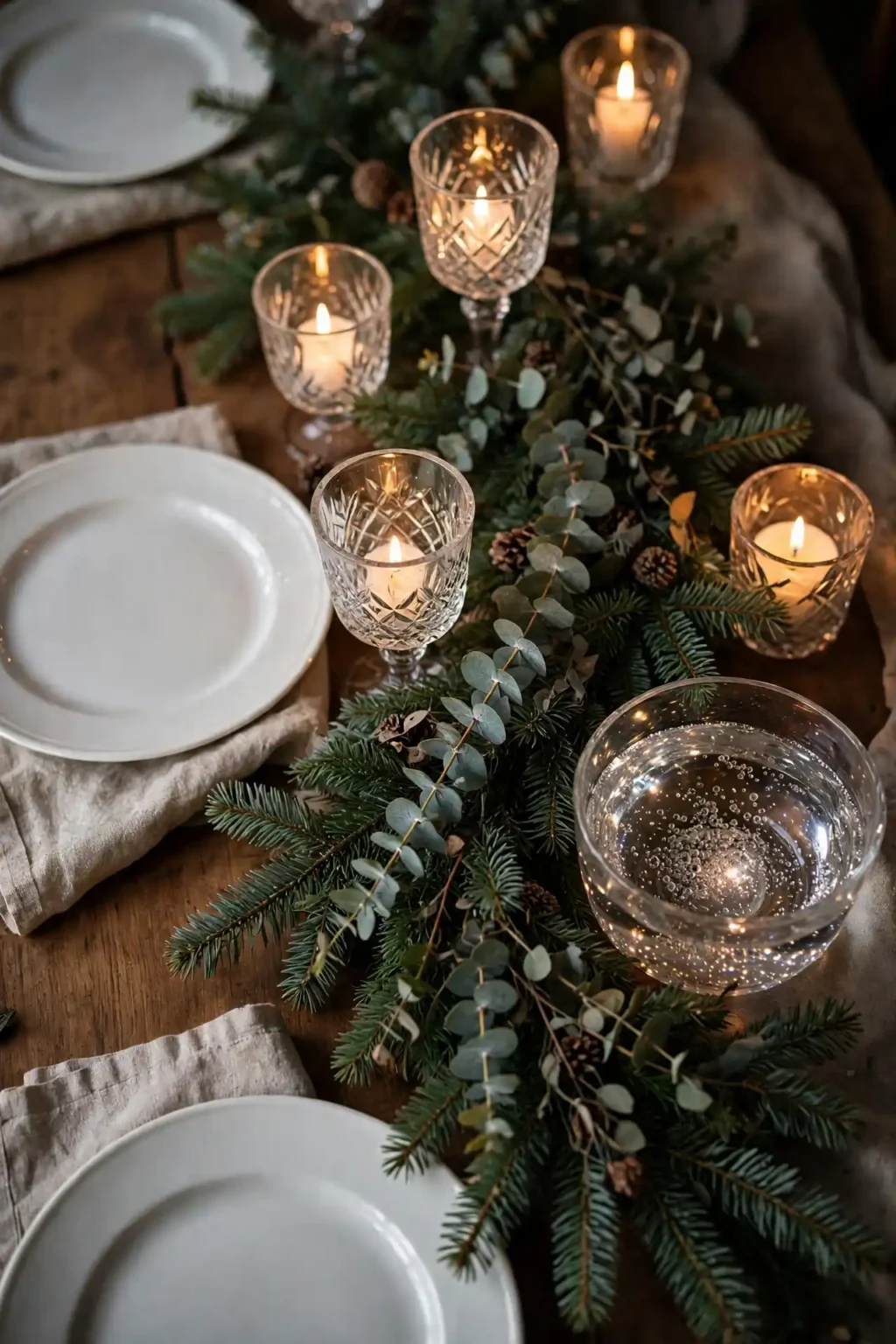
Natural Greenery Against Glass
A table dressed only in shop-bought decorations can feel plastic, because nothing on it grew. Natural greenery against glass fixes that, because fresh fir and eucalyptus laid beside cut-glass candle holders and a glass bowl give the table both life and sparkle. Lay the greenery down the centre, place glass holders among the branches, and keep the plates simple so the greenery and glass stay the stars. Christmas decor dining table compositions built on greenery and glass suit a cabin or a modern home alike, because the pairing works with wood and with white walls.
Try it: Lay greenery in one direction, stems to the ends, not in a tangled pile. Greenery laid one way reads as a designed runner, while a tangled pile reads as garden waste.
Runner and Placemat Art
13
Overlapping Runners
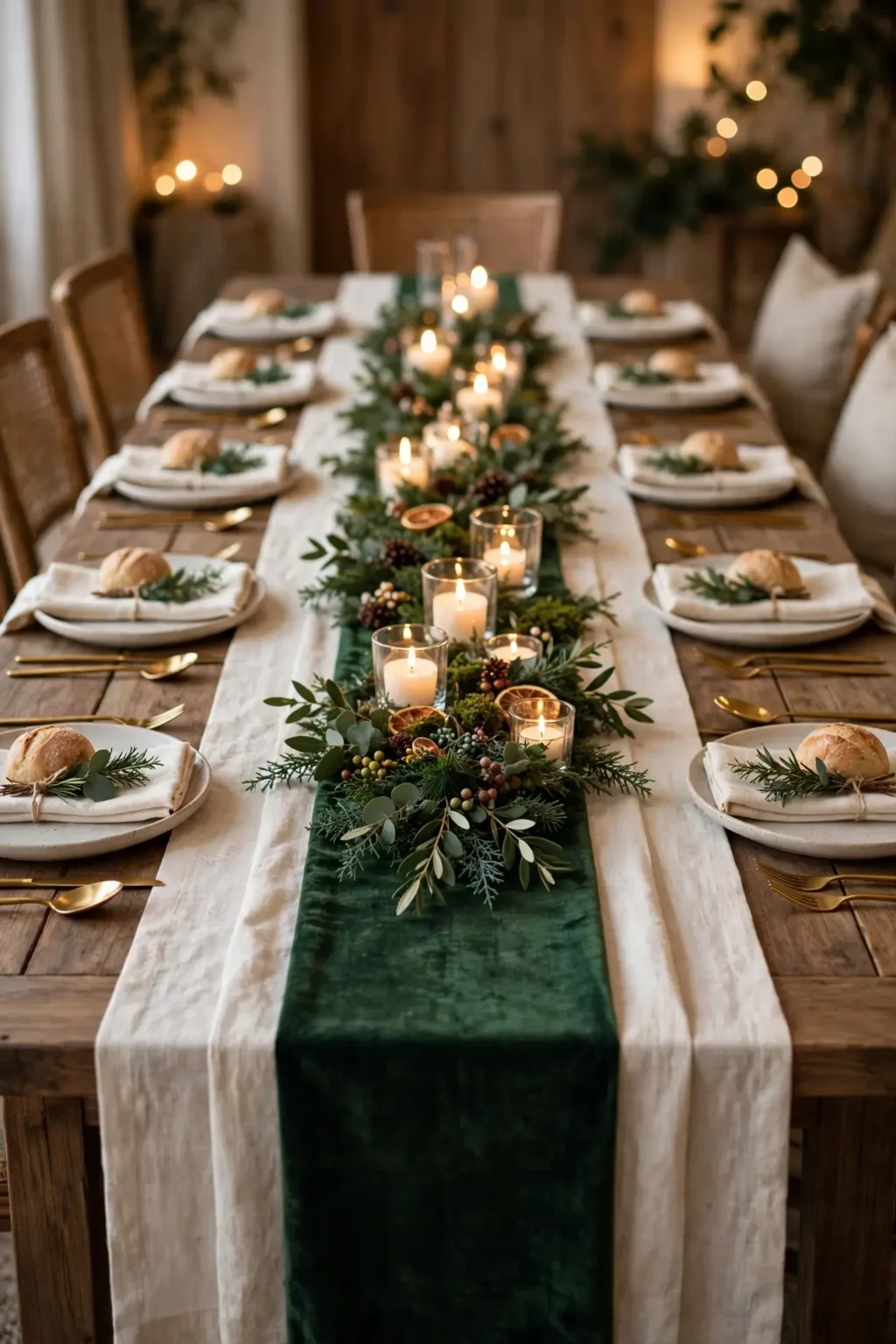
A single runner down a long table can look thin, because one strip of fabric cannot carry a table built for twelve. Overlapping runners give the long table its spine, because a wide base runner in linen with a narrower runner in velvet or burlap laid on top creates a layered stripe down the centre. Centre the wide runner first, lay the narrow runner on top with equal margins on both sides, and let both hang evenly at the ends. The overlap reads as depth, because the eye sees two layers instead of one flat strip. Christmas table place settings arranged along an overlapped runner suit a long table best, because the double runner carries the eye down its whole length.
Try it: Keep the top runner at least 10 cm narrower on each side than the base runner. A top runner nearly as wide as the base looks like a mistake, while a clear margin reads as a layer.
14
Placemat Layering
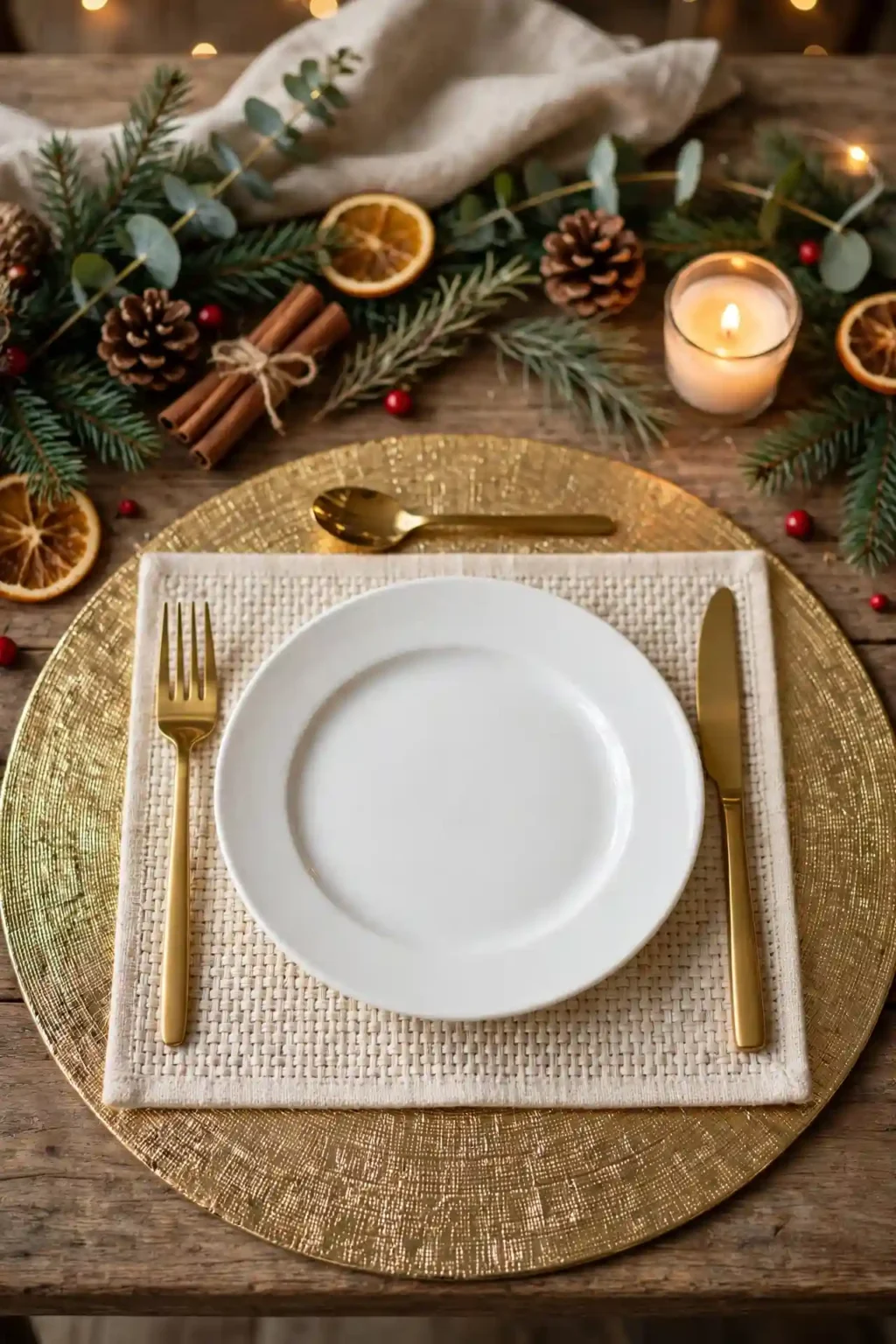
A single placemat under each plate can look thin, because one flat shape gives the setting no frame. Placemat layering frames each place, because a large round charger mat, a smaller rectangular placemat, and the plate stacked in order build a setting with depth. Lay the large mat first, centre the smaller placemat on it, then set the plate on top, aligning all three with the chair. The layered mats read as a composed place, because each layer frames the next. Christmas table setting ideas built on layered placemats suit a formal dinner best, because the setting looks finished before any food arrives.
Try it: Align the layers with the chair, not with the table edge. Mats aligned to the chair read as a place for a guest, while mats aligned to the edge look like a display.
15
No Runner Placemats Only
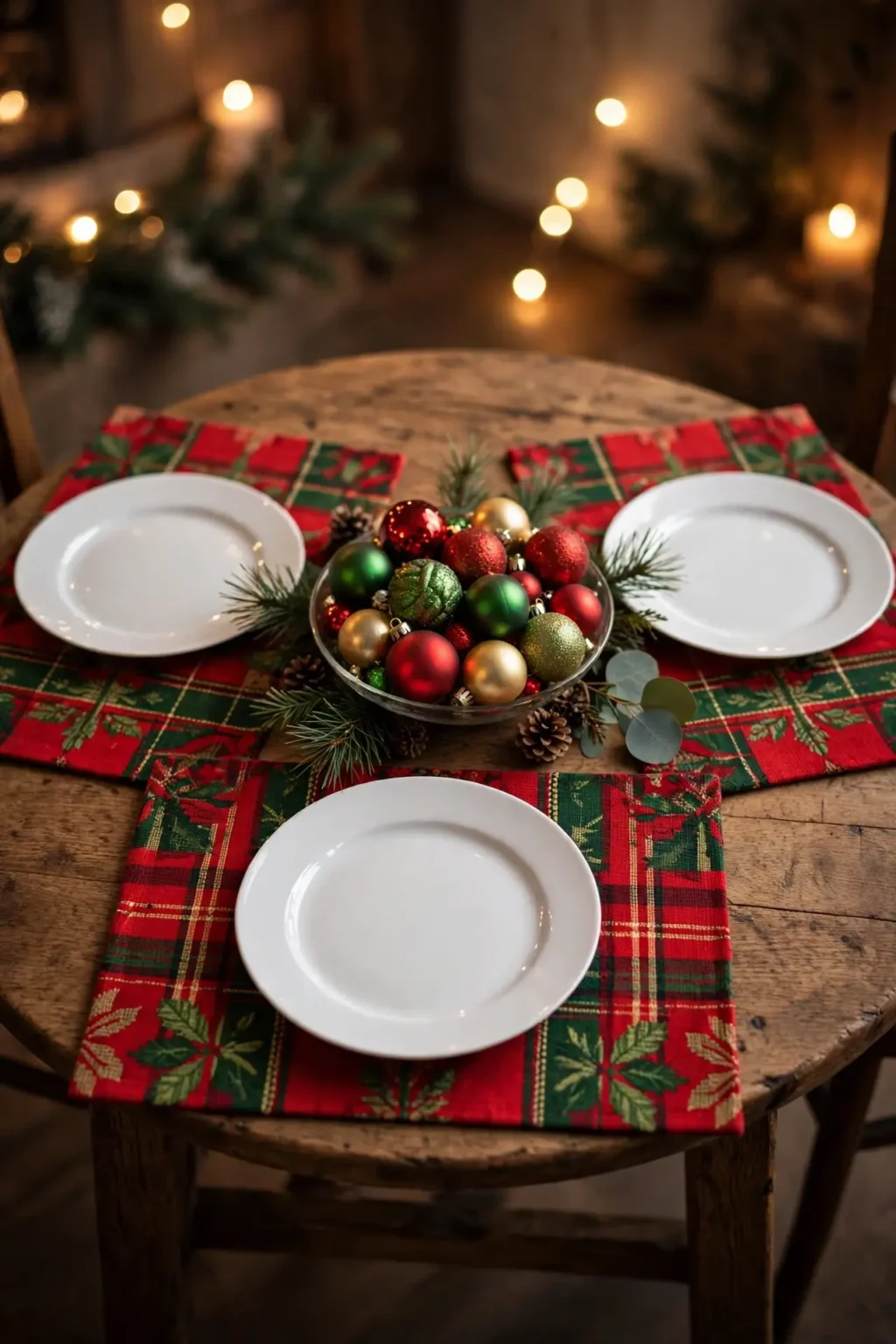
A runner on a small table can crowd the settings, because the runner and the placemats fight for the same space. A no-runner tablescape lets the placemats do the work, because one bold placemat per setting, in a festive print or a strong colour, carries the whole composition without a centre strip. Choose placemats in one pattern, space them evenly, and keep the centre to one low bowl or a few candles. A simple christmas table setting built on placemats alone suits a small table or a breakfast nook best, because the table keeps its full surface for plates.
Try it: Match the placemats to the napkins, not to the plates. Placemats and napkins in the same story tie the settings together, while plates in another colour break it.
Candle and Light Placement
16
Candle Cluster Placement
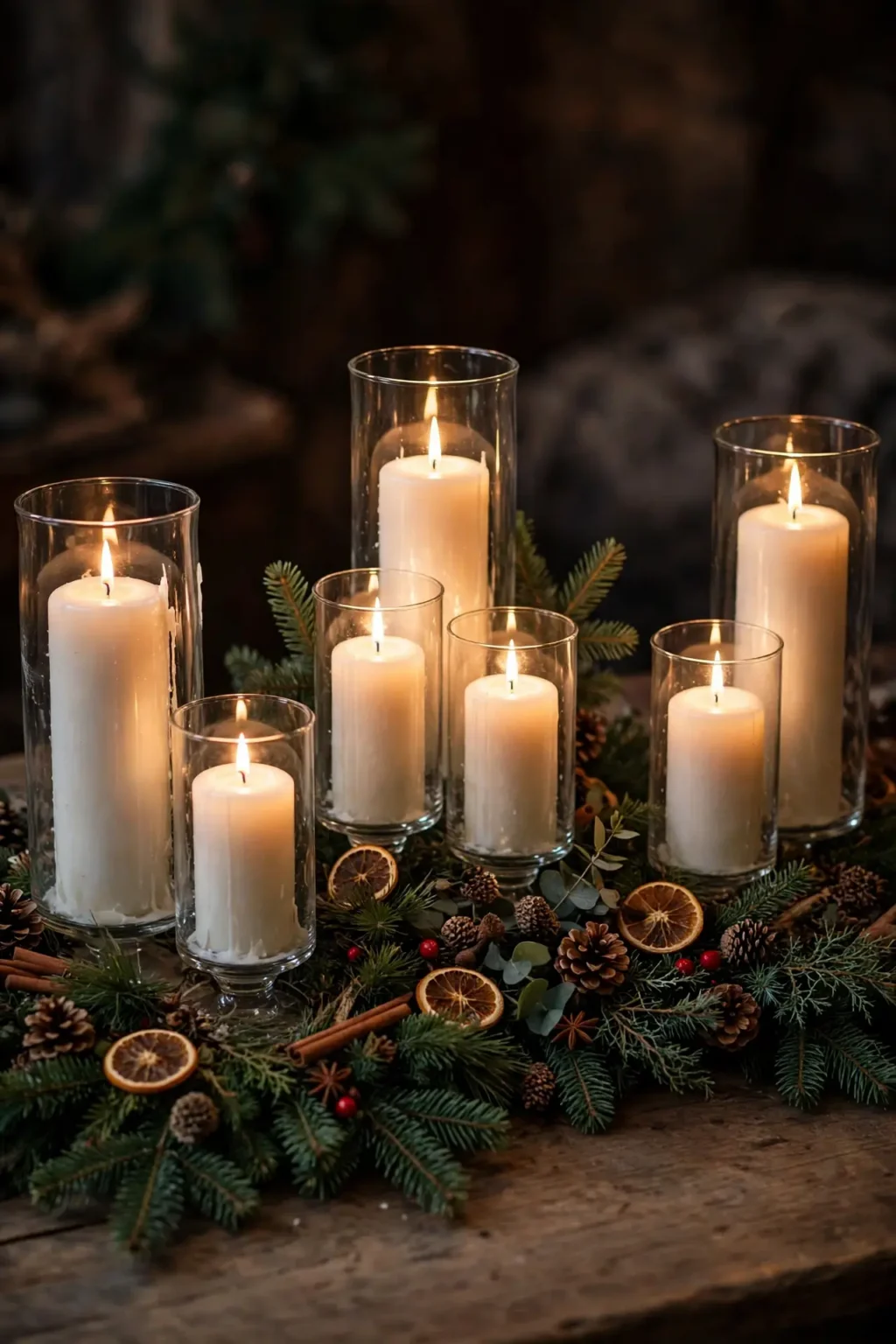
A table with one tall candle can look bare, because a single flame gives no spread of light. A candle cluster spreads the light, because pillar candles of three heights grouped in odd numbers, three or five, down the centre light every place. Group the candles in clusters at two or three points along the runner, use glass hurricanes around the tallest candles, and keep the flames clear of branches and napkins. Christmas table styling built on clusters suits a long table best, because the repeated clusters carry the eye down its whole length.
Try it: Group candles in odd numbers, three or five, not pairs. Even groups look like bookends, while odd groups read as a natural cluster.

17
Fairy Light Weave
A candlelit table can feel dim in a room with no other light, because candles alone light only the centre. A fairy light weave adds light everywhere, because warm fairy lights woven through a fir runner or a low greenery centre glow along the whole table. Weave battery lights through the runner, hide the battery box under a napkin or a decoration, and set them on a timer so they switch on before guests arrive. Holiday tablescape ideas built on a light weave suit an evening party best, because the lights keep glowing after the candles are blown out.
Try it: Use warm white fairy lights, not cool white. Cool white reads as blue and clinical, while warm white reads as candlelight.
18
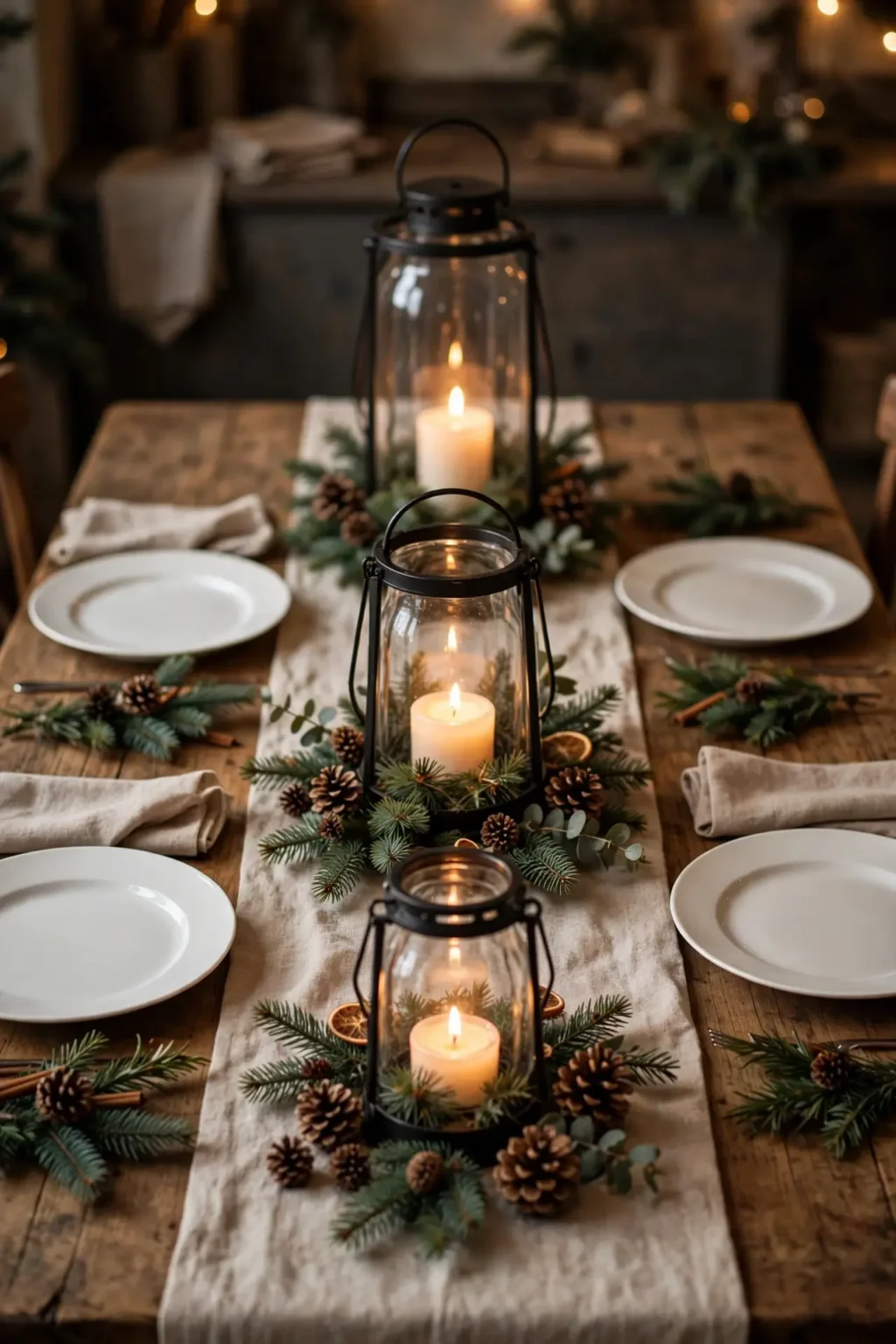
Lantern Row Down the Centre
A table full of open candles can worry a host with children or pets, because open flames sit within reach. A lantern row removes the worry, because candles inside glass lanterns give the same glow behind glass. Place two or three lanterns of different sizes down the centre, add fir sprigs and pinecones around their bases, and keep the plates simple. A christmas tablescape decor built on lanterns suits a family dinner best, because the glow stays and the risk goes.
Try it: Put a battery candle in any lantern that will sit near a child. A real flame near small hands is a risk, while a battery candle in a lantern looks identical from the table.
Napkin and Detail Art
19
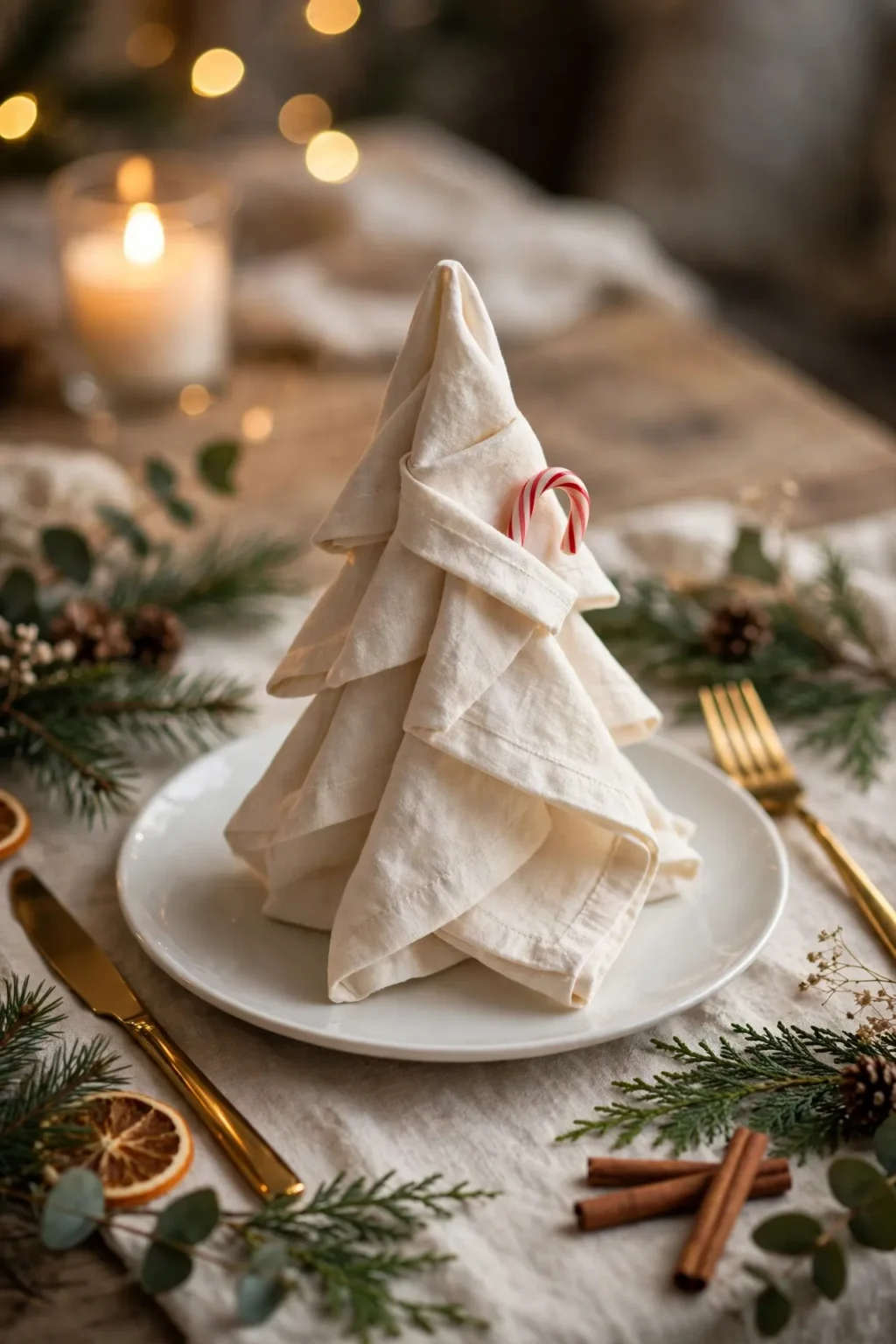
Napkin Fold as Focal Point
A table where every setting looks identical can feel flat, because nothing draws the eye to a single place. A napkin fold as focal point gives each setting its finish, because a napkin folded into a tree, a fan, or a simple pocket, and set on the plate, turns the napkin into the decoration. Fold all napkins the same way, set one on each plate, and tuck a small sprig or a candy cane into the fold. Beautiful christmas table settings built on a napkin fold suit a dinner where the budget is tight, because the fold costs nothing and lifts the whole setting.
Try it: Fold every napkin the same way. One folded napkin among flat ones looks like an accident, while twenty matching folds read as a designed detail.

20
Place Card and Sprig Detail
A table with no place cards can feel anonymous, because guests hover, unsure where to sit. A place card and sprig detail settles the table, because a small card with each guest’s name, propped against the glass or laid on the plate with a fir sprig, tells every guest they have a place. Write the cards by hand on kraft or cream card, add one sprig of fir or eucalyptus, and lay each card on its plate. Modern christmas table settings ideas built on place cards suit a formal dinner best, because the detail says the host planned each seat.
Try it: Write place cards by hand, even if the handwriting is plain. A handwritten card reads as personal, while a printed card reads as a restaurant.
Finished Styled Looks
21
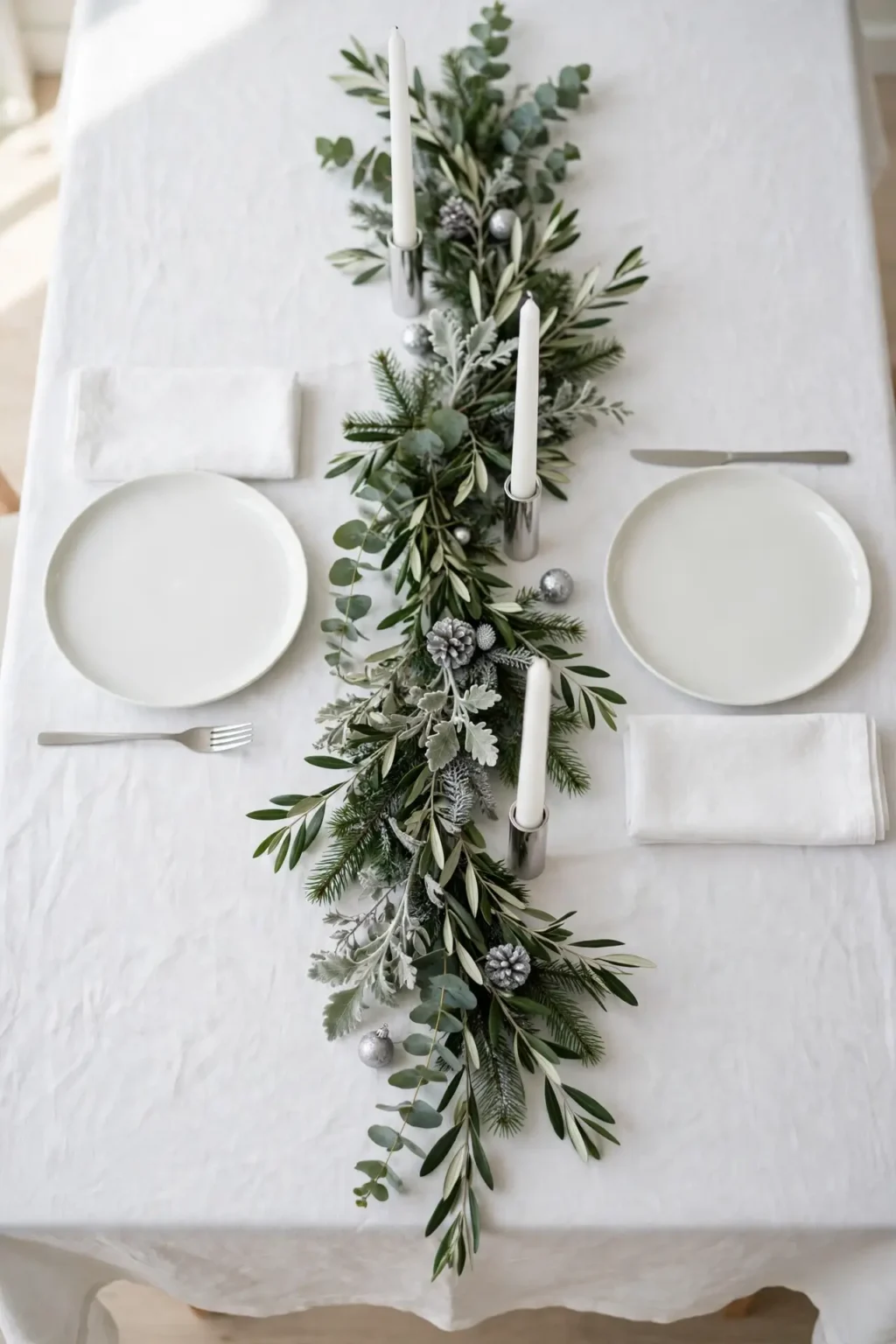
Modern Minimal Tablescape
A table loaded with decorations can overwhelm a modern room, because the room itself is quiet and the table shouts. A modern minimal tablescape matches the room, because a white cloth, one low greenery runner, white plates, and a few slim candles give the table its Christmas feel without clutter. Keep the palette to white, green, and one metal, leave generous empty space between settings, and let one low arrangement be the only centre. Beautiful christmas tablescapes in minimal form suit a contemporary home best, because the restraint matches the room.
Try it: Leave at least 60 cm of width per guest, even on a minimal table. A minimal table squeezed tight reads as cramped, while the same table with space reads as calm.
22
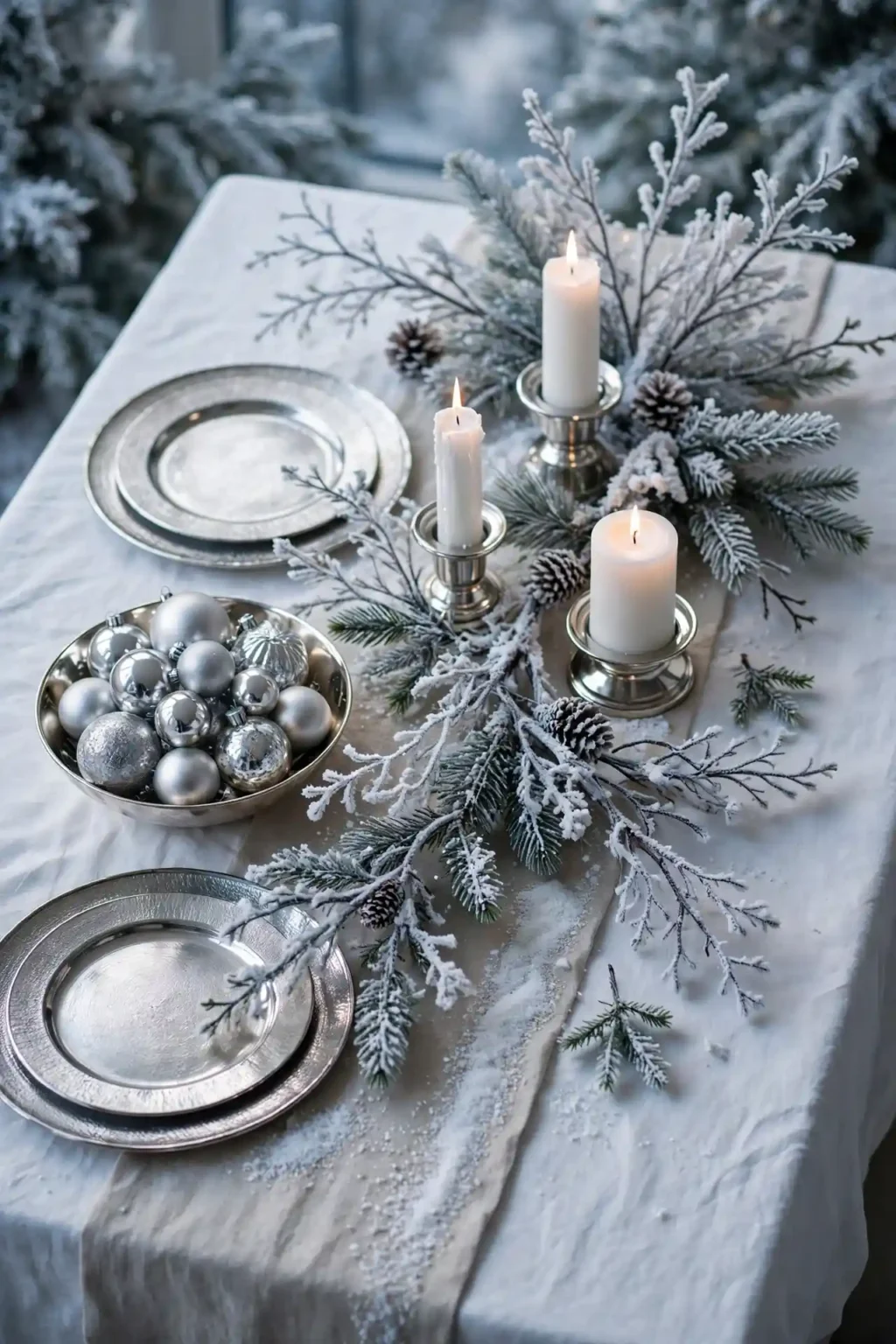
Winter Wonderland Tablescape
A traditional red and green table can feel expected, because every home has done it. A winter wonderland tablescape changes the season, because a white cloth, silver chargers, frosted branches, white candles, and a dusting of fake snow along the runner read as snow rather than Christmas colour. Add silver baubles in a low bowl, keep all colour out except the green of a few fir sprigs, and let white candles in silver holders do the glowing. A winter wonderland tablescape suits a modern dining room or a snowy themed dinner best, because the cool palette matches grey walls and glass tables.
Try it: Add one green element, a few fir sprigs, to a silver and white table. Pure silver and white can look cold, while a touch of green makes it read as Christmas, not just winter.
Pro tip: Build the tablescape the day before and look at it from the doorway before you add anything else. A table that looks full from close up can look thin from the doorway, and a table checked from the room entrance is the only one you can trust.
Three rules for Christmas tablescapes that look intentional, not thrown together
Most christmas tablescape attempts look unfinished for the same three reasons, and all three are fixable.
- First, layer in order. A tablescape built cloth, runner, placemat, charger, plate, candle, greenery reads as designed, while pieces placed in random order read as clutter, because each layer frames the next.
- Second, keep the centre low. A centrepiece above eye level blocks faces and kills conversation, while a low centre lets guests see each other, because the table is for people first and decorations second.
- Third, pick one colour story. A table in one colour family with one accent reads as designed, while a table in five mixed colours reads as a jumble, because the eye spots the clash at once.
Storing and reusing your Christmas tablescape pieces
Christmas tablescape pieces last for years if you store them properly, and the storage step is part of the styling, not an afterthought.
- First, roll tablecloths and runners, never fold them sharply. Sharp folds crease linen and velvet for a year, so roll cloths and runners around a tube and store them flat.
- Second, box baubles and candle holders separately. Baubles knocked against candle holders chip and scratch, so wrap each fragile piece in tissue and box it on its own.
- Third, label the box with the tablescape inside. A box labelled with the colour scheme and the year saves the December hunt, while an unlabelled box means opening every box to find one runner, and a labelled box also tells you which pieces need replacing next year.
Questions readers ask
What is a Christmas tablescape?
A christmas tablescape is a table styled as one composition, with layers, heights, textures, and colours chosen together, rather than a table with decorations placed one by one. A tablescape reads as designed because the cloth, runner, placemats, chargers, candles, and greenery were planned as a whole.
How do you layer a Christmas tablescape?
You layer a christmas tablescape in order: tablecloth first, then runner, then placemats, then chargers, then plates, then candles, then greenery last. A tablescape built in order reads as a composition, since each layer frames the next, while pieces placed in random order read as clutter.
How do you keep a tablescape centrepiece low?
You keep a tablescape centrepiece low by building the centre under 25 cm tall, with greenery and baubles at the base and tall candles only at the ends of the runner. A low centre lets guests see each other, while a tall centre blocks faces and kills conversation.
What colours work best for a Christmas tablescape?
The colours that work best for a christmas tablescape are red and white for a crisp table, black and white for an evening table, and silver and white for a winter table, because each palette is a complete story on its own. A tablescape in one palette with one accent reads as designed, while mixed palettes read as a jumble.
How do you style a round Christmas table?
You style a round Christmas table with one low round centrepiece in the middle and settings spaced evenly around it, because a round table has no long axis for a runner. Christmas tablescapes for round tables should stay under 30 cm wide for four guests, since a wider centre leaves no room to eat.
How do you mix textures on a Christmas table?
You mix textures on a Christmas table by combining three different surfaces, velvet, linen, and wood, or greenery and glass, in one colour family. Texture mixing gives the table depth, since each surface catches light differently, while a table in one texture looks flat.
How far in advance can you set a Christmas tablescape?
You can set a christmas tablescape the night before the meal, laying the cloth, runner, placemats, chargers, candles, and settings, and adding fresh greenery last. A tablescape set the night before saves morning stress, while fresh greenery added on the day stays perky, since cut branches wilt overnight in a warm room.
How do you style a Christmas tablescape on a budget?
You style a christmas tablescape on a budget with a bare wood table, one runner, woven placemats, and greenery cut from the garden, spending the small budget on one visible piece. A dollar-store table looks dressed for a few dollars, while a table with a little spent on everything looks thin all over.
People Also Ask
What is the difference between a tablescape and a table setting?
A tablescape is the whole table styled as one composition, while a table setting is one guest’s place, the placemat, charger, plate, cutlery, and glass. The tablescape holds all the settings together, since the runner, centre, and candles frame every place at once.
How many candles should be on a Christmas tablescape?
A Christmas tablescape should have three to five candles, grouped in odd numbers at different heights down the centre, because odd groups read as a natural cluster. One candle looks bare, while more than five crowd the centre, since the candles should light the table, not fill it.
What Christmas tablescape ideas should beginners avoid?
Beginners should avoid tall centrepieces and mixed colour palettes on a first attempt, because each of those needs careful balance to look clean. Start with a cloth runner placemat layer, a low centre with tall candle edges, and a one-colour three-texture tablescape, and save tall arrangements and black and white palettes for a second season.
loved these ideas? ✿
Save this guide for later
Pin it to your board so it’s there when you’re ready to recreate it.

Curated by
Hey! I'm Sanaullah — visual curator and content creator. I search, curate, and test the best aesthetic ideas across Pinterest so you can easily transform your living space, style daily outfits, and try simple creative DIYs without the overwhelm.