
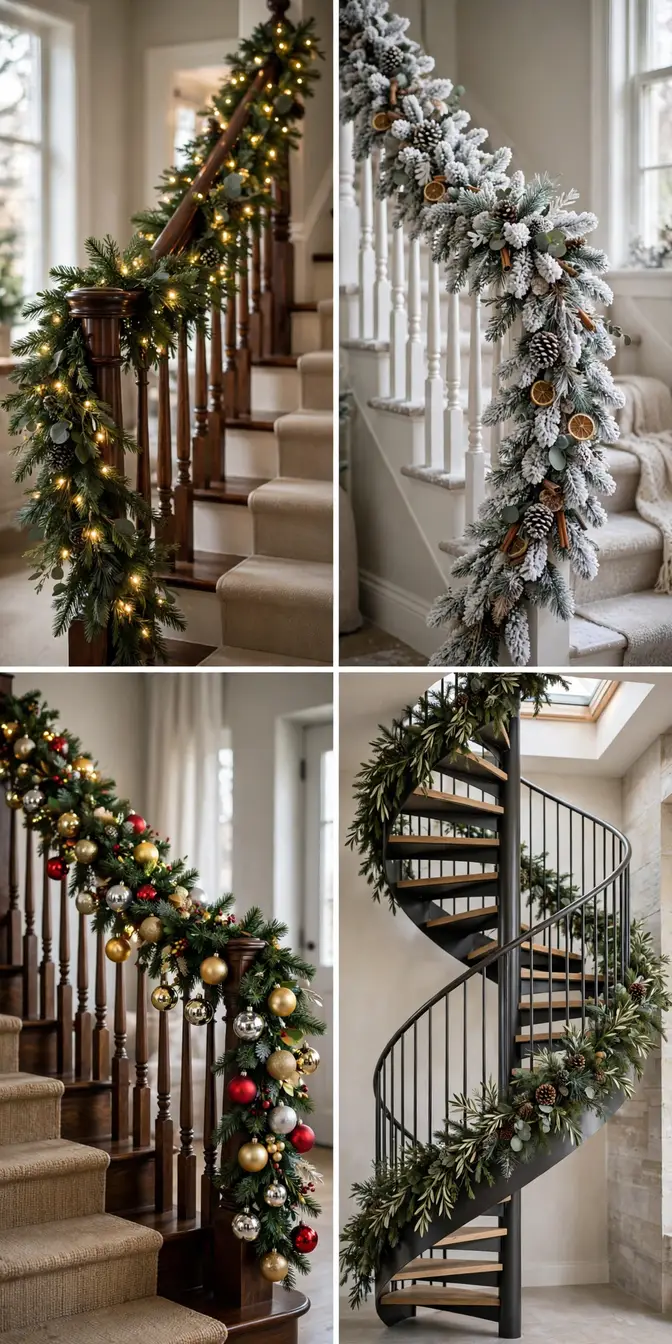
A bare staircase at Christmas can look like the one part of the house nobody decorated, because every other room has a tree or a mantel and the stairs have nothing. A staircase dressed with a staircase christmas garland looks finished, because the garland carries the decoration up the house and ties the ground floor to the rooms above. Most staircase christmas garland attempts fail in the same way: people buy a garland that is too short for the banister, tie it only at the ends so it sags in the middle, or hang a heavy garland on a handrail that guests need to hold, and end up with a staircase that looks half done and feels unsafe. This list works the other way around. These 22 staircase christmas garland ideas are grouped by staircase situation, lit, greenery, swags and ribbon, bauble and bead, tricky staircases, and safe and damage-free hangs, and every idea comes with real measuring, tying, and safety steps, so you can dress your exact staircase, straight, spiral, wide, or short, in one afternoon. For the wider garland picture, including mantels, doors, and tables, see Christmas Garland Ideas. Pick one idea here, measure your banister first, and your staircase will become the decoration guests notice on their way up.
- The key takeaway: Measure the banister before you buy the garland. A garland bought to the banister length looks stretched, while a garland bought longer gives you swags, drops, and winding room, because length is what makes a stair garland look generous.
- The detail most people miss: Tie the garland at every second spindle, not just at the ends. A garland held only at the ends sags in the middle and slides when the handrail is used, while a garland tied along its length keeps its swag and stays safe to grip.
- What it costs or how long it takes: Most of these 22 stair garlands cost $20 to $90, and each takes 20 to 60 minutes to hang. A garland for staircase with lights costs more than an unlit one, but it also lights the hallway at night, because the stair lights do the work of a lamp as well as a decoration.
| Group | Ideas | Materials | Best for |
|---|---|---|---|
| Lit Stair Garlands | 01-04 | Prelit, battery, plug-in garlands, timers | Evening hallways and long banisters |
| Greenery Stair Garlands | 05-08 | Cedar, faux fir, flocked, norfolk pine | Family stairs and pale hallways |
| Swags, Bows and Ribbon | 09-12 | Swags, wired ribbon, plaid, newel bows | Traditional halls and wide banisters |
| Bauble, Bead and Berry | 13-15 | Baubles, wooden beads, gold beads, berries | Formal, rustic and dark hallways |
| Tricky Staircases | 16-19 | Long garlands, flexible faux, double runs | L-shaped, spiral, wide and short stairs |
| Safe and Damage-Free | 20-22 | Soft trims, shatterproof baubles, removable hooks | Kids, pets and rentals |
jump to an idea ↓
- 01 Prelit Garland for a Long Straight Banister
- 02 Battery Fairy Light Garland for Stairs Without an Outlet
- 03 Stair Garland with Lights for Evening Hallways
- 04 Plug-In Garland with a Timer for the Main Staircase
- 05 Fresh Cedar Garland for a Covered Entry Stair
- 06 Faux Fir Garland for a Busy Family Staircase
- 07 Flocked Garland for a White Hallway Stair
- 08 Norfolk Pine Garland for a Staircase That Gets Brushed Daily
- 09 Deep Swag Garland for a Wide Banister
- 10 Ribbon-Woven Garland for a Plain Banister
- 11 Newel Post Bow Garland
- 12 Plaid Ribbon Garland for a Traditional Hallway
- 13 Bauble Garland for a Formal Staircase
- 14 Wooden Bead Garland for a Rustic Staircase
- 15 Gold Bead and Berry Garland for a Dark Hallway
- 16 Landing Turn Garland for L-Shaped Stairs
- 17 Spiral Stair Garland
- 18 Wide Double-Run Garland
- 19 Short Entry Step Garland
- 20 Child-Safe Stair Garland
- 21 Pet-Safe Stair Garland
- 22 No-Damage Rental Stair Garland
Lit Stair Garlands
01
Prelit Garland for a Long Straight Banister
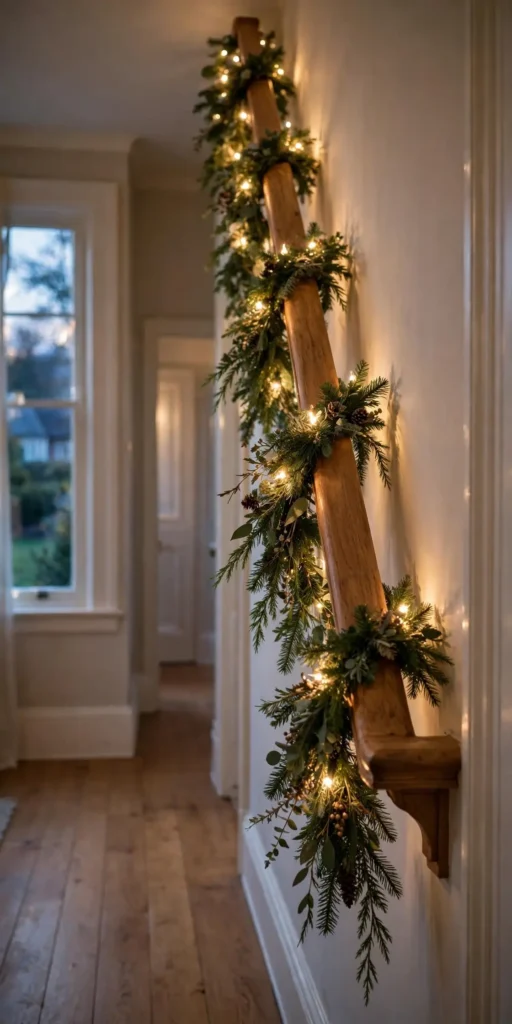
A long straight banister with an unlit garland can look flat after dark, because the greenery disappears once the hallway lights go off. A prelit garland for a long straight banister fixes that, because the lights are already woven through the branches and glow along the whole run. Steps: 1. Measure the banister from newel post to newel post, and buy a prelit garland at least that long plus 60 cm for swag. 2. Wind the garland loosely around the banister, tying it at every second spindle with green twist ties. 3. Hide the plug or battery box at the bottom newel post, and set the lights on a timer so they switch on at dusk. A staircase christmas garland in prelit form suits a main hallway best, because the lights guide guests upstairs all evening.
Try it: Tie the garland at every second spindle, not every spindle. Ties at every spindle make the garland look strapped down, while ties at every second spindle let it swag naturally.
02
Battery Fairy Light Garland for Stairs Without an Outlet
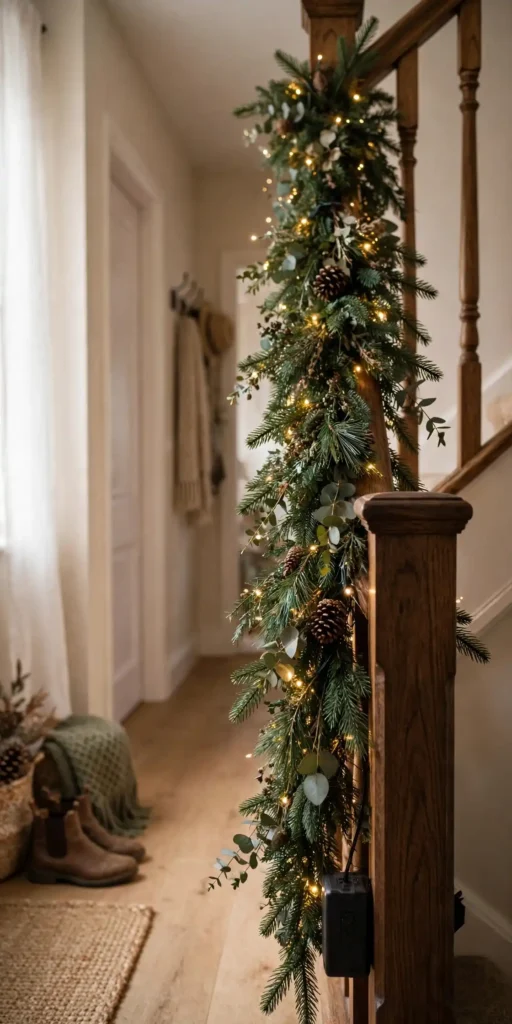
A staircase far from any outlet can look left out at Christmas, because a plug-in garland cannot reach it without a trailing cable. A battery fairy light garland solves the outlet problem, because the battery box hides at the newel post and no cable crosses the floor. Steps: 1. Buy a faux garland and a separate battery fairy light string, or a prelit battery garland, in your banister length. 2. Wind the garland around the banister, tying it at every second spindle, then weave the fairy lights through the branches in a loose wave. 3. Tuck the battery box behind the bottom newel post, and set the lights on their built-in timer. A stair garland in battery form suits a landing staircase or a back stair best, because those stairs rarely sit near an outlet.
Try it: Use a timer battery box, not a manual switch box. A manual box means climbing the stairs to switch the lights off, while a timer box switches itself off after six hours.
03
Stair Garland with Lights for Evening Hallways
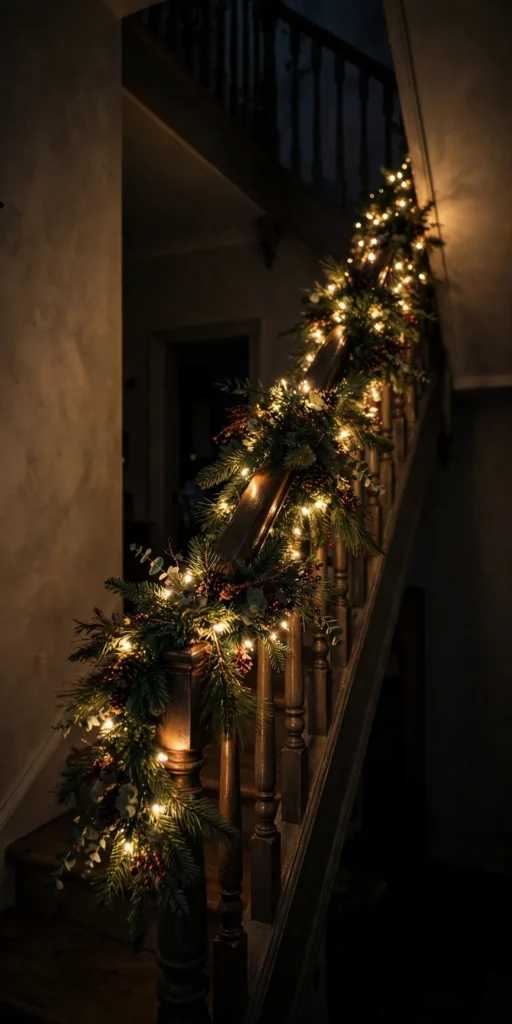
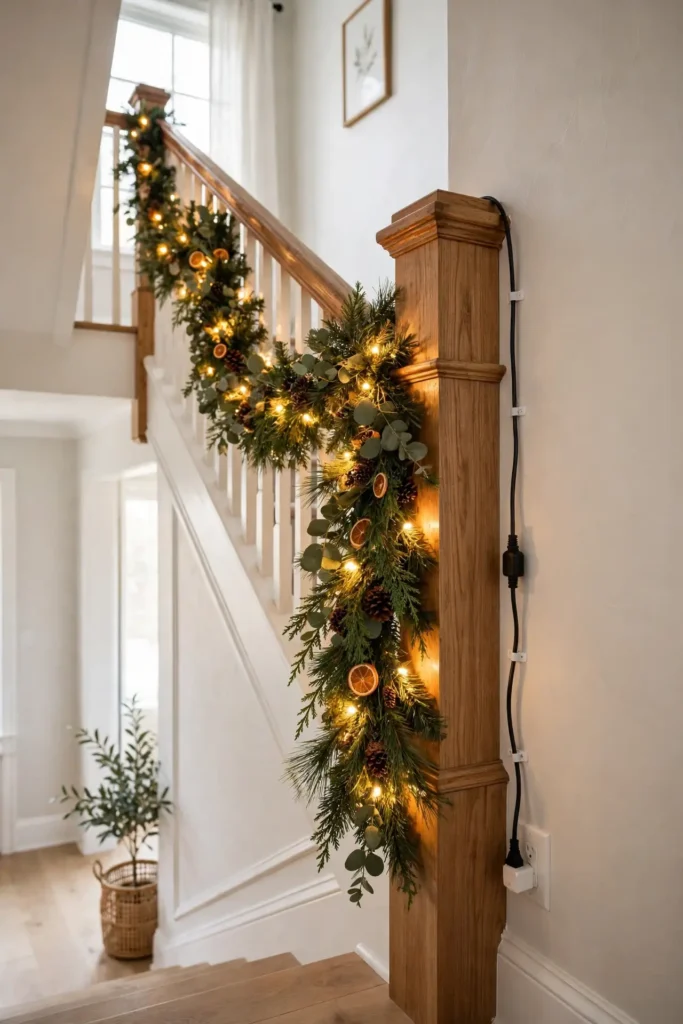
A hallway staircase can look dark in the evening, because the ceiling light sits too high to light the stairs themselves. A stair garland with lights fixes the dark hallway, because the lights sit at hand height and glow along every step. Steps: 1. Choose a garland for staircase with lights in warm white, since warm white flatters wood and paint better than cool white. 2. Hang the garland along the banister with ties at every second spindle, keeping the light wire tucked inside the branches. 3. Set the lights to switch on at dusk, and check from the bottom of the stairs that no bulb sits where a hand grips the rail. Stair garland lights in warm white suit a dark wood hallway best, because the glow warms the wood instead of washing it out.
Try it: Keep every bulb tucked inside the branches, not dangling over the handrail. A bulb over the rail gets knocked by hands, while a bulb inside the branches glows safely.
04
Plug-In Garland with a Timer for the Main Staircase
A battery garland on the main staircase can run out of power mid-season, because the main stairs get the most use and the longest lit hours. A plug-in garland with a timer suits the main staircase better, because mains power never runs flat and the timer handles the switching. Steps: 1. Check for an outlet near the bottom or top of the stairs, and buy a plug-in prelit garland long enough for the banister plus 60 cm. 2. Run the cable neatly along the wall side of the newel post, never across a step, and fix it with cable clips. 3. Plug it into a timer set for dusk to bedtime, and test the full run before you finish dressing the garland. Stair garland lights on mains power suit the main family staircase best, because that staircase is lit every evening for weeks.
Try it: Run the cable along the wall side, never across a tread. A cable across a step is a trip hazard, while a cable clipped to the wall side disappears.
Greenery Stair Garlands
05
Fresh Cedar Garland for a Covered Entry Stair
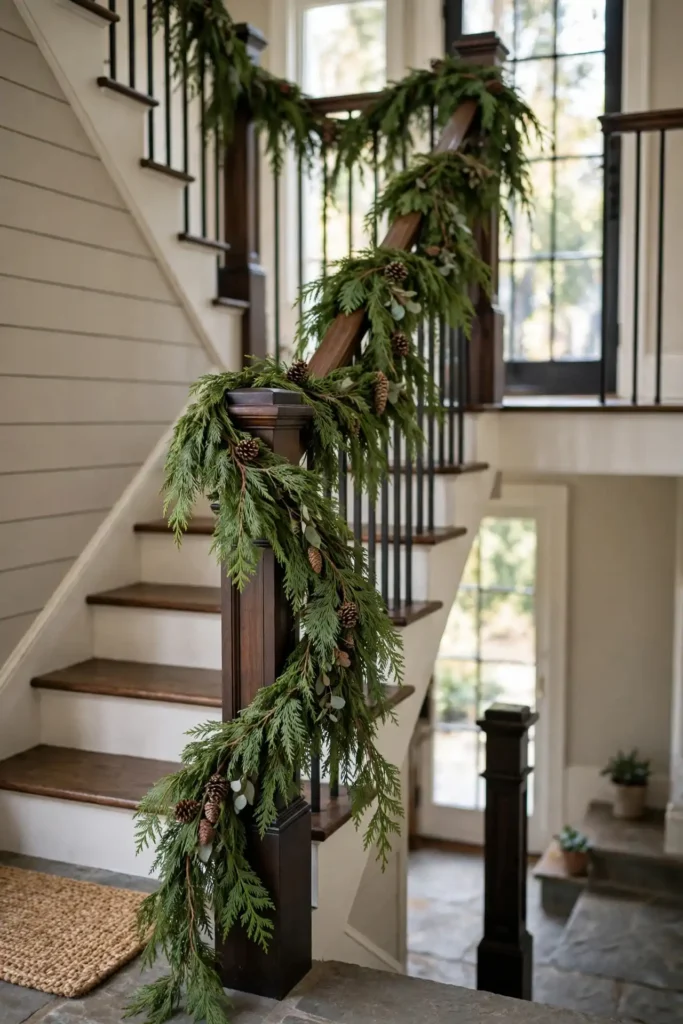
A front entry stair dressed in faux greenery can look flat, because plastic branches give no scent and no softness. A fresh cedar garland fixes that, because fresh cedar is soft, fragrant, and full, and it drapes beautifully on a banister. Steps: 1. Buy a fresh cedar garland at least 30 cm longer than your banister, so the ends can drop at the newel posts. 2. Wind it loosely around the banister, tying it at every second spindle, and mist it lightly twice a week. 3. Keep it away from radiators and direct heat, since fresh cedar dries fast in a heated hallway. A christmas garland for stairway use in fresh cedar suits a covered entry stair best, because the scent greets visitors before they see the hall.
Try it: Buy the garland longer than the banister, not exactly the banister length. A garland cut to the exact length looks stretched, while a garland with ends that drop at the newels reads as generous.
06
Faux Fir Garland for a Busy Family Staircase
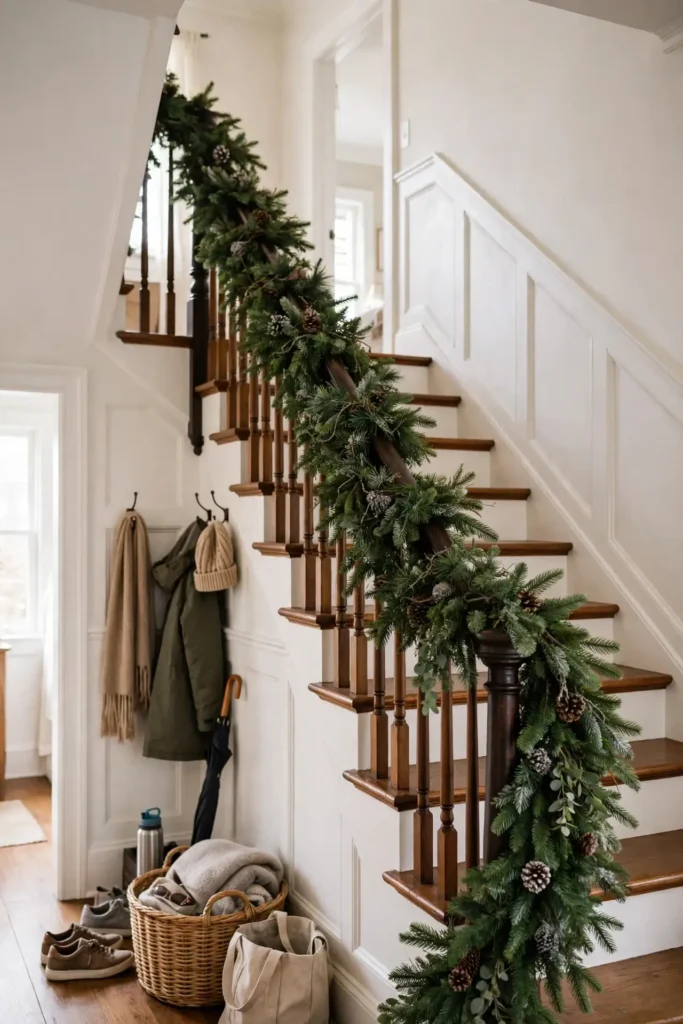
A fresh garland on a busy family staircase can shed needles all over the steps within a week, because fir dries out in a heated hallway and gets brushed by every passer. A faux fir garland survives a busy staircase, because plastic branches do not shed, dry, or mind being brushed. Steps: 1. Buy a full faux fir garland in your banister length plus 60 cm, and fluff the branches before you hang it. 2. Wind it around the banister, tying it at every second spindle, and keep the garland on the outer side of the rail so hands can still grip the top. 3. Add a few baubles or a ribbon bow at the newel posts, and shake the garland out once a week. A garland for staircase christmas use in faux fir suits a family hallway best, because it looks the same in January as it did in December.
Try it: Hang the garland on the outer side of the banister, not on top of the handrail. A garland on top of the rail blocks the grip, while a garland on the outer side leaves the rail safe to hold.
07
Flocked Garland for a White Hallway Stair
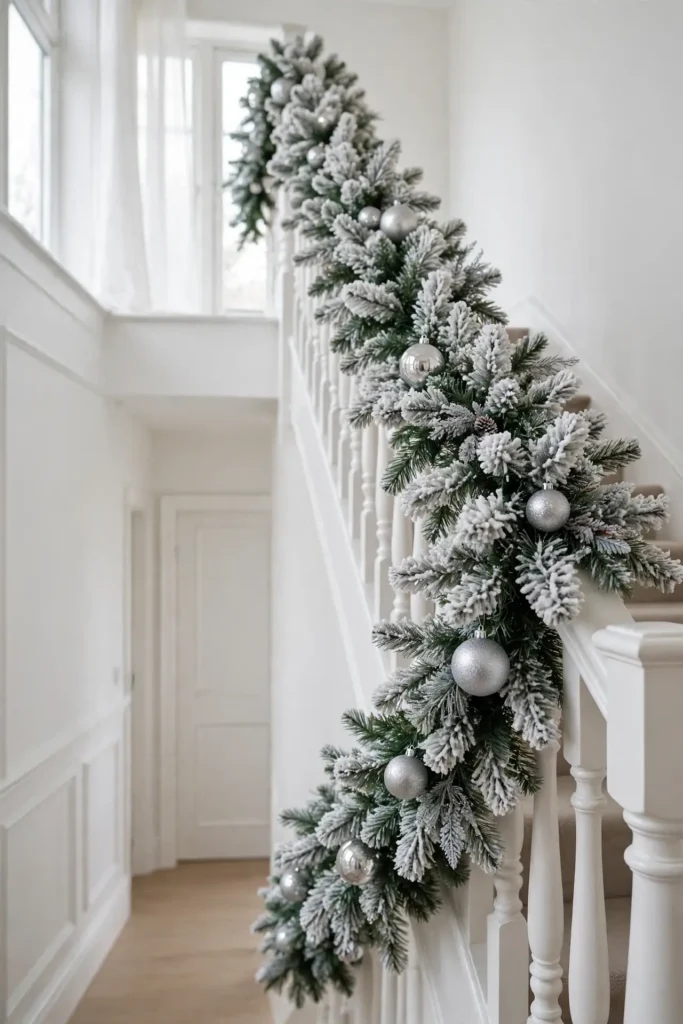
A green garland in a white hallway can look loud, because dark green stands out against pale walls. A flocked garland softens the contrast, because the snowy white tips read as frost and blend with a pale hallway. Steps: 1. Buy a flocked garland in your banister length, and fluff it outdoors or over a sheet, since flocking sheds at first. 2. Wind it around the banister with ties at every second spindle, and add silver or white baubles, avoiding red, since red fights the snowy look. 3. Vacuum the steps once after hanging, and keep the garland away from damp, since flocking clumps when wet. Christmas garland ideas for staircase use in flocked form suit a white or silver themed hallway best, because the frost tips carry the whole colour scheme.
Try it: Fluff a flocked garland outdoors before you hang it. Flocking shed indoors settles on every step, while flocking shed outdoors is gone in a shake.
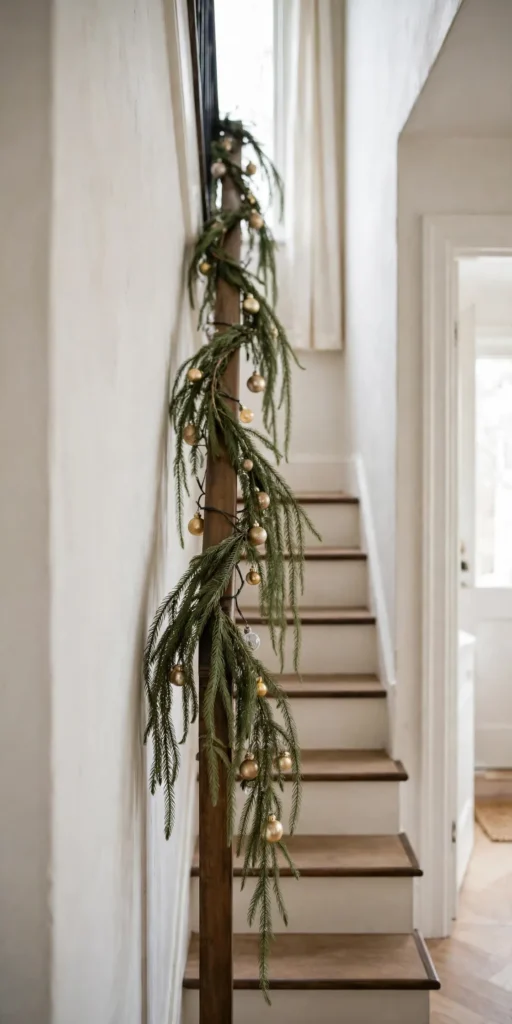
08
Norfolk Pine Garland for a Staircase That Gets Brushed Daily
A fresh fir garland on a narrow staircase can drop needles constantly, because every passer brushes it and fir dries out in a heated hall. A norfolk pine garland holds its needles far longer, because norfolk pine is softer and slower to dry. Steps: 1. Buy a norfolk pine garland in your banister length plus 60 cm for swag. 2. Wind it around the banister, tying it at every second spindle, and keep it slim, choosing a garland with a narrow profile so it does not crowd a narrow stair. 3. Mist it lightly twice a week, and add a few small baubles wired in, since wired trims survive brushing better than hooked ones. A garland on a banister in norfolk pine suits a narrow family staircase best, because it survives daily brushing better than fir.
Try it: Choose a slim profile garland for a narrow staircase, not a full one. A full garland on a narrow stair crowds the handrail, while a slim garland leaves room to grip.
Swags, Bows and Ribbon
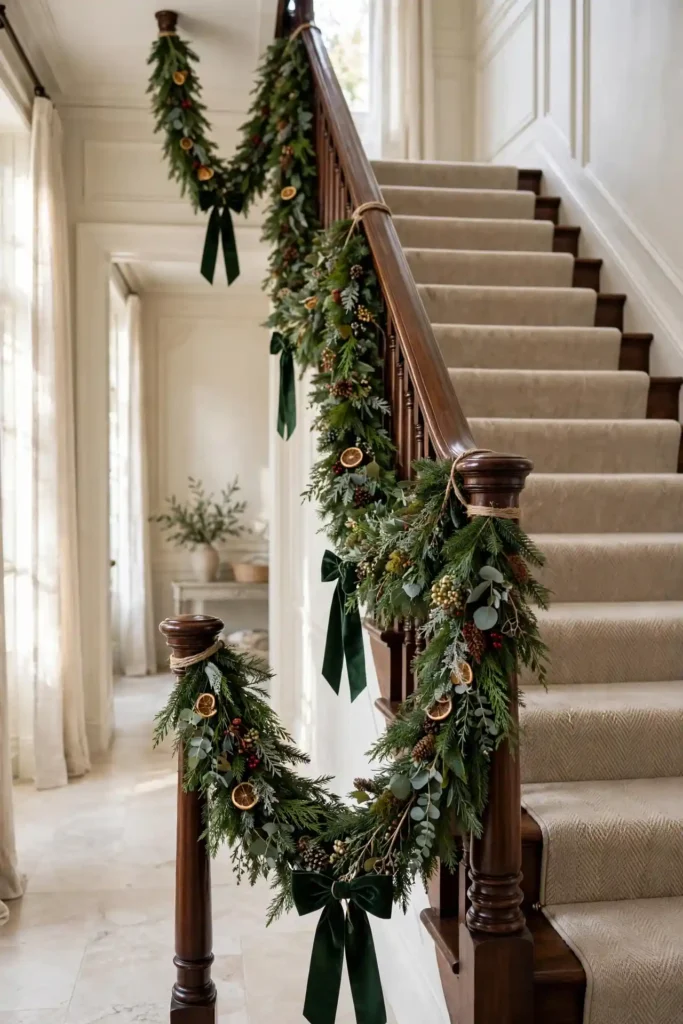
09
Deep Swag Garland for a Wide Banister
A wide banister with a garland hung straight can look like a rope, because a straight line gives the eye nothing to follow. A deep swag garland fixes that, because the garland dips low between ties and reads as a decoration, not a rope. Steps: 1. Buy a garland at least 90 cm longer than your banister, so there is enough length for deep dips. 2. Tie the garland at every third spindle instead of every second, letting it dip about 30 cm between ties. 3. Add a bow or a bauble cluster at the lowest point of each dip, and check the dips from the bottom of the stairs before you finish. Christmas swags for staircase use in deep form suit a wide, grand staircase best, because the wide banister has room for the dips to show.
Try it: Let each dip fall about 30 cm, not more. A dip deeper than that hangs into the walking line, while a 30 cm dip reads as a deliberate swag.
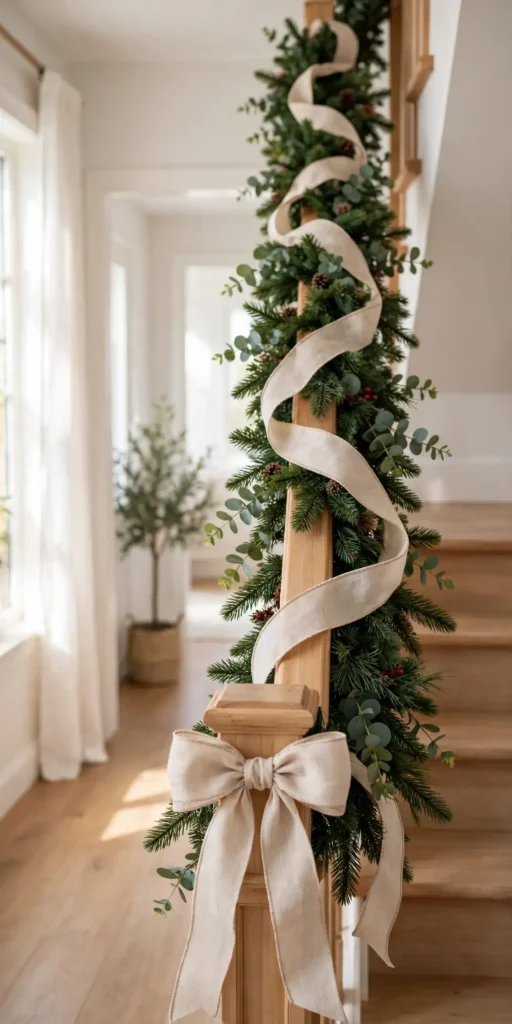
10
Ribbon-Woven Garland for a Plain Banister
A plain green garland on a plain banister can look one note, because green on wood gives no pattern. A ribbon-woven garland breaks the flatness, because wired ribbon woven through the branches gives the garland its line. Steps: 1. Hang a full faux or fresh garland along the banister first, tying it at every second spindle. 2. Weave wide wired ribbon through the branches in a loose wave, tucking it in every 40 cm. 3. Tie a ribbon bow at each newel post, and keep the ribbon to one colour across the whole staircase. Garland on banister ideas in ribbon-woven form suit a plain wooden banister best, because the ribbon is what the eye follows.
Try it: Weave the ribbon after the garland is hung, not before. Ribbon woven before hanging gets pulled out of shape as you hang the garland, while ribbon woven after stays in its wave.
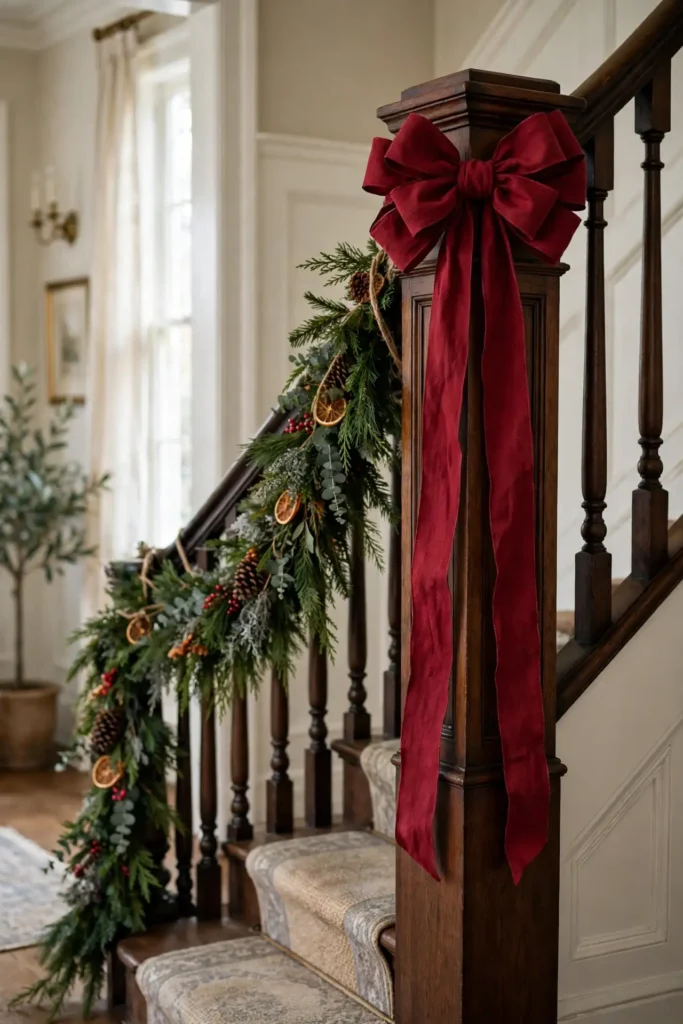
11
Newel Post Bow Garland
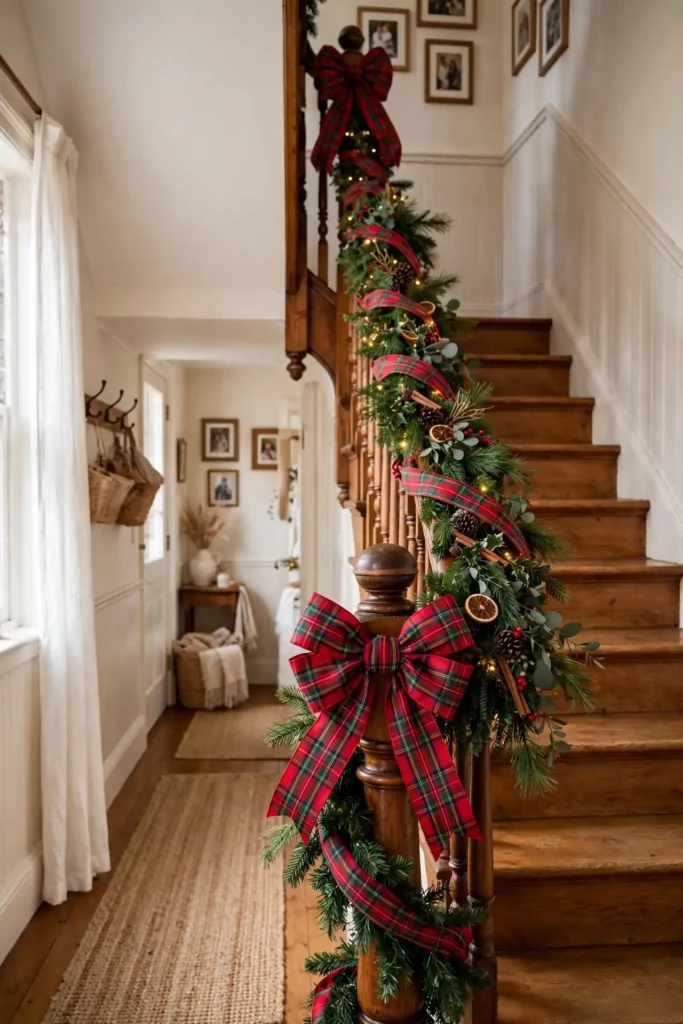
A staircase garland can look unfinished at the ends, because the garland simply stops at the newel posts with nothing to mark the finish. A newel post bow garland fixes the ends, because a large bow at each newel post gives the staircase its full stops. Steps: 1. Hang your garland along the banister, tying it at every second spindle, and let the ends drop slightly at each newel. 2. Tie a large wired ribbon bow, about a third of the newel height, and wire it to the top of each newel post. 3. Let two tails fall down the newel face, and keep the bows the same size at both ends. Christmas banister decorations in newel bow form suit a traditional hallway best, because the bows frame the whole staircase.
Try it: Wire each newel bow on, do not hook it. A bow hooked loosely slides down the newel, while a wired bow stays at the top all season.
12
Plaid Ribbon Garland for a Traditional Hallway
A staircase garland in plain green can look one note in a traditional hallway, because green on dark wood gives no pattern. A plaid ribbon garland breaks the green, because the checked pattern reads as traditional Christmas from the bottom of the stairs. Steps: 1. Hang a full faux garland along the banister, fixing it at every second spindle. 2. Weave wide plaid ribbon through the garland in a loose wave, keeping the check centred on each wave. 3. Tie plaid bows at each newel post, and keep the plaid to one pattern across the whole staircase. A banister christmas garland in plaid suits a family home best, because the check is the pattern children notice first.
Try it: Centre the check on each wave, not at the fold. A check cut in half at the fold looks like a mistake, while a centred check reads as chosen.
Bauble, Bead and Berry
13
Bauble Garland for a Formal Staircase
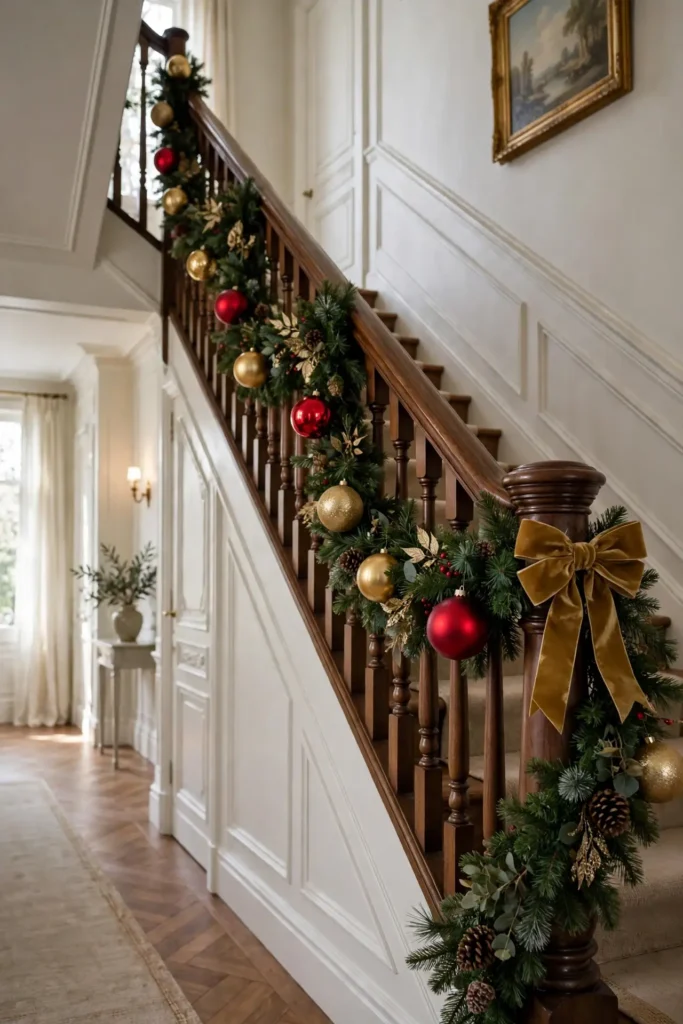
A formal staircase dressed only in greenery can look quiet, because green alone gives no sparkle. A bauble garland on the banister adds the sparkle, because large baubles wired into the garland catch the hallway light. Steps: 1. Hang a full faux garland along the banister, fixing it at every second spindle. 2. Wire large baubles into the garland every 60 cm, alternating two colours, and keep them on the outer side of the rail. 3. Add a bow at each newel post, and check the baubles from the bottom of the stairs before you finish. Stairs with garland and baubles suit a formal hallway best, because the baubles are what guests notice first.
Try it: Use large baubles, not small ones, on a staircase garland. Small baubles disappear among the branches, while large baubles read from the bottom of the stairs.
14
Wooden Bead Garland for a Rustic Staircase
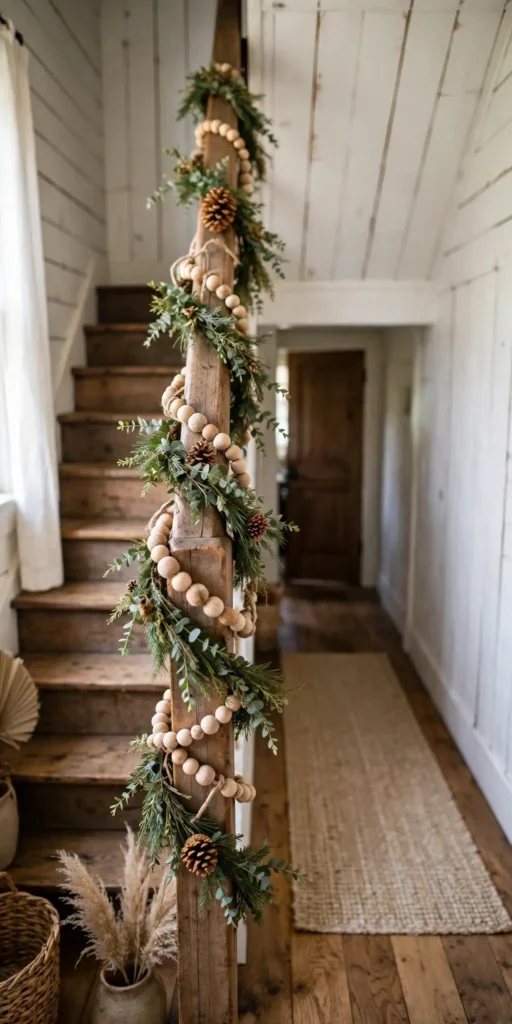
A rustic staircase dressed in shiny baubles can look wrong, because glass fights natural wood and stone. A wooden bead garland suits a rustic staircase, because wood beads read as natural against a wooden banister. Steps: 1. Buy a wooden bead garland, or make one by threading large wooden beads onto sturdy cord, in your banister length. 2. Wind the bead garland around the banister over a slim greenery garland, or hang it alone for a minimal look, tying it at every second spindle. 3. Knot the cord every 30 cm so the beads do not slide to one end, and add a few pinecones for texture. A garland staircase christmas build in wooden beads suits a farmhouse hallway best, because the wood echoes the banister itself.
Try it: Knot the bead cord every 30 cm. A bead garland knotted only at the ends slides into a bunch at the bottom, while a garland knotted along its length keeps its spacing.
15
Gold Bead and Berry Garland for a Dark Hallway
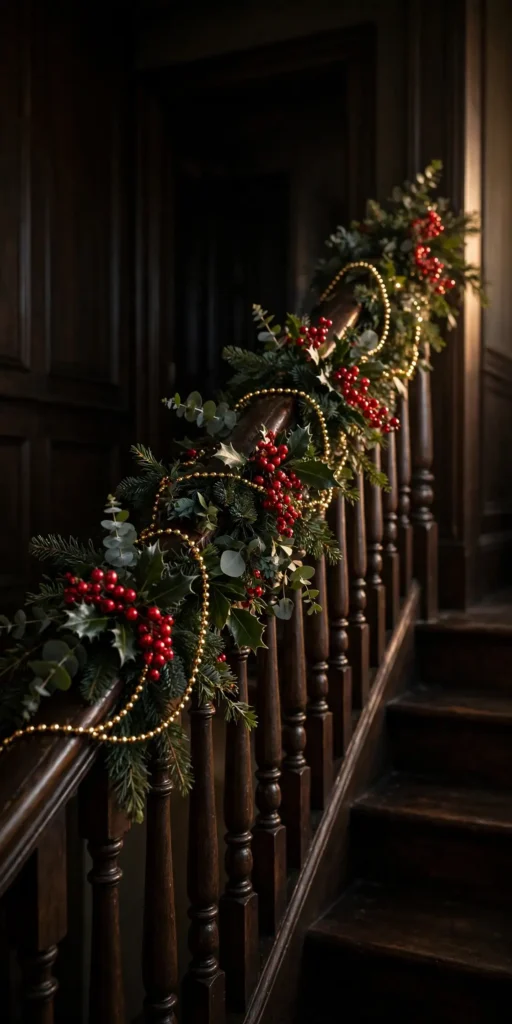
A dark hallway staircase can look gloomy, because dark wood and dark walls absorb what little light there is. A gold bead and berry garland lifts a dark hallway, because gold beads and red berries catch every bit of light. Steps: 1. Buy gold beads and faux red berry clusters, and thread them onto sturdy cord, alternating three beads and one berry cluster. 2. Wind the bead and berry garland around the banister over a dark green faux garland, tying it at every second spindle. 3. Add warm white fairy lights if the hallway has an outlet nearby, since the lights make the gold glow. A garland for banister use in gold and berry suits a dark wood hallway best, because the gold is what the eye finds first.
Try it: Pair gold beads with a dark green garland, not a pale one. Gold on pale green washes out, while gold on dark green glows.
Tricky Staircases
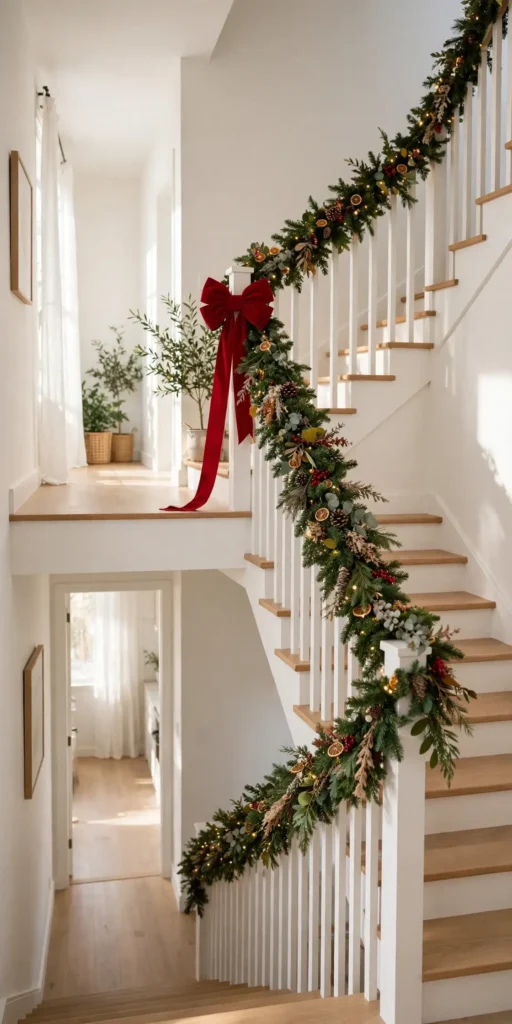
16
Landing Turn Garland for L-Shaped Stairs
An L-shaped staircase can look half decorated, because the garland stops at the landing and the turn gets nothing. A landing turn garland carries the decoration around the corner, because the garland runs up one flight, across the landing, and up the next. Steps: 1. Measure both flights plus the landing rail as one length, and buy a garland at least that long plus 90 cm for swag. 2. Hang the garland up the first flight, tying it at every second spindle, then run it along the landing rail with ties at 60 cm intervals. 3. Continue up the second flight, and add a bow or a bauble cluster at the landing corner to mark the turn. A garland in staircase form with a landing turn suits a split-level home best, because the landing is where the decoration would otherwise stop.
Try it: Mark the landing corner with a bow or a cluster, not a bare join. A bare join at the corner reads as two garlands, while a bow at the corner reads as one garland turning.
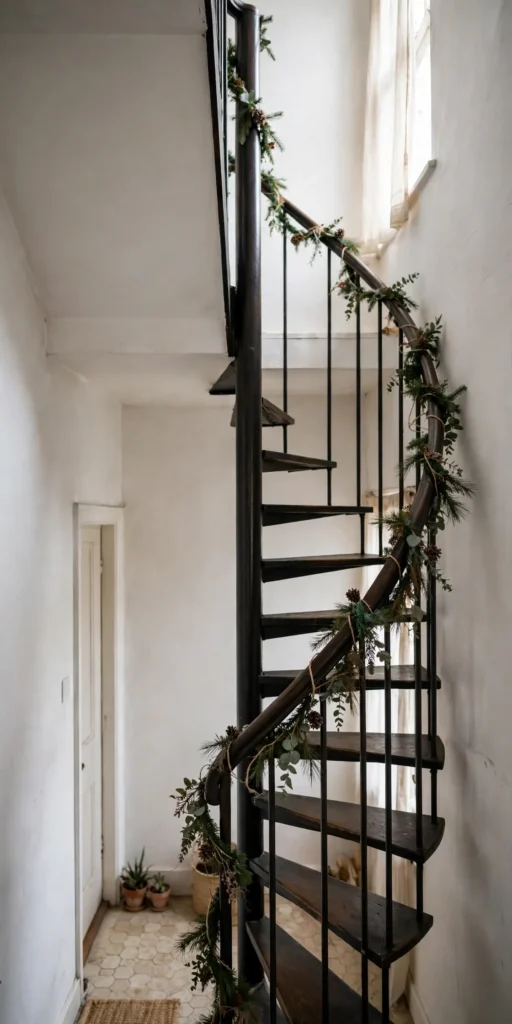
17
Spiral Stair Garland
A spiral staircase can look impossible to decorate, because the banister curves tightly and a stiff garland will not follow it. A spiral stair garland works when it is flexible, because a slim, bendy faux garland follows the curve without kinking. Steps: 1. Measure the spiral banister with a piece of string, following the curve, and buy a slim flexible faux garland at least that long. 2. Wind the garland around the banister from the bottom up, tying it at every second spindle with soft ties that will not scratch the rail. 3. Keep the garland slim and on the outer side of the rail, so the narrow treads stay clear, and add small lights only if the wire is thin. Xmas garlands for stairs in spiral form suit a compact home best, because the spiral stair is often the only staircase.
Try it: Use a slim garland on a spiral stair, never a full one. A full garland on a spiral stair crowds the treads and blocks the grip, while a slim garland follows the curve cleanly.
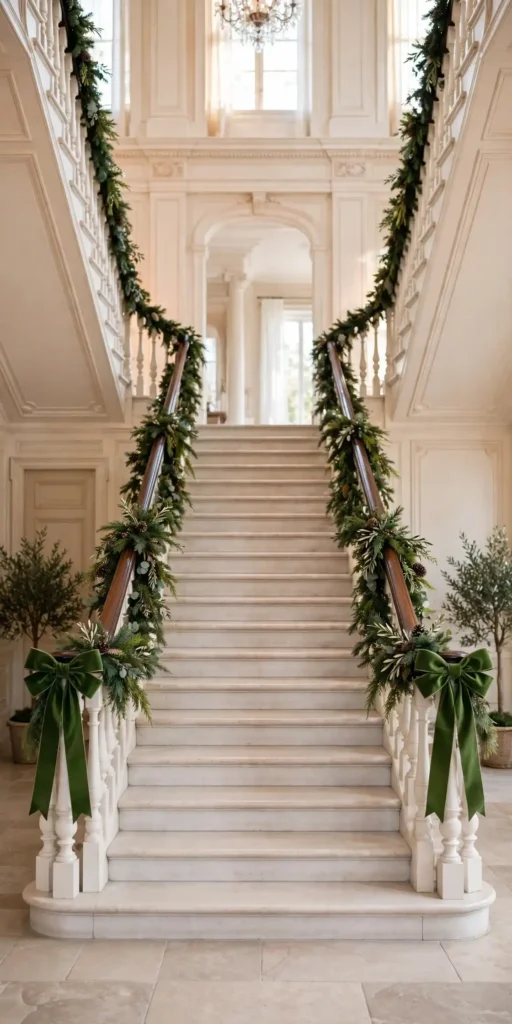
18
Wide Double-Run Garland
A wide staircase with two banisters can look lopsided if only one side is dressed, because the bare side draws the eye. A wide double-run garland dresses both sides, because matching garlands on both banisters balance the staircase. Steps: 1. Measure both banisters, and buy two garlands of the same type and length, one per side. 2. Hang both garlands the same way, same ties, same swag depth, and same newel bows, so the two sides mirror each other. 3. Check from the bottom of the stairs that the two runs match, and adjust the swag on one side if it sits lower. A staircase with garland on both sides suits a grand entrance hall best, because symmetry is the whole point of a wide stair.
Try it: Hang both sides the same day, and check them against each other from the bottom. A double-run garland hung on different days almost always ends up uneven, while sides hung together match.
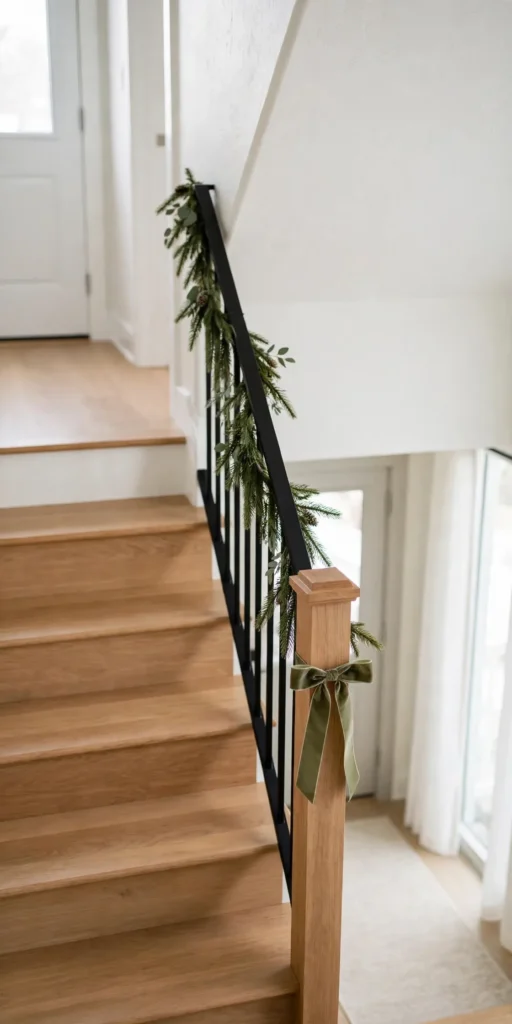
19
Short Entry Step Garland
A short flight of three to five entry steps can look silly with a full banister garland, because a long garland overwhelms a tiny staircase. A short entry step garland suits a small flight, because a slim garland with one bow is enough. Steps: 1. Buy a slim garland just longer than the short banister, plus 30 cm for one soft dip. 2. Fix it with ties at each end and one tie in the middle, letting it dip gently once. 3. Add a single bow at the bottom newel, and keep the rest plain, since a short stair needs one feature, not five. Simple staircase christmas decor in short form suits a split-level entry best, because the steps are a passage, not a feature.
Try it: Use one bow on a short stair, not a bow at every post. One bow reads as a feature, while bows everywhere on a tiny stair read as clutter.
Safe and Damage-Free
20
Child-Safe Stair Garland
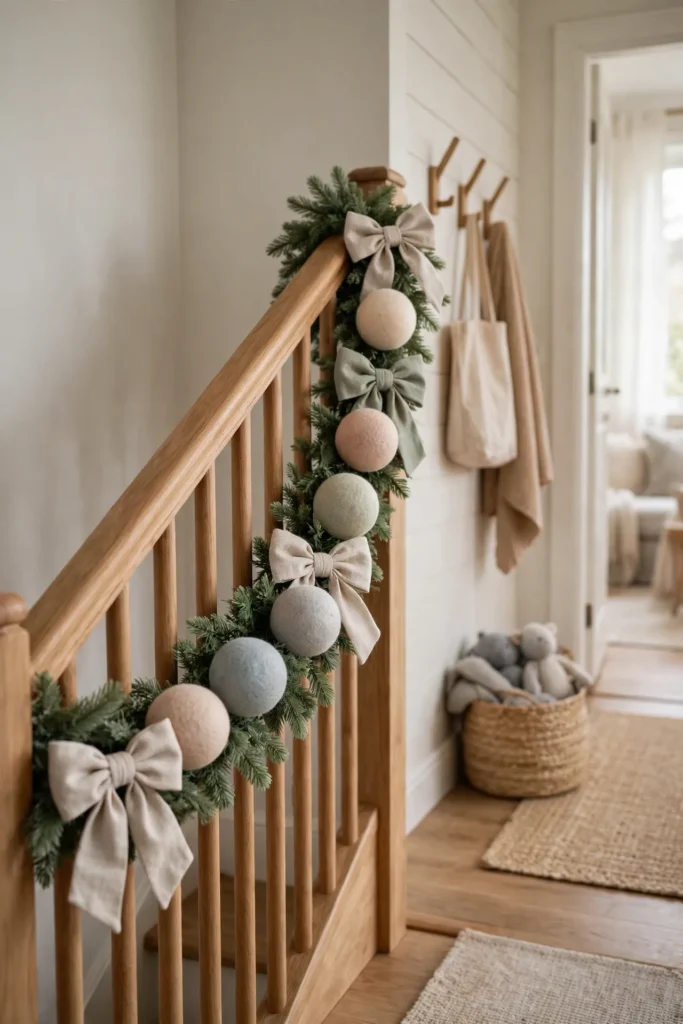
A staircase garland in a house with small children can be a hazard, because small baubles, sharp wire, and trailing cables all sit at child height. A child-safe stair garland removes those risks, because it uses soft, large, firmly fixed trims and no small parts. Steps: 1. Choose a faux garland with soft branches, and decorate it only with large felt balls, fabric bows, and wooden beads too big to swallow. 2. Tie the garland with soft fabric ties at every second spindle, and tuck all wire ends inside the branches. 3. Use battery lights with the box hidden high at the top newel, out of small hands, and keep the garland on the outer side of the rail. Christmas decoration ideas stairs in child-safe form suit a family hallway best, because the staircase is the route children use most.
Try it: Pull every trim firmly before you finish, and remove anything that comes loose. A trim that pulls off in your hand will pull off in a child’s hand, while a trim that holds firm stays safe.
21
Pet-Safe Stair Garland
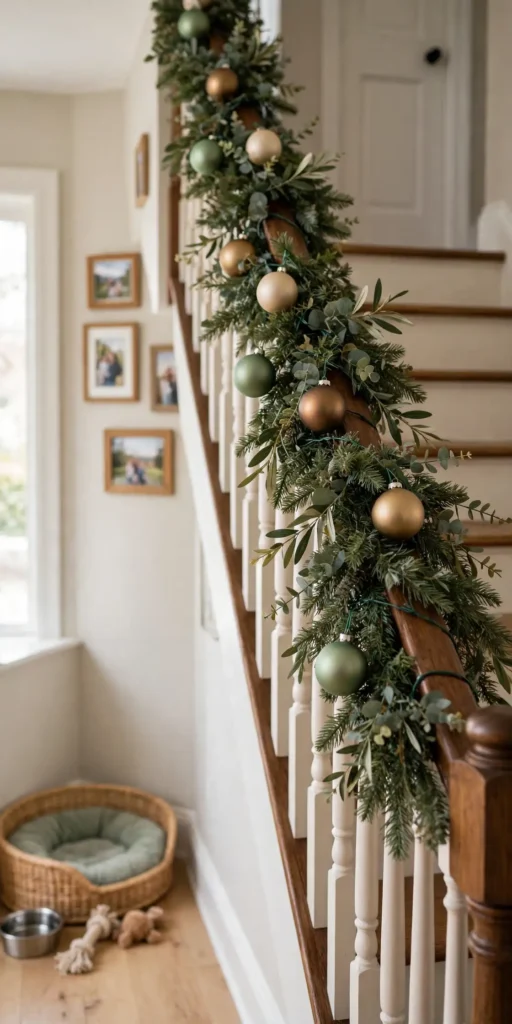
A staircase garland in a house with pets can be chewed, pulled, and shed, because pets brush past it at nose height. A pet-safe stair garland survives pets, because it uses tough, non-toxic, firmly wired trims and nothing dangly. Steps: 1. Choose a faux garland, since fresh garland drops needles that pets eat, and skip tinsel, which pets chew and swallow. 2. Wire every trim in firmly, use shatterproof baubles only, and keep ribbon tails short so nothing dangles at nose height. 3. Tie the garland at every second spindle with strong ties, and check it weekly for loose pieces. Stair railing christmas decor in pet-safe form suits a home with dogs or cats best, because the staircase is at pet height all day.
Try it: Skip tinsel entirely on a pet staircase. Tinsel is the one garland material vets warn about most, while wired greenery and shatterproof baubles stay safe.
22
No-Damage Rental Stair Garland
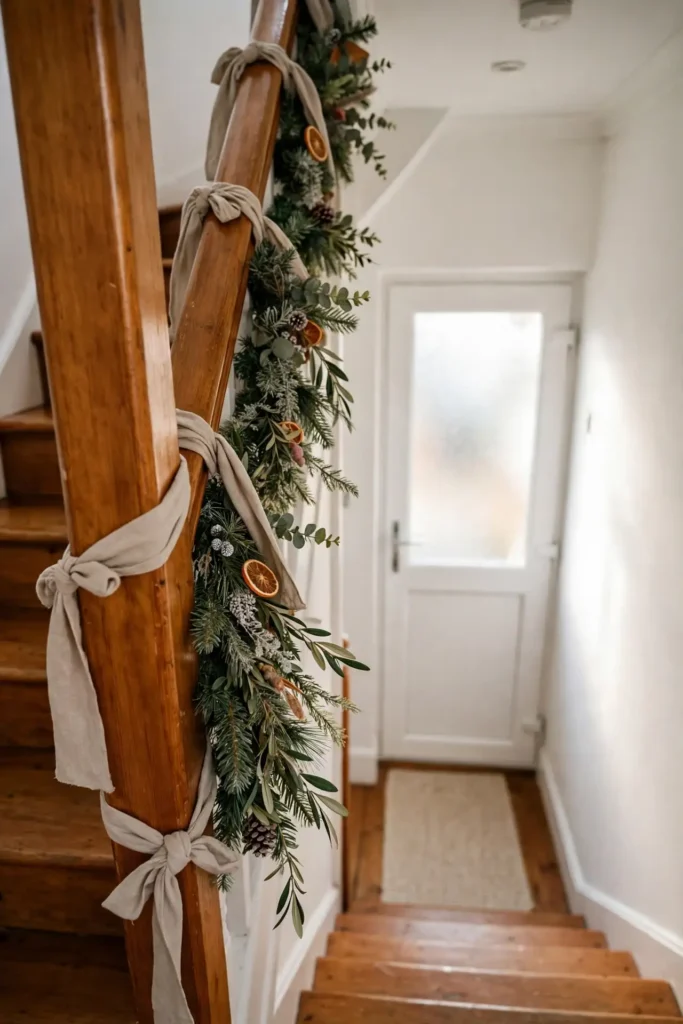
A rented staircase can be a problem at Christmas, because nails, screws, and sticky hooks can cost a deposit. A no-damage rental stair garland uses no fixings at all on the wood, because it ties on and lifts off clean in January. Steps: 1. Choose a faux garland and soft fabric ties, ribbon, or green twist ties, and avoid adhesive hooks on painted or varnished wood. 2. Tie the garland to the spindles and newel posts with fabric ties at every second spindle, keeping the ties snug but not tight enough to dent the wood. 3. Hang battery lights instead of plug-in ones, so no cable clips mark the wall, and remove the garland by untying, not pulling. Banister decorating ideas for christmas in rental form suit any rented home, because the staircase goes back to bare wood in minutes.
Try it: Use fabric ties on varnished wood, not wire ties. Wire ties can dent varnish under weight, while fabric ties grip without marking.
Pro tip: Hang the garland, then walk up and down the stairs holding the rail before you add anything else. A garland that looks full from the hallway can block the grip or catch a sleeve on the stairs, and a garland checked from the staircase itself is the only one you can trust.
Three rules for staircase garlands that look intentional, not thrown up
Most staircase christmas garlands look unfinished for the same three reasons, and all three are fixable.
- First, measure before you buy. A garland shorter than its banister looks stretched, while a garland longer than its banister gives you swags and drops to work with, because length is what makes a stair garland look generous.
- Second, support the garland along its length. A garland held only at the ends sags in the middle, while a garland tied at every second spindle keeps its swag all season, because gravity works on every unsupported section.
- Third, keep the handrail usable. A garland on the outer side of the rail, with lights tucked inside the branches and cables clipped to the wall, leaves the rail safe to grip, because a staircase is for walking first and decorating second.
Storing and reusing your staircase garlands
Staircase garlands last for years if you store them properly, and the storage step is part of the hanging, not an afterthought.
- First, store garlands hanging, not boxed flat. A garland crushed in a box loses its shape and sheds, so hang each garland on a hook in a dry cupboard or garage.
- Second, store fresh garlands as compost, not keepsakes. A fresh cedar or fir garland dries out within weeks, so compost it in January and keep only the reusable baubles, bows, and lights for next year.
- Third, keep faux garlands dry and out of sunlight. Faux greenery fades in sun and flocking crushes under weight, so store prelit, flocked, and faux garlands in a dry cupboard away from direct sun, and test the lights once before hanging each year.
Questions readers ask
How do you hang garland on a staircase?
You hang garland on a staircase by measuring the banister from newel post to newel post, buying a garland at least 60 cm longer, and fixing it with ties at every second spindle. A staircase christmas garland should swag gently between ties, not hang straight, and the battery box or plug should hide at a newel post.
How long should garland be for stairs?
Garland should be at least 60 cm longer than the banister, and 90 cm longer if you want deep swags, because a garland cut to the exact length looks stretched. For a spiral staircase, garland should match the curved banister length measured with string, since a straight measurement always comes up short.
How do you attach garland to a banister without damage?
You attach garland to a banister without damage by tying it to the spindles with soft fabric ties or green twist ties, not nails, screws, or adhesive hooks. A garland for banister use tied this way lifts off clean in January, and fabric ties will not dent varnished wood the way wire ties can.
Should I buy fresh or faux garland for stairs?
You should buy fresh garland for stairs if you want scent and a natural look for one season, and faux garland if you want a garland that lasts for years. Fresh garland suits a covered entry stair in a cool hallway, while faux garland suits busy family stairs, narrow stairs, and any spot near heat.
How do you keep stair garland from sagging?
You keep stair garland from sagging by tying it at every second spindle along its length, not just at the ends, because gravity pulls on every unsupported section. A garland with lights or baubles should be tied even more often, since the light wire and baubles add weight.
Can I put lights on a staircase garland safely?
Yes, you can put lights on a staircase garland safely by using battery lights or a plug-in set with the cable clipped to the wall side, never across a step. Keep bulbs tucked inside the branches, away from the handrail grip, and use a timer so the lights switch off on their own.
How do you decorate a spiral staircase with garland?
You decorate a spiral staircase with garland by measuring the curved banister with string, buying a slim flexible faux garland, and winding it around the rail from the bottom up. Keep the garland slim and on the outer side of the rail, so the narrow treads stay clear and the handrail stays usable.
How do I store staircase garland so it lasts?
You store staircase garland so it lasts by hanging it on a hook in a dry cupboard, away from sunlight and weight. Stored this way, prelit, flocked, and faux garlands last for many seasons, while fresh garlands should be composted and only their reusable trims kept.
People Also Ask
What is the 70/30 rule for staircase garlands?
The 70/30 rule for staircase garlands means roughly 70 percent of the garland stays as its base greenery, and 30 percent carries decoration, such as baubles, bows, or lights. The rule is a guide, not a law, but a garland that follows it will read as full rather than cluttered.
How do I make my stair garland look full, not thin?
You make your stair garland look full, not thin, by buying a garland longer than its banister, fluffing the branches outward before hanging, and tying it with soft dips between ties. A garland with no wire showing, firm ties, and a clear colour family reads as full, while gaps and mixed colours read as thin.
What staircase garlands should beginners avoid?
Beginners should avoid spiral stair garlands and deep swag garlands on a first attempt, because each of those needs careful measuring or even dipping to look clean. Start with a prelit faux garland on a straight banister, a ribbon-woven garland, and a newel post bow garland, and save spiral and deep swag hangs for a second season.
loved these ideas? ✿
Save this guide for later
Pin it to your board so it’s there when you’re ready to recreate it.

Curated by
Hey! I'm Sanaullah — visual curator and content creator. I search, curate, and test the best aesthetic ideas across Pinterest so you can easily transform your living space, style daily outfits, and try simple creative DIYs without the overwhelm.